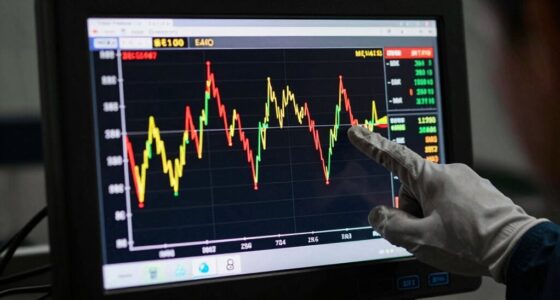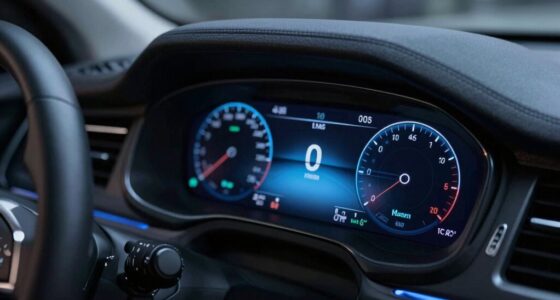
Your vehicle’s instant MPG can be misleading because it relies on sensors like mass airflow and oxygen sensors, which may be uncalibrated or inaccurate, causing fluctuating readings. It also interprets raw data, which can vary with driving conditions like idling or braking. Because of these factors, the instant MPG is more of a trend indicator than an exact measure. Keep exploring to understand how to interpret these numbers accurately and improve your fuel efficiency.
Key Takeaways
- Instant MPG readings depend on sensor accuracy, which can be affected by miscalibration or faults, leading to misleading data.
- Raw sensor signals are processed into instant MPG, but fluctuations may reflect normal driving variations, not actual fuel efficiency issues.
- Sensor inaccuracies and data interpretation limitations cause instant MPG to sometimes display false or inconsistent fuel economy figures.
- Instant MPG is a short-term trend indicator, not a precise measurement; it can fluctuate due to traffic, idling, or sensor errors.
- Proper sensor calibration and understanding of data limitations are essential for accurately assessing true fuel economy.

Have you ever wondered how your vehicle’s onboard diagnostic system can help you improve fuel efficiency? The answer lies in the data it provides, especially through the OBD2 port, which offers real-time insights into your driving habits and engine performance. However, understanding this data requires a grasp of two key aspects: sensor accuracy and data interpretation. These play a pivotal role in determining how reliable the instant miles per gallon (MPG) readings are and how you should use them to optimize your fuel economy.
Sensor accuracy is fundamental. Your vehicle relies on various sensors—like the mass airflow sensor, oxygen sensors, and throttle position sensor—to gather real-time information about engine conditions and airflow. If any of these sensors are faulty or miscalibrated, the data they send to your vehicle’s computer can be skewed. This means the instant MPG figure you see might be inaccurate, fluctuating wildly or consistently overestimating or underestimating your actual fuel efficiency. Recognizing that sensor accuracy can vary helps you understand why instant MPG readings aren’t always a perfect reflection of your driving habits. Additionally, sensor calibration plays a crucial role in ensuring data reliability, as poorly calibrated sensors can significantly distort real-time readings.
Sensor accuracy impacts instant MPG readings and overall fuel efficiency insights.
Data interpretation is equally important. The onboard computer processes signals from multiple sensors, translating raw data into a format displayed on your dashboard or scan tool. However, this interpretation isn’t always straightforward. For example, sudden acceleration or deceleration can cause sharp swings in instant MPG, which might look alarming but are normal for short-term changes. Likewise, idling or stop-and-go traffic can temporarily lower your MPG reading, even if your overall driving pattern is efficient. Learning how to interpret these fluctuations enables you to distinguish between normal variations and genuine issues that could be affecting your fuel economy.
Understanding the limitations of instant MPG is indispensable. While it provides immediate feedback on your driving style, it’s not a thorough measure of your vehicle’s fuel efficiency over time. Factors like sensor accuracy and how data is interpreted can cause the readings to be misleading, especially if you rely solely on this number to gauge your driving habits. Instead, use it as a guide to identify rough trends rather than exact figures. When you combine an awareness of sensor accuracy with proper data interpretation, you’ll be better equipped to make adjustments—like gentle acceleration, steady speeds, or reduced idling—that genuinely improve your fuel economy over the long run.
In essence, your onboard diagnostic system is a powerful tool, but only if you understand its nuances. Recognizing how sensor accuracy influences data quality, and learning to interpret the fluctuating numbers correctly, allows you to make smarter driving decisions. This, in turn, helps you avoid chasing inaccurate instant MPG figures and focus on sustainable habits that truly maximize your vehicle’s fuel efficiency.

ANCEL AD310 Classic Enhanced Universal OBD II Scanner Car Engine Fault Code Reader CAN Diagnostic Scan Tool, Read and Clear Error Codes for 1996 or Newer OBD2 Protocol Vehicle (Black)
CEL Doctor: The ANCEL AD310 is one of the best-selling OBD II scanners on the market and is...
As an affiliate, we earn on qualifying purchases.
Frequently Asked Questions
How Accurate Is the Instant MPG Reading?
Your instant MPG reading isn’t perfectly accurate because it relies on sensor calibration and real-time data, which can fluctuate. There’s often a data lag, so the number might not reflect your current driving conditions precisely. Factors like sudden acceleration or deceleration can cause misleading readings. Keep in mind, it’s a useful guide, but for precise fuel economy, check your actual mileage over time rather than trusting instantaneous numbers.
Can I Improve My Vehicle’s Fuel Economy Based on OBD2 Data?
Think of your vehicle’s OBD2 data as a compass guiding your fuel economy journey. Yes, you can improve it through fuel economy enhancement by analyzing OBD2 diagnostics regularly. Focus on maintaining ideal engine performance, fixing sensors, and avoiding aggressive driving. These steps help you make informed decisions, reducing fuel consumption. Remember, your vehicle reveals its secrets in OBD2 codes—listen closely to unseal savings and maximize efficiency.
Do All Vehicles Display the Same OBD2 Fuel Economy Data?
No, not all vehicles display the same OBD2 fuel economy data. Vehicle variations and sensor differences can affect what information you see. Some cars might provide more detailed or accurate readings, while others may show limited data due to design or sensor capabilities. You should understand your vehicle’s specific system to interpret the fuel economy data correctly and avoid assuming all OBD2 reports are identical across different makes and models.
How Often Should I Check My Instant MPG for Reliable Insights?
You should check your instant MPG at least every few minutes to get reliable insights, considering the data refresh rate. Frequent checks help you better understand how your driver behavior impacts fuel economy. Keep in mind, though, that instant MPG can fluctuate rapidly, so avoid making decisions based solely on short-term readings. Instead, look for patterns over time to truly improve your driving efficiency.
What Factors Cause Fluctuations in Instant MPG Readings?
Fluctuations in your instant MPG readings are mainly caused by changes in engine load and your driving style. When you accelerate or drive uphill, engine load increases, causing MPG to drop. Conversely, gentle acceleration and steady speeds improve fuel efficiency. Sharp braking or rapid acceleration also cause variations. Your driving style, such as aggressive or smooth driving, directly impacts instant MPG, making it fluctuate frequently.

OBD2 Scanner Reader Bluetooth Wireless Auto Diagnostic Scan Tool for iOS & Android for Performance Test Bluetooth 5.4 Car Check Engine Car Code Reader, Clear Error Code Live Data Reset Exclusive APP
【Comprehensive Performance Testing】V011 OBD2 Scanner provides a complete diagnostic solution, giving you a thorough understanding of your vehicle's...
As an affiliate, we earn on qualifying purchases.
Conclusion
Now that you know instant MPG can be misleading, will you trust your dashboard’s numbers blindly? Remember, OBD2 data offers valuable insights, but it’s not always the full story. Keep an eye on long-term trends instead of getting caught up in fleeting figures. By understanding these nuances, you’re better equipped to optimize your fuel efficiency. After all, isn’t smarter driving what we all aim for? Stay curious and keep learning!

BlueDriver Bluetooth Pro OBDII Scan Tool for iPhone & Android - No Subscription Fee - OBD2 Car Scanner and Code Reader - Diagnose Check Engine, ABS, SRS, Airbag & 7000+ Issues on Vehicles 1996+
[Pro OBD2 Scanner] - BlueDriver is the easiest way to scan and understand your vehicle like a professional...
As an affiliate, we earn on qualifying purchases.

Veepeak OBDCheck BLE Bluetooth OBD II Scanner for iOS & Android, Car Wireless Check Engine Light Code Reader Diagnostic Tool
Note: This device requires a compatible third-party app to work. Generic OBD functions are typically free via apps...
As an affiliate, we earn on qualifying purchases.