
Wear leveling in your MicroSD card spreads out data writes evenly across all memory cells, preventing certain areas from wearing out faster. When the card gets full, the controller has less space to distribute new data, making wear leveling less effective. This causes some sectors to wear out sooner, leading to card failure. If you want to understand how to extend your card’s lifespan and keep it working longer, there’s more to discover ahead.
Key Takeaways
- Wear leveling distributes write/erase cycles evenly across all memory cells, preventing early failure of specific sectors.
- As the MicroSD fills up, free space declines, reducing the controller’s ability to evenly spread data writes.
- Limited write cycles per cell mean overused areas wear out faster without effective wear leveling.
- Near capacity, the controller struggles to balance data, increasing the risk of sector wear and premature failure.
- Maintaining free space enhances wear leveling efficiency, extending MicroSD lifespan and preventing full cards from failing first.
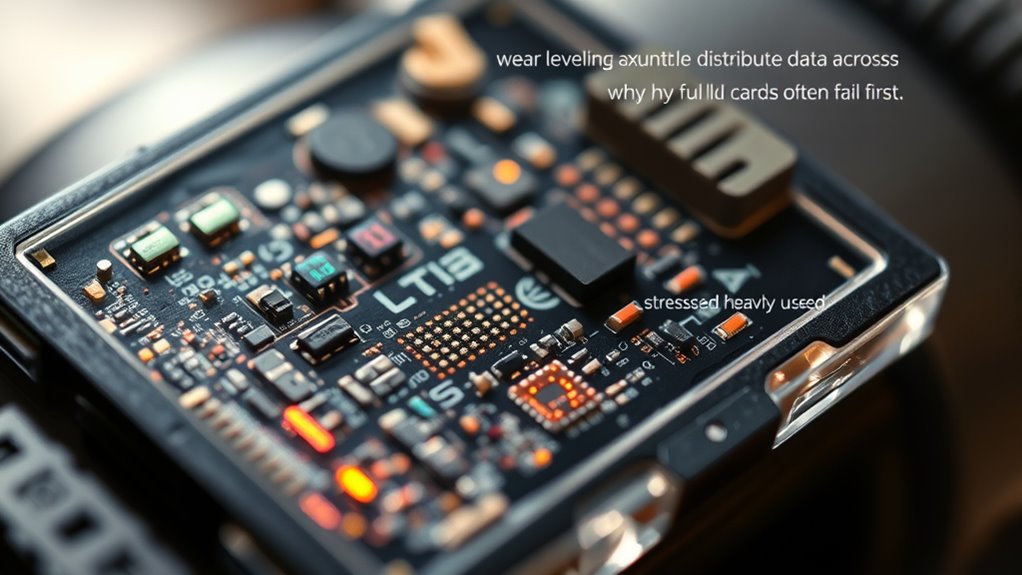
MicroSD wear leveling is a essential process that helps extend the lifespan of your memory card by evenly distributing data writes across its storage cells. Without this mechanism, certain areas of the flash memory would wear out faster than others, leading to premature failure. The core idea behind wear leveling is to prevent overuse of specific sectors, ensuring that all parts of the card are used uniformly. This is especially important because flash memory, the technology that powers your MicroSD card, has a limited number of write cycles per cell. By managing how data is written, wear leveling enhances the overall data longevity of your device, allowing it to serve you longer without issues.
Wear leveling extends your MicroSD card lifespan by evenly distributing data writes across memory cells.
When data is written to a MicroSD card, it doesn’t get stored in just one spot. Instead, the card’s controller dynamically manages where data goes, spreading writes across different memory cells. This process prevents any single area from experiencing excessive wear. As a result, the card maintains its integrity over time, reducing the risk of corrupted data or total failure. For you, this means that your files stay safe longer, and your device remains reliable even after repeated use. The more evenly your data is distributed, the less likely you’ll encounter issues caused by worn-out sectors.
It’s essential to understand that flash memory’s architecture makes it susceptible to wear. Unlike traditional storage media, each cell can only handle a limited number of write and erase cycles. Once those cycles are exhausted, the cell becomes unreliable, potentially leading to data loss. This is why wear leveling is so important: it optimizes the use of every cell, pushing back the inevitable decline caused by finite write cycles. The result is a significant improvement in data longevity, ensuring your media stays functional for as long as possible.
However, as your MicroSD card fills up, especially nearing capacity, you might notice a decline in performance or increased error rates. Full cards tend to fail first because the controller has fewer free sectors to manage, making it harder to balance data evenly. When the card is nearly full, wear leveling becomes less effective, and the risk of wearing out specific sectors rises. Additionally, block management techniques help maintain performance, but their effectiveness diminishes as capacity approaches maximum. That’s why maintaining some free space on your card is recommended; it gives the controller more flexibility to distribute data writes, ultimately extending the life of your MicroSD card.

VIRROW Dash Cam Front and Rear: 4K+2.5K Dash Camera for Cars with Touch Screen 3.39" - Dashcam with WiFi APP Control 64GB Parking Mode Night Vision Loop Recording Emergency Lock (X5)
[4K+2.5K Dual Dash Cam Front and Rear] - The front dash cam records stunning 4K videos, while the...
As an affiliate, we earn on qualifying purchases.
Frequently Asked Questions
How Does Wear Leveling Differ Between Brands of Microsd Cards?
Different brands of microSD cards use brand-specific algorithms for wear leveling, which impacts their durability. You’ll notice that manufacturer quality varies, affecting how well the cards distribute data writes evenly. Some brands optimize wear leveling better, extending the card’s lifespan, while others may not. It’s important to choose reputable brands with proven algorithms to guarantee your microSD card lasts longer and performs reliably over time.
Can Wear Leveling Be Manually Optimized or Adjusted?
You can’t manually optimize wear leveling on your microSD card, as it’s managed automatically by the card’s firmware. However, keeping your firmware updated can improve wear leveling efficiency and overall performance. Some manufacturers release firmware updates that enhance lifespan or fix bugs, so regularly check for updates. Avoid overusing the card or filling it to capacity constantly, as these actions can accelerate wear, regardless of firmware improvements.
What Are Signs That a Microsd Card’s Wear Leveling Is Failing?
Like a ticking time bomb, failing wear leveling shows signs in your microSD card’s performance. You might notice frequent read/write errors, files becoming corrupted, or unexpected data loss. Reduced transfer speeds and the card’s inability to store new data also signal wear leveling issues. Since flash memory’s longevity factors depend on even data distribution, these symptoms indicate that the card’s wear leveling mechanism is compromised, risking premature failure.
Does Frequent Data Transfer Accelerate Wear Leveling Processes?
Frequent data transfer does accelerate wear leveling processes on your microSD card. When you transfer data often, it increases write cycles, which impacts the card’s write endurance. Wear leveling tries to distribute these writes evenly, but constant transfers push the process harder, leading to faster wear. So, if you frequently move large files, expect the card’s lifespan to decrease sooner, as the wear leveling struggles to keep up with the high data transfer rate.
How Does Wear Leveling Impact Data Recovery Efforts?
Ever tried fixing a jigsaw puzzle with pieces constantly shifting? Wear leveling impacts data recovery efforts by adding complexity, making it harder to locate and restore lost data. The process distributes wear unevenly, complicating data recovery challenges because the original data locations become unpredictable. This means you might face increased difficulty retrieving files, especially as the card ages and wear leveling intensifies, ultimately hindering efficient data restoration.

TERUNSOUl 4K Dash Cam Front and Rear, Full HD 3 Channel Dashcam, Free 128GB MicroSD Card, Built-in 5.8GHz WiFi Built-in GPS, Collision Sensor, Night Vision, HDR, 3.16" IPS, 24H Parking Mode(Black)
UHD 4K Front + 1080 Rear + 1080P Cabin Recording: Supports simultaneous triple-channel recording, delivering crystal-clear details for...
As an affiliate, we earn on qualifying purchases.
Conclusion
Understanding how wear leveling works helps you see why your MicroSD card wears out over time. Think of it like a diligent gardener tending every part of a garden, ensuring no single spot gets overgrown or worn thin. By spreading out the wear, the card prolongs its life, but eventually, all gardens need rest. So, treat your card kindly, knowing that even the toughest can’t escape the inevitable march of time.

REDTIGER 4K Dash Cam Front Rear, STARVIS 2 Sensor, Free Card Included, 5.8GHz WiFi-20MB/s Fast Download, Dash Camera for Cars with GPS, WDR Night Vision, 170°Wide Angle, 24H Parking Mode(F7NP)
[4K+1080P Front & Rear Recording] REDTIGER F7NP dash cam captures every detail with stunning 4K front and 1080P...
As an affiliate, we earn on qualifying purchases.

SIX M200 128GB Micro SD Card Read Up to 190MB/s for 4K UHD Continuous Recording - A2, U3, V30 microSDXC Memory Card 128GB with Adapter for Action Cameras, Drones, Gaming Consoles, Dash Cams, Phones
【Capture Every Adventure in Stunning 4K UHD】 This 128GB microSD card with an adapter, engineered with U3/V30 speed...
As an affiliate, we earn on qualifying purchases.