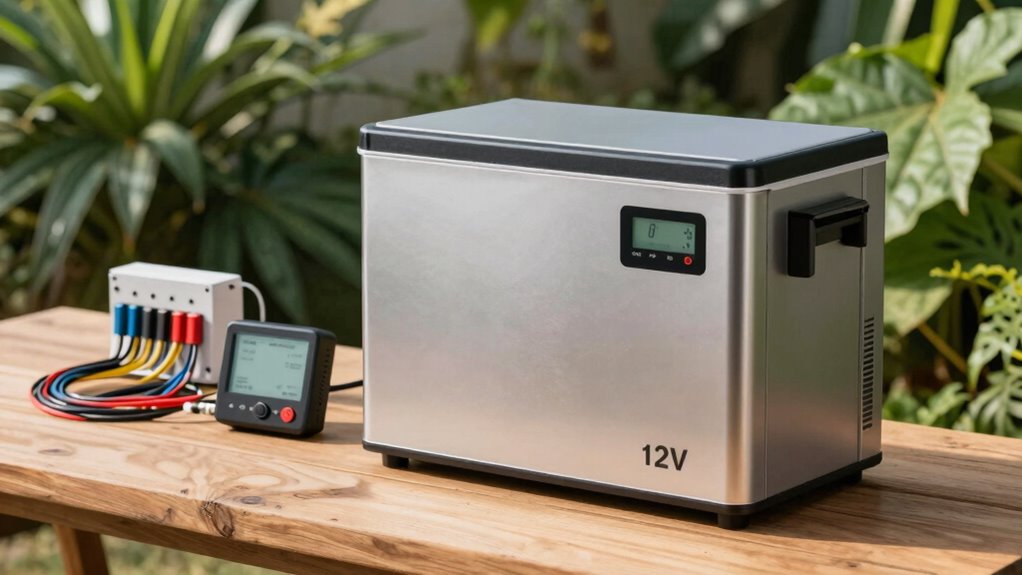

To set your 12V fridge’s low-voltage cutoff safely, start by consulting your battery’s specifications for the recommended voltage (around 11.5V–12V). Use a multimeter to monitor the battery voltage under load and at rest, adjusting the cutoff to avoid dropping below this critical level. Regularly check your voltage and fine-tune the settings as your battery ages or usage changes. Keep your batteries healthy—learn the full process below to find the perfect balance.

Get business pricing on garage and car supplies
- Business-only prices and quantity discounts
- Tax-exempt purchasing
- Multiple users, one account, clear invoices
Key Takeaways
- Measure your battery voltage under load and at rest with a reliable multimeter before setting the cutoff.
- Refer to your battery manufacturer’s recommended cutoff voltage (around 11.5–12V) for safe operation.
- Adjust the low-voltage cutoff setting gradually, ensuring it triggers before the battery drops to unsafe levels.
- Regularly monitor voltage during use to verify the cutoff prevents over-discharge.
- Fine-tune the cutoff based on actual voltage readings and battery performance to maximize lifespan and safety.

A 12V fridge relies on your vehicle’s battery to keep food and drinks cold, but if the voltage drops too low, it can damage the battery and cause the fridge to stop working. That’s where low-voltage cutoff (LVC) settings come into play. Properly setting the cutoff ensures your battery stays protected, preventing over-discharge that could weaken or ruin it. To do this effectively, you need to focus on battery protection and voltage calibration. These two steps are essential for keeping your system safe and functional over the long haul.
Battery protection is your top priority. When your vehicle’s battery discharges beyond a certain point, it risks damage, and your fridge might stop working unexpectedly just when you need it most. Setting a low-voltage cutoff acts as a safeguard, automatically shutting off the fridge before the battery reaches a critically low level. To do this correctly, you need to determine the appropriate voltage level for your specific battery type and usage. Most deep-cycle batteries, for example, have recommended cutoff voltages around 11.5V to 12V under load, but it’s best to consult your battery’s specifications for exact numbers. Proper battery protection means you avoid draining your battery to the point where it can’t start your vehicle or damage its internal chemistry. Ensuring you understand the battery chemistry and its limits is crucial for setting effective cutoff points.
Voltage calibration is the process of fine-tuning your low-voltage cutoff setting to match your battery’s actual voltage range. This involves measuring your battery’s voltage under load and at rest, then adjusting your cutoff accordingly. If you set the cutoff too high, your fridge might turn off prematurely, risking spoilage of perishable items. If it’s too low, you could over-discharge your battery, leading to potential damage. To calibrate correctly, use a reliable multimeter to check your battery’s voltage at different states—both when the vehicle is off and after running the fridge for a while. Once you know the actual voltage levels, you can set your cutoff device to a value that protects your battery but still keeps your fridge running as long as possible.
As an affiliate, we earn on qualifying purchases.
Frequently Asked Questions
Can Low-Voltage Cutoffs Damage My Fridge?
Low-voltage cutoffs typically won’t damage your fridge if you set them correctly, but ignoring battery maintenance and inverter compatibility can cause issues. If the cutoff is too high, your batteries might drain prematurely, risking damage, or your inverter may not handle the load properly. Always guarantee your low-voltage cutoff is properly calibrated, maintain your batteries well, and verify your inverter’s compatibility to avoid any damage.
How Often Should I Test the Cutoff Settings?
You should test your cutoff settings regularly, ideally every few months, to guarantee proper battery maintenance. Use voltage monitoring to check that the cutoff activates at the correct voltage and prevents over-discharging. Frequent testing helps you fine-tune the settings, avoiding damage to your batteries and fridge. Consistent checks keep your system reliable and extend your batteries’ lifespan, so make it a routine part of your maintenance schedule.
Are There Different Types of Low-Voltage Cutoffs?
Yes, there are different types of low-voltage cutoffs, including manual and automatic ones. You should focus on battery protection, ensuring your cutoff accurately detects voltage levels to prevent over-discharging. Proper voltage calibration is essential so your system responds correctly. By understanding these types, you can set your cutoff effectively, safeguarding your batteries while keeping your fridge running smoothly. Regular testing helps maintain peak performance.
What Is the Ideal Voltage Threshold for My Batteries?
You should set your battery voltage threshold around 50-60% of its capacity to protect voltage stability and prevent overdischarging. For most deep-cycle batteries, this means a cutoff around 11.8V to 12.2V per cell (roughly 11.4V to 12.0V for 12V batteries). Adjust based on your specific battery type and usage, always aiming to maintain voltage stability and extend battery life.
Can I Override the Low-Voltage Cutoff Temporarily?
You can usually override the low-voltage cutoff temporarily, but it’s a risky move that can compromise battery safety. Voltage monitoring is essential to prevent damage, so only do this if absolutely necessary and understand the potential consequences. Keep in mind, overriding might lead to over-discharge, shortening your battery’s lifespan. Always re-enable the cutoff promptly to protect your batteries and maintain safe operation.
low voltage cutoff for 12V fridge
As an affiliate, we earn on qualifying purchases.
As an affiliate, we earn on qualifying purchases.
Conclusion
By setting your low-voltage cutoff correctly, you protect your batteries, prolong your fridge’s lifespan, and make certain of reliable cooling. You prevent damage, avoid unexpected shutdowns, and maintain energy efficiency. You stay in control, preserve your power, and enjoy your adventures without worry. Keep your system balanced, your batteries healthy, and your fridge running smoothly. With proper settings, you maximize performance, minimize risks, and keep your off-grid lifestyle sustainable and hassle-free.
As an affiliate, we earn on qualifying purchases.
adjustable low voltage cutoff switch
As an affiliate, we earn on qualifying purchases.
As an affiliate, we earn on qualifying purchases.
Fall Picks
fall essentials
As an affiliate, we earn on qualifying purchases.