
The best car battery testers help separate a weak battery from a charging-system problem, but the right choice depends on your vehicles and how much diagnostic detail you need. I’d put the TOPDON BT200 first for its broad 12V/24V coverage and reported 100–2000 CCA range; the KONNWEI KW208 is a simpler 12V alternative, while the TOPDON BT600 stands out for its large screen and built-in printer. The main tradeoff is between quick digital readings and traditional load testing, with added functions and documentation bringing more complexity. Battery voltage alone cannot tell the whole story, so compatibility and test method matter as much as convenience. Continue reading for a comparison of all 15 car battery testers and a guide to choosing one for your needs.

Get business pricing on garage and car supplies
- Business-only prices and quantity discounts
- Tax-exempt purchasing
- Multiple users, one account, clear invoices
Complete the kit


Key Takeaways
- TOPDON BT200 leads for broad vehicle coverage: Its stated 12V/24V support and 100–2000 CCA range make it a flexible pick for buyers who test more than one vehicle type.
- Digital testers and load testers answer different questions: Options such as the KONNWEI KW208 focus on electronic test results, while the Schumacher BT-100 and Yaegoo model use a load-testing approach.
- Printer-equipped models serve record-keeping needs: The TOPDON BT600 and BT300P add printed results, a feature more useful for repeat checks or service documentation than occasional home diagnosis.
- Several choices are limited to 12V systems: The BT200 and BT600 list 12V/24V support, while many other models in the roundup are 12V-focused; check vehicle voltage before buying.
- Extra alternator functions vary by model: Products such as the QWORK, ANENG BT172, and FOXWELL BT705 include alternator testing, but buyers should confirm which battery types and test procedures their chosen model supports.
| TOPDON BT200 12V/24V Car Battery Tester, 100–2000 CCA | 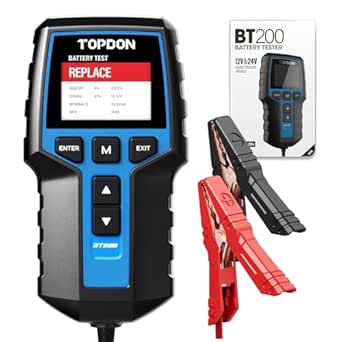 | Best Overall | Battery voltage: 12V or 24V | CCA range: 100–2,000 CCA | Compatible battery types: Flooded, AGM, GEL, and deep-cycle | VIEW LATEST PRICE | See Our Full Breakdown |
| KONNWEI KW208 12V Car Battery Tester |  | Best Compact Digital Pick | Compatible batteries: 12V flooded, AGM flat plate, AGM spiral, and gel | Battery capacity range: 100–2,000 CCA | Measurements: Voltage, internal resistance, CCA, capacity, health, and charge status | VIEW LATEST PRICE | See Our Full Breakdown |
| Schumacher Electric BT-100 Battery Load Tester, 6V/12V | 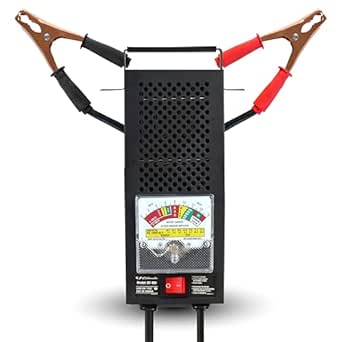 | Best Analog Load Tester | Voltage compatibility: 6V and 12V | Maximum battery capacity: Up to 1,000 cranking amps | Load test at 6V: 50 amps | VIEW LATEST PRICE | See Our Full Breakdown |
| TOPDON BT600 12V/24V Car Battery Tester with 3.5″ Screen and Built-in Printer |  | Best for Professional Record-Keeping | Battery voltage: 12V and 24V | Compatible battery type: Lead-acid | Diagnostics: Battery health, CCA, cranking, and charging system | VIEW LATEST PRICE | See Our Full Breakdown |
| QWORK Battery Load and Voltage Tester with Alternator Testing |  | Best Basic 6V/12V Pick | Supported batteries: 6V and 12V | Maximum CCA: 1,000 | Tests: Battery and alternator performance | VIEW LATEST PRICE | See Our Full Breakdown |
| FOXWELL BT301 12V Automotive Battery Tester |  | Best for Detailed 12V Diagnostics | Battery voltage: 12V | Supported CCA: 100–2000 CCA | Battery types: Flooded, AGM Flat, AGM Spiral, EFB, GEL | VIEW LATEST PRICE | See Our Full Breakdown |
| ANENG BT172 12V Car Battery Tester and Alternator Analyzer |  | Best for Quick Voltage Checks | Battery compatibility: 12V | Voltage test range: 4–30V DC | Accuracy: Approximately 0.01V | VIEW LATEST PRICE | See Our Full Breakdown |
| MOTOPOWER MP0515A 12V Automotive Battery Tester, 100–2000 CCA |  | Best for CCA-Based 12V Checks | Battery voltage: 12V | CCA range: 100–2000 CCA | Operating voltage: 12–12.29 volts | VIEW LATEST PRICE | See Our Full Breakdown |
| UHANBUT 12V Car Battery and Alternator Tester |  | Best Compact Status Checker | Operating voltage: 12V | Measurement type: Voltmeter | Display: LED | VIEW LATEST PRICE | See Our Full Breakdown |
| FOXWELL BT705 12V/24V Car Battery, Alternator, and Load Tester |  | Best for 12V and 24V Fleets | Voltage range: 12V and 24V | CCA range: 100–2000 CCA | Compatible battery types: Flooded, AGM, GEL, and EFB lead-acid | VIEW LATEST PRICE | See Our Full Breakdown |
| TOPDON BT100 12V Car Battery Tester |  | Best Lightweight All-Rounder | Minimum operating voltage: 12V | CCA range: 100–2000 CCA | Compatible battery types: Flooded, AGM, EFB, and GEL | VIEW LATEST PRICE | See Our Full Breakdown |
| TOPDON BT300P 12V/24V Automotive Battery Tester with Built-In Printer | 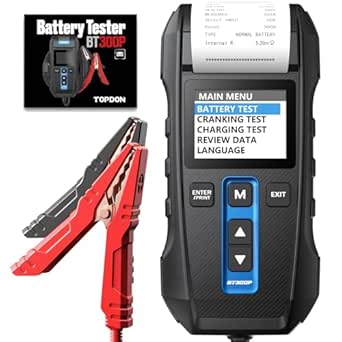 | Best for Printed Diagnostic Reports | Battery compatibility: 12V lead-acid, 100–2000 CCA | Vehicle system tests: 12V and 24V cranking and charging | Supported standards: CCA, JIS, EN, DIN, SAE, IEC | VIEW LATEST PRICE | See Our Full Breakdown |
| ANCEL BA101 12V Car Battery Tester |  | Best for Broad 12V Battery-Standard Support | Battery voltage: 12V | CCA range: 100–2000 CCA | Compatible battery types: Flooded, AGM, GEL, and EFB | VIEW LATEST PRICE | See Our Full Breakdown |
| OBDResource BR502 Digital Car Battery Tester, 6V/12V/24V, 100–2000 CCA |  | Best for Mixed-Voltage Batteries | Battery voltage: 6V, 12V, and 24V | CCA range: 100–2000 CCA | Compatible battery types: Flooded, AGM flat plate, AGM spiral, and gel | VIEW LATEST PRICE | See Our Full Breakdown |
| Yaegoo 6V/12V Battery Load Tester |  | Best for Hands-On Load Checks | Supported battery voltage: 6V and 12V | Maximum battery capacity: 1000 CCA | Load test at 6V: 50A | VIEW LATEST PRICE | See Our Full Breakdown |
| car battery tester | Power source | Display | Weight | Dimensions |
|---|---|---|---|---|
| TOPDON BT200 12V/24V Car Batte | Battery powered | 2.4-inch color LCD | 15.52 ounces | 7 × 3.72 × 1.3 inches |
| KONNWEI KW208 12V Car Battery | Battery powered | — | 230 g | 0.79 × 3.07 × 5 inches |
| Schumacher Electric BT-100 Bat | — | Analog meter | — | — |
| TOPDON BT600 12V/24V Car Batte | Battery powered | 3.5-inch color screen | — | — |
| QWORK Battery Load and Voltage | Battery powered | — | — | — |
| FOXWELL BT301 12V Automotive B | Powered by the tested battery | 2.8-inch color screen | — | — |
| ANENG BT172 12V Car Battery Te | Battery powered | LCD with LED status indicators | 0.09 kg | — |
| MOTOPOWER MP0515A 12V Automoti | Battery powered | — | 340 g | 5.91 × 0.91 × 3.35 inches |
| UHANBUT 12V Car Battery and Al | Battery powered | LED | 81 g | 4.53 × 2.75 × 0.79 inches |
| FOXWELL BT705 12V/24V Car Batt | Corded electric | — | 325 g | — |
| TOPDON BT100 12V Car Battery T | Battery powered | — | 9 ounces | 5.3 × 3 × 1 inches |
| TOPDON BT300P 12V/24V Automoti | — | 2.4-inch color screen | 16 ounces | 12 × 8.5 × 4.5 inches |
| ANCEL BA101 12V Car Battery Te | — | Black-and-white screen with adjustable contrast and white backlight | 5 ounces | 9.5 × 7 × 2 inches |
| OBDResource BR502 Digital Car | — | 1.8-inch HD screen | — | 4.72 × 0.79 × 2.56 inches |
| Yaegoo 6V/12V Battery Load Tes | Battery powered | — | — | — |
More Details on Our Top Picks
TOPDON BT200 12V/24V Car Battery Tester, 100–2000 CCA
The TOPDON BT200 is my most balanced pick for drivers who want more than a simple voltage check. It tests 12V and 24V batteries and covers battery health, cranking, and charging, so one tool can help distinguish a weak battery from a starter or alternator issue. Its support for flooded, AGM, GEL, and deep-cycle batteries also gives it broader use than the 12V-only KONNWEI KW208. The color screen and Good/Replace prompts make results easier to interpret without giving up useful diagnostics. Its tradeoff is a CCA range capped at 2,000 and battery-powered operation, so it is not a fit for batteries outside that rating or buyers seeking advanced printed records like the TOPDON BT600. I’d choose it for a versatile home or mixed-vehicle toolkit.
Pros:- Tests 12V and 24V batteries
- Checks battery health, cranking, and charging systems
- Supports flooded, AGM, GEL, and deep-cycle batteries
- Color LCD with straightforward Good/Replace prompts
Cons:- Limited to batteries rated from 100 to 2,000 CCA
- Does not provide the built-in report printing offered by the TOPDON BT600
Best for: DIY owners who maintain both 12V and 24V vehicles or equipment and want battery, starter, and charging checks in one tester.
Not ideal for: Owners of batteries below 100 or above 2,000 CCA, or repair shops that need printed diagnostic reports.
- Battery voltage:12V or 24V
- CCA range:100–2,000 CCA
- Compatible battery types:Flooded, AGM, GEL, and deep-cycle
- Tests:Battery health, cranking, and charging system
- Display:2.4-inch color LCD
- Operating temperature:-4°F to 140°F (-20°C to 60°C)
- Power source:Battery powered
- Weight:15.52 ounces
- Dimensions:7 × 3.72 × 1.3 inches
Our verdict“Choose the BT200 for broad battery-type and voltage coverage with clear results, unless you need shop-style printed records.”
KONNWEI KW208 12V Car Battery Tester
The KONNWEI KW208 suits drivers who want several useful readings in a small, easy-to-store tester. Along with voltage and CCA, it reports internal resistance, capacity, battery health, and charge status, then checks starter cranking and alternator charging. That makes it more informative than a basic voltage tester, while its compact body is easier to tuck away than the larger TOPDON BT200. It can test a battery in or out of the vehicle, which is handy for bench checks. The main limitation is its 12V-only support; the BT200 and BT600 accommodate 24V systems. Its supported chemistry list covers flooded, AGM, and gel batteries, but not the deep-cycle category listed for the BT200. I’d pick it for compact 12V diagnostics, not mixed-voltage fleets.
Pros:- Reports voltage, internal resistance, CCA, capacity, health, and charge status
- Checks starter cranking and alternator charging
- Can test batteries in or out of the vehicle
- Compact 230 g body with eight language options
Cons:- Supports 12V batteries only
- Capacity range is limited to 100–2,000 CCA
- Product data does not independently verify its claimed accuracy
Best for: 12V car and light-vehicle owners who want multiple battery readings and starter/alternator checks in a compact tool.
Not ideal for: People maintaining 24V vehicles or needing listed support for deep-cycle batteries.
- Compatible batteries:12V flooded, AGM flat plate, AGM spiral, and gel
- Battery capacity range:100–2,000 CCA
- Measurements:Voltage, internal resistance, CCA, capacity, health, and charge status
- System tests:Battery, starter cranking, and alternator charging
- Testing location:In-vehicle or out-of-vehicle
- Power source:Battery powered
- Weight:230 g
- Dimensions:0.79 × 3.07 × 5 inches
- Languages:8
Our verdict“Pick the KW208 for compact, information-rich checks on 12V batteries, but choose a 12V/24V model for broader vehicle coverage.”
Schumacher Electric BT-100 Battery Load Tester, 6V/12V
The Schumacher BT-100 takes a different approach from digital analyzers: it applies a load and shows the result on an analog meter. That suits owners who want a direct load-test reading and need support for both 6V and 12V batteries, including motorcycles, lawn tractors, boats, and RVs. Its steel case and heavy-duty clamps are geared toward workshop handling. Compared with the KONNWEI KW208, it gives up detailed digital readouts such as internal resistance and displayed CCA, but it supports 6V systems the KW208 cannot test. The BT-100’s load is rated at 50 amps for 6V and 100 amps for 12V, with compatibility up to 1,000 cranking amps. I’d favor it for straightforward load checks, not for buyers who want guided digital results or higher CCA coverage.
Pros:- Supports both 6V and 12V batteries
- Tests battery condition, charging performance, and starter draw
- Analog meter gives a direct visual reading
- Steel case and heavy-duty clamps suit garage use
Cons:- Analog display offers less detailed readout than the digital KONNWEI KW208
- Maximum battery capacity is 1,000 cranking amps
- Load test is limited to 50 amps at 6V and 100 amps at 12V
Best for: Owners of 6V and 12V vehicles who prefer a traditional load test and a durable, workshop-oriented tester.
Not ideal for: Drivers who want digital battery-health analysis, displayed CCA readings, or testing above 1,000 cranking amps.
- Voltage compatibility:6V and 12V
- Maximum battery capacity:Up to 1,000 cranking amps
- Load test at 6V:50 amps
- Load test at 12V:100 amps
- Display:Analog meter
- Case:Steel with baked enamel finish
- Compatible vehicles:Motorcycles, ATVs, lawn tractors, cars, boats, light trucks, and RVs
- Included:BT-100 tester, voltmeter, and user manual
Our verdict“Choose the BT-100 for hands-on 6V/12V load testing, but opt for a digital analyzer if you need more diagnostic detail.”
TOPDON BT600 12V/24V Car Battery Tester with 3.5″ Screen and Built-in Printer
The TOPDON BT600 is the lineup’s most documentation-focused choice. Its 3.5-inch color screen presents diagnostics for 12V and 24V lead-acid batteries, while the built-in thermal printer can produce an immediate report for a service record or customer handoff. Data playback adds another way to revisit results. Compared with the simpler TOPDON BT200, the BT600 is better suited to repeated shop or fleet checks where a record matters; the BT200 is a more straightforward choice for home use. That added reporting comes with extra upkeep: thermal paper must be replaced, and firmware updates require a Windows PC and mini-USB connection. The available product details do not list a precise weight range for its supported CCA, so buyers should confirm fit for their battery before purchase.
Pros:- Tests 12V and 24V lead-acid batteries
- Large 3.5-inch color display
- Built-in thermal printer creates immediate reports
- Data playback supports reviewing stored results
Cons:- Thermal paper is a recurring supply that must be replaced
- Firmware updates require a Windows PC and mini-USB connection
- More reporting features may be unnecessary for occasional home checks
Best for: Independent mechanics and fleet operators who test 12V/24V lead-acid batteries and need printed reports or playback records.
Not ideal for: Casual owners seeking a simple, low-maintenance tester, especially if they do not need printouts or data history.
- Battery voltage:12V and 24V
- Compatible battery type:Lead-acid
- Diagnostics:Battery health, CCA, cranking, and charging system
- Display:3.5-inch color screen
- Printer:Built-in thermal printer
- Data handling:Data playback
- Power source:Battery powered
- Compatible devices:Cars, motorcycles, pickup trucks, heavy-duty trucks, and boats
- Item weight:1.29 kg
Our verdict“Choose the BT600 when battery diagnostics need printable records; the BT200 is a simpler fit for routine personal use.”
QWORK Battery Load and Voltage Tester with Alternator Testing
The QWORK Battery Load and Voltage Tester is a pared-back option for owners who need basic checks across 6V and 12V vehicles. It tests batteries up to 1,000 CCA and also checks alternator performance, making it more useful than a voltage-only tool for tracing a charging concern. Its shock-resistant steel case, copper-plated clamps, and carrying handle point to practical garage or vehicle use. Compared with the Schumacher BT-100, it shares the 6V/12V and 1,000 CCA limits, but the supplied details do not specify its load-test amperage or describe an analog meter, so the BT-100 offers clearer information about its testing method. QWORK’s listed features are simpler than the multi-parameter digital readings of the KONNWEI KW208. Warranty details are also absent, which may matter to frequent users.
Pros:- Supports both 6V and 12V batteries
- Tests batteries and alternator performance
- Rated for batteries up to 1,000 CCA
- Steel case, copper-plated clamps, and carrying handle
Cons:- Product details do not specify load-test amperage or a detailed diagnostic readout
- Maximum CCA is lower than the 2,000 CCA capacity listed for the TOPDON BT200
- Warranty details are not specified
Best for: Owners of 6V or 12V cars, trucks, RVs, or golf carts who need basic battery and alternator checks in a steel-cased tool.
Not ideal for: Users who need detailed digital measurements, testing above 1,000 CCA, or clearly stated warranty coverage.
- Supported batteries:6V and 12V
- Maximum CCA:1,000
- Tests:Battery and alternator performance
- Measurement type:Voltmeter
- Power source:Battery powered
- Case:Shock-resistant steel
- Clamps:Heavy-duty copper-plated
- Compatible devices:Vehicles with 6V or 12V batteries
- Included components:Tester
Our verdict“Choose QWORK for basic 6V/12V battery and alternator checks, but select a more fully specified tester for detailed diagnostics.”
FOXWELL BT301 12V Automotive Battery Tester
The FOXWELL BT301 earns this spot for buyers who want more than a quick voltage check: it reports SOH, SOC, CCA, voltage, and internal resistance, alongside battery, cranking, and charging-system results. Its 2.8-inch color screen gives those readings room to be understood, while the 6.5-foot cable can make it easier to work alone than with a short-lead tester such as the ANENG BT172. It also accommodates several common lead-acid battery types and a wide range of vehicle classes. The tradeoff is a firm 12V-only focus: unlike the FOXWELL BT705, it does not cover 24V systems, and it is not intended for lithium batteries. Choose it for more diagnostic detail, not broad voltage-system coverage.
Pros:- Combines battery health, cranking, and charging-system checks
- Shows SOH, SOC, CCA, voltage, and internal resistance
- Supports flooded, AGM, EFB, and GEL lead-acid batteries
- 6.5-foot cable and included carrying bag support practical garage use
Cons:- Does not support lithium batteries
- Limited to compatible 12V lead-acid systems
Best for: DIY owners of 12V cars, motorcycles, boats, or RVs who want battery condition and charging-system information in one tester.
Not ideal for: Owners of 24V vehicles or lithium batteries, since this model is specified for 12V lead-acid batteries.
- Battery voltage:12V
- Supported CCA:100–2000 CCA
- Battery types:Flooded, AGM Flat, AGM Spiral, EFB, GEL
- Display:2.8-inch color screen
- Cable length:6.5 ft
- Minimum operating voltage:6 volts
- Power source:Powered by the tested battery
- Compatible vehicles:Cars, SUVs, trucks, motorcycles, boats, RVs, ATVs, UTVs, lawn mowers
Our verdict“Choose the BT301 if you want detailed diagnostics for varied 12V lead-acid vehicles and do not need 24V or lithium support.”
ANENG BT172 12V Car Battery Tester and Alternator Analyzer
The ANENG BT172 suits drivers who mainly need a quick voltage reading and a basic indication of alternator status, rather than the expanded battery-health metrics shown by the FOXWELL BT301. Its LCD readout and LED status indicators make the result easy to scan, and reverse-connection protection offers a useful safeguard when attaching the clamps. The stated accuracy is approximately 0.01V, with a 4–30V DC test range. At just 0.09 kg, it is a compact option to keep with roadside tools. That simplicity comes with limits: it does not list CCA, internal resistance, or the multi-category diagnostic reporting of the BT301, and its readings fall outside the stated range below 4V or above 30V. I’d pick it for fast checks, not deeper battery evaluation.
Pros:- Checks battery voltage and analyzes alternator charging status
- LCD readout pairs with LED status indicators
- Reverse-connection protection helps guard against incorrect clamp hookup
- Lightweight design suits a vehicle emergency kit
Cons:- Designed for 12V vehicle batteries rather than 24V systems
- Does not specify CCA or internal-resistance measurements
- Readings are outside the stated range below 4V or above 30V
Best for: Drivers and small-fleet owners who want a lightweight 12V tester for quick battery-voltage and alternator-status checks across different vehicle types.
Not ideal for: DIY mechanics who need CCA-based battery evaluation, internal-resistance readings, or detailed battery-health reporting.
- Battery compatibility:12V
- Voltage test range:4–30V DC
- Accuracy:Approximately 0.01V
- Display:LCD with LED status indicators
- Protection:Reverse-connection protection
- Power source:Battery powered
- Weight:0.09 kg
- Included components:Tester, alligator-clamp adapter cable, user manual
Our verdict“Choose the BT172 for portable, quick voltage and charging checks; choose the FOXWELL BT301 if you need broader battery diagnostics.”
MOTOPOWER MP0515A 12V Automotive Battery Tester, 100–2000 CCA
The MOTOPOWER MP0515A is a straightforward choice for owners who want a defined 100–2000 CCA range and checks of battery, cranking, and charging performance. That makes it a more relevant fit for CCA-based checks than the ANENG BT172, whose supplied specifications focus on voltage and alternator status. The MP0515A also comes with a storage bag and instruction manual, plus a two-year manufacturer warranty. Its compact body weighs 340 g, so it can live in a home garage or vehicle kit without taking much space. The narrow fit is the tradeoff: its listed compatibility is car batteries, and its operating-voltage specifications are unusually constrained to 12 volts through 12.29 volts. I’d favor it for basic 12V car testing, not for a multi-voltage or multi-vehicle setup.
Pros:- Checks battery, cranking, and charging-system performance
- Supports a stated 100–2000 CCA range
- Includes a storage bag and instruction manual
- Backed by a two-year manufacturer warranty
Cons:- Listed compatibility is limited to car batteries
- Specified operating-voltage range is narrow at 12–12.29 volts
- Does not list a screen size or detailed displayed metrics
Best for: Car owners who want a compact tester for 12V battery, cranking, and charging checks within a stated 100–2000 CCA range.
Not ideal for: Owners of 24V vehicles or people seeking a clearly specified tester for motorcycles, boats, and other vehicle classes.
- Battery voltage:12V
- CCA range:100–2000 CCA
- Operating voltage:12–12.29 volts
- Measurement type:Multimeter
- Power source:Battery powered
- Weight:340 g
- Dimensions:5.91 × 0.91 × 3.35 inches
- Warranty:Two-year manufacturer warranty
Our verdict“Choose the MP0515A for compact CCA-based checks on a 12V car, but look elsewhere for broad vehicle compatibility or 24V testing.”
UHANBUT 12V Car Battery and Alternator Tester
The UHANBUT 12V tester is aimed at buyers who want a small, uncomplicated readout of battery voltage and charging status. At 81 g and 4.53 inches long, it is easier to stash in a glovebox or roadside kit than the larger FOXWELL BT301, though it does not provide that model’s SOH, SOC, CCA, or internal-resistance details. Its LED display is intended to be readable at night, and reverse-connection plus over-voltage protection add safeguards during hookup. The result is a practical status checker rather than a diagnostic tool for battery condition: the listed measurement type is a voltmeter, with no CCA range or broader test sequence specified. It is limited to 12V systems and depends on correct terminal connection, so buyers wanting more guided analysis should compare it with the BT301.
Pros:- Small 81 g form factor is easy to store
- LED display presents voltage and battery or charging status
- Reverse-connection and over-voltage protection are included
- Listed for cars, trucks, motorcycles, and boats
Cons:- Limited to 12V systems
- Voltmeter specification does not list CCA or internal-resistance testing
- Requires correct connection to the battery terminals
Best for: Drivers who want a very light, easy-to-store 12V voltage and charging-status checker for routine or roadside checks.
Not ideal for: Mechanics and DIY owners who need CCA testing, cranking analysis, or detailed battery-health measurements.
- Operating voltage:12V
- Measurement type:Voltmeter
- Display:LED
- Protection:Reverse-connection and over-voltage protection
- Power source:Battery powered
- Weight:81 g
- Dimensions:4.53 × 2.75 × 0.79 inches
- Compatible devices:Cars, trucks, motorcycles, boats
Our verdict“Choose the UHANBUT for compact 12V status checks, but pick the FOXWELL BT301 for a more detailed battery diagnosis.”
FOXWELL BT705 12V/24V Car Battery, Alternator, and Load Tester
The FOXWELL BT705 ranks here for buyers who need one tester to cover both 12V and 24V lead-acid systems. It checks battery health, cranking performance, and charging output, with support for 100–2000 CCA and flooded, AGM, GEL, and EFB batteries. Its guided 2.8-inch screen reduces guesswork by summarizing results as GOOD, RECHARGE, or REPLACE, while the 5.9-foot cable can reach the driver’s seat for solo testing. Compared with the 12V-only FOXWELL BT301, the BT705 is the more flexible choice for mixed-voltage vehicles, but the BT301 specifies additional readings including SOH, SOC, and internal resistance. The BT705 also works only with lead-acid batteries and its corded setup requires access to the battery. I’d choose it for mixed 12V/24V garages, not lithium systems.
Pros:- Tests both 12V and 24V systems
- Checks battery health, cranking performance, and charging output
- Guided screen summarizes results as GOOD, RECHARGE, or REPLACE
- 5.9-foot cable and hard carrying case support organized solo testing
Cons:- Compatible with lead-acid batteries only
- Corded operation requires access to the vehicle battery
- Does not list the BT301’s SOH, SOC, or internal-resistance readings
Best for: Small fleet operators and DIY mechanics who service both 12V and 24V vehicles with lead-acid batteries.
Not ideal for: Owners of lithium-battery vehicles or buyers who want a wireless or battery-powered handheld tester.
- Voltage range:12V and 24V
- CCA range:100–2000 CCA
- Compatible battery types:Flooded, AGM, GEL, and EFB lead-acid
- Screen size:2.8 inches
- Cable length:5.9 ft
- Power source:Corded electric
- Weight:325 g
- Included accessories:Hard carrying case
Our verdict“Choose the BT705 if you need guided battery and charging checks across 12V and 24V lead-acid vehicles.”
TOPDON BT100 12V Car Battery Tester
The TOPDON BT100 is a compact pick for drivers who want more than a voltage reading: it checks battery health, cranking, and the charging system across a range of 12V lead-acid batteries. Its support for 100–2000 CCA and flooded, AGM, EFB, and GEL types gives it broader battery coverage than a basic voltage checker. At 9 ounces, it is also easier to keep in a glove box or tool bag than the larger BT300P, though it lacks that model’s screen-and-print report setup. The main limit is its 12V-only scope; buyers with 6V or 24V battery-testing needs should look at the OBDResource BR502 instead. It also draws power from the battery being tested, so it cannot operate independently.
Pros:- Checks battery health, cranking, and charging systems
- Supports flooded, AGM, EFB, and GEL 12V batteries from 100–2000 CCA
- Works with a broad range of vehicle types
- Copper clamps include reverse-polarity protection and spark-proof features
Cons:- Tests only 12V batteries
- Requires connection to a battery for power
Best for: Drivers who want a lightweight tester for routine checks on 12V cars, motorcycles, boats, or ATVs with lead-acid batteries.
Not ideal for: Owners of 6V or 24V systems, or anyone who needs a tester that can power on without being connected to a battery.
- Minimum operating voltage:12V
- CCA range:100–2000 CCA
- Compatible battery types:Flooded, AGM, EFB, and GEL
- Tests:Battery health, cranking, and charging system
- Power source:Battery powered
- Weight:9 ounces
- Dimensions:5.3 × 3 × 1 inches
Our verdict“Choose the BT100 for portable, multi-check testing of 12V lead-acid batteries, but pick the BR502 if your vehicles use other battery voltages.”
TOPDON BT300P 12V/24V Automotive Battery Tester with Built-In Printer
The TOPDON BT300P suits buyers who want a record of test results, not just a reading on a screen. Its built-in thermal printer can produce diagnostic receipts without ink cartridges, while the 2.4-inch color display presents results directly at the vehicle. It tests 12V lead-acid batteries from 100–2000 CCA and checks cranking and charging systems on both 12V and 24V vehicles; that distinction matters because its battery compatibility is still listed as 12V. Compared with the smaller BT100, the BT300P adds printed documentation and a larger display, but it weighs more and needs thermal paper. I would choose it for workshop records or repeat diagnostics, not for someone seeking the simplest compact tester.
Pros:- Prints diagnostic reports with its built-in thermal printer
- Checks cranking and charging systems on 12V and 24V vehicles
- 2.4-inch color screen makes results easier to read
- Supports multiple battery standards and includes protected, spark-free clamps
Cons:- Battery testing is specified for 12V lead-acid batteries; 24V support is for cranking and charging checks
- Requires thermal paper for printed reports
- At 16 ounces, it is heavier and larger than the BT100
Best for: Mechanics and fleet owners who want printed records of 12V battery tests and 12V/24V vehicle cranking or charging checks.
Not ideal for: Drivers who need to test 24V batteries themselves, want a pocket-size tool, or do not want to keep thermal paper on hand.
- Battery compatibility:12V lead-acid, 100–2000 CCA
- Vehicle system tests:12V and 24V cranking and charging
- Supported standards:CCA, JIS, EN, DIN, SAE, IEC
- Display:2.4-inch color screen
- Printer:Built-in thermal printer
- Cable length:31.5 inches
- Weight:16 ounces
- Dimensions:12 × 8.5 × 4.5 inches
Our verdict“Pick the BT300P if printed diagnostic records are useful to your work; skip it if you need 24V battery testing or a smaller, simpler unit.”
ANCEL BA101 12V Car Battery Tester
The ANCEL BA101 is a capable choice for someone who wants battery condition, cranking, and charging checks alongside support for a long list of rating standards, including JIS, EN, DIN, SAE, BCI, GB, CA, MCA, and IEC. That breadth can help when a vehicle’s battery label uses a standard less commonly listed on simpler testers. Like the TOPDON BT100, it is limited to 12V lead-acid batteries, but the BA101 specifies a minimum capacity above 30Ah—a meaningful restriction for small motorcycle batteries. Its backlit black-and-white screen and protective circuitry make routine connection and reading straightforward, though correct results depend on entering battery details accurately. Compared with the BT100, it offers more listed standards but is less suitable for low-capacity batteries.
Pros:- Checks battery health, charge, CCA, cranking, and charging systems
- Supports a wide range of battery types and rating standards
- Backlit screen with adjustable contrast
- Reverse-polarity, short-circuit, overcurrent, and overvoltage protection
Cons:- Does not support lithium or non-12V batteries
- Not suitable for batteries at or below 30Ah
- Accurate results depend on entering battery details correctly
Best for: DIY owners and small repair shops testing varied 12V lead-acid batteries above 30Ah that use different rating standards.
Not ideal for: Motorcycle owners with batteries below 30Ah, lithium-battery users, or anyone who needs a 6V or 24V tester.
- Battery voltage:12V
- CCA range:100–2000 CCA
- Compatible battery types:Flooded, AGM, GEL, and EFB
- Minimum battery capacity:Over 30Ah
- Supported standards:JIS, EN, DIN, SAE, BCI, GB, CA, MCA, IEC
- Display:Black-and-white screen with adjustable contrast and white backlight
- Weight:5 ounces
- Dimensions:9.5 × 7 × 2 inches
Our verdict“Choose the BA101 for varied 12V lead-acid batteries and rating standards, provided your battery is over 30Ah and you can enter its specifications correctly.”
OBDResource BR502 Digital Car Battery Tester, 6V/12V/24V, 100–2000 CCA
The OBDResource BR502 stands apart from the BT100 and ANCEL BA101 by testing 6V, 12V, and 24V batteries, making it the most flexible choice here for a garage with older and newer vehicles. It reports state of health, state of charge, CCA, voltage, and internal resistance, with results shown in about two seconds. That combination gives a broader snapshot than a basic voltmeter, while its support for flooded, AGM flat-plate, AGM spiral, and gel batteries covers common lead-acid designs. The compact body is easy to store, but the 1.8-inch screen is smaller than the BT300P’s, and the display may flicker if the clamps are not firmly attached. Its stated chemistry coverage does not include lithium.
Pros:- Tests 6V, 12V, and 24V batteries
- Measures battery health, charge, CCA, voltage, and internal resistance
- Provides results in about two seconds
- Supports flooded, AGM flat-plate, AGM spiral, and gel batteries
Cons:- The screen may flicker when clips are not clamped properly
- Does not list lithium battery compatibility
- The 1.8-inch screen is smaller than the BT300P’s display
Best for: Home mechanics and small garages that need one tester for 6V, 12V, and 24V flooded, AGM, or gel batteries.
Not ideal for: Lithium-battery owners or users who prefer a larger display and do not want to pay close attention to clamp placement.
- Battery voltage:6V, 12V, and 24V
- CCA range:100–2000 CCA
- Compatible battery types:Flooded, AGM flat plate, AGM spiral, and gel
- Measurements:SOH, SOC, CCA, internal resistance, and voltage
- Display:1.8-inch HD screen
- Test time:About 2 seconds
- Minimum operating voltage:6V
- Dimensions:4.72 × 0.79 × 2.56 inches
Our verdict“The BR502 is the clearest choice for mixed-voltage lead-acid battery testing, but lithium users and readers wanting a larger screen should look elsewhere.”
Yaegoo 6V/12V Battery Load Tester
The Yaegoo 6V/12V Battery Load Tester takes a different approach from the electronic analyzers in this group: it applies a direct load of up to 50A on 6V or 100A on 12V systems, and can also check starter draw and charging performance. That makes it a more hands-on option for someone who wants load-test behavior rather than the BR502’s quick screen-based readings of internal resistance, CCA, and battery condition. Its insulated handle, color-coded clips, and ventilated case support practical workshop use. The tradeoff is narrower battery coverage, capped at 1000 CCA and limited to 6V and 12V; unlike the BT100, the supplied details do not list specific lead-acid battery chemistries or included components. Buyers should confirm the package contents before relying on it.
Pros:- Performs battery load checks up to 50A at 6V and 100A at 12V
- Can assess battery condition, starter motor draw, and charging system
- Supports both 6V and 12V systems
- Insulated handle, color-coded clips, and ventilated case
Cons:- Limited to 6V and 12V batteries with a maximum capacity of 1000 CCA
- Does not provide listed support for 24V systems
- Product details do not specify included components or supported battery chemistries
Best for: DIY mechanics who want a direct load test for 6V or 12V vehicle batteries and need to check starter draw or charging performance.
Not ideal for: Owners of 24V systems, batteries above 1000 CCA, or buyers who want a detailed digital report with broad battery-type specifications.
- Supported battery voltage:6V and 12V
- Maximum battery capacity:1000 CCA
- Load test at 6V:50A
- Load test at 12V:100A
- Voltage accuracy:±0.2V
- Measurement type:Ammeter
- Power source:Battery powered
- Part number:243-S
Our verdict“Choose the Yaegoo for direct 6V or 12V load testing and starter checks, but select the BR502 for wider voltage coverage and more detailed digital measurements.”

How We Picked
I compared the 15 testers by the jobs buyers are likely to ask them to do: check battery condition, investigate starting trouble, and, where supported, assess charging-system output. I gave weight to listed voltage compatibility, stated CCA range, test method, and whether the unit offers useful added functions such as alternator checks or printed reports. Ease of interpreting results and the practical value of screen or connection features also shaped the comparison.
The ranking favors tools that balance useful coverage with manageable operation, rather than rewarding the longest feature list. That puts the TOPDON BT200 first for its stated 12V/24V support and wide CCA range; more specialized picks rank higher for their particular users, such as the BT600 for printed records or the Schumacher BT-100 for conventional load testing. I also treat product names and listed features as model-specific claims: buyers should verify battery chemistry, voltage, and testing instructions against the manufacturer’s specifications before use.
| car battery tester | Power source |
|---|---|
| TOPDON BT200 12V/24V Car Batte | Battery powered |
| KONNWEI KW208 12V Car Battery | Battery powered |
| Schumacher Electric BT-100 Bat | — |
| TOPDON BT600 12V/24V Car Batte | Battery powered |
| QWORK Battery Load and Voltage | Battery powered |
| FOXWELL BT301 12V Automotive B | Powered by the tested battery |
| ANENG BT172 12V Car Battery Te | Battery powered |
| MOTOPOWER MP0515A 12V Automoti | Battery powered |
| UHANBUT 12V Car Battery and Al | Battery powered |
| FOXWELL BT705 12V/24V Car Batt | Corded electric |
| TOPDON BT100 12V Car Battery T | Battery powered |
| TOPDON BT300P 12V/24V Automoti | — |
| ANCEL BA101 12V Car Battery Te | — |
| OBDResource BR502 Digital Car | — |
| Yaegoo 6V/12V Battery Load Tes | Battery powered |
Factors to Consider When Choosing Car Battery Testers
Before choosing a tester, decide what question you need it to answer. A no-start can come from a discharged battery, a battery nearing failure, a poor connection, or a charging fault; one basic voltage reading may not distinguish them. These factors help match the tester to your vehicle, your troubleshooting habits, and the level of evidence you need.
Match voltage and battery type before comparing features
Start with the vehicle and battery specifications, not the tester’s display or feature count. A tester listed for 12V systems is not automatically suitable for a 24V vehicle, and a stated voltage range does not by itself confirm support for every battery chemistry. Check the manual for compatible battery types, CCA entry range, and any restrictions on where the test can be performed. A common buying mistake is assuming that a broad CCA range means broad vehicle compatibility. If you maintain several vehicles, including a 24V system, prioritize explicit support for each rather than relying on a general claim of versatility. For a single 12V car, a simpler compatible tool may be easier to use and store.
Choose a test method that fits your troubleshooting
Digital conductance-style testers and traditional load testers do not provide the same experience or output. Digital models can return an interpreted result quickly, while a load tester applies a load and calls for closer attention to the test procedure and safety instructions. Neither method makes every diagnosis on its own: a battery that passes a check can still behave differently under vehicle-specific conditions, and a failed test may follow a low state of charge. Avoid treating one reading as a complete diagnosis, especially after a vehicle has sat unused or experienced a charging issue. If you want a fast first check, a digital unit may suit your routine; if you specifically want a load test, choose a tool designed for that procedure and follow its limits.
Treat CCA entry and rating standards as a matching task
Many digital testers ask you to enter the battery’s rated cold cranking amps, or CCA, before producing a result. The entered value and rating standard need to match the label or battery documentation; an incorrect input can make the displayed assessment misleading. Before purchasing, check that the tester’s supported range covers your battery and that its instructions list the rating standards you need. Do not assume that entering a higher number gives a more conservative or useful result. If you service vehicles with different battery ratings, a broad input range can reduce the chance that the tester is unsuitable, but correct setup still matters more than range alone.
Decide whether alternator checks are part of the job
A battery tester with alternator analysis can help distinguish a battery problem from a charging-system concern, which is useful when a replacement battery also goes flat. The feature does not replace a full electrical-system diagnosis or identify every fault in wiring, belts, or parasitic draw. Check what the manufacturer means by alternator testing and whether the procedure requires the engine to run or particular vehicle conditions. Buyers who only need occasional battery checks may not benefit from paying for additional functions they will rarely use. For a household with several vehicles or recurring charging questions, the extra capability can make one tool more useful across different troubleshooting tasks.
Pay for records and readability only when they solve a real problem
A large display can make results easier to read in a dim garage, while a built-in printer can create a physical record for repeat checks or customer documentation. Those features add bulk and create extra practical details, such as paper availability and storage, that a basic tester avoids. If you only check your own car once in a while, a compact screen and clear instructions may matter more than printed output. For a workshop or anyone tracking battery condition over time, a saved or printed result can make comparisons easier. Think about where you will test, who needs to read the result, and whether you will keep records before choosing a more elaborate unit.
Build safety and connection habits into the choice
Battery testing involves clamps, electrical connections, and sometimes a running engine, so practical handling matters alongside diagnostic claims. Look for clear polarity markings, secure leads, readable instructions, and guidance on testing a battery in or out of the vehicle. A small or inexpensive tool is not a good fit if its controls or leads make correct connection difficult for you. Follow the manufacturer’s safety directions, remove jewelry, and keep sparks and flames away from the battery area. If you are new to vehicle electrical checks, favor a straightforward interface and a manual that explains setup and result interpretation rather than choosing by feature count alone.
Frequently Asked Questions
Can one tester work on both 12V and 24V vehicles?
Only if the manufacturer explicitly lists support for both system voltages. In this roundup, models such as the TOPDON BT200, TOPDON BT600, TOPDON BT300P, FOXWELL BT705, and OBDResource BR502 list broader voltage support than the 12V-only options, but their exact battery and test limits still differ. Check the manual for the voltage of the battery being tested, not just the vehicle’s model year or engine size. Never connect a tester outside its stated range. If you only own a 12V car, a 12V-focused model may be sufficient.
Will a battery tester tell me whether I need a new battery?
A tester can provide evidence about battery condition, but its result is not a guarantee that replacement is the only fix. A discharged battery, corroded terminals, poor connections, or a charging fault can affect starting and test results. Follow the tester’s procedure and interpret its result alongside the battery’s age, recent charging history, and the vehicle’s symptoms. If a battery fails repeatedly after charging, or the vehicle still has trouble starting with a suitable battery reading, further diagnosis may be needed. Avoid replacing parts based on a single reading without checking the connections and charging system.
Should I buy a digital tester or a traditional load tester?
Choose based on the kind of check you want and how comfortable you are following the procedure. Digital testers generally emphasize interpreted results and quick checks, while conventional load testers apply a load and require careful attention to their instructions and limits. The Schumacher BT-100 and Yaegoo model represent load-testing options in this lineup; many other picks are digital testers. Neither format is a universal substitute for the other, and a single test cannot explain every starting problem. If you are unsure, prioritize clear instructions and a method that matches the checks you expect to perform.
Do I need alternator testing if I already own a battery tester?
Alternator testing is useful when you want to investigate whether the charging system is contributing to a weak or repeatedly discharged battery. It can help guide troubleshooting, but it does not identify every possible cause, such as a parasitic drain or a wiring fault. Models in this roundup with listed alternator functions include the QWORK, ANENG BT172, UHANBUT, and FOXWELL BT705, among others. Check each product’s instructions for the exact test procedure and supported systems. If you only perform occasional battery checks, a dedicated alternator feature may not justify added complexity.
What should I verify before entering a CCA value?
Read the battery label or documentation and use the rating value and standard requested by the tester. The model’s supported CCA range must include that value, and the selected standard must match the battery rating; entering a number from a different standard can skew the interpretation. Do not estimate the CCA from vehicle size or choose a value just because it falls within the tester’s range. If the label is worn or unclear, consult the battery maker’s specifications before running the test. Setup accuracy is part of getting a useful result, not a minor menu detail.
Conclusion
For broad coverage, I’d choose the TOPDON BT200 as the best overall, while the KONNWEI KW208 is a sensible value-oriented pick for buyers who only need a 12V digital tester. Beginners may prefer a straightforward digital option with clear setup instructions, such as the TOPDON BT100, rather than a more involved load-testing procedure. For premium-style features and printed documentation, compare the TOPDON BT600 and BT300P against your need for a larger screen, printer, and supported voltage range. For conventional load testing, look at the Schumacher BT-100 or Yaegoo; for broader system checks, consider a model with listed alternator testing such as the FOXWELL BT705. Match voltage, battery type, and test method to your vehicles first, then pay for extras only when they fit how you plan to use the tester.
Halloween Picks
halloween
As an affiliate, we earn on qualifying purchases.