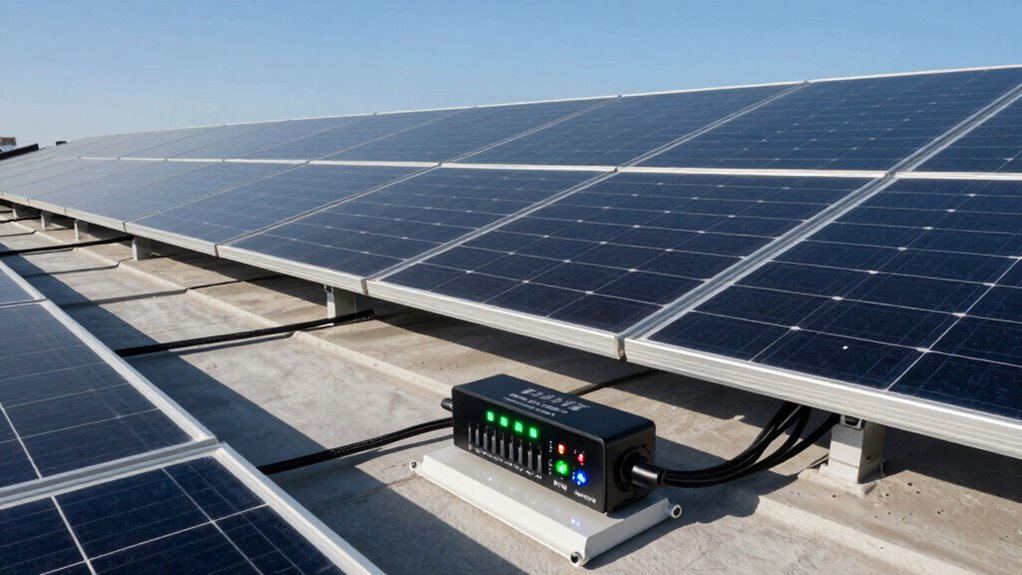

Solar charge controllers regulate power from your panels to your batteries, ensuring safe and efficient charging. PWM controllers are simple and cost-effective but reduce current gradually, especially in shaded conditions. MPPT controllers track peak voltage and current, extracting maximum power and performing better in shade or cold weather. Shade impacts performance markedly, making MPPT controllers more advantageous for complex setups. To understand how these devices optimize your system, keep exploring the details ahead.

Get business pricing on garage and car supplies
- Business-only prices and quantity discounts
- Tax-exempt purchasing
- Multiple users, one account, clear invoices
Key Takeaways
- PWM controllers reduce current as batteries reach full charge, while MPPT controllers optimize power by tracking peak voltage and current.
- MPPT controllers are more efficient in cold, cloudy, or shaded conditions by better handling uneven panel outputs.
- Shade causes uneven voltage in panels, making MPPT controllers more effective at maximizing energy extraction than PWM units.
- MPPT controllers suit larger or complex systems by working with higher voltage inputs and enhancing overall system resilience.
- Proper charge regulation with PWM or MPPT extends battery lifespan and improves system efficiency, especially under shading or environmental challenges.
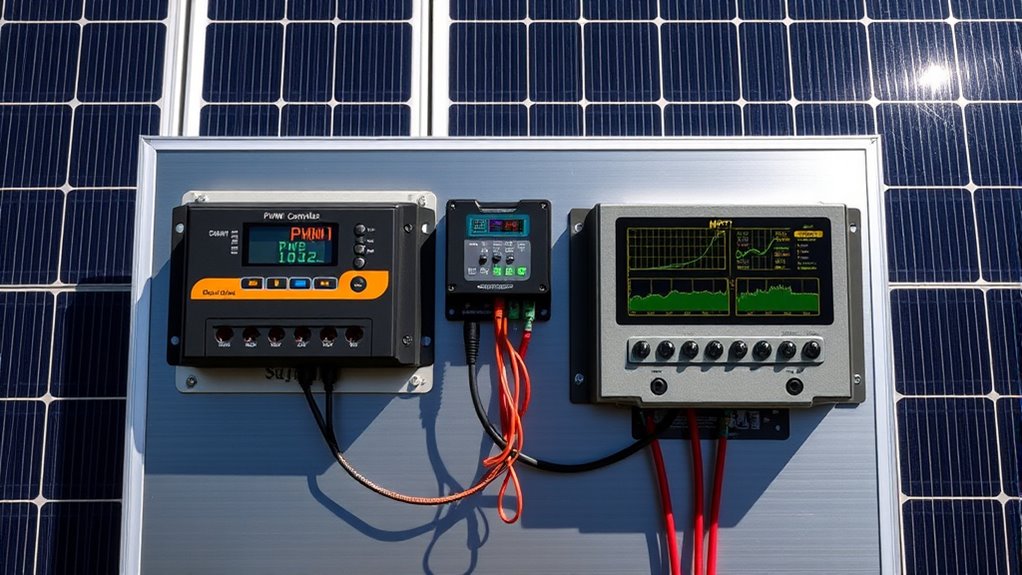
Solar charge controllers are vital devices that regulate the flow of electricity from your solar panels to your batteries, ensuring they stay charged safely and efficiently. When you’re managing a solar power system, proper battery maintenance becomes a top priority. A good charge controller prevents overcharging by adjusting the current delivered to your batteries, which extends their lifespan and maintains peak performance. This not only safeguards your investment but also keeps your entire system running smoothly. If batteries are overcharged or discharged too deeply, their capacity diminishes, leading to reduced system efficiency. That’s why choosing the right charge controller is essential for your setup’s longevity and performance.
Understanding the differences between PWM (Pulse Width Modulation) and MPPT (Maximum Power Point Tracking) controllers helps you make an informed decision. PWM controllers are straightforward and cost-effective. They work by gradually reducing the current to your batteries as they reach full charge, effectively “pulsing” the power on and off. While this method is simple, it’s less efficient, especially in cold or cloudy conditions, because it doesn’t maximize the power your panels can produce. On the other hand, MPPT controllers are more sophisticated. They constantly track the peak voltage and current point of your solar panels, adjusting dynamically to extract the maximum possible power. This results in higher system efficiency, particularly in colder weather or when your panels operate at higher voltages.
Shade introduces a different challenge altogether. When your panels are partially shaded, the performance of PWM controllers drops noticeably because they rely on a uniform voltage across all panels. Shade causes uneven voltage levels, which can trick PWM controllers into reducing power unnecessarily, decreasing overall efficiency. MPPT controllers handle shading better because they can isolate the shaded sections and still extract usable energy from the unshaded parts. This flexibility makes MPPT controllers more resilient in varied environments, ensuring your system maintains higher efficiency and better battery maintenance even when shade is unavoidable. Additionally, the efficiency of MPPT controllers is often enhanced by their ability to work with higher voltage inputs, which is especially beneficial in larger or more complex systems.
Frequently Asked Questions
How Do I Choose the Right Charge Controller for My System?
To select the appropriate charge controller, first consider your battery chemistry to guarantee compatibility, whether it’s lead-acid or lithium. Then, evaluate your system’s voltage and current ratings to match the controller’s specifications. For maximum efficiency, especially in shaded conditions, an MPPT controller is often best. Make sure the controller is compatible with your solar panel setup and can handle your system’s power needs for reliable performance.
Can I Upgrade My PWM Controller to MPPT Later?
Yes, you can upgrade your PWM controller to MPPT later. Doing so improves battery longevity by optimizing power transfer, especially in varied sunlight conditions. Just guarantee your system’s voltage and current ratings match the MPPT controller’s specifications for seamless system integration. Upgrading enhances efficiency, maximizes energy harvest, and supports better performance as your system grows or your energy needs change.
What Maintenance Is Required for Solar Charge Controllers?
You should inspect your solar charge controller monthly to guarantee peak performance. Regular maintenance helps extend battery lifespan and keeps your system running smoothly. Check for loose wiring, corrosion, and dirt buildup, and follow installation guidelines carefully to prevent issues. Keep the controller clean and ensure proper ventilation. Proper upkeep not only improves efficiency but also minimizes the risk of system failure, saving you money and headaches down the line.
How Do Charge Controllers Protect Batteries From Overcharging?
You can protect your batteries from overcharging by using a charge controller that employs voltage regulation. It monitors the battery’s voltage and reduces or stops charging once the ideal level is reached, preventing damage. This process extends your battery lifespan by avoiding overcharge stress. Whether you’re using PWM or MPPT controllers, proper voltage regulation ensures your batteries stay healthy and last longer, especially during fluctuating sunlight conditions.
Are There Any Safety Concerns With Installing Charge Controllers?
You should know that installing charge controllers involves some safety concerns, especially related to battery safety and electrical hazards. Make sure to follow manufacturer instructions carefully, use proper wiring, and wear protective gear. Avoid working on live circuits, and double-check connections to prevent short circuits or sparks. Proper installation minimizes risks, but always stay cautious to prevent electrical hazards and guarantee your system operates safely and efficiently.
Conclusion
Understanding the differences between PWM and MPPT charge controllers helps you optimize your solar setup. Did you know MPPT controllers can be up to 30% more efficient than PWM ones? This means more power, even in shaded conditions, where MPPT’s ability to track maximum power points really shines. By choosing the right controller, you guarantee your solar system performs at its best, saving you money and maximizing energy production—especially in challenging, shady environments.
Halloween Picks
halloween
As an affiliate, we earn on qualifying purchases.