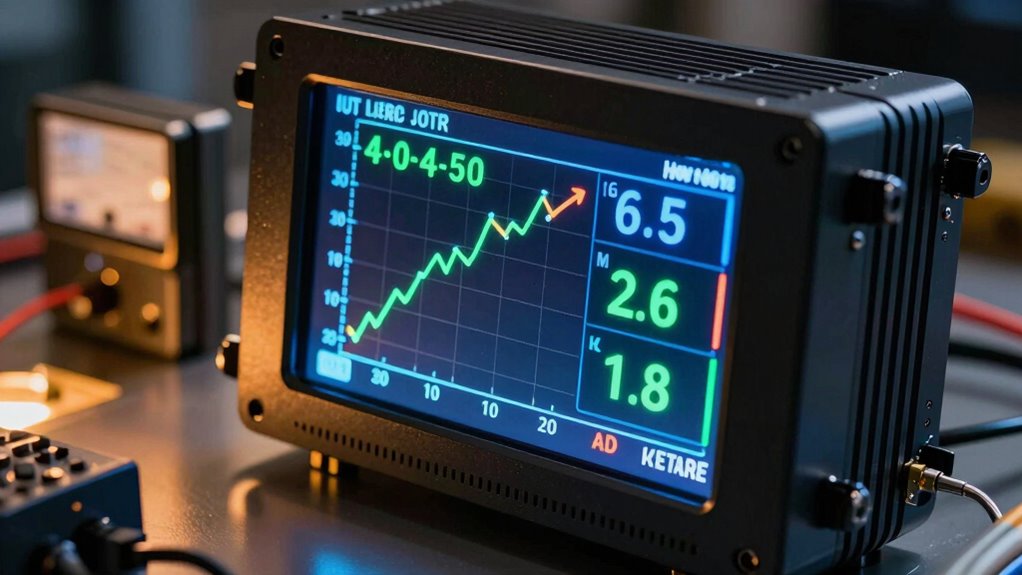

To master inverter power, understand that watts equal volts times amps, guiding your calculations for continuous load. Remember, appliances with motors or compressors need surge power—often twice the running wattage—to start smoothly. Always add headroom (20–50%) to handle surges and future expansion. Proper sizing guarantees safe and reliable operation while maximizing efficiency and battery life. Keep these basics in mind, and you’ll quickly see how to size your inverter correctly—more tips are just ahead.

Get business pricing on garage and car supplies
- Business-only prices and quantity discounts
- Tax-exempt purchasing
- Multiple users, one account, clear invoices
Key Takeaways
- Watts = Volts × Amps; knowing two allows you to calculate the third, essential for system sizing.
- Surge power is short-term, often twice the continuous wattage, needed for motor startups and appliances with high initial loads.
- Add a safety headroom (20-50%) to your total wattage to ensure inverter reliability during surges and future expansions.
- Inverter ratings include continuous and surge power; ensure your selected inverter can handle both for all connected appliances.
- Properly sizing involves summing appliance wattages, accounting for surge, efficiency, and safety margins for stable, reliable operation.
Understanding Basic Power Relationships: Watts, Volts, and Amps

Understanding how Watts, Volts, and Amps relate is fundamental to sizing and operating inverter systems effectively. Watts measure power, while Volts indicate voltage, and Amps show current flow. The key relationship is Watts = Volts × Amps. When you know any two, you can calculate the third. For example, if you have a device drawing 10 amps at 120 volts, it consumes 1,200 watts. To size wiring and select fuses, you need to determine the current, so Amps = Watts ÷ Volts. This helps prevent overheating and ensures safety. Whether working with AC or DC systems, understanding these relationships lets you accurately estimate power needs, select appropriate components, and avoid under- or over-sizing your inverter system. Proper understanding of power factors ensures your setup remains safe and efficient. Recognizing the effect of power factor correction can further optimize your system’s performance. Additionally, considering voltage stability can improve overall system reliability. Being aware of system efficiency can help you maximize energy use and reduce waste.
Differentiating Continuous and Surge Power Ratings

Differentiating between continuous and surge power ratings is essential for guaranteeing your inverter can handle all the demands of your appliances. Continuous power is what your inverter can supply indefinitely under normal conditions, while surge power covers short bursts—like motor starts—that can be twice as high. Ignoring surge ratings risks overload failures during startup. To visualize, consider this:
| Appliance Type | Continuous Power | Surge Power |
|---|---|---|
| Fridge | 150 W | 300 W |
| Pump | 200 W | 400 W |
| Power Tools | 300 W | 600 W |
| Laptop Charger | 100 W | N/A |
| HVAC Fan | 250 W | 500 W |
Knowing both ratings guarantees your inverter can handle peak loads and avoid unexpected shutdowns. Understanding power factor and how it influences your inverter’s performance can also help optimize your setup. Additionally, being aware of inverter efficiency ensures you select a model that minimizes energy loss during operation. It’s also important to consider headroom to provide extra capacity for unforeseen power surges or future expansion, ensuring reliable operation. Considering seasonal variations in load demands can further help in planning a reliable backup system.
How to Properly Size Your Inverter for Peak and Running Loads
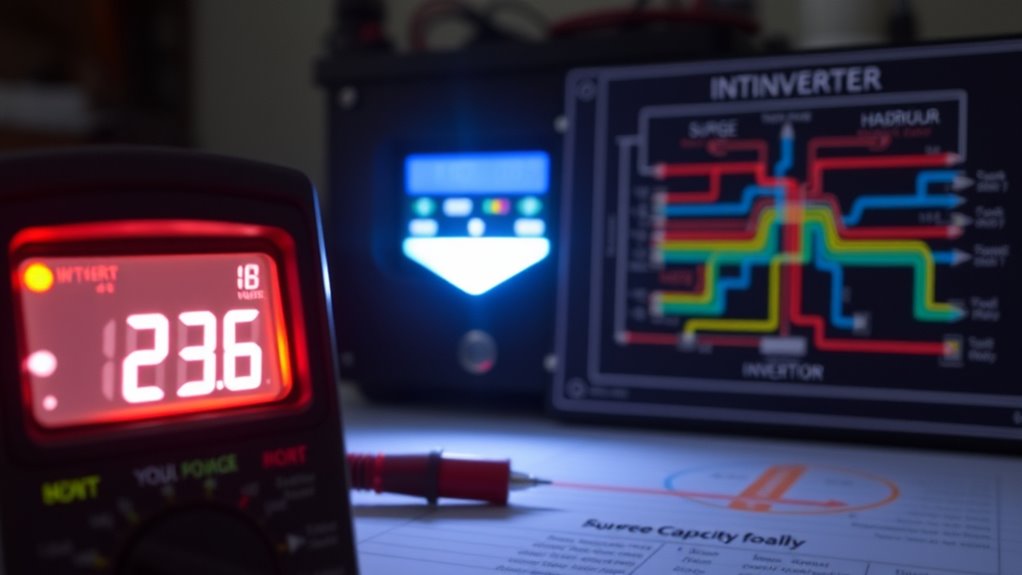
To properly size your inverter, you need to account for both your peak (surge) and continuous (running) loads. First, add up the wattages of all appliances you’ll run simultaneously. Multiply this total by a safety factor of 1.2 to 1.5 to include headroom. For appliances with motors or compressors, ensure your inverter can handle the surge wattage, which can be up to twice the running load. Check the surge duration — typically a few seconds — and confirm your inverter’s surge rating exceeds this. Avoid selecting an inverter based solely on continuous power; it must also handle startup surges. Planning for future additions and environmental factors helps prevent undersizing. Understanding load requirements and load requirements ensures your system is properly configured. Proper sizing guarantees reliable operation without overloading or overheating your inverter. Additionally, considering the power output of electric dirt bikes and other devices can help optimize your inverter’s performance for various applications. Being aware of power quality factors like harmonic distortion can further improve system stability and longevity. Incorporating load analysis can aid in more precise inverter sizing and improve overall system efficiency.
The Role of Efficiency in Power Conversion and Battery Sizing

Efficiency plays a crucial role in power conversion because it directly impacts how much energy is lost during the process. When your inverter converts DC from batteries to AC power, higher efficiency means less energy wasted as heat, extending your system’s runtime. For example, an inverter with 90% efficiency consumes less battery power than one at 85% for the same output. This difference influences battery sizing; lower efficiency requires larger batteries to deliver the same usable power. Keep in mind that efficiency varies with load—many inverters perform best at 50–75% load. Including conversion losses from chargers and wiring ensures accurate sizing. Additionally, understanding the inverter’s efficiency curve helps optimize performance across different loads. Recognizing the impact of system losses can further improve overall efficiency and reduce operational costs. Overall, maximizing efficiency reduces costs, improves performance, and helps you select appropriately sized batteries for reliable operation.
Calculating Battery Capacity for Your Inverter System

Calculating the right battery capacity for your inverter system guarantees you have enough energy to run your appliances without frequent recharging. First, determine your total continuous load in watts. Next, decide on your desired runtime. Finally, include system inefficiencies and safety margins. To visualize:
- Imagine a 500W fridge, a 100W laptop, and a 200W light all running simultaneously.
- Multiply their combined wattage by your runtime in hours.
- Divide that figure by your battery voltage and system efficiency to find needed amp-hours.
- Remember, affiliate relationships ensure you can access quality components and tools needed for your setup. Additionally, understanding power factor can help optimize your system’s efficiency and capacity planning. Incorporating battery chemistry considerations can also impact performance and longevity. Recognizing system headroom is essential to prevent overloads and extend your inverter’s lifespan. Being aware of power quality standards can help ensure your appliances operate smoothly and safely. This process ensures your battery bank supplies sufficient energy smoothly. Remember, oversizing slightly accounts for aging, temperature, and unexpected surges, keeping your system dependable and ready for future demands.
The Significance of Headroom and Safety Margins in Inverter Selection

Selecting the right inverter size isn’t just about adding up your appliances’ wattages; it’s essential to incorporate headroom and safety margins to guarantee reliable operation. Overloading your inverter can cause overheating, trips, or damage, especially during startup surges. Adding a safety margin—typically 20–50%—gives your system room to handle transient loads and unexpected power spikes. This buffer prevents your inverter from operating at its maximum capacity constantly, which can shorten its lifespan and compromise efficiency. It also helps accommodate future upgrades or additional devices without needing a complete system overhaul. Proper headroom ensures your inverter runs smoothly under real-world conditions, providing peace of mind and extended equipment longevity. It’s a critical factor in selecting an inverter that’s both reliable and scalable. Understanding power surge and how inverters handle transient loads is essential for maintaining system stability and safety. Considering inverter efficiency can further optimize energy consumption and reduce operational costs over time. Additionally, being aware of credit card security measures can help protect your financial information when making online purchases related to system upgrades or maintenance. Incorporating knowledge of personality assessments can also help you evaluate how different systems or team members might adapt to technical changes or upgrades.
Practical Wiring Considerations and DC Current Management
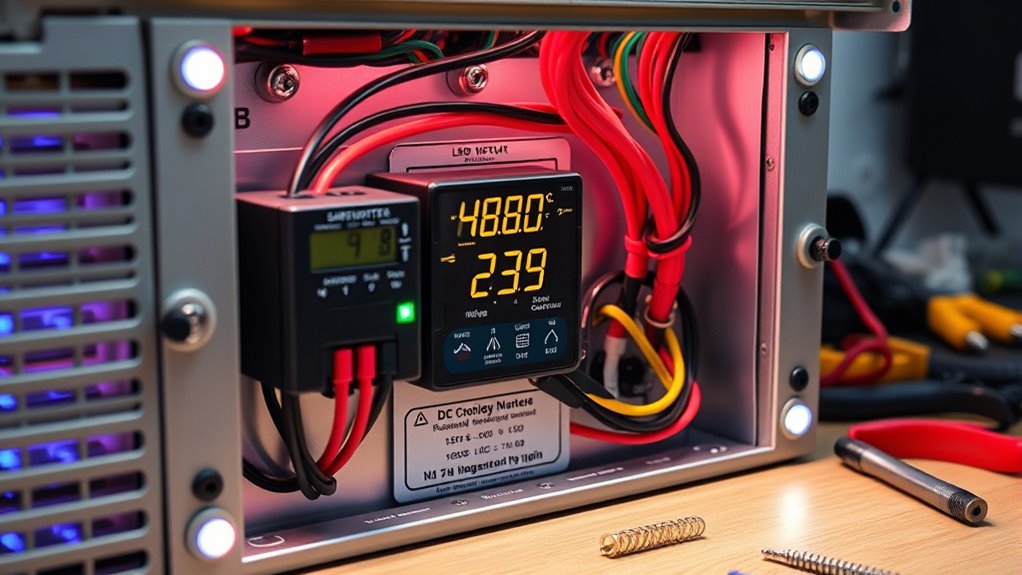
Proper wiring practices are essential to guarantee your inverter system operates safely and efficiently. When managing DC current, you need to think about:
- Using thick cables with sufficient ampacity to handle high currents without overheating.
- Installing appropriately rated fuses or breakers close to the battery to protect against short circuits.
- Keeping wiring connections clean, tight, and secure to prevent resistance buildup and voltage drops.
Imagine a thick, copper cable connecting your battery to the inverter, capable of carrying over 100 amps without heating. Visualize a high-quality fuse protecting your system like a safety net, and tight connections ensuring minimal power loss. Proper wiring reduces heat, prevents failures, and prolongs system life.
Converting Between Energy Units: Watt-Hours, Amp-Hours, and Battery Capacity

Converting between watt-hours (Wh), amp-hours (Ah), and battery capacity is essential for understanding how energy flows in your inverter system. Watt-hours measure total energy, calculated by multiplying watts by hours, which helps size batteries for specific runtimes. Amp-hours indicate the charge a battery can deliver at a given voltage, so converting Ah to Wh involves multiplying Ah by the battery’s voltage. To determine the battery capacity needed, divide your total load (W) times the desired runtime (h) by the system efficiency and voltage. Keep in mind, usable capacity depends on the battery chemistry and depth of discharge (DoD), which reduces the total available energy. Proper conversion guarantees you select the right battery size to meet your power needs without over- or under-sizing.
Common Mistakes to Avoid When Planning Inverter Power Systems

One common mistake is underestimating the surge power needs of inductive loads like motors and compressors. These devices require a brief, high-startup current that can be 2–3 times their running wattage. If you ignore this, your inverter may fail during startup. To avoid this, consider:
Avoid underestimating surge power for motors and compressors to prevent inverter failure during startup.
- Visualizing a refrigerator motor: it needs a quick surge to start spinning, then settles into a lower running current.
- Imagining a pump: it demands a burst of energy to overcome inertia before operating normally.
- Thinking of a compressor: it requires a hefty kick of power to initiate the compression cycle.
Sizing your inverter without accounting for these surges risks overloads and shutdowns, so always include surge capacity in your planning.
Frequently Asked Questions
How Does Ambient Temperature Affect Inverter Performance and Sizing?
You need to account for ambient temperature because higher temperatures reduce inverter efficiency and can cause overheating, leading to shutdowns or damage. Cooler environments help in maintaining ideal performance and extend lifespan. When sizing your inverter, add a safety margin for temperature variations and guarantee proper ventilation. Operating at or near the inverter’s maximum capacity in hot conditions risks overheating, so plan for extra headroom and cooling solutions for reliable operation.
Can Inverter Surge Ratings Handle All Motor Startup Currents Simultaneously?
Think of your inverter like a skilled acrobat—its surge rating is its grand jump. It can handle multiple motor startups if their combined surge stays within that peak capacity. But push it too far, and the inverter will falter, tripping or overheating. To keep your system safe, always guarantee the surge ratings cover the highest simultaneous startup currents, especially when running heavy appliances together.
What Is the Impact of Inverter Idle Power Consumption on Battery Runtime?
Your inverter’s idle power consumption directly impacts your battery runtime, especially during standby periods. The higher the standby or quiescent current, the more energy your batteries drain even when no load is active. This continuous draw reduces overall run time, meaning you’ll need larger batteries or more efficient inverters to maintain desired operation durations. Always consider standby power when planning your system to avoid unexpected short runtimes.
How Do I Choose the Right Battery Chemistry for My Inverter System?
Choosing the right battery chemistry is like picking the right tool for a job—you want reliability, efficiency, and safety. If you need long-lasting, deep-cycle power, go for lithium-ion; it’s lightweight, high capacity, and durable. For budget-friendly options, lead-acid batteries work but require maintenance and shorter lifespan. Consider your system’s voltage, discharge needs, and environmental conditions to match chemistry with your inverter system for ideal performance.
When Should I Upgrade Inverter Size for Future Load Additions?
You should upgrade your inverter size when you anticipate adding loads that exceed your current inverter’s continuous or surge ratings. It’s smart to plan for future growth by sizing your inverter 20–50% above your current needs. This headroom guarantees your system handles peak surges and transient loads comfortably, prevents overloads, and accommodates new appliances or tools without risking damage or system failure. Regularly reassess your load needs to keep your system appropriately scaled.
Conclusion
Now that you understand how watts, surge, and headroom work together, you’re better equipped to size your inverter confidently. Remember, oversizing your system provides safety and flexibility, but knowing your actual needs keeps costs in check. So, next time you think about powering your gadgets, ask yourself: are you designing a setup that’s ready for peak moments or just the basics? With this knowledge, you’re ready to make smarter, safer choices.
Fall Picks
fall essentials
As an affiliate, we earn on qualifying purchases.