
If you have a small solar system with lead-acid batteries and a limited budget, PWM controllers are often the better choice. They are simpler, more reliable, and cost less upfront, making them ideal for straightforward setups. While MPPT controllers are more efficient in many conditions, PWM systems work well with moderate sunlight and smaller scales. Want to discover more about when PWM truly holds an edge? Keep exploring to find out.

Get business pricing on garage and car supplies
- Business-only prices and quantity discounts
- Tax-exempt purchasing
- Multiple users, one account, clear invoices
Key Takeaways
- Small, low-budget solar setups with lead-acid batteries benefit from PWM’s simplicity and affordability.
- PWM controllers excel in moderate sunlight conditions where maximum efficiency is less critical.
- For systems prioritizing low initial costs over peak energy harvesting, PWM remains cost-effective.
- Simple installations with minimal configuration needs favor PWM’s straightforward design.
- In environments with stable, predictable sunlight, PWM provides sufficient performance at lower cost.
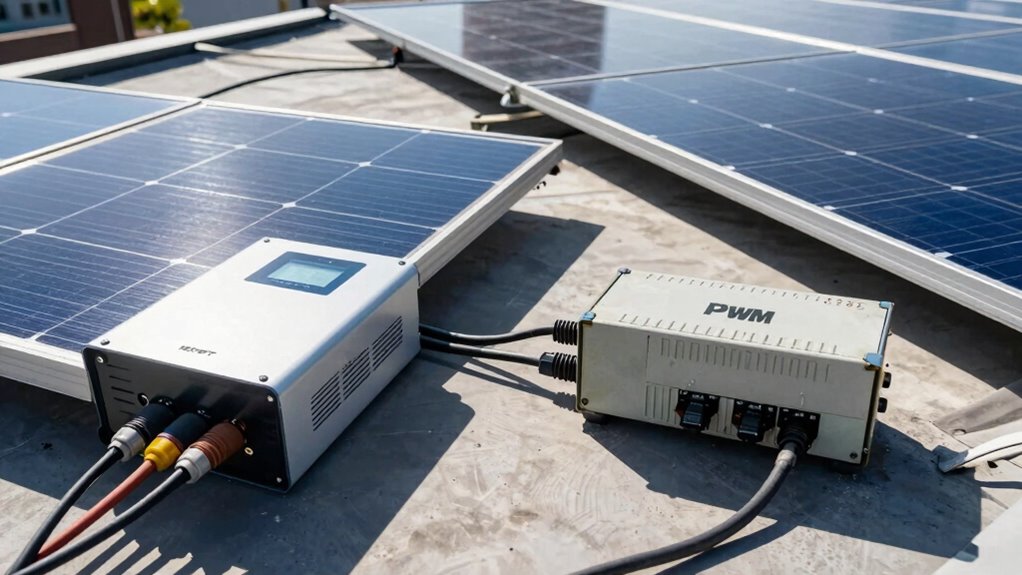
When choosing a solar charge controller, understanding the differences between MPPT and PWM technologies is essential. Both serve the same purpose—regulating power flow from your solar panels to your batteries—but they do so differently, impacting your system’s overall performance and cost efficiency. One of the key considerations is battery compatibility. PWM controllers are straightforward and tend to work well with traditional, lead-acid batteries. They connect directly to the battery, providing a simple, reliable charge. If you’re using standard batteries and your system budget is tight, PWM controllers often do the job without complications.
PWM controllers are simple, reliable, and ideal for small systems with lead-acid batteries on a budget.
On the other hand, MPPT controllers shine when it comes to maximizing energy harvest, especially in systems with higher voltages or diverse battery types. They intelligently track the maximum power point of your solar panels, adjusting their input to optimize energy transfer. This adaptability not only boosts the system’s efficiency but also makes MPPT controllers more versatile with various battery chemistries, including lithium-ion and advanced lead-acid variants. If your setup involves different battery types or aims for higher efficiency, MPPT controllers are generally the better choice despite a higher initial cost.
Cost efficiency is a significant factor in your decision-making process. PWM controllers are typically less expensive upfront, making them attractive for smaller or budget-constrained installations. Their simplicity means fewer components that could fail, which can translate into lower maintenance costs over time. However, because PWM controllers don’t optimize energy transfer to the same extent as MPPT units, you might end up with less overall energy, especially in colder climates or when panels operate at higher voltages. Over the long term, this can lead to slightly higher operating costs due to reduced energy savings.
Despite the advantages of MPPT controllers in efficiency and flexibility, there’s still a notable use case where PWM controllers are preferable. If your solar system is relatively small, uses standard lead-acid batteries, and operates in moderate sunlight conditions, PWM can be perfectly sufficient. In such scenarios, the lower initial investment and simplicity outweigh the incremental gains in efficiency that MPPT offers. When your system’s scale and battery type align with these conditions, PWM still wins as a practical, cost-effective solution, demonstrating that sometimes, simplicity remains the best choice.
small solar charge controller PWM
As an affiliate, we earn on qualifying purchases.
As an affiliate, we earn on qualifying purchases.
Frequently Asked Questions
Can PWM Controllers Handle High-Voltage Solar Arrays Effectively?
Yes, PWM controllers can handle high-voltage solar arrays effectively, but with limitations. They regulate voltage by switching on and off rapidly, which can cause reduced power efficiency at higher voltages. You might notice less efficient energy transfer compared to MPPT controllers, especially in variable conditions. So, if maintaining maximum power efficiency and precise voltage regulation are priorities for your high-voltage array, an MPPT controller could serve you better.
What Maintenance Is Required for MPPT Versus PWM Controllers?
Think of maintaining your solar controllers like tending a garden; MPPT units require more attentive pruning and calibration due to their complex electronics, ensuring maximum cost efficiency. PWM controllers, meanwhile, are like hardy perennials, needing less fuss and simpler upkeep. You’ll find MPPTs demand regular checks to prevent dust buildup and firmware updates, while PWM units stay steady with minimal maintenance, making them easier and cheaper to care for over time.
How Do Temperature Variations Affect Each Controller’s Performance?
Temperature effects can substantially impact each controller’s performance. As temperatures rise, MPPT controllers typically maintain higher efficiency because they adapt to changing conditions, optimizing power extraction. PWM controllers, however, are more affected by temperature fluctuations, which can reduce their efficiency. You’ll notice that in extreme heat, MPPTs perform better, helping you get the most out of your solar setup, especially in hot climates.
Are There Specific Battery Types Better Suited for PWM Controllers?
If you’re using lead-acid batteries, PWM controllers work well because they match the battery chemistry and provide reliable, straightforward charging. They’re especially suitable for smaller systems or those with stable sunlight conditions. While they may have slightly lower charging efficiency compared to MPPT controllers, PWM units are simple, cost-effective, and do a good job with batteries that tolerate bulk charging, making them ideal for certain lead-acid applications.
What Is the Typical Lifespan Difference Between MPPT and PWM Controllers?
Think of your controller as a steadfast ship charting the solar seas; MPPT controllers typically sail longer, about 10-15 years, thanks to higher efficiency and better build quality, while PWM controllers often cruise for 5-10 years. The efficiency difference impacts lifespan, with MPPT’s advanced technology reducing stress on components. Although MPPT controllers cost more upfront, their durability and superior efficiency often make them a wiser investment over time.
lead-acid battery solar controller
As an affiliate, we earn on qualifying purchases.
As an affiliate, we earn on qualifying purchases.
Conclusion
As you consider your options, imagine standing at a busy crossroads where the sun’s rays dance unpredictably, illuminating different paths. It’s a coincidence that, despite MPPT’s efficiency, PWM controllers still shine in simple, steady conditions—like a steady breeze guiding a sailboat smoothly across calm waters. Sometimes, less sophisticated technology quietly outperforms the complex, proving that in the right situation, tradition and simplicity can still steer you right.
As an affiliate, we earn on qualifying purchases.
solar panel charge controller for small systems
As an affiliate, we earn on qualifying purchases.
As an affiliate, we earn on qualifying purchases.
Halloween Picks
halloween
As an affiliate, we earn on qualifying purchases.