
By choosing the optimal racing line, you can brake later, accelerate sooner, and take corners more efficiently, which directly reduces your lap times. A good line helps you stay close to the grip limits of your tires, minimizing scratching and loss of traction. It also allows your car’s aerodynamics to work more effectively while maintaining steady speed through corners. Mastering these techniques will give you the edge you need to shave off precious seconds; explore more to reveal your full potential.
Key Takeaways
- Optimal racing lines reduce distance traveled and unnecessary adjustments, leading to faster lap times.
- Proper lines maximize tire grip and aero efficiency, allowing higher speeds through corners.
- Correct entry, apex, and exit points enable smoother, more controlled cornering and quicker acceleration.
- Maintaining ideal lines minimizes tire scrubbing and aerodynamic drag, boosting overall speed.
- Consistent line selection and vehicle setup enhance cornering stability and lap time consistency.
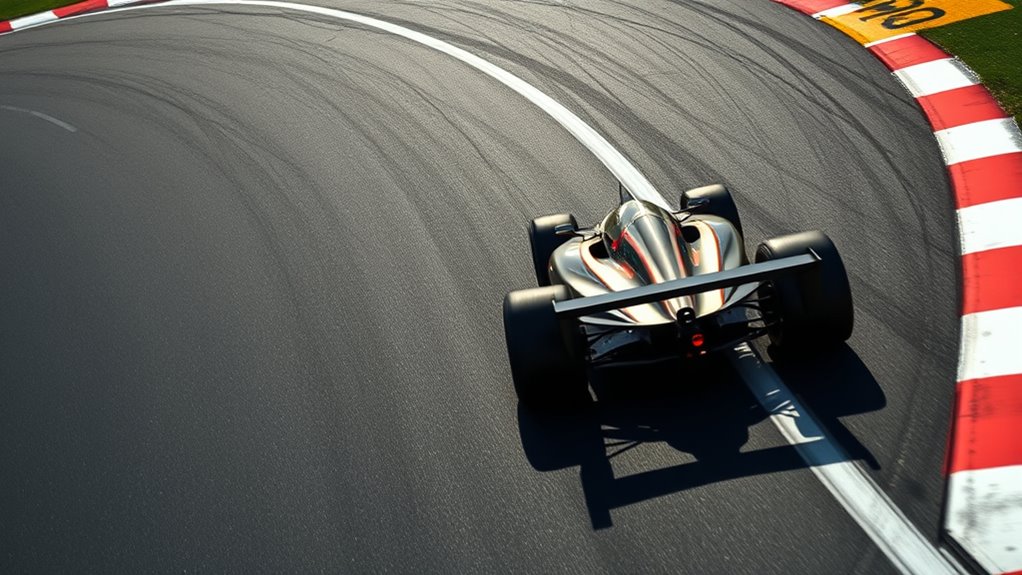
Mastering racing lines is essential for achieving faster lap times because they determine how efficiently you navigate each turn. When you pick the optimal line through a corner, you maximize your car’s potential, reducing the distance traveled and minimizing unnecessary adjustments. This efficiency directly impacts your overall speed, especially when you consistently hit the ideal trajectory. To do this effectively, you need to understand how aero efficiency and tire grip play crucial roles in maintaining control and speed through corners.
Mastering racing lines boosts speed by optimizing corner navigation and reducing unnecessary adjustments.
Aero efficiency influences how well your car slices through the air, especially when you’re carrying speed into and through turns. A well-laid racing line allows you to maintain a steady, controlled approach, minimizing unnecessary aerodynamic drag by reducing abrupt steering inputs. When your line is smooth and predictable, your car’s aerodynamic elements, like wings and diffusers, work optimally, providing the downforce needed to keep tire contact patch firmly planted on the track. This increased aero efficiency translates to more stable handling and less loss of speed at critical moments, enabling you to carry higher velocities through corners.
Tire grip is equally vital when following a racing line. The closer you stay to the ideal path, the more you can exploit the maximum grip your tires offer. Deviating from this line causes your tires to scrub against the asphalt, reducing grip and increasing the risk of understeering or oversteering. When you position your car correctly, you allow the tires to work within their optimal grip zone, giving you the confidence to carry more speed into corners and accelerate sooner on exit. Properly managing tire grip through your line also minimizes tire wear, which is essential for maintaining high performance throughout a race. Additionally, the role of the ideal racing line is supported by a well-maintained vehicle setup that maximizes grip and stability.
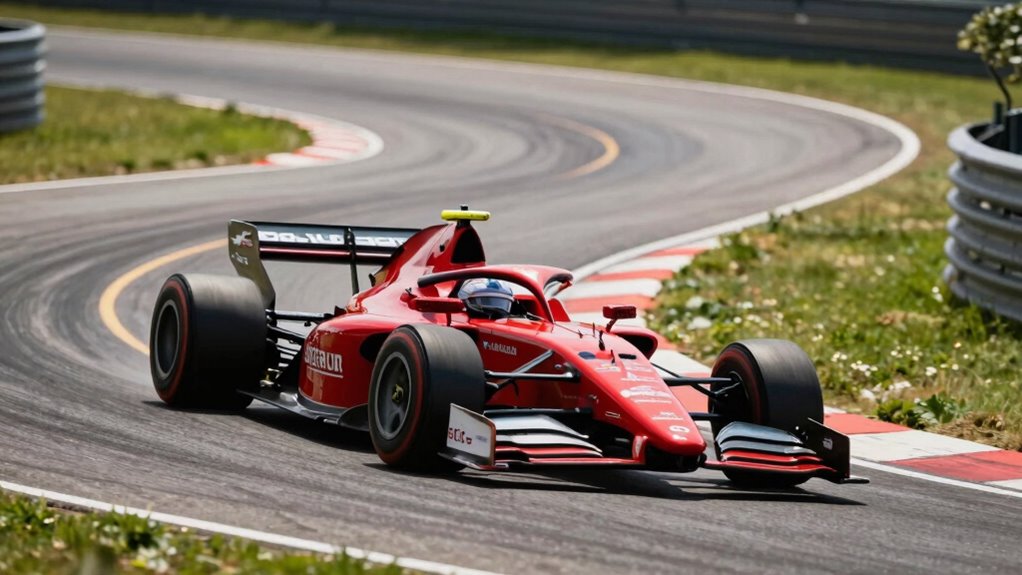
In addition to these factors, understanding the importance of entry, apex, and exit points helps you refine your racing line. Entering the corner at the right angle allows you to set up for the apex, the tightest point of the turn, where you want to hit with precision. Exiting with a smooth, wide arc ensures you maximize acceleration and set yourself up for the next section of track. When you combine good line choice with an awareness of aero efficiency and tire grip, you’ll notice a significant reduction in lap times. Moreover, practicing driving techniques consistently enhances your ability to adapt your line in response to changing conditions.
Furthermore, using proper filtration and pump protection on your equipment ensures consistent spray quality and prolongs the lifespan of your tools, which can be likened to maintaining optimal tire grip on a race car. When you focus on these elements, you’ll find yourself consistently improving your lap times, gaining confidence, and becoming a more skilled driver.

SIM RACING TRAINING BOOK: Racing Games Journal to help you learn tracks, improve your lap times by drawing and noting down driving lines, apex points, … intermediate or competitive Simracer
As an affiliate, we earn on qualifying purchases.
As an affiliate, we earn on qualifying purchases.
Frequently Asked Questions
How Do Weather Conditions Affect Optimal Racing Lines?
Weather impacts your racing lines crucially, as wet or slippery conditions require you to adapt your track approach. You need to choose lines that maximize grip and minimize risks, often avoiding the usual racing line to prevent slipping. Track adaptation becomes essential; you might brake earlier, take wider turns, or stay off the racing line altogether to maintain control and optimize your lap time under changing weather conditions.
Can Racing Lines Be Personalized for Different Driving Styles?
Think of racing lines as a tailor-made suit—they can be personalized for your driving style. You can adapt your approach by choosing personalized techniques that suit your comfort and skill, whether it’s taking tighter corners or smooth, sweeping arcs. Your unique driving style influences your best racing line, helping you carve through the track with confidence. By customizing your lines, you turn every lap into a reflection of your individual driving flair.
How Do Racing Lines Influence Tire Wear During a Race?
Racing lines substantially impact tire wear by affecting tire degradation and grip enhancement. When you take the best line, you distribute forces evenly across your tires, reducing excessive grip demands that cause rapid wear. This helps maintain consistent grip throughout the race, prolonging tire life. Conversely, poor lines increase uneven pressure, accelerating tire degradation. Properly chosen lines allow you to maximize grip, minimize tire wear, and improve overall race performance.
Are Racing Lines the Same for All Types of Vehicles?
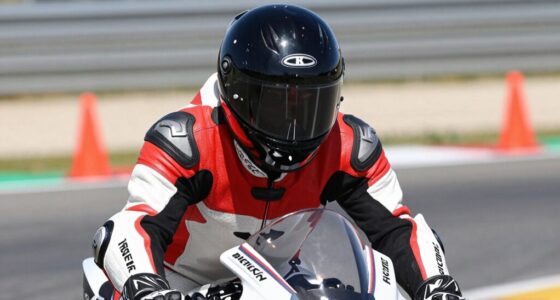
You might think racing lines are the same for all vehicles, but they actually vary based on vehicle dynamics and driver skill. Different cars, like motorcycles or Formula 1, require unique approaches because of their handling and weight distribution. As a driver, you adapt your racing line to optimize grip and balance, ensuring you maximize performance. So, understanding your vehicle’s specific dynamics helps you choose the best line for faster lap times.
How Do Track Surface Changes Impact Racing Line Choices?
Track surface changes considerably impact your racing line choices. When grip decreases, you should adapt your racing line by taking a wider, more gradual approach to corners, minimizing steering and throttle inputs. Conversely, on high-grip surfaces, you can adopt a tighter, more aggressive line for faster cornering. Paying attention to surface grip and adjusting your racing line accordingly helps maintain ideal speed and control, ultimately improving your lap times.

Serpent High Performance Racing Tires, 44/100mm RC Tires, Mounted on 2.9" 17mm Hex Wheels (Set of 2), Wheel/tyre set fr L+R 426 Outlaw (SER304018)
Unmatched traction, featuring “Zooms” composite material—multi-terrain, all-condition remote-controlled car tires designed for street performance. These tires utilize Serpent's…
As an affiliate, we earn on qualifying purchases.
As an affiliate, we earn on qualifying purchases.
Conclusion
Mastering racing lines can substantially shave seconds off your lap times. By choosing the best path through each corner, you maximize grip and minimize steering adjustments. Remember, it’s not just about pushing hard but pushing smart. When you get the hang of it, you’ll see improvements that make all the difference. Sometimes, the key to winning is to know when to turn on a dime—showing that a little finesse beats brute force every time.

Tesla Model 3 Body Kit Full Aero Package for 2017-2023, Rear Bumper Diffuser, Side Skirts, Front Splitter Lip, Spoiler, Fog Light Eyebrow Side Camera Cover (Style A, Glossy Black)
Vehicle Compatibility: Fits Tesla Model 3 (2017–2023). Not compatible with the Highland version.
As an affiliate, we earn on qualifying purchases.
As an affiliate, we earn on qualifying purchases.

Speedway Motors Front Anti Sway Bar Kit – 1 Inch – Performance Upgrade – Black Powder Coated – Hardware Included – Flatter Cornering at Speed, Compatible with 1955-57 Chevy Car
Enhanced Performance: Improve the performance and stability of your 1955-57 Compatible with Chevy Tri-5 with this robust 1"…
As an affiliate, we earn on qualifying purchases.
As an affiliate, we earn on qualifying purchases.