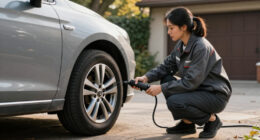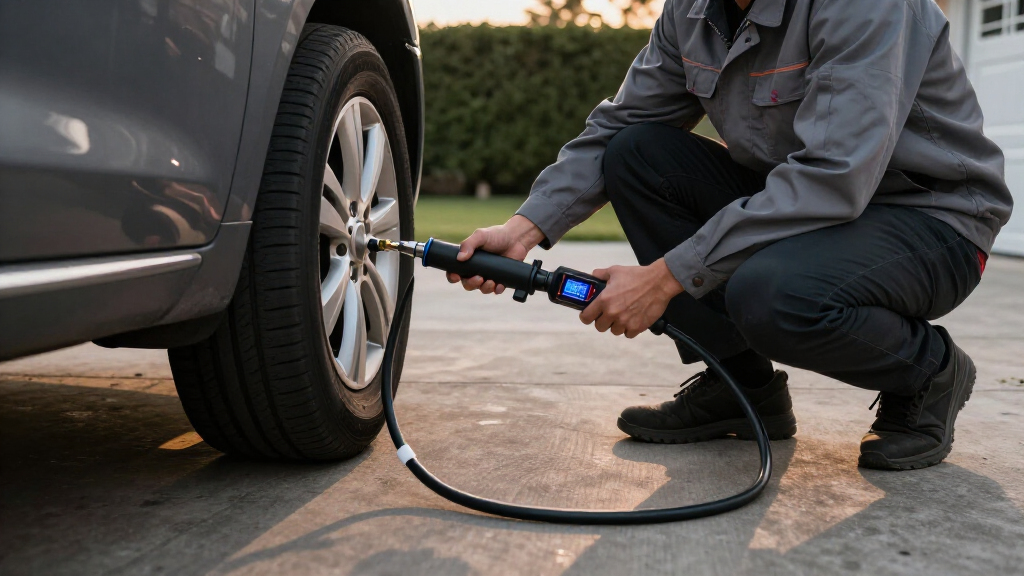
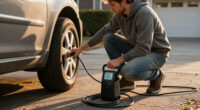
Choosing an automatic tire inflator is mainly a choice between freedom from a power cord and a steady supply of vehicle power. Cordless models are convenient for topping up tires in a driveway, garage, or roadside spot where reaching the cabin is awkward. A 12V plug-in inflator connects to the vehicle’s accessory outlet, so it can keep running without relying on a separate battery charge.

Get business pricing on garage and car supplies
- Business-only prices and quantity discounts
- Tax-exempt purchasing
- Multiple users, one account, clear invoices
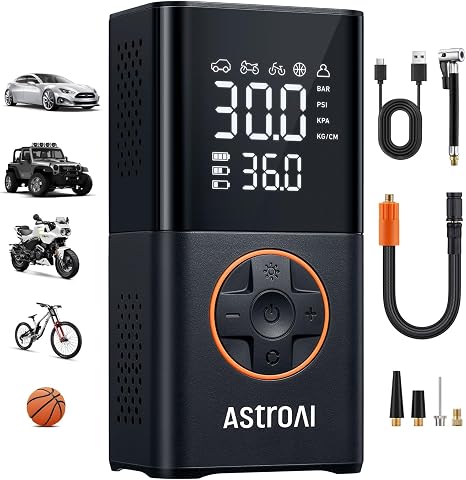
AstroAI L7 Cordless Portable Tire Inflator, 150 PSI
- ✔ Maximum pressure: 150 PSI
- ✔ Battery capacity: 4000 mAh
- ✔ Runtime: Up to 8 sedan tires (30–36 PSI) per charge

OlarHike Portable Tire Inflator Air Compressor, Dual Power, 3 x 2000mAh Battery & 12V DC
- ✔ Power modes: Cordless battery, 12V DC
- ✔ Battery capacity: 3 x 2000mAh
- ✔ Cordless runtime: Up to 18 car tires / 11 SUV tires per charge

Airmoto Tire Inflator Portable Air Compressor for Cars, Bikes and Bicycles
- ✔ Max pressure: 120 PSI
- ✔ Battery: 2000 mAh rechargeable, USB-C fast charging
- ✔ Pressure units: PSI, kPa, BAR, KG/CM
Both types let you set a target pressure and stop automatically when they reach it, though actual speed, accuracy, noise, and durability vary by model. Cordless inflators make more sense for occasional use and portability; plug-in units are usually the practical pick for several tires, larger tires, or drivers who want the inflator ready whenever the vehicle is available. The deciding tradeoff is convenience versus runtime confidence.
At a Glance
| Criteria | Cordless automatic tire inflators | 12V plug-in automatic tire inflators | Winner |
|---|---|---|---|
| Power source and readiness | Built-in rechargeable battery; needs charging before use | Powered from a 12V vehicle outlet while in use | Depends |
| Portability | Works without a vehicle nearby; easiest to carry around | Requires the vehicle to be within reach of the power cable | A |
| Runtime and repeated use | Limited by charge and heat; may need a recharge or cooling between tires | Can keep running while the vehicle supplies power, subject to outlet limits and unit cooling | B |
| Inflation performance | Varies by model; battery output can constrain sustained performance | Often better suited to extended or repeated use; performance remains model-dependent | B |
| Storage and setup | No vehicle power lead to manage, but charger and battery add bulk | Long power cable must be routed and stored | A |
| Cost and value | Often costs more, especially with a high-capacity battery | Commonly costs less; no separate inflator battery to replace | B |
AstroAI L7 Cordless Portable Tire Inflator, 150 PSI
The AstroAI L7 earns the top spot because it makes the fewest compromises for the widest range of drivers. Its 4000 mAh battery is double the capacity of the Airmoto’s, which translates to servicing up to eight standard car tires on a single charge — enough for a full top-up routine across two vehicles without worrying about recharging. Inflation speed is also class-leading here: a 195/65R15 tire goes from 30 to 36 PSI in roughly 90 seconds, noticeably quicker than the Airmoto on the same task.Where the L7 pulls ahead of the OlarHike is pressure flexibility. Its custom range runs from 3 to 150 PSI across PSI, Bar, kPa, and kg/cm², so it handles bicycle tires, motorcycle tires, and sports balls at pressures the OlarHike simply cannot reach. The preset mode dial — car, motorcycle, bicycle, ball, or custom — makes it feel approachable for drivers who have never used an inflator before. Compared with the Airmoto, the L7 adds a three-mode flashlight (including SOS) plus USB-C power output, giving it a legitimate secondary role as an emergency power bank.The tradeoffs are real, though. The 25-inch tire diameter limit means it is not a fit for larger SUV and crossover tires, which is exactly where the OlarHike shines. And like most compact compressors, it needs a 10-minute cool-down after 15 minutes of continuous use, so it is built for top-ups and emergencies rather than inflating four flat tires back to back.
Pros:
- 4000 mAh battery services up to eight car tires per charge
- Wide 3–150 PSI custom range with presets for cars, bikes, motorcycles, and balls
- Fast inflation — roughly 90 seconds for a standard sedan tire top-up
- Three-mode flashlight and USB-C power output double as emergency tools
Cons:
- Not suitable for tires larger than 25 inches in diameter
- Requires a 10-minute rest after 15 minutes of continuous use
Best for: Drivers of sedans, hatchbacks, and small crossovers who want one device for car, bike, and ball inflation with strong battery endurance.
Not ideal for: Owners of larger SUVs and trucks with tires over 25 inches in diameter.
Bottom line: The most balanced automatic inflator of the three — fast, flexible, and long-running, provided your tires are under 25 inches.
“The most balanced automatic inflator of the three — fast, flexible, and long-running, provided your tires are under 25 inches.”
OlarHike Portable Tire Inflator Air Compressor, Dual Power, 3 x 2000mAh Battery & 12V DC
What separates the OlarHike from the other two picks — and the reason it holds a distinct place in this lineup — is dual power. Three 2000mAh batteries give it a genuinely impressive cordless runtime, but when those run dry you can plug it into your car’s 12V outlet and keep working. Neither the AstroAI nor the Airmoto offers that fallback, and on a long road trip with an unfamiliar leak, that redundancy is worth more than any single spec sheet.It is also the strongest performer on bigger tires. The OlarHike handles SUV and light-pickup tires that the AstroAI L7’s 25-inch limit excludes, inflating an SUV tire from 30 to 35 PSI in about 2.2 minutes. Its rated runtime of up to 18 car tires or 11 SUV tires per charge is the best endurance figure in this comparison. Standard car tires take just 55 seconds, which is quicker than the AstroAI on comparable work, though the margin narrows once you factor in the AstroAI’s lighter weight and broader pressure range.The catch is the ceiling. The OlarHike is limited to 51 PSI, which is fine for passenger vehicles but rules out high-pressure bicycle tires and some performance applications the AstroAI handles easily. It also demands a specific 5V 2A or 5V 3A charging adapter, a small but real annoyance if you travel with a mix of chargers. At 1.2 lbs it is heavier than both competitors, so it belongs in a trunk kit rather than a glove box.
Pros:
- Dual power: cordless batteries plus 12V DC for unlimited runtime
- Fastest endurance in the lineup — up to 18 car tires per charge
- Handles SUV and light-pickup tires the AstroAI L7 cannot
- Memory recall, dual LED screens, and bundled travel accessories
Cons:
- 51 PSI pressure ceiling limits versatility
- Requires a specific 5V 2A or 3A charging adapter
- Heavier than the AstroAI and Airmoto at 1.2 lbs
Best for: SUV, crossover, and light-pickup owners, especially frequent road-trippers who want a 12V backup power option.
Not ideal for: Cyclists needing high pressures above 51 PSI, or owners of heavy-duty trucks and RVs.
Bottom line: The most dependable choice for bigger tires and long trips thanks to dual power, as long as you never need pressures above 51 PSI.
“The most dependable choice for bigger tires and long trips thanks to dual power, as long as you never need pressures above 51 PSI.”
Airmoto Tire Inflator Portable Air Compressor for Cars, Bikes and Bicycles
The Airmoto plays a different game than the other two: it is the inflator you will actually carry everywhere. Small enough for a glove box or tank bag, it trades battery muscle for pocketability, and for city drivers and cyclists that trade makes sense. Its accessory kit is the most complete here — Schrader, Presta, needle, and general nozzles — which makes it especially appealing to road cyclists who need to switch between car and Presta valves on the same outing.Functionally, it delivers the core automatic-inflator experience: set your pressure on the large LCD, and it shuts off when it gets there. A deflate button is a thoughtful addition neither competitor matches, letting you bleed off excess pressure without reattaching anything. The retractable air hose keeps the whole package tidy in a way the OlarHike’s separate hose and cord set does not.But the compromises are the steepest of the three. Its 2000 mAh battery is half the AstroAI L7’s capacity and drains quickly on larger or high-pressure tires, so a full four-wheel top-up on an SUV may exceed what it can deliver — a job the OlarHike handles without breaking a sweat. Cold weather further cuts battery efficiency, which matters if your emergency kit lives in an unheated garage. It is also unsuitable for high-volume items like air mattresses and paddle boards. As a second inflator or a glove-box companion, though, it is hard to beat for the price of admission in space alone.
Pros:
- Smallest footprint of the trio — fits in a glove box
- Complete adapter set including Presta and needle valves
- Handy deflate button for bleeding off excess pressure
- Auto shutoff with a large, easy-to-read LCD
Cons:
- 2000 mAh battery drains quickly on larger or high-pressure tires
- Cold weather noticeably reduces battery efficiency
- Not suitable for high-volume inflatables
Best for: Cyclists, commuters, and motorcyclists who want a barely-there inflator with a full adapter kit always within reach.
Not ideal for: SUV owners topping up four large tires at once, or anyone inflating air mattresses and paddle boards.
Bottom line: The right pick when portability outranks raw power — a true pocket inflator, provided your tire needs are modest.
“The right pick when portability outranks raw power — a true pocket inflator, provided your tire needs are modest.”
As an Amazon Associate we earn from qualifying purchases.
Key Differences
The largest practical difference appears when you need air in more than one tire. A cordless inflator can be carried to the wheel without moving the vehicle or running a cord through the cabin, but its usable runtime depends on battery charge, tire size, and the unit’s duty cycle. For a quick pressure correction, that tradeoff is usually easy to live with. For several low tires, a larger vehicle, or repeated use, a 12V model has the advantage because it draws power from the vehicle rather than spending a finite stored charge.
That does not make plug-in models universally better. Their cable limits where they can reach, and setup can be awkward if the outlet is far from the tire or the vehicle cannot be positioned nearby. Cordless models remove that constraint and are easier to use around bicycles, sports equipment, or a parked car in a garage. Performance and accuracy depend on the particular unit in either category, so check the specified pressure range, airflow, hose length, gauge accuracy, and recommended duty cycle before buying.
Price often follows the same divide: 12V inflators tend to be the economical choice, while cordless units charge a premium for a built-in battery and untethered use. That premium is worthwhile when portability saves hassle often. If the inflator will live in the trunk and handle occasional emergencies, compare battery life, charging options, and whether it can be charged in the vehicle. Drivers who mainly maintain their own car at home can usually get better value from a dependable plug-in model.
Detailed Comparison
Power source and readiness (moderate difference)
Cordless models are ready only when their internal battery has enough charge; they can be less convenient after long storage if the battery has drained. A 12V inflator needs a compatible vehicle outlet, but can draw power during use. The winner depends on where the user needs to inflate: cordless for access away from the car, plug-in for use beside it. This is a moderate difference because both can be ready with basic preparation.
Portability (Cordless automatic tire inflators wins — major)
Cordless inflators win clearly because they can reach a tire without keeping the unit connected to the vehicle. That matters for a car in a tight garage, a spare tire in a trailer, or equipment away from a parked vehicle. A 12V model remains portable in the sense that it can be carried, but the outlet and cable restrict where it can work. This is a major gap for users who inflate items in different locations.
Runtime and repeated use (12V plug-in automatic tire inflators wins — major)
A 12V unit has the edge for repeated inflation because it can draw from the vehicle while running, although the outlet’s limits and the inflator’s cooling requirements still apply. Cordless units may handle routine top-ups comfortably, but several tires or a very low tire can use a significant share of the charge. This is a major difference for larger vehicles and frequent use, and a minor concern for occasional top-ups.
Inflation performance (12V plug-in automatic tire inflators wins — moderate)
Plug-in models often suit longer sessions because they are not limited by a small inflator battery, but category alone does not guarantee faster inflation or a more accurate gauge. A powerful cordless model may outperform a basic 12V unit. Check measured airflow or stated inflation times, pressure range, and independent accuracy information for the specific product. The general advantage goes to 12V for sustained work, with a moderate gap that narrows when comparing higher-performing models.
Storage and setup (Cordless automatic tire inflators wins — moderate)
Cordless units avoid a long power lead, making setup simpler and storage neater. Their built-in battery and charger still take space, and charging must be part of the owner’s routine. Plug-in units avoid battery upkeep but require storing and unwinding the cable, then reaching a vehicle outlet. Cordless wins by a minor to moderate margin for quick access and tidy storage; drivers who keep the inflator beside the car may barely notice the difference.
Cost and value (12V plug-in automatic tire inflators wins — moderate)
12V inflators usually offer stronger value for a driver who just wants reliable tire maintenance, since they do not include a rechargeable battery. Cordless models cost more, and the extra expense makes sense when untethered operation is used regularly or when a vehicle outlet is inconvenient. This is a moderate difference: the cheaper option is not automatically better value if its cable makes it cumbersome for the buyer’s actual needs.
Cordless automatic tire inflators: Pros and Cons
Pros:
- Can be used without a vehicle outlet nearby
- Fast setup at a wheel in a tight parking space or garage
- No long power cable to route or wind away
- Useful for tires and other compatible inflatables in different locations
Cons:
- Must be charged and may lose charge in storage
- Runtime can limit several tires or larger, low-pressure tires
- Battery replacement or charging access may add long-term cost
- Often more expensive than a comparable basic plug-in model
12V plug-in automatic tire inflators: Pros and Cons
Pros:
- Draws power from the vehicle while operating
- Better suited to repeated inflation when the outlet and duty cycle allow it
- Often costs less and avoids maintaining a separate inflator battery
- Convenient for drivers who keep it in the car and use it near the outlet
Cons:
- Must remain within reach of a compatible 12V outlet
- Cable routing can be awkward around some vehicles
- Vehicle position can limit access to a wheel
- Outlet capacity and inflator cooling limits still apply
Who Should Choose What
Choose Cordless automatic tire inflators if:
- You want an inflator that can reach any wheel without moving the vehicle or managing a power cord.
- You expect to inflate equipment away from the car as well as maintain tires.
- You value quick, simple setup and are willing to keep the battery charged.
- You inflate occasionally and do not need long sessions across many tires.
Choose 12V plug-in automatic tire inflators if:
- You mainly maintain tires beside your car or another vehicle with a compatible 12V outlet.
- You may need to inflate several tires in one session or handle larger tires.
- You want a lower-cost unit and prefer not to track a separate battery’s charge.
- You can route the cable to each tire and will follow the inflator’s duty-cycle guidance.
Skip both if: You need a high-volume compressor for frequent workshop use, demanding off-road tires, or heavy equipment; choose a suitably rated compressor and verify its airflow and duty cycle instead.
Value for Money
For most drivers who only check and top up their car tires near the vehicle, a 12V plug-in inflator is the better value. It costs less in many product ranges and avoids paying for a battery that may sit unused between checks. Choose a cordless model when freedom from the power lead solves a recurring problem, such as reaching a vehicle in a cramped space, servicing more than one vehicle, or inflating gear away from the car. Paying more is justified when that convenience will be used often; for occasional roadside readiness, weigh the price against battery storage and charging needs.
Final Verdict
Choose a 12V plug-in automatic tire inflator for routine car ownership: it is usually the better-value choice and is better suited to repeated inflation when the vehicle outlet can reach the tires. Choose cordless if portability is the feature you will use most, especially around tight parking spaces or equipment away from the vehicle. The biggest deciding factor is whether you can conveniently reach a 12V outlet at the place you need air. For most drivers who can, start with a well-reviewed 12V model with a clear pressure display, suitable hose length, and stated duty cycle.
Frequently Asked Questions
Are cordless tire inflators as powerful as 12V plug-in models?
Some cordless models perform as well as basic plug-in units, but results depend on the specific pump, battery, and tire. Plug-in models often have an advantage during longer sessions because they draw from the vehicle. Compare stated airflow or inflation times and duty-cycle limits rather than relying on the power-source label alone.
Can a cordless tire inflator inflate all four car tires?
It depends on the battery capacity, tire size, starting pressure, and the inflator’s heat limits. A charged model may manage several routine top-ups, while filling multiple very low tires can exhaust the battery or require cooling breaks. Check the manufacturer’s guidance for a realistic workload.
Is a 12V tire inflator safe to use with the engine off?
That depends on the vehicle and its accessory outlet. Some outlets work with the ignition off, while others do not; running a high-draw inflator can also drain the vehicle battery. Follow the vehicle and inflator manuals, and use the engine only as those instructions permit.
Which type is better for an emergency kit?
A cordless inflator is easier to position and does not rely on an outlet, provided its battery is charged. A 12V unit avoids a separate inflator battery but needs a working outlet and enough cable reach. For either type, check it periodically and carry a pressure gauge or confirm the built-in display against a trusted gauge.
Fall Picks
fall essentials
As an affiliate, we earn on qualifying purchases.