
TL;DR

Get business pricing on garage and car supplies
- Business-only prices and quantity discounts
- Tax-exempt purchasing
- Multiple users, one account, clear invoices
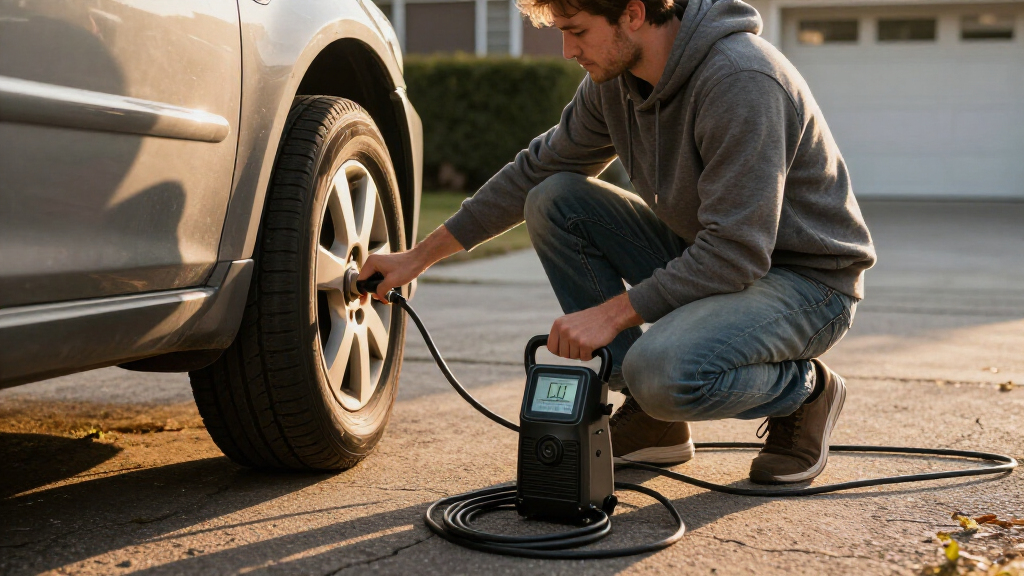
Automatic tire inflators are portable devices that add air to a tire and shut off automatically when they reach a pressure you set in advance. Many plug into a vehicle’s 12-volt outlet, while cordless models run on rechargeable batteries. They’re excellent for maintenance and roadside top-ups, but they can’t fix a puncture, and their accuracy depends on the quality of the built-in sensor — so verify with a separate gauge.
You’re standing in a gas station parking lot at 7 a.m., holding a hissing air hose, trying to read a gauge while cold air bleeds out of your tire faster than you can count PSI. Now imagine skipping all of that. You clip a device the size of a paperback onto your valve stem, punch in 33 PSI, press start, and walk away. Thirty seconds later it clicks off by itself.
That’s the promise of automatic tire inflators: portable devices that add air and stop on their own when they reach your target pressure [1]. No guesswork, no bleeding air, no frozen fingers.
In this article, you’ll learn how the shutoff actually works, which features matter (and which are fluff), how to pick the right model for your car — and the one mistake that quietly ruins tires and fuel economy.
Set your inflator to the pressure on the driver’s door placard — the sidewall number is a maximum rating, not your target.
Check and inflate tires cold; pressure naturally drops in cold weather and rises with heat, so readings shift throughout the day.
Match the power source to your life: 12-volt units for sustained car-tire duty, cordless models for portability and bikes/inflatables.
Treat automatic shutoff as a convenience, not a guarantee — verify with a separate gauge when accuracy matters.
A tire that repeatedly loses pressure needs a repair, not more air; inflators maintain pressure, they don’t fix leaks.
How Automatic Shutoff Actually Works (and When It Doesn’t)
Automatic tire inflators use a built-in pressure sensor paired with a digital display: you set a target, the pump measures pressure while running, and it switches off when the tire reaches that value [1]. That’s the whole trick — a sensor, a display, and a relay that cuts power. Simple, but genuinely useful, because it reduces the chance of overinflating a tire in one careless moment.
Here’s the catch: the shutoff is only as accurate as the sensor inside the device [1]. A $30 inflator with a mediocre sensor might stop at 35 PSI when you asked for 33. Not a disaster for a commuter car, but if you’re inflating a motorcycle tire or a high-pressure bike tire where a few PSI changes handling, that slop matters.
There’s also a physics quirk that confuses everyone the first time. Compressing air creates heat, so a tire warms slightly during inflation. When you recheck the pressure five minutes later, the reading can differ from what the display showed [1]. That’s normal — not a broken pump.
Automatic shutoff is a convenience, not a guarantee. Verify with a reliable handheld gauge when accuracy matters.
One more limitation worth knowing: a small portable inflator may be slow on — or unable to handle — a completely flat tire, especially if the tire has come unseated from the wheel bead [1]. For a truly flat, damaged tire, call roadside assistance rather than burning out your pump.
Why Your Tire Pressure Keeps Changing (and Where to Find the Right Number)
Tire pressure isn’t a set-it-and-forget-it number — it falls as the weather gets colder and rises as it warms [1]. The rule of thumb among technicians: for roughly every 10°F drop in temperature, you lose about 1 PSI. That’s why the TPMS light on your dash tends to appear on the first cold snap of autumn, like clockwork.
Underinflated tires hurt you three ways at once: worse handling, longer braking distances, and faster, uneven tread wear [1]. Overinflation has its own price — reduced grip and a harsh ride, since the contact patch shrinks.
Now the mistake. When people set their inflator, many glance at the tire sidewall and use that number. Wrong. The figure molded into the sidewall is a maximum pressure rating — the routine target lives on the placard in the driver’s door jamb or in your owner’s manual [1]. On most sedans it’s somewhere between 30 and 36 PSI; the sidewall might say 44 or 51.
Also check your tires cold — meaning the car has sat for a few hours or driven only a short distance [1]. If you check after a highway drive, the reading will run high and you’ll underinflate.
12-Volt vs. Cordless: Which Inflator Fits Your Life
Automatic tire inflators come in two main power flavors: units that plug into your vehicle’s 12-volt outlet and cordless models running on rechargeable batteries [1]. Each has a clear personality.
A 12-volt unit is like a wired workhorse. As long as the engine is running, it has sustained power and can pump tire after tire without dying [1]. The tradeoff: you’re tethered to your car, and you should follow both the vehicle and inflator instructions about using the outlet so you don’t blow a fuse.
A cordless unit is the one you’ll actually carry. It lives in a backpack, tops off a bike tire in the garage, and works on soccer balls and pool floats with the right adapters [1]. The tradeoff: battery capacity is finite, and when the pack runs low mid-inflation, you’re done until it recharges.
| Feature | 12-Volt Plug-In | Cordless Battery |
|---|---|---|
| Power source | Car’s 12V outlet | Rechargeable battery |
| Runtime | Unlimited while driving | Limited by battery charge |
| Portability | Tethered to vehicle | Goes anywhere |
| Best for | Car tires, roadside emergencies | Bikes, motorcycles, top-ups, inflatables |
Some models do both — 12-volt plug plus an internal battery. If your budget allows, those hybrids are hard to beat.
7 Features Worth Paying For (and 2 You Can Skip)
The spec sheet on an inflator box can read like alphabet soup, so here’s the short list of what actually changes your day-to-day experience [1]:
- Pressure range and accuracy — confirm it covers your vehicle’s recommended pressures, with headroom to spare.
- Airflow and duty cycle — these determine inflation speed and how long it can run before needing a cooling break.
- Gauge readability — a clear digital display with your preferred units (PSI, kPa, or bar).
- Hose and cable length — if the hose can’t reach all four tires, everything else is irrelevant.
- Valve compatibility — the right connector for your tires, plus adapters for bikes and inflatables.
- A built-in light — genuinely useful for the flat-tire-at-night scenario you didn’t plan.
- Replacement battery availability — a cordless unit with a dead, irreplaceable battery is e-waste.
You can safely ignore the mode-count arms race. Twelve preset modes on a device with a two-inch hose is marketing, not engineering. And treat manufacturer inflation-time claims skeptically: they’re not directly comparable unless tested under the same conditions, since time depends on tire size, starting pressure, temperature, battery charge, and airflow [1].
Real-world example: a compact cordless unit that inflates a 17-inch sedan tire from 28 to 33 PSI in under two minutes might need ten minutes — and a cooling break — on a light-truck tire. Same device, very different jobs.
How to Use an Automatic Inflator in 5 Steps
Using an automatic tire inflator is a five-minute job once you know the sequence. Here’s the process, whether you’re topping off in the driveway or stopped on a shoulder [1]:
- Check your tires cold — parked for several hours or driven only a short distance.
- Find your target pressure on the driver’s door placard or in the owner’s manual — never the sidewall.
- Connect the hose securely to the valve stem, listening for hissing that signals a poor seal.
- Set the target on the display and start the pump. Stay nearby — don’t wander off, even with auto shutoff.
- Recheck with a separate gauge when the pump stops, and recheck again when the tire is cold.
Why stay nearby? Because hoses can leak and some models need cooling breaks — automatic shutoff doesn’t make every device suitable for unattended use [1]. Watch it work; it’s only a minute or two.
And if one tire keeps dropping week after week while the others hold steady, stop inflating and start investigating. A recurring pressure loss usually means a puncture, a damaged valve, or a leak where the tire meets the wheel [1]. No inflator fixes that — a tire shop does.
Inflator vs. TPMS: They Sound Similar, Do Different Jobs
People often confuse these two because both deal with tire pressure, but they’re opposites. An inflator adds air and may measure pressure during use; a tire-pressure monitoring system (TPMS) only watches pressure while you drive and warns when it drops below a threshold — it can’t inflate anything [1].
Think of TPMS as the smoke detector and the inflator as the fire extinguisher. The detector tells you there’s a problem; the extinguisher lets you do something about it. You want both, and since 2008, TPMS has been standard equipment on new U.S. vehicles.
Here’s the practical wrinkle: if your TPMS light comes on repeatedly, that’s your car telling you something is leaking slowly. Top off with your inflator to get home safely, then get the tire inspected. A warning light you keep silencing with air is a repair you keep postponing.
Frequently Asked Questions
How often should I check my tire pressure?
Check at least monthly and before any long trip, and always when the tires are cold [1]. Cold means the vehicle has been parked for several hours or driven only a short distance. Consult your owner’s manual for the schedule specific to your vehicle.
Can an automatic inflator handle a completely flat tire?
Sometimes, but not always. A small portable inflator may be slow or unable to seat a tire bead [1]. If the tire is damaged, separated from the wheel, or unsafe to drive on, call roadside assistance or a professional instead of risking it.
Will the inflator stop at the exact pressure I set?
It should stop near your selected value, but consumer gauges vary in accuracy [1]. Check the result with a reliable handheld gauge, especially if the reading seems off or precision matters — such as on a motorcycle or bicycle tire.
Can one inflator work for both car tires and bicycles?
Possibly, if its pressure range and valve fittings cover both [1]. High-pressure bicycle tires and high-volume car tires make very different demands on a pump, so check the specifications and use the correct adapter for each valve type.
Can I leave an automatic inflator running unattended?
Follow the manual. Automatic shutoff is helpful, but it doesn’t make every device safe for unattended use — hoses can leak, equipment can overheat, and some models require cooling breaks between sessions [1]. Stay nearby while it runs.
Conclusion
The single habit worth building: once a month, when your tires are cold, check all four against the door-placard number and top off with your inflator before the TPMS light ever gets a vote. Five minutes, better fuel economy, shorter stopping distances, and tires that last thousands of miles longer.
Because the best flat tire is the one that never happens — and the second best is the one you handled in your own driveway, in slippers, while your coffee was still hot.
Fall Picks
fall essentials
As an affiliate, we earn on qualifying purchases.