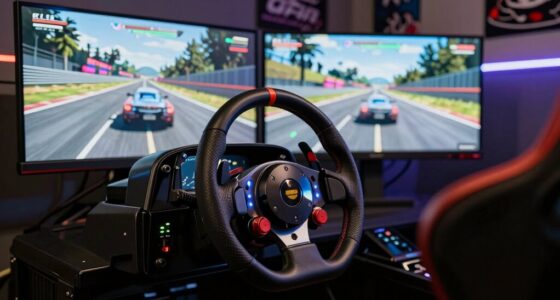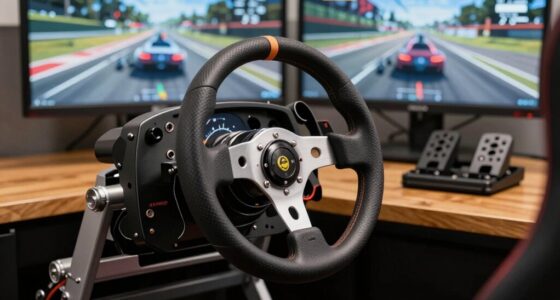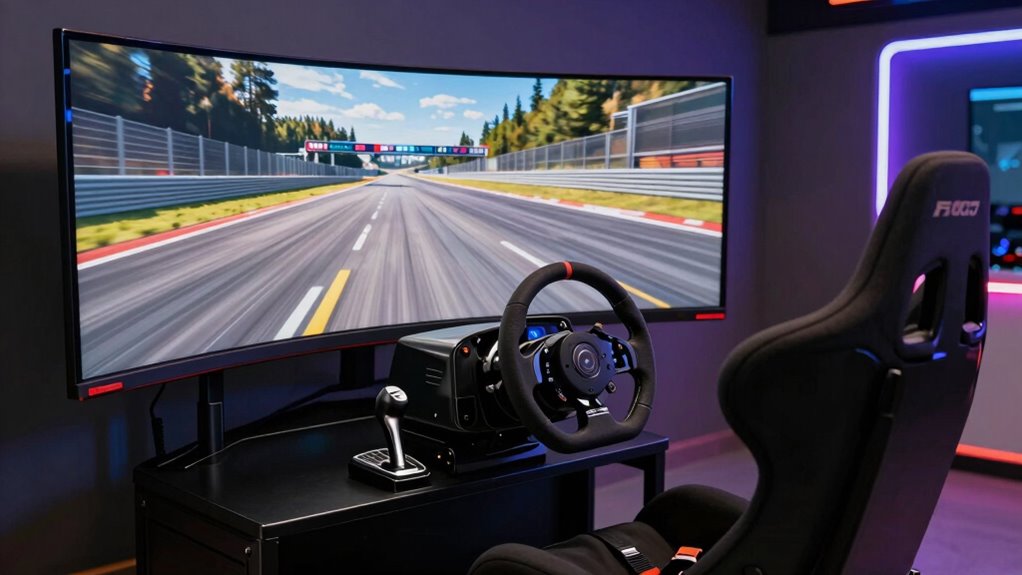
Sim racing training boosts your track day prep by helping you fine-tune your car setup, improving handling and stability. It also sharpens your tire management skills, teaching you to react effectively to changing conditions. Virtual practice enhances your understanding of vehicle dynamics and builds your confidence in diverse scenarios like rain or surface changes. Plus, it helps you develop focus and data-driven decision-making. Keep exploring to discover more ways sim racing can elevate your track day performance.
Key Takeaways
- Practice car setup adjustments to optimize handling and stability for specific track conditions.
- Develop tire management techniques to maximize grip and longevity during track day sessions.
- Simulate various weather and surface scenarios to improve adaptability and decision-making.
- Enhance vehicle dynamics understanding to better control and respond to different track layouts.
- Build focus and data analysis skills for consistent performance and quick adjustments during track days.
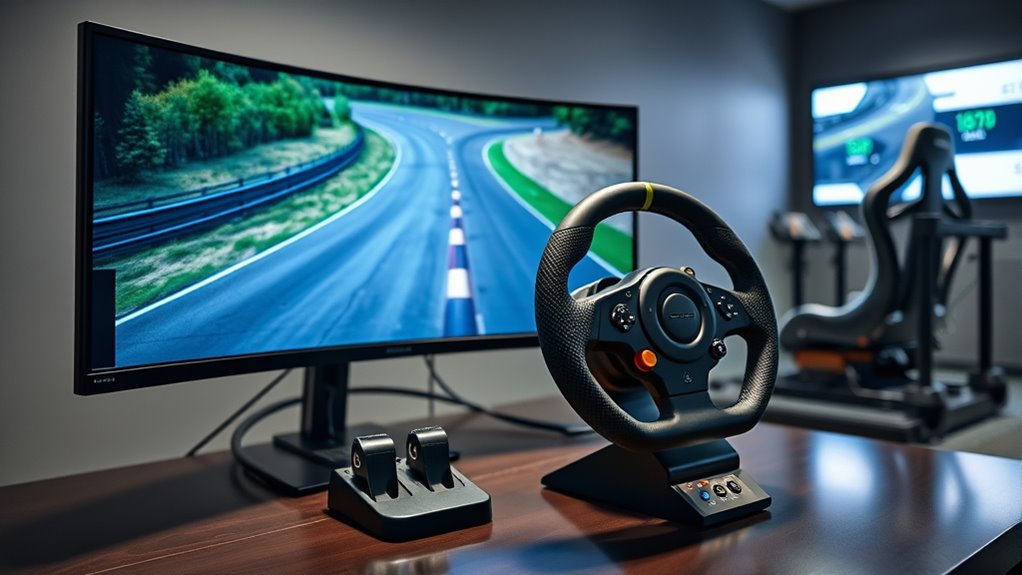
If you’re looking to maximize your performance at track days, sim racing training offers a practical and affordable way to hone your driving skills. One of the biggest advantages is that it allows you to experiment with car setup without the costs or risks associated with real-world adjustments. In a sim, you can tweak suspension stiffness, brake bias, tire pressures, and aerodynamic settings, then instantly see how these changes affect handling. This immediate feedback helps you understand how different setups influence grip, stability, and overall control, so you can fine-tune your car before hitting the track. By practicing various setups in a virtual environment, you develop a deeper understanding of how each adjustment impacts your driving, giving you a competitive edge when you’re behind the wheel in real life.
Sim racing enables safe, cost-effective car setup experimentation to improve handling and performance on track days.
Tire management is another critical aspect that sim racing can help you master. In a simulation, you can simulate hours of track time, experiencing how tire wear and temperature influence tire grip and responsiveness. Understanding how to manage tire pressures and temperatures during a run is essential for maintaining ideal performance, especially in longer sessions. You learn to recognize signs of tire degradation and adapt your driving style accordingly—whether that’s easing off the throttle to preserve tire life or adjusting your line to reduce grip loss. This knowledge translates directly to real-world track days, where maintaining tire health can mean the difference between a good lap and a costly mistake. Sim racing allows you to practice these skills repeatedly, without risking expensive tires or safety. Additionally, focusing on vehicle dynamics in a virtual setting helps you grasp how subtle changes can lead to significant performance gains, making you a more thoughtful and adaptable driver. Incorporating data analysis into your training further enhances your ability to interpret and utilize information for better decision-making on the track.
In addition, sim racing improves your ability to anticipate and react to changing track conditions. You can simulate rain, varying grip levels, and different track surfaces, enabling you to develop strategies for maintaining ideal tire management in diverse scenarios. This preparedness helps you stay confident and consistent, regardless of weather or track conditions. Moreover, focusing on car setup and tire management in a virtual setting sharpens your overall understanding of vehicle dynamics. You begin to see how subtle changes can lead to significant performance gains, making you a more thoughtful and adaptable driver. Furthermore, practice consistency in a simulator helps build the mental discipline necessary for high-level racing. As technology advances, virtual environments increasingly replicate real-world physics, enhancing the effectiveness of training. Additionally, understanding the importance of reliable data from simulations can help you make better-informed decisions on the track, translating virtual practice directly into real-world performance.

Logitech G920 Driving Force Racing Wheel and Floor Pedals, Real Force Feedback, Stainless Steel Paddle Shifters, Leather Steering Wheel Cover for Xbox Series X|S, Xbox One, PC, Mac – Black
Immersive Gaming Experience: Perfect for Xbox and PC gaming titles, the Driving Force simulates the feeling of driving…
As an affiliate, we earn on qualifying purchases.
As an affiliate, we earn on qualifying purchases.
Frequently Asked Questions
Can Sim Racing Replace Real Track Day Experience?
Sim racing can’t fully replace real track day experience, but virtual reality and driving simulators do a great job of preparing you. They help you understand car dynamics, racing lines, and braking points, boosting your confidence. However, real track days give you tactile feedback, vehicle feel, and unpredictable conditions that simulators can’t fully replicate. Use sim racing as a valuable supplement, but don’t skip actual track experience.
What Is the Best Sim Racing Setup for Beginners?
The best sim racing setup for beginners includes a quality wheel with adjustable gear ratio and responsive pedals. Look for a wheel that offers smooth steering and realistic force feedback. Make sure you calibrate the pedals properly to match your driving style, which enhances control. Starting with a mid-range setup allows you to learn the basics and improve before investing in more advanced gear. This foundation helps you enjoy and develop your sim racing skills effectively.
How Do I Transfer Skills From Sim Racing to Real Driving?
Think of your sim racing as planting seeds in a garden. To transfer skills to real driving, focus on mental transfer—visualize real roads and driving scenarios while you race. Practice maintaining skill consistency, just like nurturing plants daily. This mental discipline helps your reflexes and decision-making improve on actual roads. Over time, your simulated practice becomes instinctive, making real driving feel natural and confident, as if your virtual skills have blossomed into reality.
Are There Specific Sim Racing Games Recommended for Track Training?
You should consider sim racing games like Assetto Corsa, iRacing, or rFactor 2 for track training. They offer great virtual calibration options and support a wide range of wheel compatibility, ensuring you get realistic feedback. These games simulate real-world physics, helping you refine your racing techniques. Focus on adjusting settings for precise control, and you’ll improve your skills effectively for actual track days.
How Often Should I Practice Sim Racing for Optimal Improvement?
You should practice sim racing at least three to four times a week, creating a consistent practice schedule. Picture yourself behind the wheel, feeling the grip of the virtual tires and the rush of corners—this helps develop skill consistency. Regular sessions sharpen your reflexes and improve your technique, so sticking to a routine guarantees steady progress and keeps you sharp for real track days.

Monitor Alignment Tool for Sim Racing, Compatible with Triple Screen Setup, Pack of 2 Adhesive Hinges with No-Clamp Design
Eliminates Screen Gaps – Creates a flat joining surface across triple monitors for a seamless panoramic view
As an affiliate, we earn on qualifying purchases.
As an affiliate, we earn on qualifying purchases.
Conclusion
So, after all that sim racing practice, you’re finally ready to hit the track. Or are you? Remember, no matter how realistic your setup feels, nothing beats the thrill of real asphalt beneath your tires. All those virtual laps might make you confident, but don’t be surprised if the first actual turn surprises you. Irony at its finest: you’ve trained for the race, yet the track might still have a few tricks up its sleeve.
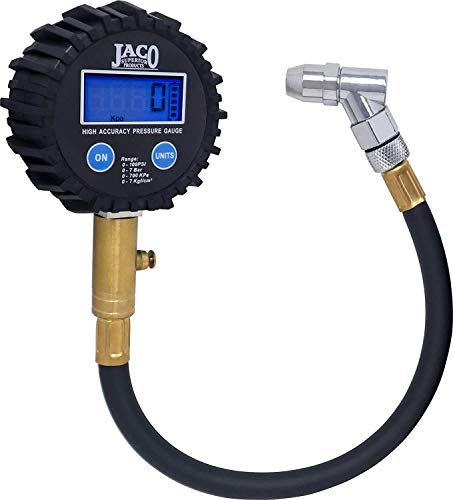
JACO ElitePro Digital Tire Pressure Gauge – Professional Accuracy – 100 PSI
PRO ACCURACY – mechanic recommended, performance tested, & calibrated accurate to professional ANSI 2A standards – with dual…
As an affiliate, we earn on qualifying purchases.
As an affiliate, we earn on qualifying purchases.

GTPLAYER Sim Racing Wheel Stand Simulator Cockpit Wheel Stand Racing Steering Shifter Mount fit for Logitech G25 G27 G29 G920 G923 Thrustmaster T330TS Gaming Stand Wheel Pedals NOT Included, Black
High Compatibility: As a universally designed wheel stand, this bracket fits all racing wheels, pedals, and shifters. It…
As an affiliate, we earn on qualifying purchases.
As an affiliate, we earn on qualifying purchases.