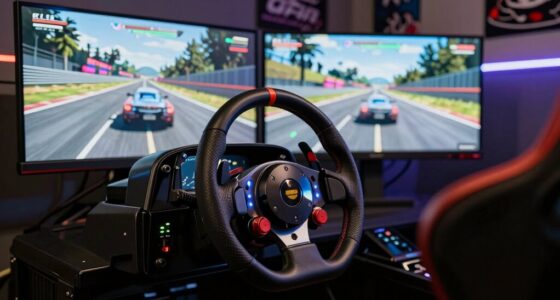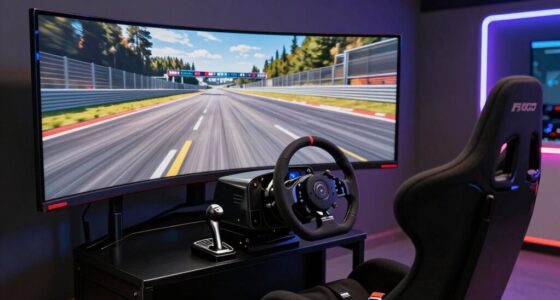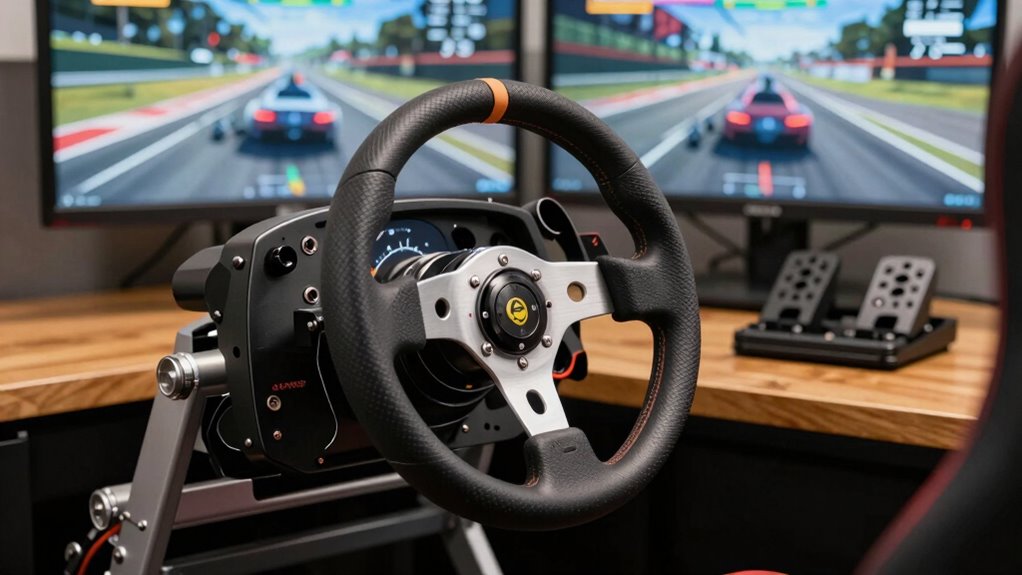

To get started with sim racing hardware, focus on your force feedback wheel, pedals, and accessories like shifters or handbrakes. Ensuring your wheel provides realistic feedback and your pedals are calibrated correctly are key for accurate control and immersion. Adjusting and fine-tuning your setup will improve your skills and confidence on the virtual track. Keep exploring how hardware options can elevate your experience and performance as you go along.
Key Takeaways
- Force feedback creates a realistic, responsive driving experience by simulating the car’s reactions and improving control accuracy.
- Pedal calibration ensures precise, consistent input response, enhancing control and overall driving realism.
- Proper setup and fine-tuning of hardware optimize comfort, responsiveness, and racing performance.
- Additional hardware like shifters and handbrakes can be integrated to increase immersion and control options.
- Regular calibration and adjustments are essential for maintaining accuracy, feel, and consistent performance across sessions.
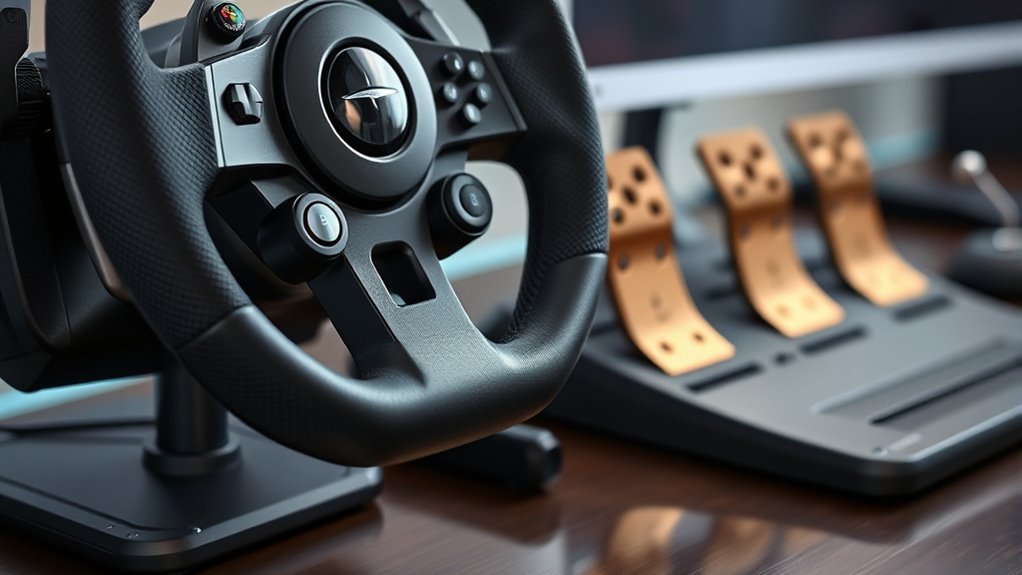
Getting familiar with force feedback and pedal calibration forms the foundation of effective sim racing hardware use. These features work together to create a realistic and responsive driving environment. Once you’ve set up your force feedback to match your comfort level and calibrated your pedals properly, you’ll notice a marked improvement in how your virtual car responds to your inputs. This setup process is crucial for accurate control**, which directly impacts your racing performance. It not only boosts your confidence but also enhances your ability to learn tracks and improve your skills. Remember, the initial setup might take some time, but it’s worth the effort. As you become more comfortable with these basics, you can explore additional hardware options like shifters or handbrakes to further elevate your sim racing experience. Proper calibration** is essential for accurate and consistent control, further enhancing your overall sim racing performance. Understanding how force feedback influences wheel responsiveness can help you fine-tune your setup for optimal feel and precision.
Frequently Asked Questions
What Is the Ideal Budget for Beginner Sim Racing Hardware?
For a beginner, the ideal budget for sim racing hardware is around $300 to $500. This range balances budget considerations and hardware longevity, giving you decent quality gear without overspending. Investing within this range allows you to experience good performance while ensuring your equipment lasts through regular use. As you progress, you can upgrade parts gradually, making the most of your initial investment and enhancing your sim racing experience.
How Do I Choose the Best Steering Wheel for My Setup?
To choose the best steering wheel, focus on your racing style and setup. Look for a wheel with strong force feedback to feel every turn and bump, enhancing realism. Consider wheel paddle shifters for quick gear changes, especially if you prefer manual transmission. Make certain of compatibility with your gaming system and check reviews for durability. A well-chosen wheel boosts immersion and performance, making every race more exciting.
Can I Upgrade My Existing Hardware Later?
Yes, you can upgrade your existing hardware later. Just make sure to check hardware compatibility before purchasing new components to guarantee they work seamlessly with your current setup. Many sim racing hardware brands offer upgrade pathways, allowing you to enhance features like force feedback, pedals, or wheel rotation over time. Planning your upgrades carefully helps you improve your experience without needing a complete overhaul, saving you time and money.
What Are the Common Compatibility Issues With Sim Racing Gear?
You might face unexpected challenges when setting up your sim racing gear. Common compatibility issues include hardware conflicts, where devices refuse to work together, or software incompatibilities that cause crashes or glitches. These problems can be tricky, especially as new updates roll out. To avoid surprises, double-check that your wheel, pedals, and peripherals are compatible with your system and software before making a purchase or upgrade.
How Do I Optimize My Hardware for the Best Performance?
To optimize your hardware for the best performance, start with proper hardware calibration to guarantee accurate input readings and smooth operation. Next, fine-tune your force feedback settings to enhance realism and control without causing fatigue. Keep your drivers updated and check for firmware updates regularly. Organize your setup for comfort and stability, and test different settings. This combination boosts your driving experience, making it more immersive and responsive.
Conclusion
Now that you’ve explored the essentials of sim racing hardware, it’s clear how each component plays a crucial role in your experience. Imagine dusting off your setup after a long day, the steering wheel in hand, ready to race. As you immerse yourself in your next challenge, it’s no coincidence that your gear feels just right—like it was made for you. With the right hardware, every race becomes a seamless extension of your passion.