To avoid draining your car battery in parking mode, voltage cutoff circuits protect against deep discharges by disconnecting power when the voltage drops too low. They act as a safeguard, but their effectiveness depends on proper setup, account for battery age and temperature, and may require external power sources for longer run times. Understanding how these systems work helps you keep your battery safe. Keep exploring so you can set it up correctly and get reliable parking mode operation.
Key Takeaways
- Voltage cutoff circuits prevent deep battery discharge during parking by disconnecting power at preset voltage levels.
- Properly set thresholds protect batteries from damage but may limit parking time if too high.
- Aging and cold temperatures lower battery voltage, requiring threshold adjustments to avoid false shutdowns.
- External power sources can supplement or replace vehicle battery power, reducing the risk of dead batteries in parking mode.
- Correct wiring and grounding are essential for accurate voltage detection and reliable operation of parking mode systems.
Understanding Battery Voltage and State of Charge
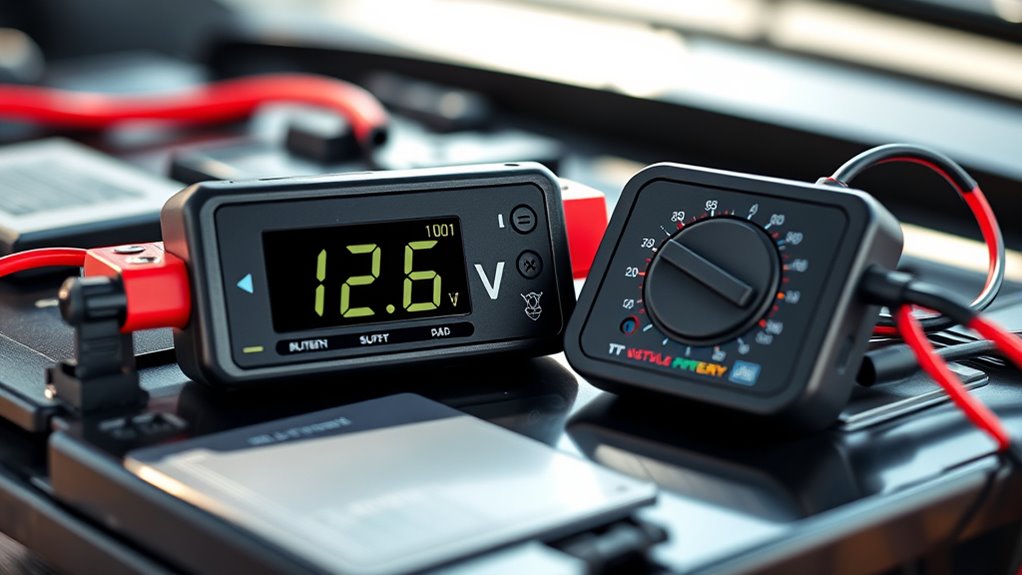
Have you ever wondered what your vehicle’s battery voltage really indicates about its charge level? When your battery is fully charged, it typically rests around 12.6 to 12.8 volts when off. A reading near 12.4 volts suggests about 80% charge, which is generally safe to prevent deep discharge. Once voltage drops below roughly 12.0 volts, the risk of damaging the battery increases, especially if it dips below 11.8 volts. During engine operation, the alternator boosts voltage to around 13.5–14.5 volts, recharging the battery. Keep in mind, cold temperatures reduce available capacity, making voltage readings less reliable indicators of charge. Also, measurement tolerances mean your voltage meter might show slight variations, so always consider these factors when evaluating your battery’s health or setting cutoff thresholds. Understanding voltage cutoffs helps prevent unnecessary battery drain or damage, especially in parking modes. Additionally, battery age and condition can significantly influence voltage readings, so regular testing is recommended to maintain optimal performance. Properly configured voltage thresholds can also help protect the battery during long-term parking modes by avoiding unnecessary drain.
How Low-Voltage Cutoff Circuits Function

Low-voltage cutoff circuits protect your vehicle’s battery by monitoring its voltage and disconnecting connected devices before the battery becomes too depleted. When voltage drops to a preset threshold, the circuit automatically cuts power to parking-mode accessories, preventing deep discharge. Some units include a short delay to allow current completion before shutting down. They primarily act on the constant (BAT) line, while the accessory (ACC) remains active during parking. Different designs vary: simple relays or smarter controllers that emulate ACC signals. These cutoffs don’t recharge the battery; they only limit further drain. Additionally, understanding the voltage thresholds helps optimize the balance between battery safety and device functionality. Furthermore, some advanced cutoff units incorporate adjustable settings to better tailor protection to specific battery conditions and usage patterns. Properly set voltage cutoffs can extend your battery’s lifespan by preventing unnecessary deep discharges, especially when combined with smart monitoring to track overall battery health.
Common Configurations and Settings for Voltage Cutoffs

Selecting the right voltage cutoff setting depends on your vehicle’s battery condition and your parking habits. For healthy batteries, a setting around 12.2–12.4V offers a good balance, protecting the battery while maximizing parking time. If your battery is older or weaker, consider a higher cutoff, like 12.4V, to prevent deep discharge. Conversely, a lower setting around 11.8–12.0V extends runtime but risks damaging the battery if it’s not in top shape. Many hardwire kits allow adjustable thresholds, so choose based on your typical parking duration and battery health. For short-term parking, a lower cutoff is acceptable; for long-term, safer settings help avoid starting issues. Always account for voltage meter tolerances and temperature effects to ensure reliable operation. Proper configuration safeguards your battery without sacrificing monitoring capabilities. Understanding pinball machine weights can also be useful if installing hardware components or upgrades in your vehicle that require proper support. Additionally, considering piercings and jewelry materials can be relevant when planning modifications or installations that involve close contact with body accessories.
The Impact of Temperature and Aging on Voltage Thresholds
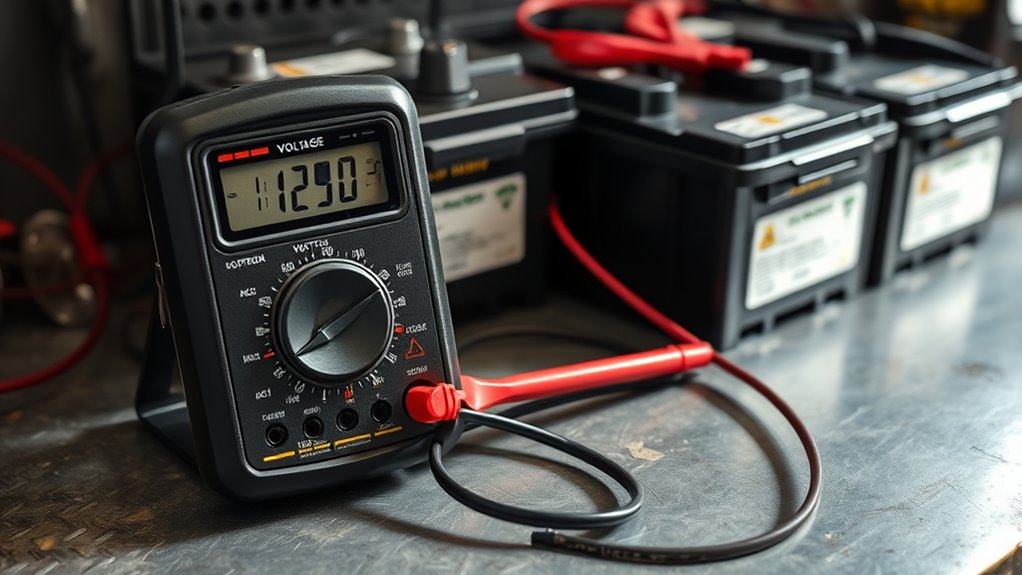
Cold temperatures lower your battery’s available capacity and resting voltage, making standard voltage thresholds less reliable in winter. As your battery ages, it holds less charge and may show a lower voltage even when still healthy, risking premature cutoff or deep discharge. To keep your parking mode safe year-round, you need to account for these temperature and aging effects on voltage thresholds. Understanding herbalism principles can help you better grasp how external factors influence the reliability of voltage-based monitoring systems. Additionally, recognizing battery chemistry nuances can provide deeper insights into how different batteries respond to environmental changes. Being aware of voltage thresholds adjustments for temperature and age can significantly improve your battery management strategies, especially considering how water usage impacts overall system performance. Moreover, considering temperature-dependent voltage behavior can improve the accuracy of your voltage cutoff settings across different climates.
Cold Temperature Effects
Temperature has a significant impact on your vehicle battery’s voltage readings, especially in cold conditions. Cold weather reduces the battery’s capacity and CCA, making voltage thresholds less reliable. As temperatures drop, the battery’s voltage can appear lower even if it’s still healthy, risking premature shutdowns or missed cutoffs. You need to account for this sag to avoid unexpected power loss. Additionally, high refresh rates in projectors can help you monitor real-time voltage changes more effectively. Recognizing how battery chemistry reacts to temperature variations can further improve your cutoff strategies and prevent false triggers. Monitoring battery health regularly can help you better understand how temperature fluctuations influence voltage readings and improve your cutoff strategies. Cold causes voltage to dip below cutoff points prematurely. Battery capacity diminishes, lowering available runtime. Aging batteries suffer more from cold voltage drops. Inaccurate readings can lead to improper cutoff settings. To compensate, consider adjusting voltage thresholds higher in winter or using external power solutions. Regularly testing your battery’s health helps ensure your parking mode functions reliably despite temperature fluctuations. Moreover, understanding temperature effects on battery performance can guide you in implementing appropriate safeguards and maintenance routines. Additionally, employing thermal insulation around the battery can help mitigate extreme cold impacts and maintain more stable voltage readings.
Battery Aging Impacts
As batteries age, their ability to hold and deliver charge diminishes, which directly affects voltage readings used for parking-mode cutoff settings. An older battery’s resting voltage may be lower even when it’s healthy, risking false triggers or early shutdowns. This decline means that a cutoff voltage safe for a new battery might cause deep discharge in an aging one. Temperature exacerbates this issue, lowering capacity further in cold weather. To adapt, you should monitor battery health regularly and adjust cutoff thresholds accordingly. Use the table below to compare how aging impacts voltage thresholds across different battery states:
| Age/Condition | Typical Voltage Reading | Recommended Cutoff |
|---|---|---|
| New Battery | 12.6–12.8V | 12.4V |
| Aged Battery | 12.2–12.4V | 12.0V |
| Severely Worn | Below 12.0V | Above 11.8V |
Additionally, understanding battery aging impacts can help prevent unintended shutdowns and extend your battery’s lifespan, especially considering voltage thresholds that vary with battery condition.
Limitations and Tolerance of Voltage Detection Devices

Voltage detection devices rely on measuring the battery’s voltage to determine when to disconnect or activate parking-mode functions, but their readings are inherently limited by various tolerances and inaccuracies. These tolerances can cause premature or delayed shutdowns, risking battery damage or insufficient protection. Factors affecting accuracy include:
Voltage measurements can be inaccurate, risking premature shutdowns or damage.
- Manufacturing tolerances: sensors can vary by ±0.3V or more, impacting reliability.
- Load and temperature: under load or cold weather, voltage sag may trigger false cutoffs.
- Battery age: older batteries hold less voltage, risking deep discharge at higher cutoff thresholds.
- Wiring issues: incorrect connections or parasitic loads can skew readings, making device response unpredictable.
Understanding these limitations helps you set realistic thresholds and avoid unintended shutdowns or battery damage in parking mode.
Risks of Setting Cutoffs Too Low or Too High

Setting your voltage cutoff too low may extend parking-mode runtime but risks deep-discharge damage that can leave your vehicle unable to start. When you set the cutoff below about 12.0V, you increase the chance of over-discharging the battery, especially if it’s older or cold. This can reduce battery life or cause complete failure, forcing costly replacements. Conversely, setting the cutoff too high—around 12.4V or higher—protects your battery but shortens your parking-recording time. It may also prevent the device from running long enough to capture important footage. Finding the right balance is essential: too low, and you risk damage; too high, and you limit functionality. Always consider your battery’s condition, climate, and your parking duration when choosing the cutoff threshold.
Practical Strategies for Extending Parking-Mode Runtime

To extend your parking-mode runtime without risking a dead battery, start by optimizing your device’s power consumption—use motion detection and lower-sensitivity settings to reduce unnecessary draw. Consider adding external power sources, like auxiliary batteries, to take the load off your vehicle’s main battery during long stays. Regularly monitoring your battery’s health helps you adjust cutoff thresholds and guarantees your system runs safely over time.
Optimize Power Consumption
Maximizing parking-mode runtime requires reducing the power draw of your dashcam and related accessories. You can achieve this by adjusting settings and eliminating unnecessary consumption.
- Enable motion detection or event-only recording to avoid continuous recording when parked.
- Lower the camera’s resolution or frame rate to minimize energy use during recording.
- Disable features like Wi-Fi, GPS, or night vision if they’re not essential for parking surveillance.
- Use low-power modes or standby features if available, which keep the dashcam ready but draw less current.
These strategies ensure your system uses less power, extending the time before your battery approaches critical levels. Combining power-saving settings with proper voltage cutoffs maximizes parking-mode duration while protecting your battery’s health.
Use External Power Sources
Using external power sources can substantially extend your parking-mode runtime by relieving your vehicle’s battery from continuous discharge. External batteries or power packs supply energy directly to your dashcam or accessories, preventing your vehicle’s main battery from deep discharging. These packs often come with built-in features like ACC-emulation, ensuring proper parking-mode operation without risking battery damage. They can be connected via dedicated wiring or plug-in adapters, which isolate the vehicle’s battery from parasitic loads. This setup is especially useful for long-term parking or in cold climates where battery capacity drops. By using external power sources, you reduce the risk of dead batteries, avoid unnecessary voltage cutoffs, and ensure your parking surveillance runs reliably without compromising your vehicle’s starting power.
Monitor Battery Health
Monitoring your battery health is essential for ensuring reliable parking-mode operation and preventing unexpected starting issues. Regular checks help you identify when your battery is nearing end-of-life or losing capacity, so you can adjust your setup accordingly. To keep your battery in good shape, consider these strategies:
- Test voltage regularly to catch early signs of capacity loss or sag under load.
- Track battery age and replace it every 3-5 years to avoid unexpected failures.
- Perform load testing to evaluate true capacity beyond resting voltage readings.
- Inspect wiring and connections to prevent parasitic drains that accelerate battery wear.
These steps help you fine-tune cutoff settings and extend your parking-mode runtime while safeguarding your vehicle’s starting power.
External Power Solutions Versus Voltage Cutoffs

External power solutions provide a reliable way to keep your parking-mode dashcam operational without risking your vehicle’s battery health. They use dedicated batteries or power packs, isolating your vehicle’s main battery from continuous draw. This prevents deep discharges that can damage your battery or cause starting issues. Unlike voltage cutoffs, external power packs don’t rely on sensing battery voltage; instead, they supply consistent power regardless of your vehicle’s state of charge. Some packs even emulate your car’s ignition, ensuring proper parking mode functionality. They’re especially useful for long-term parking or in cold climates where voltage sag may falsely trigger cutoffs. While voltage cutoffs protect your battery by stopping draw at a set voltage, external power solutions offer peace of mind, maintaining your dashcam’s operation without risking your vehicle’s starting power.
Ensuring Proper Wiring and Installation for Reliable Cutoffs

Proper wiring is essential for reliable voltage cutoff performance, so make certain your connections are correct and secure. Always connect the cutoff circuit to a constant power source and avoid sharing circuits that switch off with the ignition. Additionally, guarantee your ground connections are solid to prevent voltage fluctuations that could cause false cutoffs or failures.
Correct Wiring Practices
To guarantee your voltage cutoff system works reliably, you need to pay close attention to correct wiring practices. Proper wiring ensures the cutoff activates accurately and prevents unintended battery drain or failure. Start by verifying the constant (BAT) line connects directly to a fused, always-on power source. Ensure the accessory (ACC) wire is correctly tied to the parking mode circuit. Use high-quality, appropriately rated fuse holders to protect your wiring. Lastly, confirm a solid ground connection to prevent voltage drops that could impair cutoff function.
- Use fused, fused, fused on the constant power line
- Confirm ACC is wired to the parking mode circuit
- Ensure a clean, solid ground connection
- Avoid shared wiring with high-current accessories
Proper Ground Connections
A solid ground connection is essential for your voltage cutoff system to work reliably because it provides a stable reference point for accurate voltage measurement. If your ground is loose, corroded, or poorly connected, your system may misread voltage levels, causing premature or delayed cutoffs. To guarantee proper grounding, use a clean, bare metal surface free of paint or corrosion. Tighten the connection securely with appropriate hardware, and consider adding a ring terminal for a reliable contact point. Avoid grounding to engine blocks or panels that may have high resistance. Instead, connect directly to the vehicle’s chassis or a dedicated grounding point designed for electrical systems. Proper grounding improves measurement accuracy, reduces false triggers, and ensures your parking-mode protection is consistently reliable.
Monitoring Battery Health to Optimize Parking Mode Performance

Monitoring your vehicle’s battery health is essential for ensuring reliable parking mode operation without risking a dead battery. You need to regularly check voltage, capacity, and aging to optimize cutoff settings and avoid deep discharge. By staying proactive, you can prevent unexpected shutdowns or starting issues. Keep an eye on:
Regularly monitor your vehicle’s battery health to ensure reliable parking mode and prevent dead batteries.
- Battery voltage trends over time to detect capacity decline
- Age and years of service, replacing batteries every 3–5 years
- Load testing results to identify weakened cells
- Cold-weather performance, which reduces capacity and affects voltage thresholds
Performing these checks helps you set appropriate voltage cutoffs, balancing parking time and battery safety. Using external power solutions or adjusting power draw further extends runtime and preserves battery health. Proper monitoring guarantees your parking mode remains reliable without damaging your battery.
Frequently Asked Questions
How Accurate Are Voltage Cutoff Thresholds in Real-World Conditions?
Voltage cutoff thresholds are generally accurate within about 0.3 volts, but real-world conditions can cause variations. Cold temperatures, load fluctuations, and aging batteries can make thresholds less reliable, sometimes triggering premature shutdowns or late cutoffs. Proper installation, testing, and accounting for these factors help guarantee thresholds work effectively. Regularly monitoring your battery’s health and adjusting cutoff settings accordingly can also improve accuracy and protect your battery.
Can Voltage Cutoffs Prevent Vehicle Battery Failure During Cold Weather?
You can use voltage cutoffs to help protect your battery in cold weather, but they aren’t foolproof. Cold temperatures lower your battery’s voltage and capacity, causing cutoffs to trigger earlier than expected. While setting a higher cutoff helps prevent deep discharge, it doesn’t completely stop cold-weather stress. Pairing voltage cutoffs with regular battery checks and external power sources offers better peace of mind during winter’s chill.
What Happens if the Cutoff Wiring Is Incorrectly Installed?
If you install the cutoff wiring incorrectly, it can cause your device to either stay on constantly or shut off prematurely. This miswiring might drain your battery faster or prevent it from disconnecting when voltage drops too low, risking deep discharge. Make certain you connect the BAT wire to a constant power source, the ACC wire to the ignition circuit, and the ground securely to avoid these issues and protect your battery’s health.
How Does Battery Age Affect the Chosen Voltage Cutoff Setting?
As your battery ages, it becomes more like a worn-out athlete, losing strength and endurance. You should set a higher voltage cutoff to protect it from deep discharge, as older batteries can’t recover as easily. Aiming for around 12.4V helps preserve its health and ensures reliable starts. Lower settings might stretch parking time, but risk more damage, so adjust your cutoff judiciously based on your battery’s age and condition.
Are External Power Packs Safer Than Low-Voltage Cutoffs for Parking Mode?
External power packs are generally safer than relying solely on low-voltage cutoffs for parking mode because they isolate your vehicle’s battery, preventing deep discharge and potential damage. They provide consistent power without risking low-voltage shutdowns that can leave you unable to start your vehicle. Plus, they help preserve your main battery’s lifespan, especially in cold weather or with older batteries, making them a more reliable and safer solution overall.
Conclusion
So, next time you rely on voltage cutoffs to keep your battery alive in parking mode, remember—they’re not foolproof. Sure, they save your battery from dying completely, but don’t be surprised if a stubborn cold snap or aging cell sneaks up on you. Ironically, the very device meant to protect your battery can sometimes leave you stranded. Keep an eye on your battery’s health, or you might find yourself wishing you’d invested in that extra power source earlier.