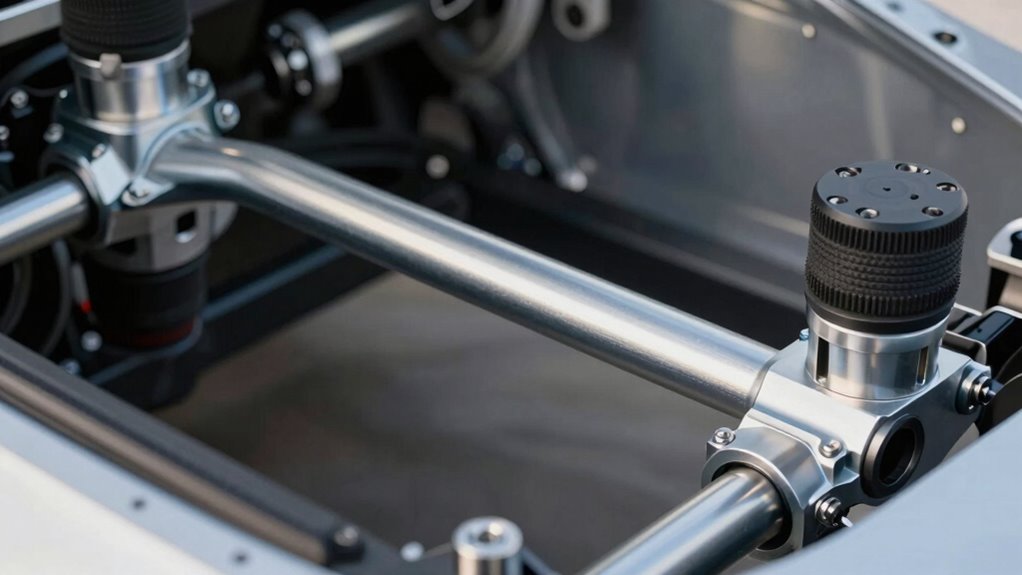

Anti-roll bars help keep your vehicle balanced by reducing body lean during turns, which improves stability and handling. If you have stiffer bars, you’ll notice less body roll and more responsive cornering, but it can also lead to a harsher ride. Softer bars offer more comfort but less control. Adjusting your anti-roll bars in conjunction with suspension settings guarantees a better balance between sharp handling and ride quality — and there’s more to contemplate as you explore how to optimize your vehicle’s performance.
Key Takeaways
- Anti-roll bars connect suspension sides to reduce body roll during cornering, enhancing vehicle balance and stability.
- Properly tuned sway bar stiffness improves handling without compromising ride comfort or causing uneven tire wear.
- The roll center influences body lean; adjusting it along with sway bars optimizes vehicle balance during turns.
- Excessive stiffness in anti-roll bars can over-stress suspension components and reduce traction on uneven surfaces.
- Achieving optimal vehicle balance involves balancing sway bar stiffness, roll center height, and suspension geometry.
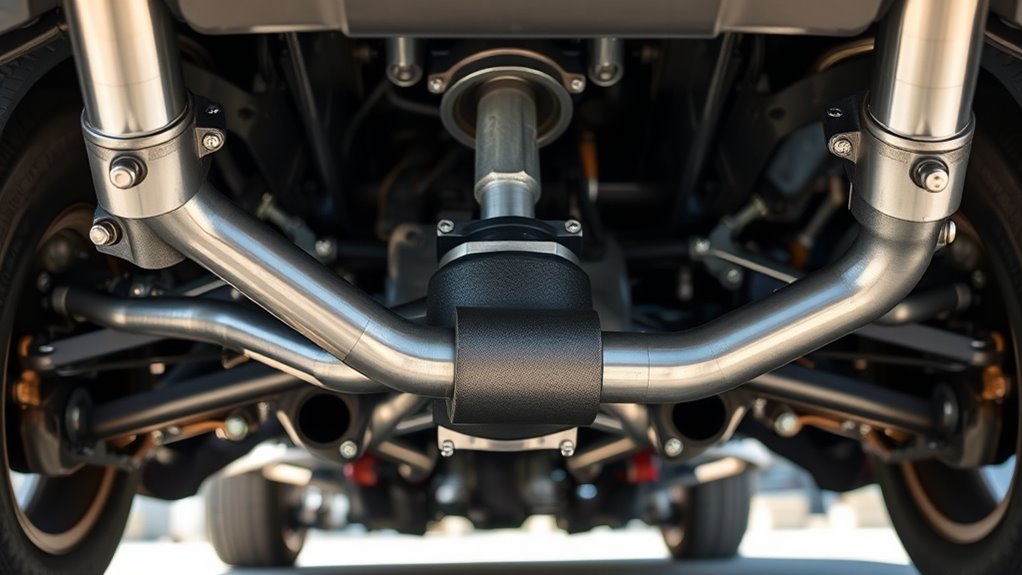
Anti-roll bars, also known as sway bars, are vital components that help improve your vehicle’s stability during cornering. They connect the left and right suspension components, distributing forces and reducing body roll. When you take a turn, your vehicle naturally leans to the outside, which can compromise handling and driver confidence. Anti-roll bars counteract this by resisting the lateral movement of the suspension, keeping your vehicle more level and balanced. The effectiveness of an anti-roll bar depends heavily on its spring stiffness, which determines how much force it exerts to resist body roll. A stiffer bar responds more aggressively, providing less body lean, but too much stiffness can result in a harsher ride and reduced traction on uneven surfaces. Conversely, a softer bar offers more comfort but less roll resistance, which might compromise handling during sharp turns.
Understanding the roll center is also vital when considering anti-roll bars. The roll center is an imaginary point associated with your vehicle’s suspension geometry, influencing how your car responds to cornering forces. If the roll center is high, the body tends to lean less, improving stability, but it can also lead to increased stress on suspension components. An anti-roll bar works in tandem with the roll center to optimize handling. When you adjust or upgrade your sway bar, you’re effectively changing how your vehicle interacts with these suspension parameters. A stiffer sway bar combined with an appropriate roll center can greatly improve turn-in response and reduce body lean. However, if the roll center is too low or too high relative to the sway bar’s stiffness, you might experience adverse effects like unpredictable handling or uneven tire wear.
Balancing spring stiffness and the roll center is key to achieving the right vehicle feel. You want an anti-roll bar that complements your suspension setup, allowing for precise control without sacrificing comfort. If your goal is to improve handling performance for spirited driving or racing, opting for a stiffer sway bar paired with a roll center adjustment can provide sharper responses. On the other hand, for daily driving, a softer bar with a balanced roll center might offer a more comfortable and predictable ride. Keep in mind that changing one element affects the others; increasing spring stiffness or altering the roll center can impact how the sway bar performs. As a result, fine-tuning these components together guarantees your vehicle remains balanced, predictable, and safe during cornering. Additionally, suspension geometry plays a crucial role in how effectively anti-roll bars perform, emphasizing the importance of comprehensive suspension tuning for optimal vehicle dynamics. Proper suspension tuning ensures that all components work harmoniously, maximizing handling and safety. Moreover, understanding the interaction between components is essential for achieving a well-balanced setup. When considering modifications, it’s also important to evaluate how vehicle weight distribution influences overall handling and stability. An understanding of component interactions can help prevent issues like oversteering or understeering, leading to safer and more predictable driving experiences.

maXpeedingrods Anti-Roll Bar Kit, 24-36 Inch Chromoly Shaft
Application: Works great on cars up to 800 HP and up to 4000 pounds. Please confirm your car…
As an affiliate, we earn on qualifying purchases.
As an affiliate, we earn on qualifying purchases.
Frequently Asked Questions
How Do Anti-Roll Bars Affect Ride Comfort?
Anti-roll bars can make your ride stiffer, which might reduce comfort, especially on rough roads. They improve handling stability by limiting body roll during turns, but this increased suspension stiffness can transmit more bumps and vibrations to you. If you prefer a smoother ride, you might want a softer setup, but keep in mind that it could slightly compromise handling stability. Balancing comfort and performance depends on your driving preferences.
Can Anti-Roll Bars Be Adjusted for Different Driving Conditions?
You can definitely adjust anti-roll bars for different driving conditions. With adjustable stiffness, you can tighten or loosen the bars, giving you more control over handling and comfort. Dynamic tuning allows you to switch settings quickly, adapting to everything from smooth highways to twisty mountain roads. Don’t let your setup be a one-trick pony—tweak your anti-roll bars and enjoy a more tailored, confident ride no matter where you’re headed.
Do Anti-Roll Bars Improve Fuel Efficiency?
Anti-roll bars don’t directly improve fuel economy, but they enhance vehicle stability, which can lead to better handling and potentially more efficient driving. When your car stays balanced during turns, you might drive more smoothly, saving fuel over time. However, since anti-roll bars add some weight and complexity, their impact on fuel efficiency is minimal. Focus on proper maintenance and driving habits for the best fuel economy.
Are Anti-Roll Bars Necessary for Daily Driving?
You might find that anti-roll bars aren’t strictly necessary for daily driving, especially if your car already handles well. Did you know that many drivers upgrade their anti-roll bars to improve cornering? Regular anti-roll bar maintenance guarantees safety and comfort, but if your vehicle feels stable without it, an upgrade isn’t a necessity. Ultimately, it depends on your driving style—upgrades can enhance your experience, but they’re not a must-have for everyday use.
How Do Anti-Roll Bars Influence Tire Wear?
Anti-roll bars can influence tire wear by affecting your tire alignment and tread pattern. When they’re too stiff or improperly installed, they can cause uneven pressure distribution, leading to faster tire wear on one side or irregular tread patterns. To prevent this, make certain your suspension components are properly maintained, and your tires are regularly aligned. Proper anti-roll bar tuning helps maintain even tire wear and extends your tires’ lifespan.

K80230 Front Suspension Sway Stabilizer Bar End Drop Link Kit 2 Pcs Left & Right Automotive Replacement Parts For K750719 for Pontiac Vibe Scion Tc 2003-2019 Toyota Corolla Matrix Prius M12
Before purchasing, research to ensure that the part will fit your vehicle; enter all vehicle information (year, make,…
As an affiliate, we earn on qualifying purchases.
As an affiliate, we earn on qualifying purchases.
Conclusion
Now that you understand how anti-roll bars work, picture them as the silent guardians of your vehicle’s harmony, keeping it balanced even when the road gets wild. They’re the unseen force that stabilizes your ride, preventing it from tipping over like a tightrope walker losing balance. Remember, a well-tuned anti-roll bar isn’t just a part — it’s the heartbeat of your vehicle’s graceful dance, ensuring every turn feels smooth and confident.
maXpeedingrods Anti-Roll Bar Kit, 24-36 Inch Chromoly Shaft
Application: Works great on cars up to 800 HP and up to 4000 pounds. Please confirm your car…
As an affiliate, we earn on qualifying purchases.
As an affiliate, we earn on qualifying purchases.

Whiteline Front Roll Center Adjustment Kit Compatible with 2003-2015 Mitsubishi Evo 8/9/10
As an affiliate, we earn on qualifying purchases.
As an affiliate, we earn on qualifying purchases.