
To quickly upgrade your skills, focus on understanding basic symbols and components like switches, resistors, and power sources, which are key to decoding diagrams. Trace circuits from the power source to the device to spot faults efficiently. Recognize common symbols and follow the connections to troubleshoot accurately. Practice regularly to build confidence, recognize patterns, and work safely. Keep learning more, and you’ll become adept at maneuvering complex systems in no time.
Key Takeaways
- Focus on learning common symbols and their meanings to quickly interpret wiring diagrams.
- Trace circuit paths from power sources to devices to identify faults efficiently.
- Practice regularly to recognize patterns and improve speed in reading diagrams.
- Use diagrams to plan modifications, ensuring safety and correct wiring during installations.
- Understand the flow of current and component functions for accurate troubleshooting in minutes.
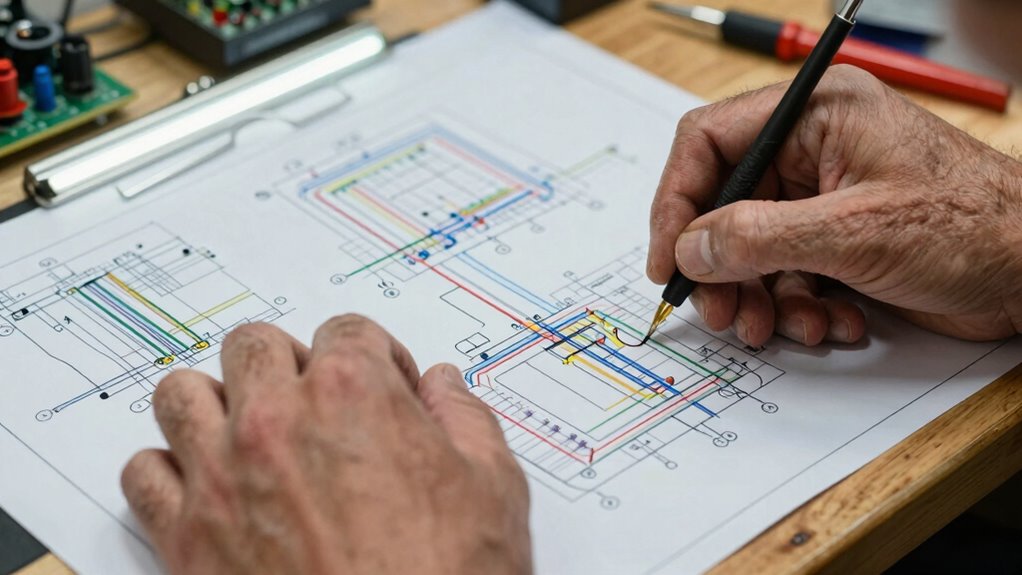
Understanding wiring diagrams is essential for anyone working with electrical systems, as they provide a clear map of how components connect and interact. When you’re tackling electrical troubleshooting, being able to read these diagrams quickly becomes a game-changer. They help you identify circuits efficiently, saving you time and reducing frustration. Instead of guessing which wire does what, you can follow the diagram step-by-step, pinpointing issues accurately.
Start by familiarizing yourself with the symbols used in wiring diagrams. These symbols represent switches, resistors, relays, power sources, and other components. Recognizing them instantly helps you decode the diagram faster. Once you understand the symbols, look for the main power source, usually marked as “L” or “Line.” From there, trace the circuit paths to see how current flows through different components. This process, known as circuit identification, is essential because it clarifies how everything connects and functions together. Developing your circuit identification skills can significantly improve your troubleshooting efficiency.
When you’re troubleshooting, clear circuit identification allows you to isolate problems quickly. For example, if a device isn’t working, you can follow the wiring diagram from the power source to the device, checking each connection along the way. If a connection is broken or a component is faulty, the diagram guides you directly to the problem spot, making repair straightforward. Without this skill, you’d waste time testing wires blindly or replacing parts unnecessarily. Additionally, understanding the electrical symbols used in diagrams helps prevent misinterpretation and ensures safer, more accurate work.
Reading wiring diagrams also helps you plan new installations or modifications with confidence. You can visualize how adding a new switch or outlet will fit into the existing system. Plus, understanding the diagram’s layout prevents wiring mistakes that could cause short circuits or electrical hazards. It’s an indispensable skill that enhances safety and efficiency, especially when working in complex systems with multiple circuits. Developing familiarity with wiring diagram symbols and their meanings can significantly improve your troubleshooting speed.
In just a few minutes of practice, you’ll notice your confidence growing. You’ll start to see patterns and understand how different parts of the system relate to each other. This improves your overall electrical troubleshooting skills and makes circuit identification faster and more accurate. Remember, the key is to keep the diagram close as you work, cross-referencing symbols and connections. With consistent practice, reading wiring diagrams will become a second nature, turning a potentially overwhelming task into an easy, logical process. Mastering this skill in just 10 minutes can greatly boost your ability to diagnose and repair electrical systems effectively.
electrical wiring diagram symbols kit
As an affiliate, we earn on qualifying purchases.
As an affiliate, we earn on qualifying purchases.
Frequently Asked Questions
How Do I Identify Different Symbols in a Wiring Diagram?
You identify different symbols in a wiring diagram by recognizing common symbol variations and understanding their meanings. Pay attention to labelings and legend keys, which clarify unfamiliar symbols. Color coding helps you distinguish wire functions quickly, like power, ground, or signal. Practice matching symbols with their real-world components, and over time, you’ll become more confident in reading diagrams efficiently, making troubleshooting and installations smoother.
What Tools Are Essential for Reading Wiring Diagrams Effectively?
Did you know 85% of electrical errors come from misreading diagrams? To read wiring diagrams effectively, you need a good tools overview, including a multimeter, wire strippers, and a flashlight. These tools help you test circuits and recognize symbols clearly. Prioritize symbol recognition by familiarizing yourself with common symbols, and keep your tools organized. This approach makes troubleshooting faster and safer, ensuring you get accurate readings every time.
How Can I Troubleshoot Common Wiring Diagram Mistakes?
To troubleshoot common wiring errors, start by carefully examining the diagram for inconsistencies or missing connections. Use diagram correction techniques like cross-referencing symbols and verifying continuity with a multimeter. Look for common wiring errors such as incorrect connections or overlooked grounding. Always double-check your work against the diagram, and isolate problems step-by-step, ensuring each part matches the schematic to prevent future mistakes.
Are There Industry Standards for Wiring Diagram Symbols?
Yes, industry standards exist for wiring diagram symbols, emphasizing consistency and clarity. You should pay attention to symbol consistency, ensuring each symbol accurately represents its component, and adhere to color coding conventions for different wire types or signals. These standards help you interpret diagrams quickly and reduce errors, especially when troubleshooting or designing circuits. Following recognized standards makes your work more professional and easier for others to understand.
How Do I Interpret Complex Wiring Diagrams With Multiple Layers?
About 85% of electricians find complex diagrams challenging, but you can master them. To interpret multi-layered wiring diagrams, focus on color coding for quick identification and connection clarity. Break the diagram into sections, analyze each layer separately, and note how symbols interact across layers. This approach simplifies complexity, helping you visualize the entire system. Practice regularly to improve your ability to navigate intricate wiring schematics efficiently.
circuit tracing tool for electrical troubleshooting
As an affiliate, we earn on qualifying purchases.
As an affiliate, we earn on qualifying purchases.
Conclusion
Mastering wiring diagrams in just 10 minutes can turn you into a wiring wizard, transforming complex circuits into child’s play. With this skill, you’ll navigate electrical systems faster than lightning streaks across the sky, confidently troubleshooting and installing with ease. Remember, every symbol and line you learn brings you closer to electrical mastery—making you the go-to expert in your community. So keep practicing, because your new wiring prowess is nothing short of electrifying!
As an affiliate, we earn on qualifying purchases.
As an affiliate, we earn on qualifying purchases.