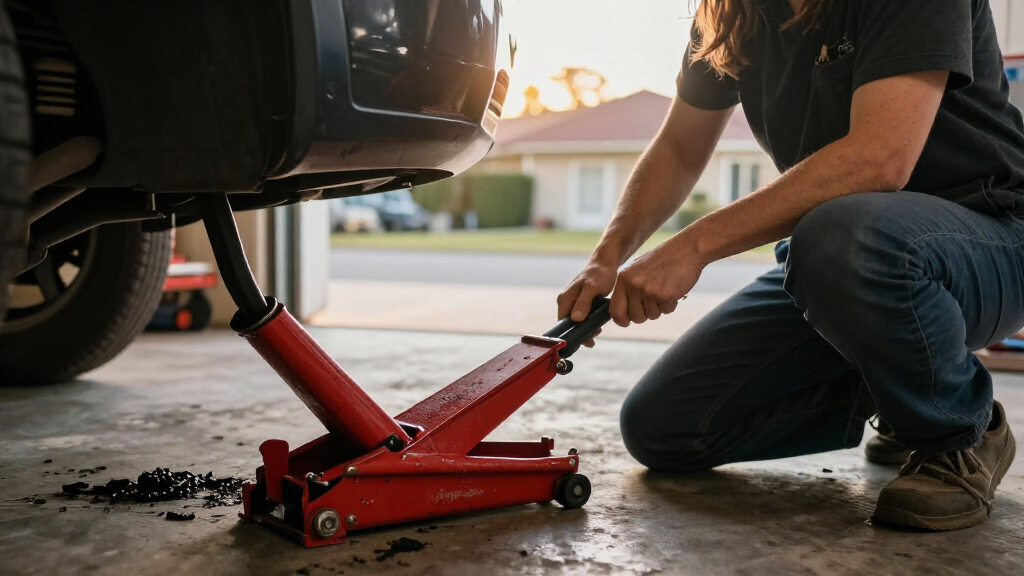

Garage floor jacks come down to three questions: how low does your car sit, how much does it weighs, and how fast do you want it in the air. For most home garages, the SATA 3-Ton Heavy-Duty Steel Floor Jack is the best overall pick thanks to its dual-piston quick-lift pump that reaches full height in a fraction of the strokes of a standard single-piston jack. If you work on lowered sports cars, the VEVOR 3-Ton Low-Profile Floor Jack slides under frames that defeat ordinary jacks, while the Maxority 5-Ton is the standout if you also lift trucks or SUVs. The main tradeoff you will face in this category is steel versus aluminum — steel models like the SATA are cheaper and more durable but heavy to roll around, while lighter jacks trade weight savings for a higher price per ton of capacity. Keep reading for the full breakdown of all 15 jacks and which one fits your vehicle and your garage.
Complete the kit


Key Takeaways
- Dual-piston quick-lift pumps (SATA, Maxority, Jack Boss 4-Ton) cut pumping effort dramatically — worth paying more for if you lift your vehicle more than a few times a month.
- Low-profile matters more than raw capacity for most buyers: several 3-ton jacks in this lineup share identical capacity but differ by over an inch in minimum saddle height, which decides whether they fit under a lowered car at all.
- The 2-ton and 3,800 lb jacks (DNA Motoring, TONDA) are the lightest and cheapest to buy, but their short lift ranges make them poor choices for trucks or SUVs — they are car-only tools.
- The Maxority 5-Ton and Jack Boss 4-Ton cover heavier vehicles, but both weigh and cost more than a 3-ton steel jack; most sedan and crossover owners are paying for capacity they will never use.
- Steel-frame jacks dominated this comparison on value, but the Jack Boss aluminum-and-steel racing jack is the only genuinely portable option if you track your car or move between garages.
| SATA 3-Ton Heavy-Duty Steel Floor Jack with Dual-Piston Quick Lift Pump |  | Best Overall | Brand: SATA | Type: Hydraulic floor jack | Overload Test Capacity: 4.5 tons (9,900 lb) | VIEW LATEST PRICE | See Our Full Breakdown |
| VEVOR 3-Ton Low-Profile Floor Jack |  | Best Value | Brand: VEVOR | Model: K500 | Lifting Capacity: 3 tons / 6,600 lbs | VIEW LATEST PRICE | See Our Full Breakdown |
| Antlevix 3-Ton Low-Profile Hydraulic Floor Jack |  | Best for Very Low Vehicles | Load Capacity: 6,600 lbs (3 tons) | Minimum Height: 2.9 inches | Maximum Height: 19.8 inches | VIEW LATEST PRICE | See Our Full Breakdown |
| AV Steel Low-Profile Floor Jack, 2.5 Ton |  | Best for Passenger Cars | Brand: AV Steel | Capacity: 2.5 tons (5,000 lbs) | Lift Range: 3.4–14.6 inches | VIEW LATEST PRICE | See Our Full Breakdown |
| Bonnlo 3-Ton Low-Profile Hydraulic Floor Jack |  | Best Lift Range | Brand: Bonnlo | Load Capacity: 3 tons (6,600 lbs) | Lifting Range: 2.95–20.1 inches | VIEW LATEST PRICE | See Our Full Breakdown |
| AUTOWN 3-Ton Alloy Steel Hydraulic Floor Jack |  | Best for Trucks and Full-Size SUVs | Capacity: 6,600 lbs (3 tons) | Material: Alloy steel | Lifting range: 7.1–20.9 inches | VIEW LATEST PRICE | See Our Full Breakdown |
| LARBANKE 3-Ton Hydraulic Floor Jack, Red |  | Best Value All-Rounder | Brand: LARBANKE | Model: S460Red | Type: Hydraulic floor jack | VIEW LATEST PRICE | See Our Full Breakdown |
| 3-Ton Low-Profile Hydraulic Floor Jack for Cars, Trucks, and SUVs |  | Best Bundle for the Money | Lifting capacity: 3 tons (6,000 lbs) | Minimum height: 3.35 inches | Max height with pad: 17.91 inches | VIEW LATEST PRICE | See Our Full Breakdown |
| DNA Motoring 2-Ton Low-Profile Hydraulic Trolley Floor Jack |  | Best Budget Pick for Small Cars | Brand: DNA Motoring | Model: TOOLS-00234 | Type: Hydraulic trolley floor jack | VIEW LATEST PRICE | See Our Full Breakdown |
| AV Steel 3-Ton Hydraulic Floor Jack, 6,000 lb Capacity |  | Best Safety-Certified Workhorse | Capacity: 3 tons (6,000 lbs) | Lift range: 5.5–18.5 inches | Weight: 63.8 lbs | VIEW LATEST PRICE | See Our Full Breakdown |
| Maxority 3-Ton Low-Profile Hydraulic Steel Floor Jack with Dual-Piston Quick-Lift Pump |  | Best for Lowered Cars | Lifting capacity: 3 tons (6,600 lbs) | Material: High-strength steel | Design: Low-profile, extended reach | VIEW LATEST PRICE | See Our Full Breakdown |
| Jack Boss 3-Ton Low-Profile Aluminum and Steel Racing Floor Jack |  | Best Premium Lightweight Pick | Capacity: 3 tons (6,600 lbs) | Lifting range: 3-15/16 to 18-5/16 inches | Dimensions: 28.3 × 13.7 × 7.8 inches | VIEW LATEST PRICE | See Our Full Breakdown |
| Maxority 5-Ton Low-Profile Hydraulic Steel Floor Jack with Dual-Piston Quick Lift Pump |  | Best Heavy-Duty Capacity | Lifting capacity: 5 tons (11,000 lbs) | Construction: Heavy-duty steel | Pump: Dual-piston quick lift | VIEW LATEST PRICE | See Our Full Breakdown |
| Jack Boss 4 Ton Low Profile Hydraulic Floor Jack with Dual Piston Pump |  | Best Lift Range for Trucks and SUVs | Capacity: 4 tons (8,800 lbs) | Lifting range: 3.9 to 20 inches | Pump type: Dual piston | VIEW LATEST PRICE | See Our Full Breakdown |
| TONDA Hydraulic Floor Jack, 3,800 lb Capacity, 4.9–11.8 in Lift Range, Blue |  | Best Budget Compact Option | Capacity: 3,800 lbs | Lifting range: 4.9–11.8 inches | Material: Steel | VIEW LATEST PRICE | See Our Full Breakdown |
| garage floor jack | Lifting Range |
|---|---|
| SATA 3-Ton Heavy-Duty Steel Fl | 3-3/4 to 19-1/8 inches |
| VEVOR 3-Ton Low-Profile Floor | — |
| Antlevix 3-Ton Low-Profile Hyd | — |
| AV Steel Low-Profile Floor Jac | — |
| Bonnlo 3-Ton Low-Profile Hydra | 2.95–20.1 inches |
| AUTOWN 3-Ton Alloy Steel Hydra | 7.1–20.9 inches |
| LARBANKE 3-Ton Hydraulic Floor | 5.31–18.11 inches |
| 3-Ton Low-Profile Hydraulic Fl | — |
| DNA Motoring 2-Ton Low-Profile | 5.1–13 in |
| AV Steel 3-Ton Hydraulic Floor | — |
| Maxority 3-Ton Low-Profile Hyd | — |
| Jack Boss 3-Ton Low-Profile Al | 3-15/16 to 18-5/16 inches |
| Maxority 5-Ton Low-Profile Hyd | — |
| Jack Boss 4 Ton Low Profile Hy | 3.9 to 20 inches |
| TONDA Hydraulic Floor Jack | 4.9–11.8 inches |
More Details on Our Top Picks
SATA 3-Ton Heavy-Duty Steel Floor Jack with Dual-Piston Quick Lift Pump
The SATA 3-Ton earns the top spot because it balances capacity, safety engineering, and lift range better than anything else in this lineup. Its 4.5-ton overload test capacity gives real headroom above the rated 3 tons, which matters if you work close to the limit with a heavy sedan or light truck. The dual-piston quick lift pump means fewer handle strokes to get a load moving, and the controlled slow-release system is a genuine safety differentiator — many budget jacks in this roundup, like the LARBANKE 3-Ton, lower loads with less precision. Compared with the VEVOR K500, the SATA starts slightly higher at 3-3/4 inches, so owners of very low sports cars may prefer the Antlevix. The tradeoff is weight: steel construction makes it a jack you store, not carry.
Pros:- 3-ton rating backed by a 4.5-ton overload test capacity for extra safety margin
- Controlled slow-release system lowers vehicles smoothly and predictably
- Dual-piston pump reduces handle effort and speeds up lifting
- Low-profile frame fits most modern unibody vehicles
Cons:- Steel build makes it heavy to reposition around the garage
- 3-3/4-inch entry height is not the lowest in this roundup
Best for: Home mechanics who want a durable, safety-focused do-everything jack for sedans, crossovers, and light trucks
Not ideal for: Owners of slammed or very low sports cars — the 3-3/4-inch minimum height may not slide under the rocker panels
- Brand:SATA
- Type:Hydraulic floor jack
- Overload Test Capacity:4.5 tons (9,900 lb)
- Lifting Range:3-3/4 to 19-1/8 inches
- Construction:Heavy-duty steel
- Pump:Dual-piston rapid lift
- Safety Features:Overload protection valve, controlled slow-release system
Our verdict“If you want one jack that handles nearly everything in a home garage with the strongest safety features here, this is the one to buy.”
VEVOR 3-Ton Low-Profile Floor Jack
This model makes the most sense for buyers who want full-size performance without a premium outlay. The dual parallel pump reaches full height in seven strokes — a pace that rivals the SATA’s quick-lift design — and the 3.35 to 19.69-inch range covers everything from low sedans to tall SUVs. Its 52-inch detachable handle gives better leverage than the shorter handles on competitors like the Antlevix, which translates to less physical effort per lift. The rotatable rubber saddle protects pinch welds, a thoughtful touch at this price tier. The main compromise is the same one across steel jacks here: it’s heavy to drag across the floor, and VEVOR’s fit and finish won’t match the SATA’s safety engineering — there’s no controlled slow-release system listed.
Pros:- Dual-pump system reaches maximum height in just seven strokes
- Wide 3.35–19.69 inch range handles cars, trucks, and SUVs
- CE, UKCA, and ASME PALD-2014 certifications
- Long 52-inch detachable handle improves leverage and storage
Cons:- Heavy steel frame is awkward to move frequently
- No controlled slow-release lowering system listed
Best for: DIYers and first-time jack buyers who want certified 3-ton capacity and fast lifting on a tight budget
Not ideal for: Buyers who prioritize long-term warranty support or the lightest possible jack for frequent repositioning
- Brand:VEVOR
- Model:K500
- Lifting Capacity:3 tons / 6,600 lbs
- Minimum Height:3.35 in / 85 mm
- Maximum Height:19.69 in / 500 mm
- Handle Length:52 in / 1,320 mm
- Construction:Steel
- Certifications:CE, UKCA, ASME PALD-2014
Our verdict“The smart pick if you want near-flagship lifting speed and range at the most accessible point in this lineup.”
Antlevix 3-Ton Low-Profile Hydraulic Floor Jack
Where this jack separates itself is the 2.9-inch minimum height — the lowest entry point among the steel 3-ton models here, slipping under vehicles the SATA and VEVOR simply can’t reach. That makes it a natural fit for lowered sedans, sports cars, and low-riding crossovers. The 19.8-inch maximum height means it doesn’t sacrifice top-end reach to get there, giving it one of the widest usable ranges in the roundup. Its dual-piston pump keeps lifting quick despite the steep travel. The weak point is support: a 90-day limited warranty is the shortest in this batch, compared with AV Steel’s 2-year coverage, so you’re betting on the build holding up past the early failure window. At 62 lbs, it’s also a two-hand job to reposition.
Pros:- 2.9-inch minimum height fits under very low vehicles
- Wide 2.9–19.8 inch total lift range
- Dual-piston pump lifts loads quickly
- Wide steel base adds stability under load
Cons:- 62-lb weight makes it difficult to move around
- Only 90 days of limited warranty coverage
Best for: Owners of lowered or low-clearance vehicles who need the lowest saddle height with full 3-ton capacity
Not ideal for: Buyers who value long warranty coverage — the 90-day term offers little protection after early use
- Load Capacity:6,600 lbs (3 tons)
- Minimum Height:2.9 inches
- Maximum Height:19.8 inches
- Weight:62 lbs
- Material:Steel
- Pump:Dual piston
- Included Components:Handle, jack body, rubber saddle
- Warranty:90 days limited
Our verdict“The go-to choice when ground clearance is your biggest constraint and 3 tons of capacity is non-negotiable.”
AV Steel Low-Profile Floor Jack, 2.5 Ton
This option stands out for knowing exactly what it is: a dedicated passenger-car jack, not an everything machine. Its 3.4-inch entry height handles low sedans and hatchbacks, while the 2-year limited warranty is the longest coverage in this batch — a clear advantage over the Antlevix’s 90 days if longevity matters to you. The quick-lift single-piston pump and rotating wheels make it easy to position in a tight garage, and at this capacity it’s a sensible match for compact and midsize cars. The honest limitation is the 14.6-inch maximum lift, well short of the Bonnlo’s 20.1 inches, and the manufacturer explicitly excludes trucks, SUVs, and lifted vehicles. Buy it for a car, and it’s excellent; buy it as your only jack and you’ll outgrow it.
Pros:- 3.4-inch entry height suits low-clearance cars
- Longest warranty in this lineup at 2 years
- Quick-lift pump and rotating wheels ease positioning
- Overload protection valve and rotating saddle included
Cons:- 14.6-inch maximum lift limits use on taller vehicles
- 2.5-ton capacity excludes most trucks and larger SUVs
Best for: Owners of compact and midsize passenger cars who want a purpose-built jack with strong warranty backing
Not ideal for: Trucks, SUVs, and lifted vehicles — the capacity and 14.6-inch lift height won’t safely or fully raise them
- Brand:AV Steel
- Capacity:2.5 tons (5,000 lbs)
- Lift Range:3.4–14.6 inches
- Material:Steel
- Pump:Single-piston hydraulic pump
- Safety Feature:Overload protection valve
- Model Number:AV-250102F
- Warranty:2-year limited warranty
Our verdict“A confident, warranty-backed pick if your garage holds a car rather than a truck — and a poor fit for anyone who needs lift height.”
Bonnlo 3-Ton Low-Profile Hydraulic Floor Jack
No jack in this batch matches the Bonnlo’s 2.95 to 20.1-inch span. It dips nearly as low as the Antlevix while reaching higher than the SATA or VEVOR, making it the most versatile single-jack garage solution for households with mixed vehicles — a lowered sedan one day, a tall SUV the next. The dual-pump design delivers smooth, quick lifting through that whole range, and swivel casters make repositioning less of a wrestling match, a real benefit given this is the heaviest model here at 70.5 lbs. Compared with the VEVOR K500, you trade the longer 52-inch handle for more top-end reach. The 1-year warranty sits in the middle of the pack — better than Antlevix, shorter than AV Steel — which fits its do-everything positioning.
Pros:- Widest lift range in the roundup at 2.95–20.1 inches
- Dual-pump design lifts smoothly and quickly
- Full 3-ton capacity for trucks and SUVs
- Swivel casters ease positioning despite the weight
Cons:- Heaviest model in this batch at 70.5 lbs
- Handling bulk makes it better suited to a fixed garage than transport
Best for: Multi-vehicle households needing one jack that reaches both very low cars and tall SUVs
Not ideal for: Anyone who frequently moves their jack between locations — at 70.5 lbs it’s the heaviest pick here
- Brand:Bonnlo
- Load Capacity:3 tons (6,600 lbs)
- Lifting Range:2.95–20.1 inches
- Pump Design:Dual pump
- Automotive Fit:Universal
- Weight:70.5 lbs
- Package Dimensions:26.3 × 14.1 inches
- Included Components:Floor jack, handle, wheel
- Warranty:1 year
Our verdict“If you own both a low car and a tall SUV and want one jack for both, this range champion covers ground nothing else here can.”
AUTOWN 3-Ton Alloy Steel Hydraulic Floor Jack
What sets the AUTOWN 3-Ton apart from the rest of this lineup is its 20.9-inch maximum lift height — the tallest in this batch. Compared with the 3-Ton Low-Profile Hydraulic Floor Jack, which tops out around 17.9 inches, that extra reach makes a real difference when you’re working on a pickup or a taller crossover and need the wheel comfortably off the ground. The cross-shaped rubber saddle pad grips the frame instead of letting it slip, a small detail that builds confidence during positioning. The detachable handle and flat-folding body also make it easier to stash than the AV Steel 3-Ton, which is a fixed-shape 63.8-pound unit.
The tradeoff is at the bottom of the range: a 7.1-inch minimum height means lowered sedans simply won’t fit underneath, unlike the 3.35-inch low-profile models in this guide.
Pros:- Highest maximum lift in this batch at 20.9 inches
- Cross-shaped rubber saddle pad reduces slipping on frame rails
- Detachable handle and flat-folding body simplify storage
- 3-ton rating covers most trucks, vans, and SUVs
Cons:- 7.1-inch minimum height is too tall for low vehicles
- Buyers must verify frame clearance before purchasing
Best for: Pickup, van, and full-size SUV owners who need tall lift height and a pad that grips the frame
Not ideal for: Owners of lowered or low-clearance cars — the 7.1-inch minimum height won’t slide under them
- Capacity:6,600 lbs (3 tons)
- Material:Alloy steel
- Lifting range:7.1–20.9 inches
- Saddle pad:Cross-shaped rubber
- Mobility:Smooth-rolling casters
- Storage:Handle disassembles; jack folds flat
Our verdict“This is the jack for tall vehicles — but sedan and sports car owners should look at a low-profile pick instead.”
LARBANKE 3-Ton Hydraulic Floor Jack, Red
The LARBANKE 3-Ton earns its spot by covering the middle ground better than anything else in this price bracket. Its 5.31–18.11-inch range is wider than the DNA Motoring 2-Ton (which stops at 13 inches) and reaches lower than the AUTOWN 3-Ton, so it handles both ordinary sedans and most SUVs without compromise. The wide base and reinforced carbon steel frame translate into a steadier platform under load, while the swivel casters make repositioning a one-hand job.
Where it gives ground is speed and refinement: unlike the 3-Ton Low-Profile model or the SATA dual-piston jack, this uses a single-piston pump, so reaching full height takes more strokes. It also lacks bundled extras like rubber pads, which some rivals include. For a straightforward, do-everything garage jack, those are acceptable cuts.
Pros:- Wide 5.31–18.11-inch range suits both cars and SUVs
- High-strength carbon steel construction with reinforced frame
- Wide base adds stability under load
- Swivel casters make it easy to reposition
Cons:- Single-piston pump needs more strokes to reach full height
- No included accessories such as rubber pads or adapters
Best for: Budget-minded home mechanics who want one jack that works on both cars and SUVs
Not ideal for: Anyone who lifts frequently and wants faster pumping — a dual-piston model will save effort
- Brand:LARBANKE
- Model:S460Red
- Type:Hydraulic floor jack
- Lifting capacity:3 tons (6,600 lbs)
- Lifting range:5.31–18.11 inches
- Material:High-strength carbon steel
- Pump system:Single-piston pump
- Color:Red
Our verdict“A sensible middle-of-the-road pick that trades pumping speed for a wide range and solid steel build.”
3-Ton Low-Profile Hydraulic Floor Jack for Cars, Trucks, and SUVs
Plenty of jacks in this guide lift well; few arrive as a ready-to-work kit. Alongside the jack itself, you get two rubber pads and an 8-piece tubeless tire repair kit, which covers the two most common roadside and garage scenarios before you’ve bought anything else. The 3.35-inch minimum height slips under lowered cars that the AUTOWN 3-Ton (7.1 inches minimum) can’t touch, and the dual-piston pump gets to height in noticeably fewer strokes than the single-piston LARBANKE or AV Steel models.
The limitation is overhead: 17.91 inches of maximum lift is fine for cars and SUVs but falls short for lifted trucks. And the 3-ton rating is aimed at light-duty vehicles only — heavy trucks and RVs need something like the Maxority 5-Ton.
Pros:- 3.35-inch minimum height fits under lowered vehicles
- Dual-piston pump reaches full height with fewer strokes
- Includes two rubber pads and a tire repair kit
- Overload valve prevents lifting beyond rated capacity
Cons:- Maximum lift of 17.91 inches is modest for taller trucks
- Not rated for heavy-duty trucks or larger work vehicles
Best for: First-time buyers who want a jack plus pads and a tire repair kit in one purchase
Not ideal for: Owners of lifted trucks or heavier vehicles — the lift height and 3-ton ceiling fall short
- Lifting capacity:3 tons (6,000 lbs)
- Minimum height:3.35 inches
- Max height with pad:17.91 inches
- Max height without pad:16.93 inches
- Pump type:Dual-piston
- Frame material:Steel
- Included accessories:2 rubber pads; 8-piece tubeless tire repair kit
- Safety feature:Overload protection valve
Our verdict“The smart pick if you want accessories bundled in and fast pumping on low cars, as long as you don’t own a lifted truck.”
DNA Motoring 2-Ton Low-Profile Hydraulic Trolley Floor Jack
The DNA Motoring 2-Ton is the lightest-duty jack in this roundup, and that’s exactly its appeal. Its 5.1-inch minimum height slides under compact cars and sedans with room to spare, and the swivel casters make it easy to muscle into position in a tight garage or driveway. Compared with the 3-Ton Low-Profile model, it’s a simpler, cheaper tool aimed squarely at occasional tire changes and brake work on smaller vehicles.
The tradeoffs are real. Its 13-inch maximum lift is the lowest here — the LARBANKE reaches over 18 inches — and the 2-ton ceiling rules out pickups and full-size SUVs. It’s also strictly a lifting tool: the manual is blunt that it cannot support a vehicle, so budget for jack stands if you don’t own any.
Pros:- Low 5.1-inch starting height fits under small cars
- Overload release valve and large saddle for safer lifting
- Swivel casters help with positioning in tight spaces
- Lighter and easier to store than 3-ton steel models
Cons:- 13-inch maximum lift is the lowest in this lineup
- Cannot support a vehicle — jack stands required for any work under the car
Best for: Compact car and sedan owners who need an affordable jack for occasional tire and brake work
Not ideal for: Truck and full-size SUV owners — the 2-ton rating and 13-inch lift simply aren’t enough
- Brand:DNA Motoring
- Model:TOOLS-00234
- Type:Hydraulic trolley floor jack
- Capacity:2 tons (4,000 lbs)
- Lifting range:5.1–13 in
- Material:Steel
- Safety feature:Overload release valve
- Use:Lifting only; use jack stands for support
Our verdict“A no-frills jack that makes sense for small-car owners who already own or will buy jack stands.”
AV Steel 3-Ton Hydraulic Floor Jack, 6,000 lb Capacity
Few jacks in this batch can point to a certification standard, and the AV Steel’s compliance with ANSI/ASME PASE is what earns it the workhorse label. That, plus a 12-month warranty and a built-in overload valve, gives it the strongest safety story among the 3-ton options here. The 360-degree rotatable saddle is a genuine convenience the LARBANKE and AUTOWN don’t offer — you can square up to the lift point without repositioning the whole jack. Its 5.5–18.5-inch range covers the everyday sweet spot for cars, minivans, and most pickups.
The downsides: at 63.8 lbs it’s the heaviest jack in this group, and the single-piston pump means more pumping than the dual-piston 3-Ton Low-Profile model to reach full height.
Pros:- Meets ANSI/ASME PASE safety standards
- 360-degree rotatable saddle simplifies alignment with lift points
- 5.5–18.5-inch range covers cars through pickups
- Includes 12-month warranty and overload protection valve
Cons:- Heavy at 63.8 lbs — the weightiest jack in this batch
- Single-piston pump takes more strokes than dual-piston rivals
- Not suitable for lifted vehicles, heavy-duty trucks, or RVs
Best for: Regular DIYers who prioritize certified safety standards and warranty coverage over speed
Not ideal for: Anyone who moves their jack between locations often — 63.8 lbs makes it a two-hand job
- Capacity:3 tons (6,000 lbs)
- Lift range:5.5–18.5 inches
- Weight:63.8 lbs
- Construction:Steel
- Piston type:Single piston
- Safety features:Built-in overload protection valve
- Saddle:360-degree rotatable
- Wheels:Two rear rotating wheels
- Warranty / Standard:12-month warranty; ANSI/ASME PASE
Our verdict“The pick for safety-first buyers who want certified construction and warranty backing, provided they can handle the weight.”
Maxority 3-Ton Low-Profile Hydraulic Steel Floor Jack with Dual-Piston Quick-Lift Pump
Among all the low-profile picks in this roundup, this Maxority 3-ton stands out for its extended reach, which matters most for anyone sliding a jack under a lowered sedan or sports car where every quarter-inch of clearance counts. Compared with the Jack Boss 3-ton racing jack, it gives up the aluminum body’s lighter weight but keeps the dual-piston quick-lift pump, so the fewer-strokes lifting benefit is preserved at a more conventional build. The overload safety valve is a meaningful plus for anyone who occasionally guesses wrong on vehicle weight. The tradeoff here is quirky rather than mechanical: the random color assignment means you can’t match your garage aesthetic, and all-steel construction makes this heavier to reposition than hybrid rivals. This pick makes the most sense for clearance-challenged vehicles rather than truck owners.
Pros:- Extended-reach low-profile design fits minimal ground clearance
- Dual-piston rapid pump reaches full height in fewer strokes
- Built-in overload safety valve guards against exceeding capacity
- High-strength steel build suits frequent garage use
Cons:- Color is selected at random, so appearance can’t be chosen
- All-steel construction makes it heavier to maneuver than aluminum-body rivals
Best for: Owners of lowered cars and sports cars who need maximum under-car reach with a 3-ton rating
Not ideal for: Owners of lifted trucks or SUVs — the low-profile geometry is wasted and the 3-ton ceiling limits headroom
- Lifting capacity:3 tons (6,600 lbs)
- Material:High-strength steel
- Design:Low-profile, extended reach
- Pump:Dual-piston rapid-pump hydraulic system
- Safety feature:Built-in overload safety valve
- Color:Random
Our verdict“If your car sits low enough that other jacks won’t fit underneath, this Maxority is the clearance specialist worth the steel-weight penalty.”
Jack Boss 3-Ton Low-Profile Aluminum and Steel Racing Floor Jack
Hybrid construction is what separates this Jack Boss racing jack from the field: an aluminum body paired with a welded steel frame trims weight while retaining rigidity, something the all-steel Maxority 3-ton can’t match. The 3-15/16 inch minimum height clears most lowered vehicles, and the rubber saddle is a thoughtful touch the Maxority lacks — it protects painted lifting points on cars you actually care about. The factory testing to 1.5 times rated capacity (4.5 tons tested against a 3-ton rating) plus ANSI/ASME PASE certification gives this model the strongest documented safety story in this batch. The tradeoff: hybrid builds cost more than comparable steel jacks, and the 1-year warranty is shorter than what dedicated steel workhorse jacks often carry. Compared with the VEVOR 3-ton low-profile, the lighter frame makes repositioning around a shop noticeably easier.
Pros:- Aluminum-and-steel hybrid build is lighter than all-steel rivals
- Rubber saddle protects vehicle lifting points from scratches
- Factory tested to 1.5 times its rated 3-ton capacity
- Meets ANSI/ASME PASE safety standard
Cons:- Hybrid construction generally costs more than comparable steel jacks
- Limited 1-year warranty is shorter than many competitors offer
Best for: Enthusiasts and weekend mechanics who frequently move their jack around and want a certified, lighter tool with a 3-ton rating
Not ideal for: Buyers on a strict budget — hybrid aluminum-steel construction typically commands a premium over all-steel equivalents
- Capacity:3 tons (6,600 lbs)
- Lifting range:3-15/16 to 18-5/16 inches
- Dimensions:28.3 × 13.7 × 7.8 inches
- Materials:Aluminum body and welded steel frame
- Pump:Dual-piston hydraulic pump
- Tested capacity:4.5 tons (9,900 lbs)
- Safety standard:ANSI/ASME PASE
- Warranty:Limited 1-year manufacturer warranty
Our verdict“This is the pick for mechanics who value certified safety margins and easy repositioning enough to pay extra for the lighter hybrid frame.”
Maxority 5-Ton Low-Profile Hydraulic Steel Floor Jack with Dual-Piston Quick Lift Pump
When a 3-ton jack isn’t enough — think full-size trucks, heavy SUVs, or loaded work vans — this Maxority 5-ton is the only option in this batch with an 11,000 lb ceiling. Compared with the Jack Boss 4-ton, it offers roughly 2,200 lbs of additional headroom and adds protective touches that model skips: an anti-slip saddle and rubber padding that keep the contact point stable and scratch-free under heavy loads. The extra-long handle translates to real leverage, which you’ll appreciate when lifting that much mass. The compromises are real, though: heavy-duty steel construction makes this the hardest jack here to drag across a garage floor, and the 90-day warranty is the shortest in the lineup — a genuine concern for a tool you’re trusting with five tons. Capacity buyers accept these tradeoffs; sedan owners shouldn’t.
Pros:- Lifts vehicles up to 11,000 lbs, the highest capacity in this batch
- Extra-long handle provides superior leverage under heavy loads
- Anti-slip saddle and rubber padding protect and stabilize the lifting point
- Overload safety valve adds a safeguard at high capacity
Cons:- Heavy-duty steel construction makes it difficult to move around the garage
- Warranty is limited to just 90 days
Best for: Owners of full-size trucks, vans, and heavy SUVs who need capacity beyond the standard 3-ton rating
Not ideal for: Sedan and compact-car owners — the extra capacity is wasted, and the heavy steel build is a burden for light-duty use
- Lifting capacity:5 tons (11,000 lbs)
- Construction:Heavy-duty steel
- Pump:Dual-piston quick lift
- Safety features:Safety valve, anti-slip saddle, rubber padding
- Model number:MAX1901-35X
- Color:Red
- Warranty:90 days
Our verdict“If your vehicles genuinely exceed 3 tons, this is the capacity pick — just be prepared to muscle it around and accept the thin warranty.”
Jack Boss 4 Ton Low Profile Hydraulic Floor Jack with Dual Piston Pump
This Jack Boss 4-ton occupies the sweet spot between the 3-ton crowd and the Maxority 5-ton: 8,800 lbs of capacity covers most light trucks and SUVs without the five-ton jack’s backbreaking weight. Its defining number is the 20-inch maximum lift height — the tallest in this batch — which means you can actually raise a truck high enough to work comfortably underneath, something the 18-5/16 inch Jack Boss 3-ton can’t quite manage. The dual-piston pump is claimed to lift five times faster than single-pump designs, cutting pumping effort during repeated jobs. The wide stance adds stability that matters more at this weight class. Tradeoffs: some assembly is required out of the box, and unlike the certified 3-ton Jack Boss, this model lacks documented safety-standard testing, so you’re relying on the rating alone.
Pros:- 20-inch maximum lift height is the tallest in this batch
- Dual-piston pump claims up to 5x faster lifting than single-pump models
- Wide stance adds stability under heavy loads
- 4-ton capacity covers cars, light trucks, and SUVs
Cons:- Assembly required before first use
- No ANSI/ASME certification documented, unlike the Jack Boss 3-ton racing model
Best for: Truck and SUV owners who need both low-profile access and a tall 20-inch max lift for real underneath work
Not ideal for: Buyers who want a certified, plug-and-play tool — it ships requiring assembly and lacks documented safety-standard testing
- Capacity:4 tons (8,800 lbs)
- Lifting range:3.9 to 20 inches
- Pump type:Dual piston
- Color:Red
- Compatibility:Cars, light trucks, SUVs
Our verdict“For truck and SUV owners who want one jack that reaches low and lifts high, the 4-ton Jack Boss covers the widest working range here.”
TONDA Hydraulic Floor Jack, 3,800 lb Capacity, 4.9–11.8 in Lift Range, Blue
The TONDA is the small-tool answer in a lineup dominated by 6,600 lb-plus bruisers. Its 1,900 lb capacity and compact footprint make it a fit for compact cars, small sedans, and lighter duty — think tire rotations on a Civic, not lifting a Silverado. Compared with the Maxority 3-ton low-profile, the minimum height of 4.9 inches is noticeably higher, so genuinely lowered cars may be out of reach, but the carrying handle and four-caster design make it far easier to stash in a trunk or carry to track days. The safety bypass valve and 1-year warranty — longer than the Maxority 5-ton’s 90 days — round out a sensible light-duty package. The hard limit is capacity: this jack is explicitly restricted to compatible vehicles under 3,800 lbs, and exceeding that is simply not an option.
Pros:- Carrying handle and compact size make it genuinely portable
- Four casters (two steel, two swivel) ease positioning
- Safety bypass valve protects against overload
- Rust-resistant steel construction with a full 1-year warranty
Cons:- Capacity limited to compatible vehicles up to 3,800 lbs
- 4.9-inch minimum height won’t fit under most lowered vehicles
Best for: Compact-car owners who want a portable, light-duty jack for occasional maintenance and roadside use
Not ideal for: Truck and SUV owners — the 3,800 lb capacity ceiling and 11.8-inch max lift rule out nearly all larger vehicles
- Capacity:3,800 lbs
- Lifting range:4.9–11.8 inches
- Material:Steel
- Casters:2 steel casters and 2 swivel casters
- Safety feature:Safety bypass valve
- Model:TD050114-BLUE
- Warranty:1 year
- Color:Blue
Our verdict“A sensible, portable choice for small-car owners — as long as you respect the 3,800 lb limit and never expect it to lift a truck.”

How We Picked
I evaluated every jack in this lineup against four buyer-relevant criteria. Lifting performance came first: capacity, minimum saddle height, maximum lift range, and whether the pump design (dual-piston versus single-piston) gets a vehicle to full height without exhausting the operator. Build quality came second — full steel frames ranked above thin-gauge alternatives, sealed hydraulics rated for sustained loads ranked above budget cylinders, and overload safety valves were treated as non-negotiable rather than a bonus. Usability covered handle length, swivel casters, saddle padding, and weight for storage and repositioning. Finally, value asked whether each jack justifies its capacity class: a 3-ton jack priced like a premium model had to outperform cheaper 3-ton rivals in speed, reach, or durability.
The ranking logic follows vehicle fit before extras. Jacks that combine a low minimum height with a tall maximum lift — the SATA, VEVOR, and Maxority models — placed highest because they handle the widest range of vehicles. Niche picks like the DNA Motoring 2-Ton and TONDA ranked lower despite solid construction, purely because their short lift ranges limit what buyers can reasonably do with them. Heavier-capacity jacks earned their spots only when their frame and pump quality matched the tonnage on the label.
Factors to Consider When Choosing Garage Floor Jacks
Before picking a jack from the list above, it helps to understand what actually separates a tool that lasts a decade from one that starts sinking within two years. These are the factors that should shape your decision more than any single product feature.Match Capacity to Your Real Vehicle, Not Your Aspirations
A jack’s tonnage rating refers to what it can lift at a single lifting point — and you only ever lift one corner of the vehicle at a time with a floor jack. That means a 3-ton jack comfortably handles most full-size trucks and SUVs, since a single corner of even a heavy pickup rarely exceeds 1.5 tons. The most common mistake buyers make is paying extra for a 5-ton jack when their sedan weighs 3,300 pounds total. Oversized jacks cost more, weigh more, and often have a higher minimum saddle height that will not fit under the lowered car the buyer actually owns. Where the bigger capacity genuinely pays off is sustained hydraulic life: running a 5-ton jack at 40 percent of its rating stresses the seals far less than running a 2-ton jack at its limit. Buy for the heaviest vehicle you will realistically lift, plus a comfortable margin — not the heaviest vehicle you might someday own.
Measure Your Clearance Before You Buy
The single most common return reason for floor jacks is a minimum saddle height that is too tall for the buyer’s vehicle. Sports cars, lowered sedans, and some EVs can have front-lip clearances under 3 inches, which rules out most standard-height jacks entirely. Before ordering anything, park your vehicle on level ground and measure from the garage floor to the flat jacking point behind the front wheel. Compare that number to the jack’s collapsed height plus roughly half an inch of clearance for the saddle to slide under. A low-profile jack with a minimum height around 2.75 to 3 inches covers lowered cars, but be aware that low-profile geometry usually sacrifices some maximum lift — check the raised height too, because a jack that only reaches 14 inches may not lift a truck’s axle high enough to remove a wheel. The jacks that do both, with a low minimum and a 18-plus-inch maximum, command a premium for good reason.
Single-Piston Versus Dual-Piston Pumps
Pump design determines how much work it takes to get your vehicle airborne. A dual-piston quick-lift pump raises the saddle to the load point in two or three strokes, then switches to the high-pressure piston for the actual lifting — so a full lift might take 6 to 8 strokes instead of 15 to 20. If you jack up a car once a season to swap tires, a single-piston jack is perfectly adequate and usually cheaper. If you rotate tires regularly, work on brakes, or lift multiple vehicles in an afternoon, the dual-piston design saves real physical effort and time. There is one tradeoff to know: dual-piston mechanisms have more internal parts and more potential leak points, so buy one from a brand with available seal kits or replacement parts. Cheaper quick-lift clones with no parts support can become scrap metal after a single seal failure.
Steel Versus Aluminum Frames
Frame material drives both price and portability. All-steel jacks are heavier — often 60 to 90 pounds — but the extra mass means thicker lifting arms, better resistance to twisting under load, and typically a longer service life for the money. Aluminum or hybrid aluminum-steel jacks cut the weight roughly in half, which matters if you carry the jack to the track, store it on a shelf, or move between garages. The honest tradeoff: an aluminum jack at the same tonnage usually costs noticeably more and can feel less planted on rough concrete. For a jack that lives in one garage bay and lifts one vehicle, steel is almost always the better value. Aluminum earns its premium only when you actually transport the tool. One warning regardless of material — avoid any jack where the lifting arm visibly flexes or the welds look thin, because no capacity sticker compensates for a bending frame.
Hydraulic Quality and Long-Term Maintenance
The pump cylinder is the part that decides whether your jack works in year five. Look for a built-in safety overload valve, which prevents lifting beyond rated capacity and protects the seals from the exact kind of abuse that kills budget jacks. Sealed or dust-protected cylinders resist the grit that settles into every garage and scores piston walls over time. Plan on basic maintenance regardless of what you buy: checking and topping off hydraulic fluid every year or two, purging air from the system if the saddle sinks slowly, and lubricating the hinge points and caster bearings. The mistake most owners make is storing a jack fully extended or on its side, which can drain or aerate the hydraulic system. A mid-priced jack that is maintained will outlast a premium jack that is ignored.
Never Rely on the Jack Alone
No jack in this roundup — or any roundup — should ever be the only thing holding up a vehicle while you work underneath. Floor jacks are lifting tools, not support tools; hydraulic seals can fail slowly and silently, and a sinking saddle gives you no warning. Every garage needs a pair of jack stands rated for your vehicle’s weight, placed at the manufacturer’s designated support points before any part of your body goes under the frame. Wheel chocks on the opposite axle complete the safety picture, along with working on level concrete rather than asphalt, which can shift under the concentrated load of a jack’s wheels. Budget for stands and chocks as part of the jack purchase, not as an optional upgrade. The total cost of doing it right is still a fraction of one emergency room visit.
Frequently Asked Questions
Is a 3-ton jack enough for a full-size truck or SUV?
For almost every full-size truck and SUV on the road, yes. A 3-ton rating applies to the single corner you are lifting, and even a 6,000-pound pickup puts well under 1.5 tons on any one wheel position. That said, there is a durability argument for stepping up to the Maxority 5-Ton or Jack Boss 4-Ton if you lift heavy vehicles regularly: running a jack far below its rated load extends seal life and keeps the pump operating in its comfort zone. If your fleet is exclusively heavy trucks, the extra capacity is a reasonable investment. If a truck is an occasional guest in your garage, a quality 3-ton jack like the AV Steel 6,000 lb model handles the job with margin to spare.
Will a low-profile jack work on my standard-height car, or is it only for lowered vehicles?
Low-profile jacks work on standard vehicles just fine — the low minimum height is a floor, not a limit. The real question is the maximum lift. Some low-profile designs trade height for accessibility, topping out around 14 to 15 inches, which can be marginal for lifting a truck axle high enough to fully unload the suspension and remove a wheel. Check the raised height against your vehicle: you generally want the jack to lift your jacking point at least 3 to 4 inches above its resting position. Models like the SATA and Maxority 3-Ton solve this by pairing a low collapsed height with an 18-plus-inch maximum, which is why they rank at the top of this list. If you own both a lowered car and a truck, those dual-range jacks are the ones to shortlist.
Are the cheaper 2-ton jacks safe, or should I spend more?
A properly built 2-ton jack is safe for any passenger car — capacity and price are not the same thing as safety. What separates a cheap jack from a good one is the quality of the hydraulic cylinder, the presence of an overload safety valve, and the thickness of the steel in the lifting arm. The DNA Motoring 2-Ton is a legitimate tool for sedans and compact cars, provided you never use it near its limit on something heavier. Where cheap jacks genuinely fall short is longevity and lift range: expect fewer years of service, more strokes per lift from the single-piston design, and a maximum height that limits what vehicles it works on. If you only lift one small car a few times a year, the savings are rational. If your vehicles vary in size, spend the extra on a 3-ton model and stop thinking about it.
How much does jack weight actually matter for a home garage?
Less than most buyers assume, and more than they expect — it depends entirely on how you use it. A 70-pound steel jack that lives in one garage bay and rolls 10 feet to the same spot every time is a non-issue; the wheels do the work, and the extra mass actually adds stability. Weight starts to matter when you load the jack into a trunk for track days, carry it up stairs, or store it on a shelf between uses. That is the specific scenario where the Jack Boss aluminum-and-steel racing jack justifies itself, cutting roughly 30 pounds from the equivalent steel design. One underappreciated middle ground: lighter steel jacks in the 2 to 2.5-ton class, like the AV Steel 2.5-Ton, are noticeably easier to maneuver without going to aluminum prices. Be honest about whether you will ever move the jack, and buy accordingly.
What does a dual-piston quick-lift pump actually get me?
It gets you speed and less physical effort, and the benefit scales with how often you lift. A dual-piston pump uses one piston to raise the saddle quickly through its unloaded travel, then a second high-pressure piston to do the heavy lifting — the result is a full lift in roughly half the strokes of a conventional single-piston jack. For a seasonal tire swap, the difference is a minute of pumping you will barely notice. For someone who rotates tires on three vehicles every few months or does regular brake work, it is the difference between a chore and a non-event, which is why the SATA, Maxority, and Jack Boss 4-Ton all rank highly in this lineup. The honest tradeoff is complexity: more pistons and valves mean more potential failure points, so parts availability matters more with these designs. If you lift rarely and want maximum simplicity, a single-piston jack is not a downgrade — it is a reasonable choice.
Conclusion
After comparing all 15 jacks, the right choice depends less on which one is objectively best and more on what sits in your driveway. For the best overall pick, I recommend the SATA 3-Ton Heavy-Duty Steel Floor Jack — its dual-piston quick-lift pump, full steel frame, and wide lift range cover the broadest set of vehicles and jobs. For the best value, the VEVOR 3-Ton Low-Profile Floor Jack delivers the low minimum height and 3-ton capacity that matter most, without the premium price of the dual-piston models. For best premium, the Maxority 5-Ton stands out: serious capacity, quick-lift pumping, and a frame built to justify its rating for truck and SUV owners. For beginners and single-car garages, the AV Steel 2.5-Ton or Antlevix 3-Ton keep things simple, affordable, and safe for standard-height vehicles. And for specific needs: lowered-car owners should shortlist the VEVOR or Antlevix for their low collapsed height, track-day enthusiasts will appreciate the portability of the Jack Boss aluminum racing jack, and heavy-truck lifters should look at the Jack Boss 4-Ton before anything else. Whatever you choose, pair it with rated jack stands — no floor jack, at any price, is a substitute for proper support once you are underneath.