
Budget coilovers that hold alignment need more than ride-height adjustment: correct vehicle fitment, sound installation, and a proper alignment matter just as much. My best overall pick is the Rev9 Hyper-Street II for 2001–2005 Honda Civic, with the maXpeedingrods BRZ/86/FR-S kit standing out for a focused sports-coupe fitment and the maXpeedingrods CR-V kit for a compact SUV. The main tradeoff is between adjustable stance and the extra cost, setup work, and alignment checks that come with changing suspension geometry. None of these kits can promise alignment retention on every car or road, so confirm fitment and plan for professional setup. Read on for the full comparison, buying criteria, and guidance on which kit best fits your vehicle and priorities.

Get garage and car supplies delivered free — and shop member deals
- Fast, free delivery on millions of items
- Access to Prime Big Deal Days deals on October 6–7
- Prime Video, Amazon Music and more included
Complete the kit



Key Takeaways
- Fitment is the first filter: The list spans specific generations and body styles, from the 2007–2011 CR-V to older Corolla platforms, so a kit that suits one model year may not fit a closely related vehicle.
- The Rev9 Hyper-Street II earns the lead through its defined Civic application: It is a more focused choice for 2001–2005 Civic owners than the broader multi-model maXpeedingrods Civic/CRX/Del Sol/Integra kit, but buyers still need to verify exact chassis compatibility.
- Platform-specific options stand out from broad application lists: The BRZ/86/FR-S kit is aimed at one closely related sports-car family, while the GM G-Body/S10/S15 front coilover pair is a partial-vehicle solution, not a full-car kit.
- Age and chassis generation change the buying decision: The E90/E100/E110/AE111 Corolla kit covers older cars, while the 2009–2019 Corolla/Matrix kit targets newer platforms; neither should be selected by the Corolla name alone.
- Alignment retention is not a coilover feature guarantee: Spring and damper setup, ride height, worn bushings, installation quality, and follow-up alignment all affect whether settings stay within specification.
| maXpeedingrods Height-Adjustable Coilover Suspension Kit for Honda CR-V (2007–2011) | 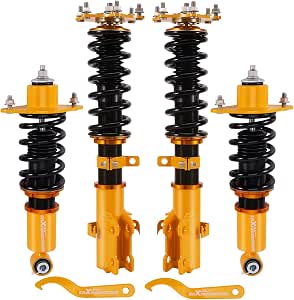 | Best for Simple, Set-and-Forget Lowering | Fitment: Honda CR-V, 2007–2011 | Set contents: Four-piece coilover suspension kit | Spring rate: Front: 6 kg/mm (336 in/lbs); rear: 6 kg/mm (336 lbs/in) | VIEW ON AMAZON | See Our Full Breakdown |
| AUTOSTARSHIP Height-Adjustable Coilover Lowering Kit for 2003–2008 Toyota Corolla |  | Best for Corolla Owners Who Want Basic Height Adjustment | Fitment: Toyota Corolla, 2003–2008 | Included components: Four coilovers and two stainless steel wrenches | Front spring rate: 8 kg/mm (448 in/lbs) | VIEW ON AMAZON | See Our Full Breakdown |
| Rev9 Hyper-Street II Coilover Suspension Lowering Kit for Honda Civic Coupe/Sedan (EM/ES) 2001-2005 |  | Best for Alignment Tuning | Compatibility: Honda Civic Coupe/Sedan (EM/ES), 2001–2005 | Shock type: Mono-tube | Front spring rate: 8 kg/mm (448 lbs/in) | VIEW ON AMAZON | See Our Full Breakdown |
| maXpeedingrods Adjustable Coilover Kit for Honda Civic, CRX, Del Sol, and Acura Integra |  | Best Multi-Model Value for Damping Control | Vehicle fitment: Select Honda Civic (1988–2000), CRX (1988–1991), Del Sol (1992–1995), and Acura Integra (1990–2001) | Kit: Four-corner coilover kit | Rebound damping: 24 levels | VIEW ON AMAZON | See Our Full Breakdown |
| maXpeedingrods Adjustable Coilover Suspension Kit for Subaru BRZ, Toyota 86, and Scion FR-S |  | Best for First-Generation BRZ/86 Alignment Adjustability | Fitment: Subaru BRZ (ZN6/ZC6), Scion FR-S, and Toyota 86, 2012–2020 | Rebound adjustment: 24 levels | Front spring rate: 6 kg/mm (336 in/lbs) | VIEW ON AMAZON | See Our Full Breakdown |
| BHB Adjustable Coilover Suspension Kit for Honda Accord 2003–2007 |  | Best for Accord Owners Wanting a Firmer Setup | Fitment: Honda Accord VII sedans CM4/CM5/CM6 and coupes CM7/CM8, 2003–2007 | Height adjustment: 1–3 inches | Front spring rate: 10 kg/mm (560 lb/in) | VIEW ON AMAZON | See Our Full Breakdown |
| maXpeedingrods Adjustable Coilovers for Toyota Corolla (2009-2019) and Matrix (2009-2014) |  | Best for Newer Corolla and Matrix Fitment | Fitment: Toyota Corolla E140/E150/E160/E170, 2009–2019; Toyota Matrix E140, 2009–2014 | Height adjustment: 1–3 inches | Front spring rate: 7 kg/mm (392 lb/in) | VIEW ON AMAZON | See Our Full Breakdown |
| Rev9 Hyper-Street ONE Adjustable Coilover Lowering Kit for 2006–2011 Honda Civic |  | Best for Drivers Who Want Damping Adjustability | Fitment: Honda Civic FA/FG/FD, 2006–2011 | Lowering range: 1.25–2.25 inches; varies by vehicle | Damping adjustment: 16 levels | VIEW ON AMAZON | See Our Full Breakdown |
| maXpeedingrods Coilover Suspension Kit for Toyota Corolla E90 E100 E110 AE111 (1987-2002) |  | Best for Older Corolla Fitment | Fitment: Toyota Corolla E90 (1987–1992), E100 (1991–1998), E110 (1995–2002), AE92 (1987–1991), AE101 (1992–1998), AE111 (1988–2002) | Height adjustment: 1–3 inches | Front spring rate: 8 kg/mm (448 lb/in) | VIEW ON AMAZON | See Our Full Breakdown |
| E-MOTOR Adjustable Front Coilover Shock Pair for GM G-Body, S10, and S15 |  | Best for Custom GM Front-End Builds | Compatible platforms: GM G-Body, S10, S15 | Position: Front | Included: Two coilover shocks with springs | VIEW ON AMAZON | See Our Full Breakdown |
| budget coilovers that hold alignment | Fitment | Front spring rate | Rear spring rate | Material |
|---|---|---|---|---|
| maXpeedingrods Height-Adjustab | Honda CR-V, 2007–2011 | — | — | 6061-T6 aluminum alloy |
| AUTOSTARSHIP Height-Adjustable | Toyota Corolla, 2003–2008 | 8 kg/mm (448 in/lbs) | 4 kg/mm (224 in/lbs) | 6063 aluminum with T6 heat treatment |
| Rev9 Hyper-Street II Coilover | — | 8 kg/mm (448 lbs/in) | 10 kg/mm (560 lbs/in) | — |
| maXpeedingrods Adjustable Coil | — | — | — | — |
| maXpeedingrods Adjustable Coil | Subaru BRZ (ZN6/ZC6), Scion FR-S, and Toyota 86, 2012–2020 | 6 kg/mm (336 in/lbs) | 5 kg/mm (280 lbs/in) | T6-treated 6061 aluminum alloy |
| BHB Adjustable Coilover Suspen | Honda Accord VII sedans CM4/CM5/CM6 and coupes CM7/CM8, 2003–2007 | 10 kg/mm (560 lb/in) | 6 kg/mm (336 lb/in) | Corrosion-treated 6061-T6 aluminum alloy |
| maXpeedingrods Adjustable Coil | Toyota Corolla E140/E150/E160/E170, 2009–2019; Toyota Matrix E140, 2009–2014 | 7 kg/mm (392 lb/in) | 6 kg/mm (336 lb/in) | 6061 aluminum alloy (T6) |
| Rev9 Hyper-Street ONE Adjustab | Honda Civic FA/FG/FD, 2006–2011 | 6 kg/mm (336 lb/in) | 10 kg/mm; listed equivalent 115.21 lb/in | — |
| maXpeedingrods Coilover Suspen | Toyota Corolla E90 (1987–1992), E100 (1991–1998), E110 (1995–2002), AE92 (1987–1991), AE101 (1992–1998), AE111 (1988–2002) | 8 kg/mm (448 lb/in) | 6 kg/mm (336 lb/in) | 6061 aluminum alloy (T6) |
| E-MOTOR Adjustable Front Coilo | — | — | — | — |
More Details on Our Top Picks
maXpeedingrods Height-Adjustable Coilover Suspension Kit for Honda CR-V (2007–2011)
For a 2007–2011 CR-V owner who wants a lower stance without tuning damping, this kit keeps the setup straightforward: preset dampers, matching 6 kg/mm springs at both ends, and 1–3 inches of lowering. Its 6061-T6 aluminum components and stated spring-cycle testing are useful durability details, but they do not establish how well the car will retain alignment; an alignment after installation and ride-height changes remains necessary. Compared with the Rev9 Hyper-Street II, this kit gives up rebound adjustment and front camber plates, so it offers fewer ways to tailor handling or alignment range. In return, it avoids a multi-setting damper setup. The key limitation is firm: it cannot return the CR-V to factory ride height, making it a poor fit for owners who need stock-height versatility.
Pros:- Vehicle-specific four-piece kit for 2007–2011 Honda CR-V models.
- Adjusts ride height 1–3 inches below stock.
- Preset damping and equal 6 kg/mm front and rear spring rates keep the setup simple.
- 6061-T6 aluminum components and stated spring testing through 600,000 cycles.
Cons:- Cannot retain or return to original ride height.
- Preset damping offers less handling control than adjustable kits such as the Rev9 Hyper-Street II.
- No camber plates are listed, so alignment range may be more limited after lowering.
Best for: 2007–2011 Honda CR-V owners who want a modest, fixed-damping drop and prefer not to tune rebound settings.
Not ideal for: CR-V owners who need to preserve factory ride height, want adjustable damping, or need included camber adjustment for alignment correction.
- Fitment:Honda CR-V, 2007–2011
- Set contents:Four-piece coilover suspension kit
- Spring rate:Front: 6 kg/mm (336 in/lbs); rear: 6 kg/mm (336 lbs/in)
- Ride-height adjustment:1–3 inches below original height
- Damping:Factory preset
- Material:6061-T6 aluminum alloy
- Model number:DQ28VD
Our verdict“Choose this CR-V kit if you want a straightforward drop with preset damping, but skip it if stock-height flexibility or extra alignment adjustment matters.”
AUTOSTARSHIP Height-Adjustable Coilover Lowering Kit for 2003–2008 Toyota Corolla
This Corolla kit focuses on one job: lowering a 2003–2008 car by 5–10 cm with four vehicle-specific coilovers. Its front 8 kg/mm and rear 4 kg/mm spring rates create a deliberately different front-to-rear balance, while the non-adjustable dampers keep setup choices limited. That simplicity is a tradeoff, not an alignment feature: changing ride height can affect suspension geometry, and the product data lists no camber plates or other alignment hardware. Compared with the maXpeedingrods Civic/CRX/Integra kit, it also lacks rebound adjustment, so there is less scope to tune the car after installation. The included stainless steel wrenches are a practical addition, but professional installation is recommended, and this kit cannot restore factory ride height.
Pros:- Vehicle-specific fitment for 2003–2008 Toyota Corolla models.
- Stated 5–10 cm lowering range at the front and rear.
- Includes two stainless steel adjustment wrenches.
- 6063 aluminum with T6 heat treatment is intended to reduce component weight.
Cons:- Non-adjustable dampers limit handling fine-tuning.
- Cannot return the car to original ride height.
- No camber plates are listed, and professional installation is recommended.
Best for: Owners of a 2003–2008 Toyota Corolla seeking a defined lowering range and a basic, non-adjustable damper setup.
Not ideal for: Drivers who want adjustable rebound, stock-height flexibility, or listed camber hardware to help manage alignment after lowering.
- Fitment:Toyota Corolla, 2003–2008
- Included components:Four coilovers and two stainless steel wrenches
- Front spring rate:8 kg/mm (448 in/lbs)
- Rear spring rate:4 kg/mm (224 in/lbs)
- Lowering range:5–10 cm, front and rear
- Damper adjustment:Non-adjustable
- Material:6063 aluminum with T6 heat treatment
- Warranty:1 year
Our verdict“This suits Corolla owners who want a defined drop without damper tuning, but not those prioritizing alignment adjustability or stock-height use.”
Rev9 Hyper-Street II Coilover Suspension Lowering Kit for Honda Civic Coupe/Sedan (EM/ES) 2001-2005
Among these five, the Rev9 offers the clearest alignment-related hardware: its front pillow ball camber plates give Civic owners an adjustment option that the CR-V and Corolla kits do not list. A 32-click rebound range and separate ride-height and spring-tension settings also allow more setup control than the preset maXpeedingrods CR-V kit. Those controls suit an owner willing to tune carefully, rather than someone seeking a fit-and-forget replacement. The mono-tube shocks and 8 kg/mm front, 10 kg/mm rear springs make this a more adjustable, firmer-oriented package, but the stated design is for lowering only; it does not return to factory height. The rear uses a standard top mount, and the product listing provides no installation instructions, so the front alignment hardware does not make setup effortless.
Pros:- Front pillow ball camber plates provide an alignment adjustment option.
- 32-click rebound adjustment allows fine changes to damping response.
- Ride height and spring tension adjust independently.
- Mono-tube shock design with 8 kg/mm front and 10 kg/mm rear springs.
Cons:- Designed for lowering and does not adjust back to factory ride height.
- No installation instructions are included; professional installation is recommended.
- Higher spring rates and multiple adjustments may demand more careful setup than the preset CR-V kit.
Best for: 2001–2005 Honda Civic Coupe or Sedan owners who want rebound tuning and front camber adjustment for a lowered street setup.
Not ideal for: Drivers who need factory ride height, want a simple preset setup, or are not prepared to arrange professional installation and alignment.
- Compatibility:Honda Civic Coupe/Sedan (EM/ES), 2001–2005
- Shock type:Mono-tube
- Front spring rate:8 kg/mm (448 lbs/in)
- Rear spring rate:10 kg/mm (560 lbs/in)
- Damping adjustment:32-click rebound
- Top mounts:Front pillow ball camber plate; rear standard
- Materials:Alloy steel and aluminum
Our verdict“Pick the Rev9 if front camber adjustment and rebound tuning matter more than an easy, stock-height-compatible setup.”
maXpeedingrods Adjustable Coilover Kit for Honda Civic, CRX, Del Sol, and Acura Integra
This kit covers a broad range of older Honda and Acura applications, pairing 24 rebound settings with 1–3 inches of ride-height adjustment. That gives owners more control than the preset CR-V coilovers and the non-adjustable AUTOSTARSHIP Corolla kit, while its twin-tube design is described as aiming for a more comfortable ride. It is not the strongest alignment pick in the group: no camber plates are listed, unlike the Rev9 Hyper-Street II, so rebound adjustment should not be mistaken for camber correction. Fitment also depends on the exact Civic, CRX, Del Sol, or Integra configuration, including specified bracket requirements for some Integra models. As with several kits here, it only lowers the vehicle and cannot preserve factory ride height.
Pros:- 24 rebound settings offer more damping control than the preset or non-adjustable kits.
- Adjustable ride height allows 1–3 inches of lowering.
- Twin-tube construction is described as targeting a more comfortable ride.
- One kit covers specified Civic, CRX, Del Sol, and Integra applications.
Cons:- Does not maintain original ride height.
- No camber plates are listed, unlike the Rev9 Hyper-Street II.
- Fitment is limited to specified years and configurations, including bracket requirements on some Integras.
Best for: Owners of a listed 1988–2001 Civic, CRX, Del Sol, or Integra who want adjustable rebound and ride height in one kit.
Not ideal for: Drivers who need factory ride height, need camber plates for alignment range, or cannot verify their exact model and bracket configuration.
- Vehicle fitment:Select Honda Civic (1988–2000), CRX (1988–1991), Del Sol (1992–1995), and Acura Integra (1990–2001)
- Kit:Four-corner coilover kit
- Rebound damping:24 levels
- Height adjustment:1–3 inches
- Front spring rates:8 kg/mm (448 lbs/in) and 5 kg/mm (280 lbs/in)
- Spring preload:7–10 mm
- Construction:Twin-tube, aluminum
- Warranty:1 year
Our verdict“Choose this for adjustable rebound across a compatible older Honda or Acura, but verify fitment and look elsewhere if camber plates are a priority.”
maXpeedingrods Adjustable Coilover Suspension Kit for Subaru BRZ, Toyota 86, and Scion FR-S
For first-generation BRZ, 86, and FR-S owners, this kit combines 24 rebound settings with camber plates and adjustable ride height, making it more alignment-oriented than the maXpeedingrods Civic/CRX/Integra kit, which lists rebound adjustment but no camber plates. The front 6 kg/mm and rear 5 kg/mm springs provide a different front-to-rear balance from the firmer Rev9 Civic setup, whose rates are 8 and 10 kg/mm. That comparison matters because spring rates shape the intended response; neither rate data nor camber plates alone guarantees that alignment will remain in specification. The stated 1–3-inch adjustment is for lowering, not returning to stock height. Its specific first-generation fitment is useful for targeted buyers, but owners of later BRZ/86/FR-S models should rule it out.
Pros:- 24 rebound settings allow damping adjustments for different driving conditions.
- Camber plates add alignment adjustment hardware.
- Ride height adjusts 1–3 inches for a lowered stance.
- 6061 aluminum alloy is T6-treated, and the listed springs are tested for up to 600,000 cycles.
Cons:- Does not retain the vehicle’s original ride height.
- Fitment is limited to first-generation models from 2012–2020.
- Alignment retention is not guaranteed by the adjustable features; setup and alignment still require attention.
Best for: Owners of a 2012–2020 first-generation BRZ, Toyota 86, or Scion FR-S who want rebound adjustment and camber plates for a lowered setup.
Not ideal for: Owners of later-generation models, drivers who need factory ride height, or buyers expecting camber plates alone to prevent alignment changes.
- Fitment:Subaru BRZ (ZN6/ZC6), Scion FR-S, and Toyota 86, 2012–2020
- Rebound adjustment:24 levels
- Front spring rate:6 kg/mm (336 in/lbs)
- Rear spring rate:5 kg/mm (280 lbs/in)
- Ride-height adjustment:1–3 inches
- Material:T6-treated 6061 aluminum alloy
- Weight:47.7 pounds
- Model number:LZ47XK
Our verdict“This is the most targeted choice here for first-generation BRZ/86/FR-S owners who want camber adjustment and rebound tuning, provided they accept a lowering-only setup.”
BHB Adjustable Coilover Suspension Kit for Honda Accord 2003–2007
I’d put this BHB kit on the shortlist for 2003–2007 Accord owners who want a fixed, lower stance and spring rates specified for front and rear. Its 10 kg/mm front and 6 kg/mm rear springs offer a firmer setup than the Corolla kits here, whose front rates are 7 or 8 kg/mm. That may suit a driver prioritizing body control, but spring rates alone can’t establish how well a car will hold alignment: ride height, installation, suspension condition, and a professional alignment all matter. The 1–3-inch lowering range also means this is not a stock-height replacement. Corrosion-treated 6061-T6 components and included adjustment tools are practical touches, though the kit is restricted to listed Accord sedan and coupe fitments. I’d choose it over the Rev9 Civic kit if Accord fitment matters more than adjustable damping.
Pros:- Height adjusts across a 1–3-inch lowering range.
- Specified 10 kg/mm front and 6 kg/mm rear spring rates provide a firmer setup than the listed Corolla kits.
- Corrosion-treated 6061-T6 aluminum components and high-tensile steel springs.
- Includes adjustment wrenches and an installation manual.
Cons:- Cannot retain factory ride height.
- Fitment is limited to the specified 2003–2007 Accord sedan and coupe models.
- No damping adjustment is listed, so the setup offers less tuning flexibility than the Rev9 Civic kit.
Best for: Owners of the specified 2003–2007 Accord sedans or coupes seeking adjustable lowering and a firmer spring setup, with an alignment planned after installation.
Not ideal for: Accord owners who need factory ride height, want damping adjustment, or have a trim or chassis code outside the listed fitment.
- Fitment:Honda Accord VII sedans CM4/CM5/CM6 and coupes CM7/CM8, 2003–2007
- Height adjustment:1–3 inches
- Front spring rate:10 kg/mm (560 lb/in)
- Rear spring rate:6 kg/mm (336 lb/in)
- Material:Corrosion-treated 6061-T6 aluminum alloy
- Set contents:Two front and two rear coilover assemblies, two adjustment wrenches, installation manual
- Model number:EGR-1098-R-BHB-NEW
Our verdict“I’d choose this for a compatible Accord that needs adjustable lowering and a firm spring setup, but not for stock-height comfort or damping tunability.”
maXpeedingrods Adjustable Coilovers for Toyota Corolla (2009-2019) and Matrix (2009-2014)
Among these choices, I’d favor this kit when the car is a listed 2009–2019 Corolla or 2009–2014 Matrix and the goal is adjustable lowering with a stated, fixed damping setup. Its 7 kg/mm front and 6 kg/mm rear rates are less aggressive at the front than the older Corolla kit’s 8 kg/mm rate, which may appeal to drivers who don’t want to start with the firmer front spring specification. Both Corolla options lower 1–3 inches and use 6061-T6 aluminum, so neither spec sheet proves one will hold alignment better; alignment depends on the vehicle, installed ride height, and setup. The factory-preset damping keeps adjustment simpler than the Rev9 Civic’s 16-level system, but gives up fine-tuning. Powder coating is a useful finish detail, while the listed 59.3-pound package is substantial to handle.
Pros:- Fits specified later Corolla generations and 2009–2014 Matrix models.
- Provides 1–3 inches of ride-height adjustment.
- Uses 6061-T6 aluminum alloy, high-tensile springs, and a powder-coated exterior.
- Factory-preset damping avoids the setup choices presented by the Rev9 Civic kit.
Cons:- Not designed to maintain original factory ride height.
- Damping is factory-preset rather than adjustable.
- Listed item weight is 59.3 pounds, which may make handling and installation logistics less convenient.
Best for: Owners of a compatible 2009–2019 Corolla or 2009–2014 Matrix who want a preset-damping kit and adjustable lowering without a separate damping-tuning process.
Not ideal for: Drivers seeking factory ride height, adjustable damping, or a kit for Corolla years outside the listed range.
- Fitment:Toyota Corolla E140/E150/E160/E170, 2009–2019; Toyota Matrix E140, 2009–2014
- Height adjustment:1–3 inches
- Front spring rate:7 kg/mm (392 lb/in)
- Rear spring rate:6 kg/mm (336 lb/in)
- Material:6061 aluminum alloy (T6)
- Exterior finish:Powder coated
- Damping:Factory-preset values
- Item weight:59.3 pounds
- Model number:RH15WA
Our verdict“I’d pick this for a compatible newer Corolla or Matrix owner who wants straightforward lowering, but skip it if damping adjustment or stock height is a requirement.”
Rev9 Hyper-Street ONE Adjustable Coilover Lowering Kit for 2006–2011 Honda Civic
The Rev9 earns a distinct place here for Civic owners who want to adjust more than ride height: its 16 damping settings offer tuning choices absent from the BHB Accord and both maXpeedingrods Corolla kits, which list preset or no damping adjustment. The mono-tube design and 1.25–2.25-inch lowering range give this kit a different setup proposition, but neither feature alone guarantees alignment retention. I’d treat the alignment result as dependent on final ride height, installation, and a proper alignment check. The fitment covers 2006–2011 FA, FG, and FD Civics; the rear reuses the factory top mount, while the front uses a standard pillow-ball mount. That reuse may simplify parts needs, but buyers should account for the listed professional-install recommendation and the fact that instructions are not included. Its narrower lowering range also differs from the 1–3-inch Corolla kits.
Pros:- Offers 16 damping settings for tuning beyond ride height.
- Mono-tube shock design.
- Provides a 1.25–2.25-inch lowering range.
- Front pillow-ball mount and factory rear top-mount reuse are clearly specified.
Cons:- Installation instructions are not included, and professional installation is recommended.
- The rear setup reuses the factory top mount rather than supplying a replacement.
- Lowering range is narrower than the 1–3-inch range of the Corolla kits.
Best for: Owners of compatible 2006–2011 Civic FA, FG, or FD models who want damping adjustment and are prepared to arrange professional installation.
Not ideal for: DIY installers who need included instructions, buyers seeking a wider 1–3-inch drop, or anyone wanting a kit that replaces both front and rear top mounts.
- Fitment:Honda Civic FA/FG/FD, 2006–2011
- Lowering range:1.25–2.25 inches; varies by vehicle
- Damping adjustment:16 levels
- Shock design:Mono-tube
- Front spring rate:6 kg/mm (336 lb/in)
- Rear spring rate:10 kg/mm; listed equivalent 115.21 lb/in
- Top mounts:Standard pillow-ball front; reuses factory rear top mount
- Manufacturer part number:R9-HPX-1128
- Warranty:Limited manufacturer warranty; parts only
Our verdict“I’d choose this Civic kit over the preset-damping alternatives when adjustment matters, provided professional installation and a post-install alignment fit the plan.”
maXpeedingrods Coilover Suspension Kit for Toyota Corolla E90 E100 E110 AE111 (1987-2002)
This kit’s main advantage is its unusually broad coverage of older Corolla generations: the listed applications span E90, E100, E110, AE92, AE101, and AE111 models from 1987 through 2002. I’d place it ahead of the newer Corolla/Matrix maXpeedingrods kit only for buyers whose chassis falls in that older range; the newer kit is the relevant choice for 2009–2019 Corollas and adds Matrix fitment. Both offer 1–3 inches of lowering, 6061-T6 aluminum, and factory-preset damping, so the spec sheet doesn’t establish an alignment advantage for either. The older Corolla kit lists an 8 kg/mm front spring rate against 6 kg/mm at the rear, a firmer front specification than the newer kit’s 7 kg/mm. It cannot preserve stock height, and its 59.7-pound listed weight is another practical drawback.
Pros:- Lists fitment across several older Corolla generations, including E90, E100, E110, AE92, AE101, and AE111.
- Offers a 1–3-inch height-adjustment range.
- Uses 6061-T6 aluminum alloy and high-tensile springs.
- Its 8 kg/mm front rate is a firmer listed front specification than the newer Corolla kit’s 7 kg/mm rate.
Cons:- Cannot maintain original factory ride height.
- Damping is listed as factory-preset rather than adjustable.
- At 59.7 pounds, the listed item weight may complicate handling.
Best for: Owners of a listed 1987–2002 Corolla generation who want adjustable lowering and have confirmed the exact chassis fitment.
Not ideal for: Owners of 2003-and-newer Corollas, drivers who need factory ride height, or buyers seeking adjustable damping.
- Fitment:Toyota Corolla E90 (1987–1992), E100 (1991–1998), E110 (1995–2002), AE92 (1987–1991), AE101 (1992–1998), AE111 (1988–2002)
- Height adjustment:1–3 inches
- Front spring rate:8 kg/mm (448 lb/in)
- Rear spring rate:6 kg/mm (336 lb/in)
- Material:6061 aluminum alloy (T6)
- Damping:Factory-preset values
- Item weight:59.7 pounds
- Manufacturer part number:JN94LF
Our verdict“I’d choose this over the newer Corolla kit only for a confirmed 1987–2002 fitment, and not for stock-height or damping-adjustment needs.”
E-MOTOR Adjustable Front Coilover Shock Pair for GM G-Body, S10, and S15
I’d treat the E-MOTOR pair as a custom-build component, not a direct substitute for the complete, vehicle-specific kits elsewhere in this roundup. It supplies two front coilover shocks with 500 lb/in springs and up to 3 inches of ride-height adjustment for GM G-Body, S10, and S15 platforms. Unlike the BHB Accord or the two Corolla kits, it covers the front only, so it does not provide a matched four-corner setup. That makes it more relevant to a builder choosing front components than to someone seeking a whole-car alignment solution. The listing specifically asks buyers to verify fitment and mounting dimensions, and professional installation is recommended. No damping-adjustment details or rear components are supplied in the data, so I’d rank it below the vehicle-specific kits for a straightforward, alignment-focused suspension replacement.
Pros:- Includes a pair of front coilover shocks and springs.
- Provides up to 3 inches of ride-height adjustment.
- 500 lb/in spring rate is specified for the included pair.
- Designed for GM G-Body, S10, and S15 platforms.
Cons:- Front pair only; it is not a complete four-corner kit like the Accord or Corolla options.
- Fitment and mounting dimensions must be verified before purchase.
- Professional installation is recommended, and damping adjustment is not specified.
Best for: GM G-Body, S10, or S15 builders assembling a custom front suspension who can verify mounting dimensions and arrange professional installation.
Not ideal for: Drivers seeking a complete four-corner kit, a confirmed vehicle-specific fit without dimension checks, or stated damping adjustability.
- Compatible platforms:GM G-Body, S10, S15
- Position:Front
- Included:Two coilover shocks with springs
- Spring rate:500 lb/in
- Ride-height adjustment:Up to 3 inches
- Model:Co_MG-124
- Item weight:24 pounds
- Exterior:Polished
- Manufacturer part number:CO_MG-124
Our verdict“I’d consider this for a dimension-verified custom GM front-end build, but choose a complete vehicle-specific kit for a full suspension replacement.”
How We Picked
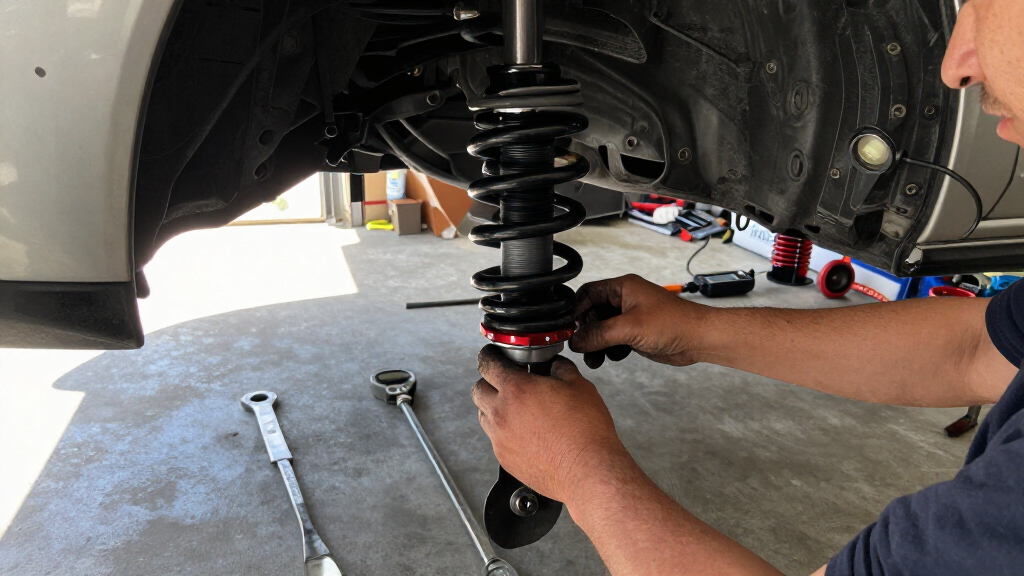
I ranked these kits by how clearly their listed applications identify the intended vehicle, how useful the adjustment is for a buyer seeking a lower stance without careless geometry changes, and whether the product appears to address a complete suspension setup or only part of one. I also weighed practical ownership factors: installation complexity, the need for alignment correction, and how much the fitment range asks the buyer to verify before ordering. A broad fitment claim is not automatically a benefit if it leaves chassis compatibility unclear.
The order favors clearly targeted applications and kits that make sense as a coherent choice for the named platform, while accounting for the limits of budget hardware and the lack of alignment-retention guarantees. The Rev9 Civic kit ranks first as a focused application; the BRZ/86/FR-S and CR-V kits follow for their defined vehicle groups. The E-MOTOR option ranks lower because it is a front coilover shock pair rather than a full-car kit, and every pick remains subject to exact fitment confirmation, condition of related suspension parts, and professional alignment after installation.
Factors to Consider When Choosing Budget Coilovers That Hold Alignment
Choosing a kit is only one part of getting a suspension setup that keeps its alignment. I would treat fitment, target ride height, adjustment range, supporting parts, and setup costs as connected decisions rather than buying by brand or lowering claims alone.
Match the Kit to the Exact Chassis
Confirm the model year, body style, drivetrain, and chassis code before ordering; similar names do not always mean shared suspension dimensions. This matters especially across Corolla generations and Civic body styles, where a broad application label can conceal meaningful differences. Check whether the kit covers the front and rear or only a pair of corners, and compare the listing with your vehicle’s original suspension layout. A mismatch can create installation problems or leave you with an incomplete setup. If a listing groups several platforms together, ask the seller or a qualified installer to verify the exact part fitment before purchase.
Choose a Sensible Ride Height Before Installation
Lowering changes suspension geometry, and pushing ride height to the limit can reduce available travel and make alignment targets harder to reach. Decide on a practical height based on road quality, tire clearance, and intended use before the car goes on the alignment rack. Avoid setting each corner by eye: measure consistently and account for driver and cargo weight where appropriate. A modest drop can preserve more usable travel than an aggressive stance, though the result still depends on the vehicle and kit. Ask the installer to flag any alignment settings that fall outside the manufacturer’s range rather than accepting a visually level car as proof of correct setup.
Budget for Alignment and Geometry Correction
The purchase price of a kit is not the full cost of a dependable setup. Installation, a four-wheel alignment where applicable, and follow-up checks after the suspension settles can add time and expense. Some cars may need adjustable control arms or other correction parts to reach suitable camber or toe after lowering; those parts are vehicle-specific and should not be bought on guesswork. Excess toe can contribute to rapid tire wear, while excessive camber may affect tire contact and handling. Get an alignment plan from a shop familiar with your platform before selecting a ride height.
Check the Rest of the Suspension First
Coilovers cannot compensate for worn bushings, damaged ball joints, loose tie rods, or bent components. Those faults can cause alignment readings to shift or prevent the shop from setting the car correctly, no matter which kit you install. Have the existing suspension inspected and replace failed parts before alignment, not after new tires begin wearing unevenly. This can make a budget kit a more expensive project upfront, but it avoids blaming the coilovers for movement caused elsewhere. Older vehicles in particular may need seized hardware addressed during installation.
Decide Whether You Need a Full Kit or a Pair
Some listings cover a complete vehicle while others, such as a front coilover shock pair, address only one end of the car. A partial kit may suit a specific build or replacement need, but it is not a direct substitute for a matched four-corner suspension package. Mixing components can create differences in spring rate, damping, and ride height that complicate handling and setup. Confirm what is included, what must be reused, and whether your intended configuration remains compatible with the rear suspension. Buyers seeking a balanced street setup should favor a matched system unless a qualified suspension specialist has planned the mixed arrangement.
Compare Adjustability With Support and Serviceability
Height adjustment is useful only if the hardware can be set and maintained properly. Ask how the manufacturer specifies adjustment, what tools are needed, and whether replacement parts or technical support are available for the exact kit. Threaded collars can become difficult to move when exposed to road grime, so periodic cleaning and inspection matter. Do not assume that damping adjustment, if listed, will correct an unsuitable spring or alignment setup. If the car is a daily driver, prioritize a clear fitment path and accessible service information over a long list of adjustment claims.
Frequently Asked Questions
Can budget coilovers keep my car aligned after lowering?
They can be part of a setup that stays within alignment specifications, but no coilover kit can guarantee that result by itself. Ride height, worn suspension parts, installation, road impacts, and the vehicle’s available adjustment range all matter. Have the car aligned after installation and recheck it if the suspension settles or you notice uneven tire wear or a change in steering behavior. If the shop cannot reach suitable readings, ask whether the ride height or vehicle-specific correction parts need attention.
Should I get an alignment immediately after installing coilovers?
Yes: changing suspension height can alter alignment, so arrange an alignment once installation is complete. Follow the kit maker’s guidance on settling time, and ask the alignment shop whether a follow-up check is appropriate after the suspension has settled. Make sure the shop inspects for loose or worn steering and suspension parts before setting the angles. Keep the alignment printout so you can compare later readings if the car starts pulling or wearing tires unevenly.
How do I know whether a kit fits my exact Corolla or Civic?
Use the exact model year, body style, and chassis details, not just the vehicle name. The Corolla options here cover distinct older and newer year ranges, and the Civic choices also target different generations and applications. Compare the product’s stated fitment with your registration details and the manufacturer’s part information, then confirm any uncertainty with the seller or installer. Do not assume that a kit for a sedan fits a coupe or that adjacent model years share the same suspension.
Do I need adjustable control arms after installing budget coilovers?
Not in every case; the need depends on your car, how far it is lowered, and whether the alignment can be brought into the required range with the original components. A shop should measure the car after installation before recommending correction parts. Buying arms in advance can waste money or introduce fitment issues if they are not suited to your exact chassis. If the readings cannot be corrected, use parts selected for the vehicle and intended ride height rather than trying to mask the issue with extreme settings.
Is a front coilover pair enough for a street car?
A front pair can be appropriate for a specific repair or build plan, but it does not provide a matched four-corner setup on its own. The E-MOTOR listing is for front coilover shocks, so buyers should confirm what remains at the rear and how the complete suspension will work together. Mixing new front components with different rear springs or dampers can affect balance and make ride height harder to coordinate. If you want a complete street suspension change, compare full kits and ask an installer to review the whole vehicle configuration.
Conclusion
For a clear starting point, I would choose the Rev9 Hyper-Street II as the best overall option for its specifically listed 2001–2005 Civic application. The maXpeedingrods older Corolla kit is the best value-oriented pick for owners of the named E90, E100, E110, or AE111 generations who verify their exact chassis, while the BRZ/86/FR-S kit is the best fit for that sports-coupe family. For beginners, I would favor the kit with the clearest match to the car and have an experienced installer handle setup rather than choosing the widest adjustment range. Buyers seeking a more premium choice should compare support, included components, and serviceability beyond this budget-focused list, since none of these listings alone establishes a premium build advantage. For specific needs, select the CR-V kit for the listed 2007–2011 SUV, the newer Corolla/Matrix kit for its stated years, or the E-MOTOR pair only when a front-only application fits the plan. Whichever kit you choose, confirm fitment, inspect the rest of the suspension, and budget for alignment and follow-up checks.
Halloween Picks
halloween
As an affiliate, we earn on qualifying purchases.