When your car’s USB-C port charges slower than USB-A, it’s often because the devices, cables, or chargers don’t support fast-charging standards like Power Delivery. USB-C can handle higher wattages, but if your phone or accessory isn’t compatible or the cable isn’t of high quality, charging speed drops. Compatibility issues and device limitations matter too. Keep in mind, understanding these factors helps you get the most out of your car’s charging options, and there’s more to explore below.

Get business pricing on garage and car supplies
- Business-only prices and quantity discounts
- Tax-exempt purchasing
- Multiple users, one account, clear invoices
Key Takeaways
- USB-C ports may default to standard or lower power modes if not supporting fast-charging protocols like Power Delivery.
- The quality and internal wiring of the cable significantly affect charging speed, with inferior cables causing voltage drops.
- Older devices lacking hardware or firmware support for fast-charging standards can limit USB-C charging speeds.
- USB-A ports often provide consistent, though slower, charging because they usually support standard or lower power outputs.
- Compatibility between charger, cable, and device determines whether USB-C can achieve faster or slower charging compared to USB-A.
Understanding USB-A and USB-C Connectors

Understanding USB-A and USB-C connectors is essential for choosing the right charging and data transfer solutions. USB-A features a rectangular shape and isn’t reversible, making it straightforward but sometimes less convenient. It supports USB 2.0 at 480 Mbps or USB 3.0 at 5 Gbps, with power outputs typically limited to 2.5W to 12W. You’ll find USB-A ports in older devices, computers, cars, and wall chargers. On the other hand, USB-C has an oval, slim design and is reversible, so you can plug it in either way. It supports faster data transfer, up to 40 Gbps with USB4, and standard power output of 18W, with optional higher wattage via Power Delivery. USB-C is increasingly common in modern smartphones, tablets, and laptops, offering greater versatility and performance. Additionally, contrast ratio plays a significant role in determining the clarity and depth of images, especially in home cinema setups. Moreover, power delivery capabilities are continually evolving, allowing USB-C to support higher wattages for charging larger devices more efficiently. The compatibility of these connectors depends on both device design and supported standards, influencing overall performance. Understanding navigation and mapping is also important because it affects how devices identify and communicate with connected peripherals, impacting overall efficiency.
Power Output Differences and Charging Speeds

Your charging speed depends on the power output capabilities of your charger and cable quality. While USB-C with Power Delivery can charge devices much faster, device compatibility and cable quality can limit those speeds. Understanding these factors helps you choose the right setup for quick, efficient car charging. Additionally, selecting a reliable backup power source can ensure consistent charging performance and safety during power fluctuations.
Power Delivery Capabilities
Power Delivery (PD) technology markedly enhances the charging capabilities of USB-C ports by negotiating higher voltages and currents, resulting in faster and more efficient power transfer. Unlike standard USB-A ports with fixed power limits, PD dynamically adjusts voltage and amperage to match device needs, enabling up to 100W or more. This flexibility allows you to charge larger devices like laptops quickly and efficiently. When your charger and device both support PD, you’ll notice considerably reduced charging times compared to traditional methods. PD also supports bidirectional power flow, meaning your device can supply power back to accessories or other devices. Overall, PD unleashes the full potential of USB-C, providing faster, smarter, and more adaptable charging experiences. Free Floating
Cable Quality Impact
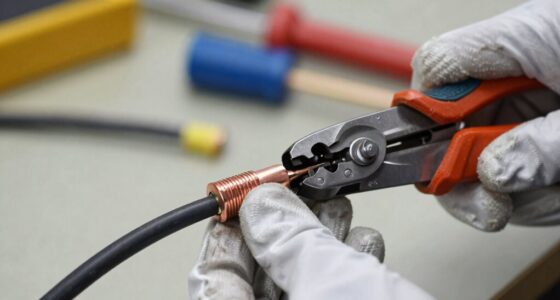
Cable quality directly affects the power output and charging speeds you experience. Poor-quality cables can’t handle high current, causing voltage drops and slower charging. Lower-grade cables may limit power transfer, even if your charger and device support fast charging. Using certified, high-quality cables ensures ideal current flow, maintaining high speeds. Conversely, cheap or damaged cables can cause overheating, reduce efficiency, or even damage your device. Always check for proper certification and compatible specifications. Additionally, cable durability plays a role in long-term performance and safety. Ensuring your cables meet industry standards helps prevent potential safety hazards and consistent performance. Proper cable construction and materials also contribute to reliable charging over time.
Device Compatibility Limits
Device compatibility plays a crucial role in determining charging speeds because not all gadgets can utilize the full potential of USB-C or high-wattage chargers. If your device isn’t designed to handle higher power levels, it won’t charge faster even with a powerful charger. For example, older smartphones or tablets may only accept limited wattages, capping your charging speed. Some devices also lack Power Delivery (PD) support, meaning they can’t negotiate higher voltages or currents, limiting maximum power intake. Additionally, the device’s battery capacity and internal charging circuitry influence how quickly it can safely charge. Using a high-wattage charger with incompatible or older devices may result in slower charging or no speed benefits at all. Compatibility issues ultimately restrict the potential speed gains from advanced USB-C charging technology, especially when device power handling capabilities are limited. Furthermore, manufacturers often implement charging protocols that determine how much power a device can draw, impacting the overall charging efficiency.
The Role of Power Delivery in Charging Performance
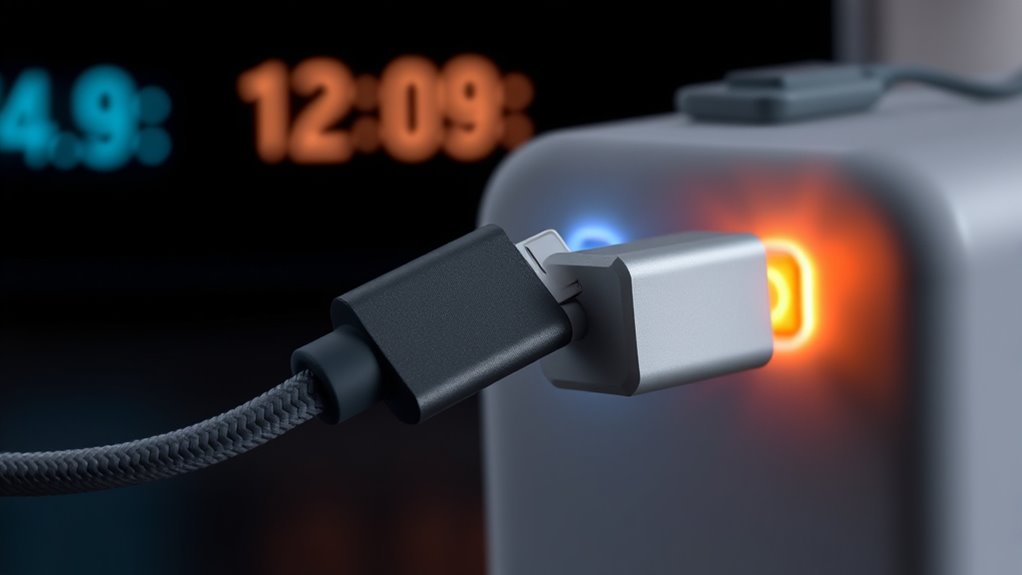
Power Delivery (PD) plays a crucial role in enhancing charging performance by allowing compatible devices and chargers to negotiate the ideal voltage and current levels. This negotiation ensures your device receives the maximum safe power, reducing charging times considerably. Without PD, USB-C ports default to lower or fixed power outputs, limiting charging speed. PD supports up to 100W, enabling fast charging for smartphones, tablets, and even laptops. It also allows bidirectional power flow, meaning your device can supply power back to accessories or other devices. When your charger and device support PD, they communicate to optimize power transfer, avoiding overheating or damage. This Power negotiation is essential for maximizing charging efficiency and safety. It also involves user consent management, allowing users to customize their experience and control over the charging process. Without PD, charging remains slower and less adaptable.
Common Reasons Why USB-C Can Be Slower

Even when using USB-C, your charging speed can be slower than expected if certain factors aren’t ideal. First, if your charger or device lacks Power Delivery (PD) support, you won’t get the full charging potential. Second, poor-quality cables may not handle high power levels, limiting speed. Third, older devices often can’t fully utilize USB-C’s faster capabilities. Fourth, some USB-C ports default to standard charging without PD, reducing power flow. Fifth, your device’s battery capacity and power-saving features can cap charging speed, even if your setup is capable. Understanding encryption can also help you protect your data during these processes. Additionally, proper port selection is crucial because not all USB-C ports are designed for fast charging. To optimize charging, it’s important to be aware of compatible accessories that support the fastest speeds. Knowing power output specifications of your charger and device can further ensure you achieve optimal charging speeds. Furthermore, AI-driven advancements are contributing to improved charging technologies, leading to faster and safer power delivery.
How Cable Quality Affects Charging Efficiency
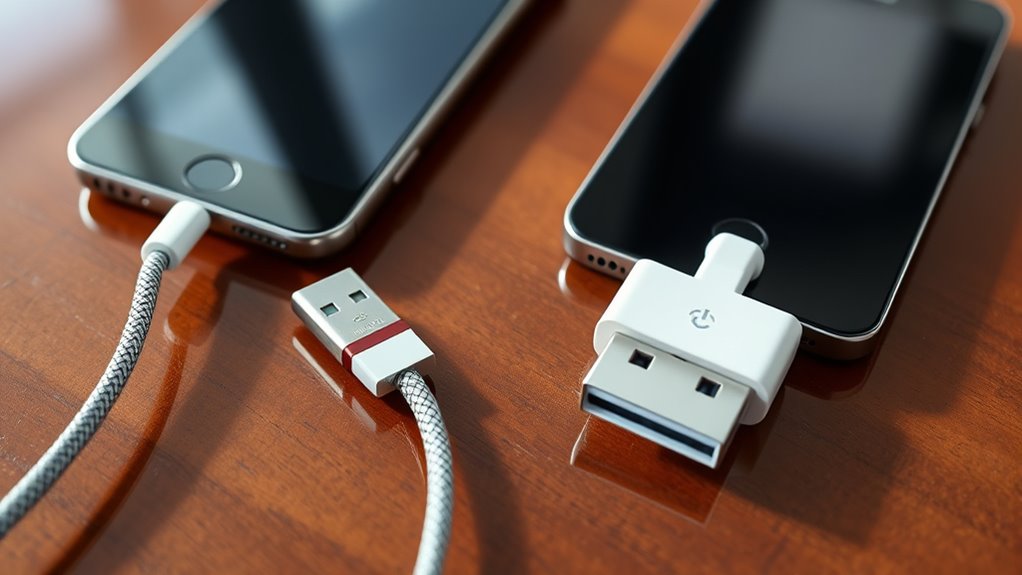
High-quality charging cables are essential for maximizing your device’s charging efficiency because they can handle higher currents without losing power or causing safety issues. Poor cables often have thinner wires or inferior materials, leading to voltage drops and slower charging. Cheap cables may also lack proper shielding, causing interference and inconsistent power flow. Using subpar cables can result in longer charging times, overheating, or even damaging your device. Additionally, cable construction plays a significant role in durability and performance during repeated use. Ensuring your cable has proper internal wiring can help maintain consistent power delivery and reduce the risk of damage over time. Moreover, the materials used in cable manufacturing can influence both safety and efficiency, as high-quality materials reduce the chances of overheating and ensure compliance with safety standards.
Device Compatibility and Limitations

Your device’s age and type can limit charging speed and compatibility with newer car chargers. Older devices may not support fast-charging technologies like USB-C Power Delivery, resulting in slower fills. Understanding these limitations helps you choose the right charger for your specific device.
Device Compatibility Limits
While USB-C offers impressive charging and data transfer speeds, device compatibility remains a key limitation. Not all devices can fully utilize USB-C’s capabilities, especially older models. Your device’s internal hardware may cap charging speed or data transfer, regardless of port quality. Some devices lack support for Power Delivery (PD), so they can’t handle higher wattages. Cable quality also matters; cheap or incompatible cables may restrict power flow. Additionally, if your device isn’t designed for fast charging, it won’t benefit from higher wattage sources. Here’s what to watch for:
- Older devices without USB-C ports
- Devices lacking PD support
- Low-quality or incompatible cables
- Devices with limited charging circuitry
- Built-in battery or software restrictions
Understanding these limits helps you set realistic expectations for charging speeds.
Older Device Capabilities
Older devices often struggle to fully utilize the capabilities of modern USB-C chargers and cables. You may find that even if you connect a high-wattage USB-C charger, your device only draws minimal power, limiting charging speed. Many older gadgets rely on USB 2.0 or earlier standards, which support lower data transfer rates and power outputs. They lack the necessary hardware to negotiate higher voltages or amperages offered by USB-C Power Delivery. Additionally, some older devices don’t have the firmware or circuitry to communicate effectively with newer chargers, resulting in slower or incomplete charging. Using incompatible cables or adapters can further restrict charging. Ultimately, your older device’s hardware and firmware define its limits, preventing it from benefiting fully from the fast-charging potential of modern USB-C technology.
The Impact of Charger and Device Support for PD

The support for Power Delivery (PD) notably affects how quickly and efficiently devices charge, as both chargers and gadgets must be compatible with PD standards. If either the charger or device doesn’t support PD, charging speeds drop significantly. You might have a USB-C cable, but without PD support, your device won’t reach its maximum charging potential. Here’s what impacts PD support:
- Using a charger without PD compatibility limits power output.
- Connecting devices that don’t support PD prevents fast charging.
- Poor-quality cables can’t handle high wattages.
- Older devices may lack hardware to utilize PD speeds.
- Non-PD ports default to standard, slower charging modes.
Ensuring both your charger and device support PD is key to enabling the fastest charging speeds and reducing your wait time.
Practical Scenarios of USB-A vs. USB-C Charging

When choosing between USB-A and USB-C for everyday charging, practical considerations often determine the best option. If you’re using older devices or cars with basic ports, USB-A might be more convenient, especially since many chargers and cables are widely available. However, if you want faster charging and data transfer, USB-C with Power Delivery is preferable, especially for newer smartphones, tablets, or laptops. In daily scenarios like charging your phone in a car or at home, USB-A can still do the job, but it might take longer, especially with limited power output. USB-C’s higher wattage and compatibility with fast-charging standards make it more future-proof for high-capacity batteries. Your choice depends on device compatibility, desired speed, and available ports.
Future Trends in Car Charging Technologies

As car manufacturers and technology developers continue to innovate, future car charging technologies are poised to become faster, more efficient, and increasingly integrated with vehicle systems. You can expect advancements like smarter charging management, allowing your car to optimize power delivery based on battery health and usage patterns. Wireless charging might become mainstream, reducing cable clutter. Vehicle-to-vehicle (V2V) charging could enable cars to share power, extending range. Enhanced Power Delivery standards will support even higher wattages for rapid charging. Additionally, integration with smart home and grid systems will let you manage charging schedules for better energy efficiency.
- Wireless charging pads embedded in dashboards
- V2V power sharing capabilities
- AI-powered charging optimization
- Higher wattage standards for super-fast fills
- Seamless integration with smart energy systems
Frequently Asked Questions
Can I Use Any USB-C Cable for Fast Charging?
You can’t use any USB-C cable for fast charging. Look for cables that support Power Delivery (PD) and high current ratings, like 3A or more. Cheap or lower-quality cables may not withstand the power needed for fast charging, which can slow down or prevent it altogether. Always choose certified, high-quality cables designed for fast charging to ensure safe, efficient, and speedy power delivery to your device.
Why Does Some USB-C Charging Seem Slower Despite Higher Specs?
You might feel like USB-C should be a lightning bolt, but sometimes it’s more like a gentle stream. This happens when your charger or device doesn’t support Power Delivery, or the cable is a weak link. Even with high specs on paper, if the tech isn’t compatible or the connection isn’t ideal, charging slows down, turning a potential thunderstorm into a slow drizzle.
Does My Device Need USB Power Delivery to Charge Faster?
Yes, your device needs USB Power Delivery (PD) to charge faster. Without PD, the charger and device negotiate a standard, lower power level, limiting charging speed. PD allows higher voltage and current, enabling rapid charging up to 100W. If your device and charger support PD, you’ll experience quicker charging times. Otherwise, you’re stuck with slower, standard charging rates, even with a USB-C cable.
Are All USB-A Ports Capable of Fast Charging?
Not all USB-A ports support fast charging. Many older or basic ports only deliver standard power levels, like 2.5W or 12W, which are too slow for modern smartphones. To get fast charging, look for ports labeled with Quick Charge or higher wattage outputs. These ports are specifically designed to deliver higher power safely. So, always check the port specifications before relying on a USB-A port for quick charging.
How Do I Know if My Charger Supports Fast Charging Protocols?
You can check if your charger supports fast charging protocols by looking at its specifications label or user manual for mentions of Quick Charge, Power Delivery (PD), or similar fast-charging technologies. Additionally, look for wattage ratings above 12W, as higher wattage indicates faster charging capability. If you’re unsure, visit the manufacturer’s website or contact customer support to confirm compatibility with your device’s fast-charging features.
Conclusion
So, next time you’re surprised that your fancy USB‑C isn’t charging faster, remember: sometimes, the old USB‑A might surprise you with its speed. It’s almost ironic how upgrading connectors doesn’t guarantee better performance—sometimes, it’s all about compatibility, cable quality, and the charger’s own capabilities. So, enjoy the tech race, but don’t be too shocked if your “latest” cable takes a while—after all, faster isn’t always better.
Halloween Picks
halloween
As an affiliate, we earn on qualifying purchases.