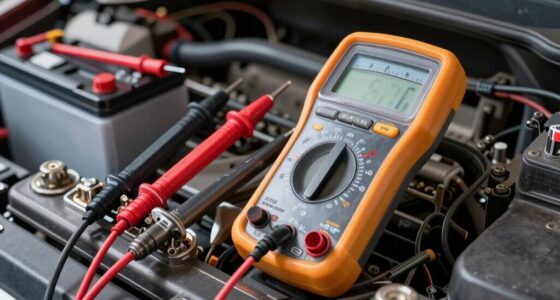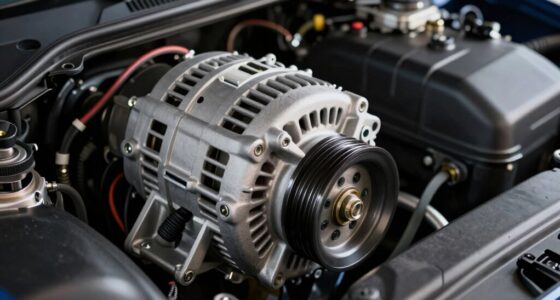
Stop relying on simplified formulas or static assumptions when calculating your power plant’s runtime. Ignoring real-time variables like fluctuating load demands, fuel quality, and equipment aging can lead to overestimating operational hours and increase the risk of unexpected failures. To improve accuracy, incorporate live sensor data, predictive analytics, and thorough maintenance planning. Staying ahead with these strategies helps optimize performance and prevents costly shutdowns—if you keep these pitfalls in mind, you’ll discover how to enhance your calculations further.

Get business pricing on garage and car supplies
- Business-only prices and quantity discounts
- Tax-exempt purchasing
- Multiple users, one account, clear invoices
Key Takeaways
- Relying solely on simplified formulas that ignore fluctuating load demands and variable conditions.
- Overlooking real-time sensor data and predictive analytics in runtime calculations.
- Assuming constant equipment performance without accounting for aging and fuel quality changes.
- Ignoring early signs of performance decline, leading to inaccurate operational estimates.
- Using static assumptions for maintenance scheduling instead of dynamic, data-driven models.

Many power station operators make a critical mistake when calculating runtime: they rely on simplified formulas that overlook key variables, leading to inaccurate predictions and potential operational issues. These formulas often assume constant conditions, ignoring factors like fluctuating load demands, fuel quality variations, and equipment aging. These oversights can cause operators to miss signs of declining performance, which could be detected earlier with better monitoring systems. As a result, you might overestimate or underestimate how long your plant can operate before maintenance is needed or efficiency drops. This oversight hampers your ability to optimize efficiency and plan maintenance effectively, risking unplanned outages or premature component failures.
To improve your runtime calculations, you need to consider all relevant variables that influence plant performance. Efficiency optimization depends heavily on understanding how these factors interact over time. For instance, if you ignore the gradual decline in turbine efficiency due to wear and tear, you could misjudge the actual available capacity, leading to inefficient operation or unexpected shutdowns. By incorporating real-time data and predictive analytics into your calculations, you gain a more accurate picture of your plant’s current state. This allows you to fine-tune operational parameters, maximizing output while minimizing fuel consumption and emissions. Incorporating comprehensive data analysis can provide deeper insights into operational trends and potential issues before they escalate.
Maintenance scheduling is another area heavily impacted by simplified runtime estimates. If you rely solely on basic formulas, you run the risk of scheduling maintenance either too early—wasting resources and reducing productivity—or too late, risking equipment failure and costly repairs. Properly accounting for variables like operational hours, temperature cycles, and vibration levels can extend the lifespan of critical components and prevent downtime. When you integrate detailed data into your planning, you create a maintenance schedule that aligns with the actual wear and tear of your equipment, not just generic timeframes. Additionally, leveraging advanced diagnostic tools can help you detect early signs of equipment deterioration, further refining your maintenance strategies. Regularly updating your models with sensor data enhances their accuracy and reliability over time.
The key to avoiding these pitfalls lies in embracing an all-encompassing approach that combines historical data, sensor inputs, and advanced modeling. Automation tools can help you continuously update your runtime estimates, reflecting real-world conditions rather than static assumptions. This way, you can make informed decisions on when to optimize efficiency and schedule maintenance, ultimately enhancing your plant’s reliability and profitability. Remember, the goal isn’t just to keep the plant running—it’s to run it smarter, with precise calculations that support your operational and financial objectives. Overcoming the common failure of oversimplified runtime math empowers you to operate more efficiently, reduce downtime, and extend equipment life, ensuring your power station remains competitive and resilient in a demanding energy landscape. Incorporating real-time data from sensors and advanced modeling techniques is crucial for achieving accurate and reliable runtime estimates.
power plant real-time sensor data monitor
As an affiliate, we earn on qualifying purchases.
As an affiliate, we earn on qualifying purchases.
Frequently Asked Questions
How Can Operators Prevent Runtime Math Errors in Power Stations?
To prevent runtime math errors, you should guarantee proper mathematical calibration of your instruments and systems. Always perform calculation validation before relying on data, double-checking for inaccuracies or inconsistencies. Regularly update calibration records and train staff on accurate calculation procedures. These steps help catch errors early, maintain data integrity, and improve overall power station performance, reducing downtime caused by faulty math and ensuring reliable operations.
What Are the Most Common Causes of Miscalculations?
You often face miscalculations caused by poor calculation accuracy and inadequate data validation. When data isn’t thoroughly validated, errors slip into your runtime math, leading to costly mistakes. You might also rely on outdated or incorrect data, skewing your results. To prevent this, always double-check your inputs, verify data sources, and prioritize calculation accuracy. Implementing rigorous validation protocols guarantees your calculations are reliable, reducing errors and improving overall station performance.
How Does Inaccurate Data Impact Power Station Performance?
Imagine your power station’s performance as a finely tuned orchestra—every note must be precise. When data is inaccurate, it’s like a missed cue, throwing everything off. Poor data validation and neglecting calibration techniques lead to flawed calculations, reducing efficiency and risking costly failures. You need to guarantee data integrity at every step, so your station runs smoothly, maximizing output and minimizing downtime. Accurate data truly powers ideal performance.
Are There Software Tools to Assist With Runtime Calculations?
Yes, software tools with automated algorithms can assist with runtime calculations effectively. They streamline complex computations, reducing human error, and improve accuracy. These tools often include data validation features that verify input data, ensuring reliable results. By using such software, you can optimize power station performance, make informed decisions faster, and minimize downtime caused by inaccuracies. Embracing these tools helps you stay ahead in maintaining efficient and reliable power generation.
What Training Is Recommended for Staff on Accurate Math Practices?
You should undergo training that emphasizes mathematical literacy and precise calibration procedures. This training helps you understand fundamental concepts and reduces errors in runtime calculations. Focus on practical workshops that simulate real scenarios, ensuring you grasp how to apply calibration procedures correctly. Improving your mathematical skills and understanding calibration methods will enhance your accuracy, preventing common failures and ensuring reliable power station operations.
predictive analytics software for power stations
As an affiliate, we earn on qualifying purchases.
As an affiliate, we earn on qualifying purchases.
Conclusion
If you keep making this mistake in power station runtime math, you’re like a pilot ignoring the fuel gauge—you risk running out of power when you need it most. By paying attention to detail and double-checking your calculations, you guarantee your operations stay steady and reliable, much like a well-tuned engine. Don’t let small errors steer you off course; correct them now and keep your power flowing smoothly, like a river that never runs dry.
maintenance scheduling tools for power plants
As an affiliate, we earn on qualifying purchases.
As an affiliate, we earn on qualifying purchases.
As an affiliate, we earn on qualifying purchases.
Halloween Picks
halloween
As an affiliate, we earn on qualifying purchases.