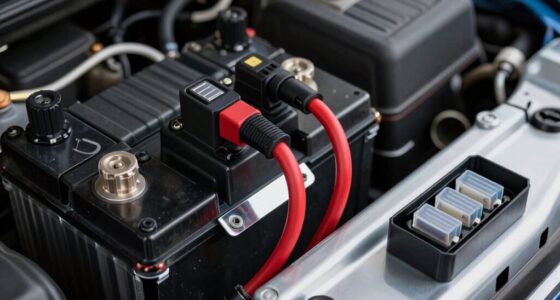
Your power station’s watt-hour rating shows how much energy it can store and deliver, directly connecting to how long it can run your devices. For example, a 500Wh station can power a 50W device for about 10 hours, but real-world use may vary due to efficiency losses and device draw. Understanding these factors helps you plan better. Keep exploring to discover how other features influence your station’s true performance and longevity.

Get business pricing on garage and car supplies
- Business-only prices and quantity discounts
- Tax-exempt purchasing
- Multiple users, one account, clear invoices
Key Takeaways
- Watt-hour ratings indicate the total energy capacity but don’t reflect battery lifespan or cycle durability.
- Real-world device runtime depends on efficiency and actual power draw, not just watt-hour ratings.
- Higher watt-hour ratings mean longer potential usage, but battery wear and efficiency losses may affect performance.
- Charging efficiency impacts how much energy is stored, influencing the practical usability of the power station.
- Consider additional factors like battery management, cycle life, and recharge times for accurate real-world performance.

Understanding power station watt-hour ratings is essential for evaluating how much energy a station can generate over time. When you’re assessing a portable or backup power station, these ratings give you a clear idea of its capacity to supply electricity during outages, camping trips, or off-grid adventures. Watt-hours measure the total amount of energy stored or delivered by the station, helping you determine how long your devices can run before needing a recharge.
However, the watt-hour rating alone doesn’t tell the full story. You should also consider factors like battery longevity and charging efficiency. Battery longevity refers to how many charge cycles the station’s battery can endure before its capacity significantly diminishes. A higher watt-hour rating isn’t always better if the battery wears out quickly. Look for stations designed with durable batteries that maintain performance over many cycles, ensuring you get steady power over years of use.
Charging efficiency is another critical aspect. When you recharge your power station, some energy is lost as heat, meaning not all the energy drawn from your power source makes it into the battery. A station with high charging efficiency minimizes this loss, allowing you to top up more effectively and get the most out of each charge. This efficiency becomes especially important if you’re relying on solar panels or other renewable sources, where maximizing energy transfer can extend your station’s usability. Recognizing the impact of energy transfer can help you optimize your setup for maximum performance.
It’s also helpful to think about how watt-hour ratings translate into real-world performance. For example, a station rated at 500 watt-hours could theoretically power a 50-watt device for about 10 hours. But in practice, inefficiencies in the system and the device’s actual power draw may reduce that runtime. Understanding these practical considerations helps you better plan your energy use, ensuring your devices stay powered when you need them most. Additionally, considering how the power station manages power output** can help you select a unit suitable for both small and high-demand devices. Recognizing the importance of battery management systems** can further extend the lifespan and reliability of your power station, ensuring consistent performance over time.
Furthermore, knowing about battery longevity can help you choose a power station that remains reliable over a long period, providing value and consistent performance for your energy needs. It’s also beneficial to compare different models’ charging times to ensure your station can be replenished quickly when needed. Ultimately, understanding watt-hour ratings, along with factors like battery longevity and charging efficiency, empowers you to choose a power station that fits your energy needs. It’s about balancing capacity, durability, and efficiency to get reliable, long-lasting power wherever and whenever you need it.
As an affiliate, we earn on qualifying purchases.
Frequently Asked Questions
How Do Watt-Hour Ratings Compare Between Different Power Station Brands?
You’ll find watt-hour ratings vary among power station brands, reflecting differences in battery longevity and reliability. Higher ratings usually mean longer-lasting power, but brand reliability plays a vital role in real-world performance. Some brands might advertise high watt-hour ratings but fall short over time, so it’s wise to take into account customer reviews and warranty coverage. Comparing these factors helps you choose a power station that offers both impressive capacity and dependable longevity.
What External Factors Can Affect a Power Station’s Actual Watt-Hour Output?
You might think your power station’s watt-hour output is invincible, but external factors can dramatically affect it. Environmental conditions like extreme temperatures, humidity, or dust can cause the station to underperform markedly. Additionally, poor maintenance impacts efficiency, leading to reduced output. If you neglect regular upkeep or expose your station to harsh weather, expect your watt-hour ratings to drop well below the ideal, making your power supply less reliable.
Are Watt-Hour Ratings Consistent Over the Lifespan of a Power Station?
Watt-hour ratings aren’t consistent over a power station’s lifespan because battery degradation gradually reduces capacity. As your station ages, its ability to produce the same watt-hours diminishes, impacting performance. Effective power management helps mitigate this decline by optimizing usage and maintenance, but some loss is unavoidable. Regularly monitoring and maintaining your system ensures you get the most out of its watt-hour capacity for as long as possible.
How Do Temperature Changes Impact Watt-Hour Performance?
Temperature swings can act like a rollercoaster, causing your power station’s watt-hour performance to fluctuate. When temperatures rise or fall, you’ll notice efficiency fluctuations because equipment may struggle or operate better. Temperature variability directly impacts your station’s ability to deliver consistent power, so monitoring and adjusting for these changes guarantees your system maintains peak performance. Staying aware helps you keep the energy flowing smoothly, no matter the weather.
Can Watt-Hour Ratings Predict the Station’s Performance in Real Emergencies?
Watt-hour ratings can give you a rough idea of a station’s potential, but they don’t fully predict real emergency performance. Battery efficiency and power consistency fluctuate under stress, temperature, and usage, impacting actual output. During emergencies, a station might underperform despite high ratings. So, rely on watt-hour ratings as a baseline, but consider additional factors like battery health and environmental conditions for a more accurate prediction.
As an affiliate, we earn on qualifying purchases.
Conclusion
Understanding power station watt-hour ratings is like having a map to navigate your energy needs. By grasping what these ratings truly mean, you can avoid being blindsided by surprises and make smarter choices. Think of it as tuning into the true pulse of your power source, ensuring your devices stay powered without a hitch. With this knowledge, you’re better equipped to harness energy efficiently—turning a confusing maze into a well-lit path.
high efficiency portable generator
As an affiliate, we earn on qualifying purchases.
As an affiliate, we earn on qualifying purchases.
battery management system for power stations
As an affiliate, we earn on qualifying purchases.
As an affiliate, we earn on qualifying purchases.
Fall Picks
fall essentials
As an affiliate, we earn on qualifying purchases.