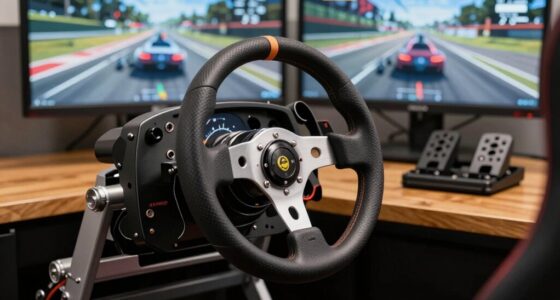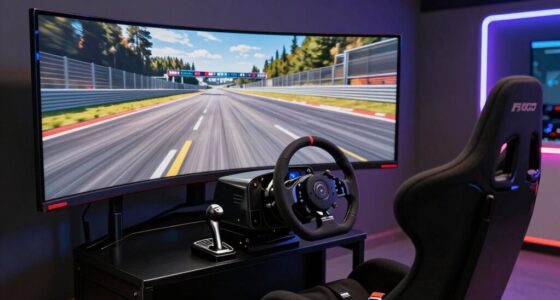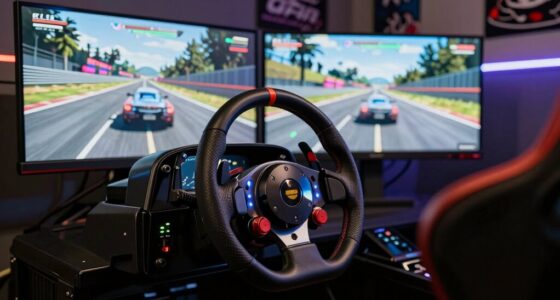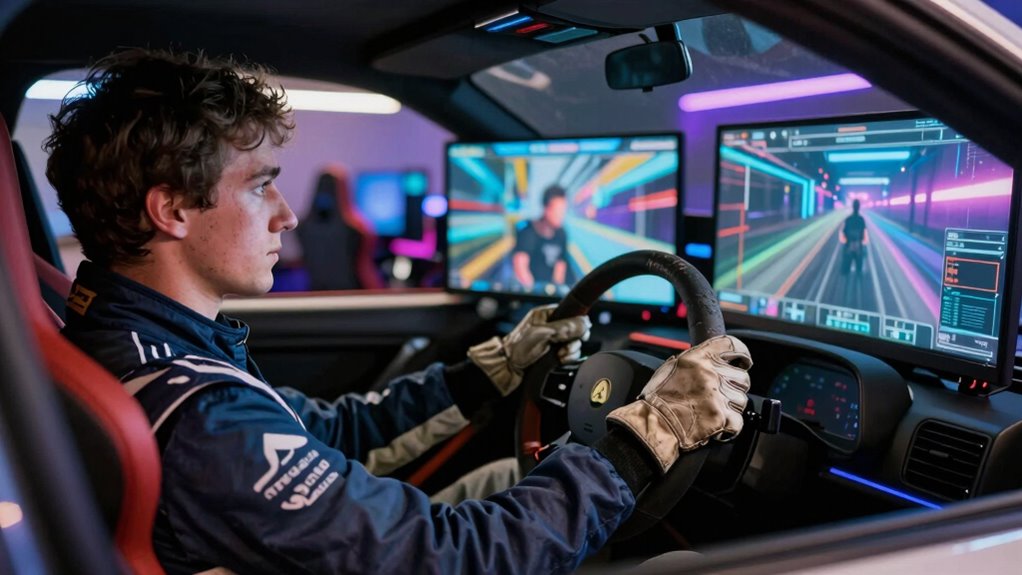

Sim racing can improve your reaction times and help you learn racing lines, but it can’t fully replicate real driving skills. Simulators lack the detailed physics, vehicle feedback, and sensory cues that you experience in actual cars. While they prepare your coordination and decision-making, real driving involves physical sensations and psychological factors that simulations can’t provide completely. Curious to see how virtual skills compare to real-world driving? Keep exploring for a deeper understanding.
Key Takeaways
- Sim racing enhances reaction times and racing lines but cannot fully replicate real vehicle physics and handling nuances.
- Physical sensations like tire grip and weight transfer are absent in simulators, limiting skill transfer to real driving.
- Psychological factors such as stress and decision-making under pressure are difficult to develop through virtual environments alone.
- Advanced simulators improve realism but still lack the tactile feedback crucial for mastering real-world vehicle control.
- Combining simulation with actual driving experience provides the most comprehensive skill development for real-world driving.
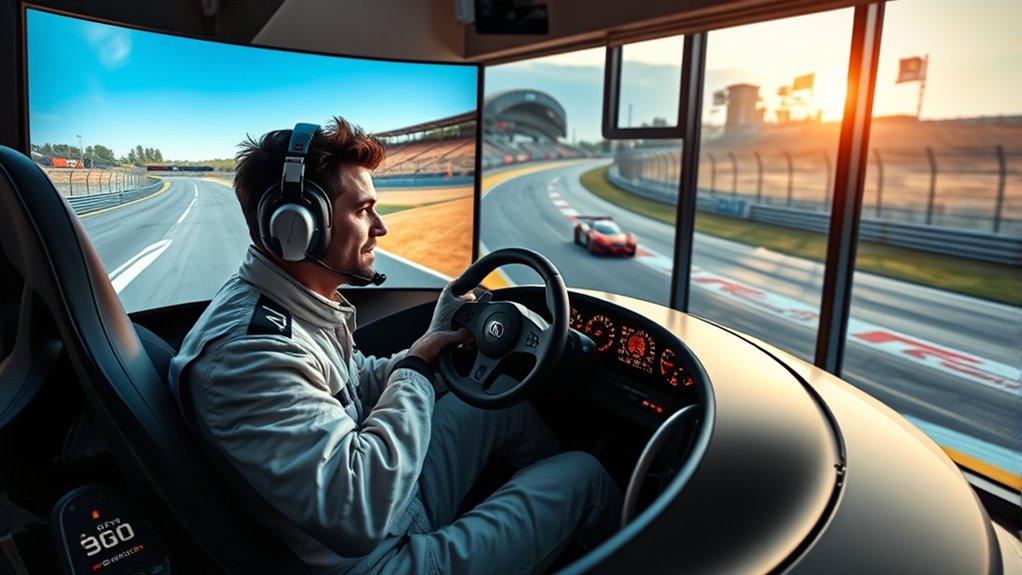
Many people wonder whether sim racing can truly prepare you for real driving, especially since both require quick reflexes and precise control. While racing simulations have become incredibly advanced, they still can’t replicate the nuances of actual vehicle physics and driver psychology. When you’re behind the wheel of a real car, every movement, sensation, and decision carries weight, demanding a level of sensory integration that screens and controllers can’t fully reproduce. Sim racing does a good job of mimicking certain elements like steering inputs and braking, but it often falls short in conveying how a vehicle responds under different conditions. The way a real car’s suspension, tire grip, and weight transfer behave isn’t fully captured by most simulations, which impacts how you develop a feel for controlling the vehicle.
Understanding vehicle physics is *essential* here. In real driving, physics dictate every interaction—how the tires grip the road, how the car behaves during oversteer or understeer, and how weight shifts during acceleration or braking. These subtle cues help you adapt quickly and make split-second decisions. In sim racing, the physics engine might be sophisticated, but it’s still a digital approximation. You might learn how to turn accurately or brake efficiently in a game, but translating that knowledge to a real car involves a different set of sensory cues. You don’t just see or hear the car respond—you feel it through your body. This is where driver psychology comes into play. In real driving, your mental state, confidence, and stress levels influence your reactions. Sim racers often experience a different psychological environment—less pressure, no real risk, and often a gaming mindset. That difference affects how you develop instinctive reactions and decision-making skills.
Practicing in a simulator can sharpen your hand-eye coordination and improve your reaction times, but it doesn’t automatically translate to handling unpredictable road conditions or dealing with real-world distractions. The psychological aspect of real driving involves managing emotions, staying calm under pressure, and trusting your instincts, which are difficult to fully cultivate through virtual practice alone. Additionally, high-quality simulators with advanced physics engines can better mimic real vehicle behavior and provide more realistic feedback, making simulation training more effective. While sim racing can complement your learning and help you grasp racing lines or braking points, it’s no substitute for actual driving experience. To truly develop the skills necessary for driving on real roads or tracks, you need to combine virtual practice with real-world driving, where the physical feel and psychological demands come into play.

PXN V99 PC Racing Wheel, Real Force Feedback Steering Wheel with Pedals and Shifter, Detachable 270/900 Degree Race Steering Wheel Simulator for PC, Xbox One, Xbox Series X/S, PS4
PROFESSIONAL SIM RACING EXPERIENCE: The PXN V99 racing wheel delivers a powerful and immersive experience for racing and…
As an affiliate, we earn on qualifying purchases.
As an affiliate, we earn on qualifying purchases.
Frequently Asked Questions
Can Sim Racing Improve Emergency Driving Responses?
Yes, sim racing can improve your emergency driving responses. It enhances your virtual reaction time, making you quicker to respond in real emergencies. Through emergency scenario training, you learn how to handle unexpected situations calmly and effectively. While it doesn’t replace real-world experience, sim racing builds vital mental and motor skills, helping you stay composed and make better decisions when real-life emergencies occur.
Do Sim Racing Skills Transfer to Motorcycle or Off-Road Vehicles?
Coincidentally, your sim racing skills can boost your motorcycle handling and off-road navigation. The core skills of quick reflexes, precise control, and understanding vehicle dynamics transfer well. By practicing in a simulated environment, you develop better throttle control, balance, and terrain awareness, which directly benefits off-road riding and motorcycle handling. So, your virtual experience can give you a significant edge when tackling challenging terrains or tight turns on real motorcycles.
How Does Physical Fitness Impact Real Driving Compared to Sim Racing?
Physical fitness directly impacts your real driving by enhancing reaction speed and overall endurance. When you’re physically conditioned, you can respond faster to sudden hazards and maintain focus during long drives. Unlike sim racing, where physical fitness plays a lesser role, real driving demands strength, agility, and stamina. Staying fit helps you handle stress on the road, making you a safer, more alert driver in real-world situations.
Are There Legal or Insurance Benefits to Advanced Sim Racing Setups?
Advanced sim racing setups can offer legal and insurance benefits, such as potential discounts on insurance premiums due to improved driving skills and safety awareness. While they don’t directly impact legal liability in real-world accidents, demonstrating responsible driving through sim training might support your case. Always check with your insurer and local laws to see if your setup qualifies for any discounts or legal benefits, and keep records of your training.
Can Sim Racing Help With Long-Distance or Highway Driving Skills?
Think of sim racing as your virtual road map; it sharpens your long-distance and highway driving skills. When you practice steering through endless highways and managing speed in a simulated environment, you build muscle memory and reaction time that translate to real roads. While it’s not a perfect substitute, it helps you stay calm and confident during long drives, making highway cruising smoother and more controlled.

Logitech G920 Driving Force Racing Wheel and Floor Pedals, Real Force Feedback, Stainless Steel Paddle Shifters, Leather Steering Wheel Cover for Xbox Series X|S, Xbox One, PC, Mac – Black
Immersive Gaming Experience: Perfect for Xbox and PC gaming titles, the Driving Force simulates the feeling of driving…
As an affiliate, we earn on qualifying purchases.
As an affiliate, we earn on qualifying purchases.
Conclusion
So, whether you’re gripping a racing wheel or behind the wheel of a car, remember that sim racing sharpens your reflexes and understanding of tracks, but real driving teaches you feel, judgment, and adaptability. Think of it like reading a map versus actually walking the trail—both are valuable, but the journey’s true essence comes alive on the road. Embrace both worlds; after all, isn’t life just a race where skills from both can make you a better driver?

Simjack UT Sim Racing Pedals 200KG Load Cell Brake Pedal PC Racing Simulator Pedals Pressure Sensor HE Hydraulic Pedal (UT-P3-H3)
Shipped from the USA warehouse. [Compatibility] Compatible with all Steam ESR (Extreme Sim Racing) wheel stands and cockpits….
As an affiliate, we earn on qualifying purchases.
As an affiliate, we earn on qualifying purchases.

Dardoo Advanced Racing Simulator Cockpit with Ergonomic Seat Fit for Logitech G920 G923, for Thrustmaster T300RS T500RS TX, for Fanatec,Adjustable Steering Wheel Stand,No Wheel,Pedal and Handbrake
【Strong & Sturdy】Racing simulator cockpit is designed with flange structure, each joint is fixed with 4 big screws,…
As an affiliate, we earn on qualifying purchases.
As an affiliate, we earn on qualifying purchases.