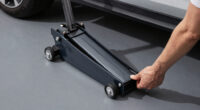
To safely lift a unibody vehicle without crushing the pinch welds, focus on the manufacturer’s designated lift points near reinforced areas or along the frame, often marked or detailed in the owner’s manual. Always use rubber or plastic pads to distribute the weight evenly across the lift point, preventing slipping or damage. Proper placement and technique are essential for safety and avoiding costly repairs, so understanding exactly where and how to lift will set you up for success as you explore these important tips.

Get business pricing on garage and car supplies
- Business-only prices and quantity discounts
- Tax-exempt purchasing
- Multiple users, one account, clear invoices
Key Takeaways
- Identify designated lift points near reinforced areas or manufacturer-marked pinch welds to prevent damage.
- Consult the vehicle’s owner’s manual for specific lift point locations and reinforcement details.
- Use proper lifting equipment, such as rubber or plastic pads, to distribute weight evenly on lift points.
- Ensure the jack is centered flat on the lift point and stable before raising the vehicle.
- Always use jack stands rated for the vehicle’s weight and avoid relying solely on hydraulic jacks for support.
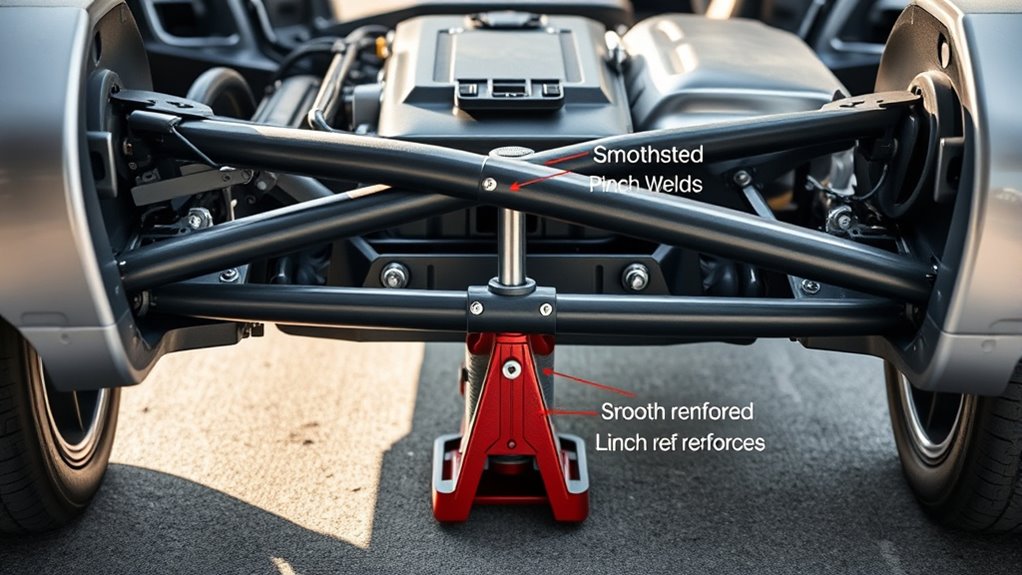
When lifting a vehicle with a unibody construction, it is vital to use designated lift points to prevent damage and guarantee safety. These specific spots are engineered to support the weight of the vehicle without crushing or deforming the frame. To do this effectively, you need to focus on proper jack pad placement and correctly identify the lift points. Ignoring these details can result in costly repairs or safety hazards, so understanding where and how to lift is essential.
First, take the time to locate the lift points, which are often marked or detailed in your vehicle’s owner’s manual. These points are reinforced areas designed to handle the pressure of a jack or lift. They are typically situated near the manufacturer’s designated pinch welds or reinforced metal areas along the frame. Identifying the right lift points is key; they are usually reinforced with extra metal or have specific indentations that make them stand out from the surrounding body panels. Using these markings ensures you’re lifting at the correct location, reducing the risk of damaging delicate unibody components. Proper identification of these points is crucial to avoid damaging the vehicle’s structural integrity.
Locate reinforced lift points marked in your owner’s manual to prevent damage when lifting unibody vehicles.
Once you’ve identified the proper lift points, focus on proper jack pad placement. Placing your jack pad directly on the lift point distributes the vehicle’s weight evenly, preventing the pad from slipping or damaging the unibody. Many jacks come with built-in pads, but for added security, you can use a rubber or plastic pad designed specifically for automotive lifts. These pads help grip the metal surface and absorb some of the pressure, reducing the chance of denting or deforming the frame. Make sure your jack pad is positioned flat and centered on the lift point to avoid uneven weight distribution.
Additionally, check the stability of your jack or lift before raising the vehicle fully. Always lift slowly, watching for any signs of slipping or instability. It’s best to lift just enough to clear the wheels or perform maintenance, then secure the vehicle with jack stands rated for your vehicle’s weight. Never rely solely on a hydraulic jack for support; always use jack stands once the vehicle is lifted. Remember, choosing the right lift equipment and following proper safety procedures are key to preventing accidents or damage.
automotive jack pad rubber plastic
As an affiliate, we earn on qualifying purchases.
As an affiliate, we earn on qualifying purchases.
Frequently Asked Questions
Can I Use a Hydraulic Floor Jack on Unibody Lift Points?
Yes, you can use a hydraulic floor jack on unibody lift points, but make sure it’s compatible with jack pads designed for your vehicle. Check for lift point markings to identify the correct spots, and use a proper jack pad if needed to prevent crushing or damaging pinch welds. Always verify your jack is rated for the weight and use a stable, level surface for safety.
Are All Unibody Lift Points the Same Across Vehicle Models?
No, all vehicle models don’t share the same vehicle specific lift points. You should always check your vehicle’s manual to locate the correct lift points, as these are designed for that specific make and model. While some universal lift locations exist, using dedicated vehicle specific lift points guarantees safety and prevents damage. Always use the right lift points for your vehicle to avoid crushing pinch welds or risking injury.
How Do I Identify the Correct Lift Points on My Vehicle?
Identifying lift points on your vehicle is like finding a hidden treasure map. You should check your owner’s manual, which clearly marks safe vehicle jack locations with diagrams. Look for reinforced areas near the pinch welds, often indicated with symbols or labels. Avoid the flimsy parts; instead, focus on these sturdy spots designed for lifting. Using the correct lift points guarantees safe jacking without damaging your vehicle.
What Are the Risks of Using the Wrong Lift Points?
Using the wrong lift points risks causing frame damage or uneven lifting, which can jeopardize your vehicle’s safety and integrity. If you don’t lift at proper locations, you might bend or crack the frame, leading to costly repairs. Always verify you identify and use designated lift points to avoid these dangers. Proper lifting prevents damage, maintains vehicle stability, and keeps you safe during maintenance.
Do Unibody Lift Points Vary Between All-Wheel-Drive and Rear-Wheel-Drive Vehicles?
Yes, unibody lift points can differ between all-wheel-drive and rear-wheel-drive vehicles due to vehicle frame differences. These differences affect the placement and strength of lift points, so you should always check your vehicle’s manual for lift point consistency. Using the correct lift points ensures you avoid damaging the frame or pinch welds, providing safe and effective jacking regardless of your vehicle’s drivetrain type.
As an affiliate, we earn on qualifying purchases.
Conclusion
So, next time you’re tempted to rely on those flimsy pinch welds to lift your unibody, remember—they’re not designed for that. It’s almost ironic how they look like sturdy spots but can easily crush under pressure. Instead, trust the proper lift points. Irony aside, taking the time to lift correctly saves you from costly repairs—and maybe a little embarrassment. After all, even your car’s pinch welds deserve a break.
As an affiliate, we earn on qualifying purchases.
car jack stand rated for vehicle weight
As an affiliate, we earn on qualifying purchases.
As an affiliate, we earn on qualifying purchases.
Fall Picks
fall essentials
As an affiliate, we earn on qualifying purchases.