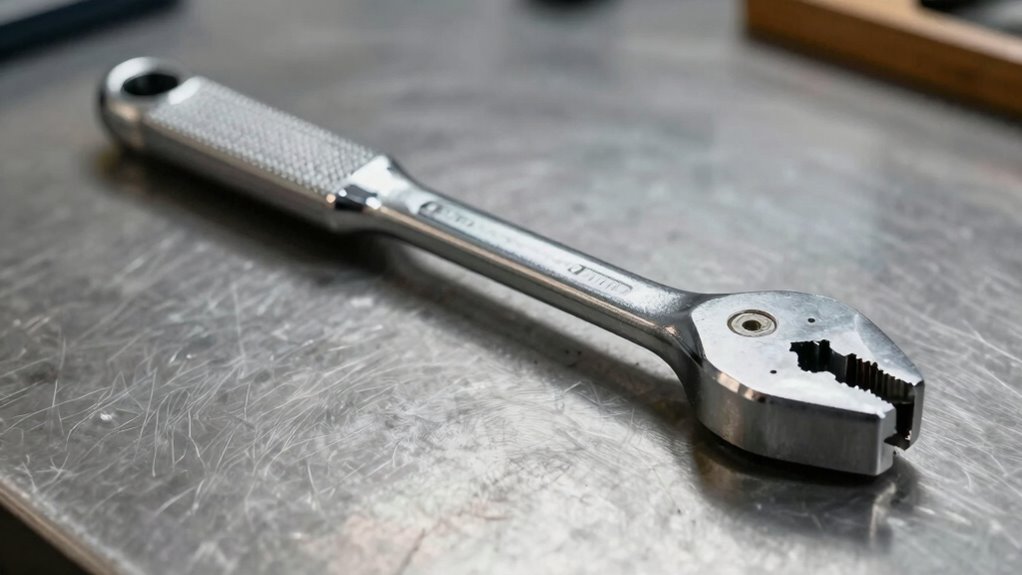

The hidden detail that makes your torque wrench more accurate is combining proper calibration with consistent handling technique. Regular calibration prevents drift and keeps measurements precise, especially if you handle the wrench gently, apply steady force, and avoid sudden jerks. Resetting the wrench after use also helps maintain its reliability. When you combine these habits, your torque tool stays accurate longer. Keep going, and you’ll discover even more tips to optimize your tool’s performance.

Get business pricing on garage and car supplies
- Business-only prices and quantity discounts
- Tax-exempt purchasing
- Multiple users, one account, clear invoices
Key Takeaways
- Proper calibration ensures the torque wrench maintains precise measurement over time, preventing drift and inaccuracies.
- Consistent handling techniques, like smooth force application and full leverage, optimize measurement accuracy.
- Resetting the wrench after each use prevents spring fatigue, preserving calibration integrity.
- Environmental factors, such as temperature and humidity, can affect calibration stability and accuracy.
- Regularly verifying calibration and handling practices helps maintain reliable, accurate torque measurements.

Accurate torque settings are indispensable for guaranteeing safety and proper function in mechanical work, yet many users overlook a subtle detail that can considerably enhance a torque wrench’s precision. That detail is the importance of regular calibration and how your user technique influences the tool’s accuracy. While it’s tempting to think that a well-made torque wrench only needs occasional calibration, neglecting this step can lead to inconsistent torque application, risking mechanical failure or damage. The key isn’t just how often you calibrate but also how you handle the wrench during use. Proper user technique—such as applying steady, smooth force and avoiding sudden jerks—ensures you get the most precise readings from your tool. When you combine regular calibration with mindful handling, you maintain the integrity of the torque wrench’s calibration, which is essential for every task. Regular calibration helps prevent calibration drift, which can subtly compromise accuracy over time. Calibration frequency depends on how often you use the torque wrench and the conditions it’s exposed to. If you use it daily or for critical applications, calibrating once every few months is wise. For occasional use, annual calibration might suffice, but it’s still a good habit to check it periodically. Environmental factors like temperature fluctuations, humidity, or exposure to dust can also affect accuracy, making more frequent calibration necessary. Ignoring calibration can cause subtle drifts in torque accuracy, which might not be immediately obvious but can have serious consequences over time. Remember, a torque wrench that isn’t properly calibrated can give false readings, leading you to over-tighten or under-tighten fasteners—an error that could compromise safety or hardware longevity. Your user technique plays an equally significant role. Applying torque smoothly and consistently prevents sudden spikes that distort the reading. Keep your body steady, avoid leaning or twisting during operation, and always use the full handle length for leverage. If you’re using a click-type torque wrench, listen carefully for the click, and don’t overshoot the target torque. Also, reset the wrench to its lowest setting after each use to prevent internal spring fatigue. Incorporating proper handling techniques into your routine helps preserve calibration and ensures each measurement is as accurate as possible. Remember, even the best-calibrated torque wrench can give skewed results if mishandled. So, paying attention to how you operate the tool complements regular calibration, creating a reliable system that guarantees safety and precision in every job.
digital torque wrench calibration kit
As an affiliate, we earn on qualifying purchases.
As an affiliate, we earn on qualifying purchases.
Frequently Asked Questions
How Often Should I Calibrate My Torque Wrench?
You should calibrate your torque wrench at least once every year or after every 5,000 uses, whichever comes first. Follow storage best practices by keeping it in a protective case and avoiding extreme temperatures or humidity. Regular calibration ensures accuracy, so don’t skip it—especially if you rely on precise torque settings for safety-critical tasks. Proper calibration frequency and storage help sustain your wrench’s performance over time.
What Types of Torque Wrenches Are Most Accurate?
You’ll find that digital and beam torque wrenches generally offer the most accuracy, especially when properly calibrated regularly. Keep in mind that calibration frequency impacts precision, so check it often. Temperature impact is also vital—using your wrench in extreme heat or cold can skew readings. To maintain accuracy, store your torque wrench in a controlled environment, calibrate it as recommended, and avoid sudden temperature changes during use.
Can Temperature Affect Torque Wrench Readings?
Imagine your hand gripping a cold metal handle, feeling the chill seep into your bones—that’s how temperature effects can alter torque wrench readings. Extreme temperatures can cause metal components to expand or contract, skewering calibration accuracy. To combat this, you should regularly check your calibration frequency, especially after temperature changes, ensuring your torque wrench stays reliable and precise, no matter the weather.
Is It Better to Use a Click or Digital Torque Wrench?
Using a click torque wrench is generally better for simplicity and durability, especially if you prefer tactile feedback. Digital torque wrenches offer precise readings and data storage, but they require frequent calibration and can be affected by temperature changes, impacting accuracy. If you work in varying temperatures or need high precision, a digital wrench with regular calibration is ideal. For routine tasks, a click wrench often suffices.
How Does Grip Position Influence Torque Accuracy?
Your grip position directly influences torque accuracy through proper grip technique and hand positioning. If you hold the wrench too tightly or unevenly, it can alter the applied force, leading to inaccurate torque readings. Maintain a firm but relaxed grip, positioning your hand consistently on the handle. This guarantees even pressure and control, helping you achieve precise torque measurements every time. Consistent hand placement is key for accurate results.
click type torque wrench handle extension
As an affiliate, we earn on qualifying purchases.
As an affiliate, we earn on qualifying purchases.
Conclusion
By paying attention to that subtle detail, you can greatly boost your torque wrench’s accuracy. Did you know that small calibration errors can lead to over-tightening by up to 30%? That’s a huge difference when working on critical components. So, always double-check your wrench’s calibration and handle it carefully. Remember, mastering these little details not only saves you time and money but also ensures your work stays safe and reliable.
torque wrench calibration and handling guide
As an affiliate, we earn on qualifying purchases.
As an affiliate, we earn on qualifying purchases.
professional torque wrench calibration service
As an affiliate, we earn on qualifying purchases.
As an affiliate, we earn on qualifying purchases.
Fall Picks
fall essentials
As an affiliate, we earn on qualifying purchases.