
TL;DR

Get business pricing on garage and car supplies
- Business-only prices and quantity discounts
- Tax-exempt purchasing
- Multiple users, one account, clear invoices
A Robot Cantina video tested old-school hot-rod modifications on a Harbor Freight 212cc Predator Hemi engine. The report says the modified engine produced 4,800 watts of continuous output, up from 3,600 watts in the stock test, and ran seven minutes longer on the stated fuel amount. The figures come from this project’s testing and do not establish results for every Predator engine.
A Robot Cantina video reports that traditional hot-rodding changes raised the measured output of a Harbor Freight 212cc Predator Hemi engine from 3,600 to 4,800 watts in the creator’s test. The project paired an adjustable carburetor and improved intake and exhaust flow with revised ignition timing, showing how simple mechanical changes can affect a low-cost, computer-free small engine.
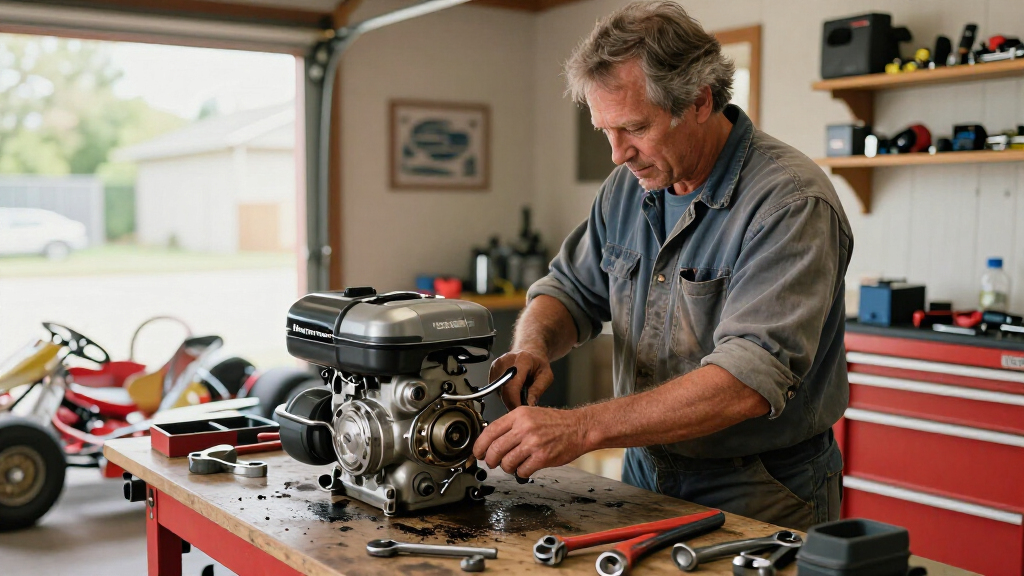
According to The Drive’s report on the video, Jimbo of Robot Cantina rebuilt a project he had made years earlier. The engine is a Predator 212cc with a hemispherical cylinder head, a version identifiable by its thick, rectangular cast-aluminum valve cover, the report says. Harbor Freight sells this head configuration from the factory.
The modifications included an adjustable carburetor to tune the low-speed mixture and main jet, a larger air filter mounted over a billet velocity stack, and a short exhaust header in place of the stock muffler. Jimbo also set ignition timing to 29 degrees before top dead center. The report says he used an upgraded ignition setup with a 12-volt coil from a General Motors LS engine, while noting that he was unsure it added much over the stock magneto.
The reported test measured 4,800 watts of continuous power after the changes, compared with 3,600 watts in an initial run with the factory engine. The Drive describes that difference as a 33.3% increase. The report also says the modified engine ran for one hour and 15 minutes on 700 milliliters of fuel, while the standard engine stopped after one hour and eight minutes. Those are results from this test, not a guarantee of performance across other engines or conditions.
Simple Changes, Measurable Output
The result offers a practical example of how carburetion, airflow and ignition timing can change the performance of a small engine without electronic engine controls. For hobbyists, the value is less about turning a utility engine into a high-speed vehicle and more about seeing established mechanical tuning methods applied to an inexpensive, widely available platform.
The reported seven-minute runtime difference may also interest people using similar engines for projects or equipment. But the source does not provide enough information to treat that result as a controlled, broadly repeatable efficiency finding. Fuel use and output can depend on load, tuning, engine condition and test setup.
Harbor Freight Predator 212cc engine carburetor
As an affiliate, we earn on qualifying purchases.
As an affiliate, we earn on qualifying purchases.
A Computer-Free Predator Project
The Drive describes the Predator engine family as a popular platform for mechanical experimentation. It says Jimbo has used these engines in projects including a Honda Insight and a hybrid golf cart. This latest build revisits a previous project rather than introducing a new engine design or a factory upgrade.
The approach contrasts with more involved builds that add equipment such as turbochargers or electronic fuel injection. Here, the reported changes follow familiar performance principles: adjust the fuel mixture, improve the path for air and exhaust, and alter ignition timing. The source provides no comparison of the project’s cost with other tuning approaches.
small engine airflow and exhaust modifications kit
As an affiliate, we earn on qualifying purchases.
As an affiliate, we earn on qualifying purchases.
Limits of the Engine Test
The source material does not specify the test equipment, calibration, environmental conditions, applied load, or whether the stock and modified runs were repeated under identical conditions. It also does not give a full power curve or a separate dynamometer horsepower result for this test. The Drive mentions a previous figure of 9.3 horsepower, about 44% above the engine’s stated 6.5-hp stock rating, but that figure should not be conflated with the video’s 4,800-watt continuous-output measurement.
It is also unclear how much each individual modification contributed, whether the runtime comparison used precisely matched loads, or how the changes affected long-term reliability. The reported improvement applies to this engine and setup; it does not establish a typical result for all Predator 212 engines.
adjustable carburetor for small engines
As an affiliate, we earn on qualifying purchases.
As an affiliate, we earn on qualifying purchases.
No Further Test Announced
The source material identifies no scheduled follow-up test or additional development. The next useful evidence would be a repeatable comparison using the same load and measurement method, with separate results for each modification and documented fuel consumption. Until then, the reported figures remain one creator’s test results, and readers should not assume the same gains will follow from copying the parts list.
small engine ignition timing tools
As an affiliate, we earn on qualifying purchases.
As an affiliate, we earn on qualifying purchases.
Key Questions
What engine did Robot Cantina modify?
The project used a 212cc Harbor Freight Predator with a hemispherical cylinder head, according to The Drive’s report.
How much more output did the modified engine produce?
The video’s reported test measured 4,800 watts of continuous power, compared with 3,600 watts for the factory-engine run. The source describes that as a 33.3% increase; it is a result from this test, not a guaranteed gain.
Which changes were made to the engine?
The modifications included an adjustable carburetor, a larger air filter and billet velocity stack, a short exhaust header, and ignition timing set to 29 degrees before top dead center. The builder also used an upgraded ignition setup.
Did the modifications improve fuel economy?
The report says the modified engine ran for one hour and 15 minutes on 700 milliliters of fuel, compared with one hour and eight minutes for the standard engine. The source does not provide enough test detail to establish how broadly that difference applies.
Are the results confirmed for other Predator engines?
No. The figures describe one project and its reported test. The source does not document repeated trials or results across other engines, loads, or tuning setups.
Source: rss
Fall Picks
fall essentials
As an affiliate, we earn on qualifying purchases.