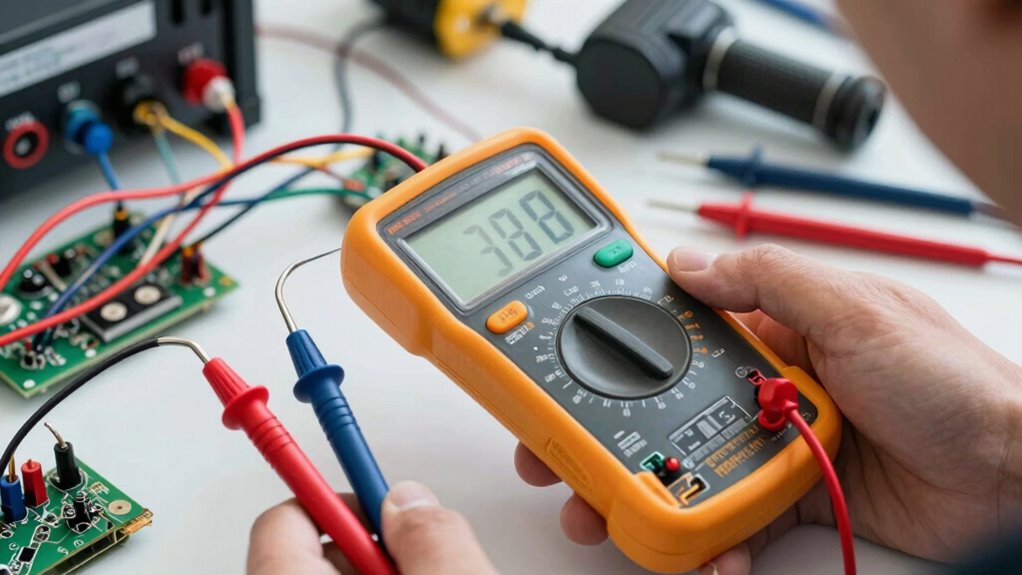

Using a multimeter is the fastest way to locate shorts and save hours of troubleshooting. Start by disconnecting the power, then use the resistance or continuity setting to systematically test circuit segments. Look for near-zero resistance or a beep, which indicates a short. Check common trouble spots like damaged insulation or loose connections. Proper testing procedures and understanding circuit diagrams make pinpointing faults quicker. Keep going, and you’ll discover even more effective techniques to speed up your diagnosis.

Get business pricing on garage and car supplies
- Business-only prices and quantity discounts
- Tax-exempt purchasing
- Multiple users, one account, clear invoices
Key Takeaways
- Use resistance and continuity functions to quickly identify near-zero resistance or beep signals indicating a short.
- Systematically test circuit segments according to the diagram to narrow down the short location efficiently.
- Check common trouble spots like damaged insulation or loose connections to speed diagnosis.
- Test components individually, such as relays or switches, to isolate faulty parts quickly.
- Follow safety procedures to prevent accidents and ensure accurate results during short circuit detection.
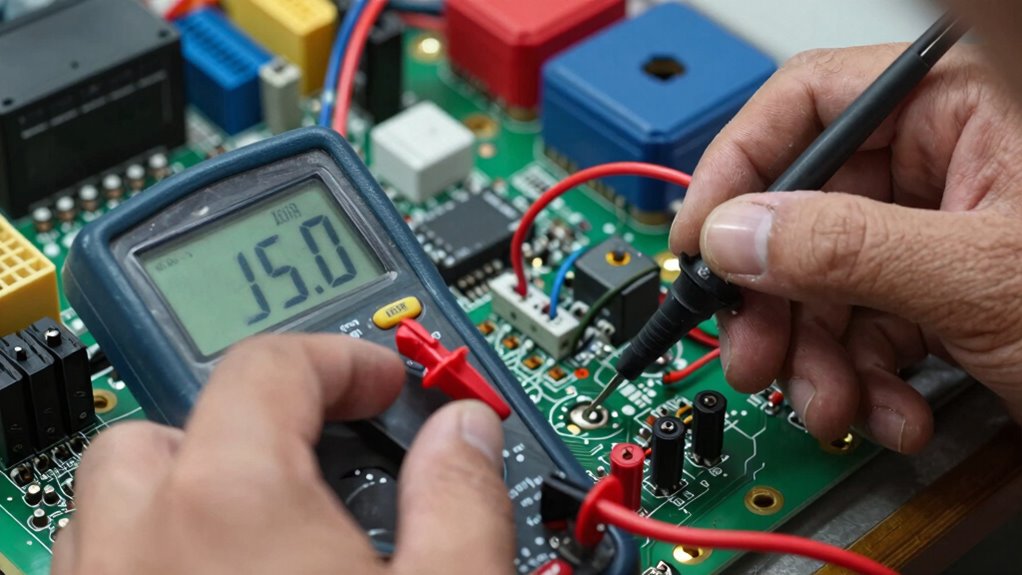
When troubleshooting electrical issues, finding a short circuit quickly is essential to prevent damage and restore proper function. A multimeter becomes your most valuable tool in this process, allowing you to pinpoint faults efficiently. To do this effectively, start by understanding how to interpret circuit diagrams. These diagrams give you a map of the wiring and components, making it easier to identify potential problem areas. Keep a copy of the circuit diagram handy to trace circuits step by step as you test different sections. Additionally, understanding etiquette and social norms can help ensure safe and respectful interactions when seeking assistance or sharing findings with colleagues.
Battery testing is also crucial in short-finding scenarios, especially when the short involves power sources. Use your multimeter’s voltage and current settings to check the health of the battery. A weakened or faulty battery can sometimes mimic or contribute to short circuits, so ruling it out early saves time. If the battery tests normal, you can focus on other parts of the circuit. Remember to disconnect the battery before testing for shorts to avoid false readings or damage to your multimeter. Recognizing proper testing procedures ensures accurate results and safe operations.
Battery testing is essential to identify power source issues and prevent false short circuit readings.
The core of short-finding with a multimeter involves using the continuity and resistance functions. Set your multimeter to measure resistance or continuity, and carefully probe the circuit. When you find a section with near-zero resistance or a continuous beep, you’ve likely located the short. Follow the wiring along the circuit diagram, testing each segment until the multimeter indicates a fault. This systematic approach helps you narrow down the exact location of the short without blindly replacing parts or tearing apart the entire system. Recognizing common trouble spots like damaged insulation or loose connections can also speed up the diagnosis process.
As you work through the circuit, keep an eye on common trouble spots like damaged insulation, loose connections, or corroded terminals. Sometimes, the short isn’t in the wiring itself but in a component like a relay or switch. Use the multimeter to test these parts individually, referencing the circuit diagram to understand their normal operation. When testing, always ensure your multimeter probes are making good contact, and avoid touching the metal parts to prevent false readings. A thorough understanding of circuit components can improve your troubleshooting accuracy. Moreover, familiarity with electrical safety procedures can help prevent accidents during testing.
digital multimeter for troubleshooting
As an affiliate, we earn on qualifying purchases.
As an affiliate, we earn on qualifying purchases.
Frequently Asked Questions
What Safety Precautions Are Essential During Multimeter Short-Finding?
You should always wear personal protective gear, like insulated gloves and safety glasses, when performing multimeter short-finding. Make certain electrical insulation on the equipment is intact to prevent accidental shocks. Before testing, turn off power if possible and verify the multimeter’s settings. Keep your hands dry and use one hand to minimize shock risk. Always follow safety protocols to protect yourself from electrical hazards during the process.
Can Multimeter Short-Finding Be Automated?
Yes, multimeter short-finding can be automated using automated testing systems. These setups use specialized equipment to continuously monitor circuits and detect shorts without manual intervention. Data logging plays a vital role by recording measurements in real-time, helping you analyze issues more efficiently. Automation speeds up the process, reduces human error, and provides detailed insights, making troubleshooting faster and more dependable for complex electrical systems.
What Are Common Mistakes to Avoid When Short-Finding?
When short-finding, avoid common mistakes like incorrect probe placement, which can lead to inaccurate readings or damage. Always verify you’re on the correct circuit and avoid ignoring circuit power; working on a live circuit can be dangerous and skew results. Double-check your connections before testing, and don’t rush—precision is key. These precautions help prevent mistakes and make your troubleshooting more efficient and safe.
How Do Environmental Factors Affect Multimeter Accuracy?
Environmental interference, like electromagnetic noise, can disrupt your multimeter readings, making them less accurate. Temperature effects also play a role; extreme heat or cold can cause the device to give false measurements. To guarantee accuracy, you should perform measurements in a stable environment, away from electrical sources and temperature fluctuations. Calibrate your multimeter regularly and consider its temperature range to reduce errors caused by environmental factors.
What Tools Complement Multimeter Short-Finding Techniques?
Think of tools as your trusty sidekicks in troubleshooting. To complement multimeter short-finding techniques, use an oscilloscope to visualize voltage fluctuations and identify anomalies quickly. Additionally, a clamp meter helps detect current issues without disconnecting circuits. Regular equipment calibration guarantees accuracy, so your readings remain reliable. Together, these tools form a powerful team, cutting down troubleshooting time and helping you pinpoint faults with confidence.
auto-ranging multimeter with continuity test
As an affiliate, we earn on qualifying purchases.
As an affiliate, we earn on qualifying purchases.
Conclusion
With your multimeter in hand, mastering the method makes short-finding swift and simple. Remember, patience and precision pave the path to pinpointing pesky problems. As you probe and pinpoint, picture your progress like a pinpointed pointer piercing through the puzzle. This technique transforms troubleshooting into a targeted task, saving hours and hassle. So, stay steady, stay sharp, and let your multimeter be your trusty tool in taming tricky circuits with confidence and clarity.
multimeter test leads and probes
As an affiliate, we earn on qualifying purchases.
As an affiliate, we earn on qualifying purchases.
multimeter for circuit short detection
As an affiliate, we earn on qualifying purchases.
As an affiliate, we earn on qualifying purchases.
Halloween Picks
halloween
As an affiliate, we earn on qualifying purchases.