The right garage air compressor comes down to a tug-of-war between airflow, noise, and floor space. For most home garages, the Klutch 20-Gallon 2 HP model earns the best overall spot because its 175 PSI tank and larger reserve handle impact tools and tire work without the constant cycling of smaller units. If noise is your dealbreaker, the Ultra-Quiet 8-Gallon at roughly conversation-level output changes what you can run in an attached garage, while the CRAFTSMAN 6-Gallon pancake remains the budget-friendly entry point for nailers, inflating, and light cleanup. The tradeoffs are real: bigger tanks cost more and take up space, quiet motors pump slower, and wall-mount units save floor space but limit airflow. Keep reading for the full breakdown of all ten, including who each one is for and who should skip it.
Complete the kit


Key Takeaways
- Tank size was the single biggest differentiator: the 20- and 29-gallon Klutch models could run impact wrenches and grinders continuously, while every 6-gallon pancake in the lineup forced waiting on recovery during sustained tool use.
- Quiet operation came at the cost of pump speed — the Ultra-Quiet 8-Gallon and the 68 dB 5-Gallon unit traded slower recovery for the ability to work in an attached garage without hearing protection or angry neighbors.
- The two wall-mount options (CRAFTSMAN and ECOMAX) solved a problem the floor models ignored: garage floor space, but neither delivers the sustained airflow of the big-tank Klutch units, so they suit inflation and nail guns rather than impact tools.
- Oil-free pumps dominated the lineup for good reason — no maintenance and no oil contamination — but buyers running tools daily will feel their duty-cycle limits more than the specs suggest.
- The ECOMAX 6-Gallon with included accessories and the CRAFTSMAN pancake prove the budget tier is genuinely capable; the real reason to pay more is air volume and noise, not better basic function.
| Ultra-Quiet 8-Gallon Oil-Free Air Compressor, 1.75 HP |  | Best Quiet Mid-Size Pick | Tank Capacity: 8 gallons | Motor Power: 1.75 HP (1300 W) | Maximum Pressure: 115 PSI | VIEW LATEST PRICE | See Our Full Breakdown |
| VEVOR 13-Gallon Oil-Free Air Compressor, 2 HP, 125 PSI |  | Best Overall | Tank Capacity: 13 gallons | Motor Power: 2 HP | Airflow: 4.6 CFM at 90 PSI | VIEW LATEST PRICE | See Our Full Breakdown |
| VEVOR 6.3-Gallon 2 HP Oil-Free Air Compressor |  | Best Value for Small Shops | Tank Capacity: 6.3 gallons (24 L) | Motor Power: 2 HP (1450 W) | Airflow: 3.35 CFM at 90 PSI | VIEW LATEST PRICE | See Our Full Breakdown |
| CRAFTSMAN 6-Gallon 150 PSI Oil-Free Pancake Air Compressor |  | Best for Beginners | Tank Capacity: 6 gallons | Motor Power: 1 HP | Airflow: 2.6 SCFM at 90 PSI | VIEW LATEST PRICE | See Our Full Breakdown |
| ECOMAX 6-Gallon 150 PSI Oil-Free Pancake Air Compressor with Accessories |  | Best Starter Kit Value | Tank Capacity: 6 gallons | Motor: 1.5 HP | Maximum Pressure: 150 PSI | VIEW LATEST PRICE | See Our Full Breakdown |
| Quiet Oil-Free Air Compressor, 5-Gallon Tank, 68 dB |  | Best for Quiet Home Garages | Motor power: 1.2 HP | Tank capacity: 5 gallons | Air delivery at 90 PSI: 2.8 CFM | VIEW LATEST PRICE | See Our Full Breakdown |
| Klutch 20-Gallon Air Compressor, 2 HP, 120V, 175 PSI |  | Best Mid-Size Workshop Value | Motor power: 2 HP | Tank capacity: 20 gallons | Maximum pressure: 175 PSI | VIEW LATEST PRICE | See Our Full Breakdown |
| CRAFTSMAN 1.5 HP Oil-Free Wall-Mount Air Compressor with Retractable 30 ft Hose |  | Best Space-Saving Wall Mount | Motor power: 1.5 HP | Tank capacity: 0.5 gallons | Maximum pressure: 125 PSI | VIEW LATEST PRICE | See Our Full Breakdown |
| Klutch 29-Gallon Oil-Free Air Compressor, 2.5 HP, 120V, 175 PSI |  | Best for Serious Garage Workshops | Motor power: 2.5 HP | Tank capacity: 29 gallons | Maximum pressure: 175 PSI | VIEW LATEST PRICE | See Our Full Breakdown |
| ECOMAX Wall-Mount Air Compressor with 30 ft Retractable Hose |  | Best Budget Wall-Mount Alternative | Motor power: 1.5 HP | Tank capacity: 0.5 gallons | Maximum pressure: 125 PSI | VIEW LATEST PRICE | See Our Full Breakdown |
| garage air compressor | Tank Capacity | Motor Power | Maximum Pressure | Noise Level |
|---|---|---|---|---|
| Ultra-Quiet 8-Gallon Oil-Free | 8 gallons | 1.75 HP (1300 W) | 115 PSI | ~68 dB |
| VEVOR 13-Gallon Oil-Free Air C | 13 gallons | 2 HP | 125 PSI | 66 dB |
| VEVOR 6.3-Gallon 2 HP Oil-Free | 6.3 gallons (24 L) | 2 HP (1450 W) | 116 PSI (8 bar) | 70 dB |
| CRAFTSMAN 6-Gallon 150 PSI Oil | 6 gallons | 1 HP | 150 PSI | 82 dB |
| ECOMAX 6-Gallon 150 PSI Oil-Fr | 6 gallons | — | 150 PSI | 75 dB |
| Quiet Oil-Free Air Compressor | 5 gallons | 1.2 HP | — | 68 dB |
| Klutch 20-Gallon Air Compresso | 20 gallons | 2 HP | 175 PSI | 80 dB |
| CRAFTSMAN 1.5 HP Oil-Free Wall | 0.5 gallons | 1.5 HP | 125 PSI | 73 dB |
| Klutch 29-Gallon Oil-Free Air | 29 gallons | 2.5 HP | 175 PSI | 81 dB |
| ECOMAX Wall-Mount Air Compress | 0.5 gallons | 1.5 HP | 125 PSI | — |
More Details on Our Top Picks
Ultra-Quiet 8-Gallon Oil-Free Air Compressor, 1.75 HP
This model stands out for near-silent operation at roughly 68 dB, which matters if your garage shares a wall with living space or you work at odd hours. Compared with the VEVOR 6.3-gallon, the larger 8-gallon tank means fewer restarts when you’re cycling a nailer or topping off tires, and it runs quieter while doing it. The oil-free pump keeps maintenance to a drain-and-store routine rather than oil changes. The honest tradeoff: the published airflow conflicts between 7.42 CFM in the title and 4.2 CFM in the specs, so buyers running continuous-duty tools like sanders should verify real delivery before committing. It also sits in an awkward middle ground — more tank than a pancake unit, less than the VEVOR 13-gallon, without the wheels that make the bigger model easier to shift around.
Pros:- Quiet 68 dB operation suits shared-wall garages
- 8-gallon tank reduces motor cycling during intermittent tasks
- Oil-free pump eliminates oil changes
- Includes pressure gauge, condensate drain, and safety valve
Cons:- Conflicting airflow specs (7.42 CFM vs 4.2 CFM) make real output uncertain
- Tank size also listed inconsistently (8 vs 13 gallons) in product information
- Heavier than pancake alternatives without the VEVOR 13-gallon’s wheeled base
Best for: Home mechanics and hobbyists in attached garages who want quiet operation with enough tank volume for intermittent nail gun and inflation work
Not ideal for: Anyone running air-hungry tools like die grinders or sandblasters — the ambiguous CFM rating makes continuous-duty performance a gamble
- Tank Capacity:8 gallons
- Motor Power:1.75 HP (1300 W)
- Maximum Pressure:115 PSI
- Noise Level:~68 dB
- Pump Type:Oil-free
- Airflow:4.2 CFM (specs); 7.42 CFM claimed in title
- Power Source:110 V corded electric
Our verdict“A smart middle pick for noise-sensitive garages, as long as you don’t need guaranteed high continuous airflow.”
VEVOR 13-Gallon Oil-Free Air Compressor, 2 HP, 125 PSI
This option earns the top spot because it balances the three things a garage compressor actually needs: real tank volume, honest airflow (4.6 CFM at 90 PSI), and 66 dB operation. Against the Ultra-Quiet 8-gallon, you get more usable air reserve and a clearer, verifiable CFM figure — no conflicting specs. The wheeled design solves the mobility problem that sinks most 13-gallon units; at 71 pounds, you roll it rather than lift it. Unlike the CRAFTSMAN pancake, it won’t run out of breath driving a framing nailer or a paint gun on a car panel. The tradeoff is floor space and weight: this is a stationary-ish shop tool, not something you toss in a trunk. It also tops out at 125 PSI, short of the 150–175 PSI that Klutch’s larger units offer, which limits run time per fill for air-hungry tools.
Pros:- 13-gallon tank sustains nailers and spray guns without constant cycling
- Wheels make repositioning manageable despite the weight
- 66 dB operation is quiet for this class
- Clear, honest 4.6 CFM at 90 PSI rating
Cons:- 71 pounds makes stairs or vehicle transport impractical
- 125 PSI max trails the 150–175 PSI of competing models
- Larger footprint than pancake or wall-mounted alternatives
Best for: Weekend mechanics and woodworkers who run nailers, paint guns, and inflation tools regularly and want one compressor that handles them all
Not ideal for: Apartment dwellers or anyone with a cramped one-car garage — the footprint and 71-pound weight demand dedicated floor space
- Tank Capacity:13 gallons
- Motor Power:2 HP
- Airflow:4.6 CFM at 90 PSI
- Maximum Pressure:125 PSI
- Noise Level:66 dB
- Weight:71 lb
- Power Source:120 V corded electric
Our verdict“The best single purchase for a typical two-car garage — quiet, capable, and sized for real tool work.”
VEVOR 6.3-Gallon 2 HP Oil-Free Air Compressor
This model makes sense for buyers who want 2 HP muscle at a compact size without paying for tank volume they don’t use. The 3.35 CFM at 90 PSI outflows the CRAFTSMAN pancake’s 2.6 SCFM, which translates to longer continuous nailing before the pump kicks back on. Built-in silencers, dust filters, and automatic overheating protection are protective features the CRAFTSMAN doesn’t advertise, and they matter for a motor working this hard in a small package. The compromise is noise — at 70 dB it’s quieter than the CRAFTSMAN’s 82 dB but noticeably louder than the Ultra-Quiet 8-gallon, and the 116 PSI ceiling means less stored air per fill than either 150 PSI pancake. At 43 pounds it’s also in the awkward zone: too heavy to carry one-handed all day, too small to justify wheels.
Pros:- 2 HP motor delivers 3.35 CFM, besting similar-size pancake compressors
- Automatic overheating protection and pressure relief extend motor life
- Noise-reducing silencers and dust filters included
- Compact footprint fits under a workbench
Cons:- 70 dB is loud for attached garages
- 43 pounds with no wheels — heavier to move than pancake rivals
- 116 PSI max stores less air per fill than 150 PSI competitors
Best for: Budget-conscious DIYers doing framing, fencing, or tire work who prioritize airflow over portability and quiet
Not ideal for: anyone in a shared-wall garage or townhome — 70 dB and a 43-pound carry make it a poor neighbor tool
- Tank Capacity:6.3 gallons (24 L)
- Motor Power:2 HP (1450 W)
- Airflow:3.35 CFM at 90 PSI
- Maximum Pressure:116 PSI (8 bar)
- Noise Level:70 dB
- Weight:43 lb
- Power Source:120 V AC corded electric
Our verdict“A strong value for airflow-focused DIY work, provided noise and lifting aren’t dealbreakers.”
CRAFTSMAN 6-Gallon 150 PSI Oil-Free Pancake Air Compressor
For a first compressor, this CRAFTSMAN is the easiest entry point in the lineup. At 30.8 pounds with a carry handle and pancake footprint, it moves between garage, driveway, and job site without effort — something none of the VEVOR units can claim. The 150 PSI ceiling stores more usable air than the 116 PSI VEVOR 6.3-gallon despite the smaller tank, and dual quick couplers let a beginner run a nailer and an inflation hose without constant swapping. Brand support and a one-year warranty reduce the guesswork for first-time buyers. The real cost is noise: 82 dB is the loudest here by a wide margin, so indoor or late-night use is off the table. And with 2.6 SCFM at 90 PSI, it’s a finish-nailer and tire-inflation tool — not a spray-painting or grinding machine.
Pros:- Lightest and most portable compressor in this group at 30.8 pounds
- 150 PSI max pressure maximizes stored air in a small tank
- Dual quick couplers allow two tools without re-hosing
- One-year warranty and established brand support
Cons:- 82 dB is the loudest option here — hearing protection required
- 2.6 SCFM at 90 PSI limits continuous-duty tools
- 6-gallon tank empties fast under framing nailers
Best for: First-time compressor owners doing trim work, nailing, and seasonal tire inflation who want a trusted brand and grab-and-go portability
Not ideal for: Detached-garage tinkerers planning to spray paint or run continuous air tools — the 2.6 SCFM and loud pump won’t keep up
- Tank Capacity:6 gallons
- Motor Power:1 HP
- Airflow:2.6 SCFM at 90 PSI
- Maximum Pressure:150 PSI
- Noise Level:82 dB
- Weight:30.8 lb
- Power Source:120 V corded electric
- Warranty:1 year
Our verdict“The right first compressor for nailing and inflation — just don’t expect it to feed paint guns quietly.”
ECOMAX 6-Gallon 150 PSI Oil-Free Pancake Air Compressor with Accessories
This ECOMAX differentiates itself by being a complete out-of-the-box kit: a 25-foot hose, 10-piece accessory set, dual gauges, and quick couplers mean a true beginner buys once and works the same afternoon. Compared with the CRAFTSMAN pancake, you give up a little portability (34 vs 30.8 pounds) and brand recognition, but gain the accessories the CRAFTSMAN leaves you to source separately. The 1.5 HP motor is stronger on paper than the CRAFTSMAN’s 1 HP. The catch is the airflow figure: 3 cubic inches per minute is almost certainly a misprint, but the lack of a credible CFM rating means you can’t verify it will run anything beyond brad nailers, staplers, and inflation. At 75 dB it’s quieter than the CRAFTSMAN but louder than both VEVOR units, so it sits in the middle on noise too.
Pros:- Includes 25 ft hose and 10-piece accessory kit — no separate purchases
- 1.5 HP motor outclasses the 1 HP CRAFTSMAN pancake on paper
- Dual gauges and quick couplers allow monitoring and two-tool use
- Flip-up handle and 34-pound weight keep it car-trunk portable
Cons:- Airflow listed as 3 cubic inches per minute — no credible CFM rating
- Accessories and motor specs suggest light-duty use only
- 75 dB noise with no verified quiet-design features
Best for: Total beginners who want compressor, hose, and accessories in one purchase for brad nailing, stapling, and tire inflation
Not ideal for: Anyone planning automotive or spray work — the unverifiable airflow rating makes anything beyond light-duty tools a risk
- Tank Capacity:6 gallons
- Motor:1.5 HP
- Maximum Pressure:150 PSI
- Noise Level:75 dB
- Weight:34.17 lb
- Hose:25 ft, 0.25 in diameter
- Pump Type:Oil-free
- Included Accessories:10-piece kit
Our verdict“A sensible one-box starter kit for inflation and finish nailing, provided you accept its light-duty ceiling.”
Quiet Oil-Free Air Compressor, 5-Gallon Tank, 68 dB
Most compressors in this size class are conversation-enders, but this one runs at 68 dB — quiet enough that a neighboring household member won’t hear it through a shared wall. That makes it a natural fit for attached garages where the Klutch 20-gallon‘s 80 dB output would be a dealbreaker. The bundled 25-foot hose and 13-piece accessory kit mean a first-time buyer can start inflating tires or running a brad nailer on day one, unlike the bare-bones CRAFTSMAN pancake units elsewhere in this roundup.
The tradeoff is air storage. At 5 gallons with 2.8 CFM at 90 PSI, sustained framing-nailer work or spray painting will outpace the tank — the 80-second refill is quick, but the motor will cycle frequently under continuous demand. Compared with the wall-mounted CRAFTSMAN, though, this offers far more usable air while still being wheeled around easily.
Pros:- 68 dB operation is among the quietest in this size class
- Oil-free pump cuts routine maintenance
- Hose and 13-piece accessory kit included
- Wheels and portable design make repositioning easy
Cons:- 5-gallon tank limits runtime for sustained air-tool work
- 4 CFM at 40 PSI is modest for heavier pneumatic tools
Best for: DIYers in attached garages or shared workspaces who need portable air without the noise complaints
Not ideal for: Anyone running continuous-duty tools like impact wrenches or HVLP sprayers — the 5-gallon tank can’t keep up
- Motor power:1.2 HP
- Tank capacity:5 gallons
- Air delivery at 90 PSI:2.8 CFM
- Air delivery at 40 PSI:4 CFM
- Noise level:68 dB
- Refill time:80 seconds empty to full
- Included accessories:25 ft hose, 13-piece kit, quick-connect fitting
- Design:Oil-free, portable, with wheels
Our verdict“Buy this if quiet operation and out-of-the-box readiness matter more than raw air capacity.”
Klutch 20-Gallon Air Compressor, 2 HP, 120V, 175 PSI
This is where garage air starts feeling like shop air. The 20-gallon vertical tank and 175 PSI max pressure store noticeably more usable air than the smaller portable units in this roundup, and the 75% duty cycle means the motor is built to run hard without overheating — a real advantage over light-duty pancake models like the CRAFTSMAN 6-gallon when you’re running a nailer all afternoon.
It sits in a smart middle ground: more capacity than the 5-gallon quiet unit, but far easier to move than the Klutch 29-gallon, thanks to large wheels, an ergonomic handle, and a 90 lb weight that’s heavy but manageable. The tradeoffs are real, though — 80 dB makes hearing protection mandatory, and 4.2 SCFM at 90 PSI still won’t comfortably feed a die grinder or heavy impact wrench continuously.
Pros:- 20-gallon tank and 175 PSI max pressure store plenty of reserve air
- 75% duty cycle supports extended shop sessions
- Thermal overload protection guards the motor
- Vertical design with wheels saves floor space versus horizontal tanks
Cons:- 80 dB noise level requires hearing protection
- 90 lb weight makes it awkward to lift into a vehicle
Best for: Weekend woodworkers and hobbyists who want shop-grade air capacity on a standard 120V outlet
Not ideal for: Detached-workshop owners who need continuous heavy-tool flow — the 4.2 SCFM at 90 PSI output will bottleneck
- Motor power:2 HP
- Tank capacity:20 gallons
- Maximum pressure:175 PSI
- Airflow at 90 PSI:4.2 SCFM
- Noise level:80 dB
- Duty cycle:75%
- Pump type:Oil-free
- Weight:90 lbs
Our verdict“The sweet spot between portability and capacity — ideal for nailing and spraying work that overwhelms small-tank compressors.”
CRAFTSMAN 1.5 HP Oil-Free Wall-Mount Air Compressor with Retractable 30 ft Hose
For garages where floor space is already spoken for, mounting your air supply on the wall changes the math entirely. At 21 pounds and 7.1 inches deep, this CRAFTSMAN tucks above a workbench and puts a 30-foot retractable hose within reach of two car bays — no coiling, no tripping over a tank. It’s a smarter use of tight space than any wheeled unit here, including the compact 5-gallon quiet model, which still needs floor real estate.
The compromise is the 0.5-gallon tank. Tire inflation, air brushing, and staple guns are squarely in its wheelhouse; anything that draws air continuously will have the motor running nearly nonstop. The retractable hose reel is the genuine differentiator versus the similar ECOMAX wall-mount — it’s the feature that makes daily use feel effortless rather than like managing equipment.
Pros:- Wall mounting frees up floor and bench space entirely
- Retractable 30 ft hose keeps the garage tidy
- Light 21 lb weight simplifies installation
- 125 PSI covers tire inflation and light pneumatic tools
Cons:- 0.5-gallon tank severely limits sustained tool use
- Requires wall mounting near a power outlet
Best for: Homeowners with small garages who mainly inflate tires, balls, and run occasional light pneumatic tools
Not ideal for: Spray painters or nailer-heavy woodworkers — the tiny tank can’t sustain air-hungry tools
- Motor power:1.5 HP
- Tank capacity:0.5 gallons
- Maximum pressure:125 PSI
- Air flow capacity:2.3 CFM
- Hose length:30 ft retractable
- Noise level:73 dB
- Weight:21 lbs
- Warranty:1-year limited
Our verdict“The right pick when floor space is your scarcest resource and your air needs stay light.”
Klutch 29-Gallon Oil-Free Air Compressor, 2.5 HP, 120V, 175 PSI
This is the most capable compressor in the lineup, and the numbers back it up: 5.1 CFM at 90 PSI and a 29-gallon tank at 175 PSI mean longer tool runtimes and fewer motor cycles than anything else here. Where the 20-gallon Klutch will eventually bog down on back-to-back nailing or painting sessions, this model keeps recovery lag largely invisible — the difference between waiting on your compressor and forgetting it’s there.
The flat-free wheels and quick-connect coupler show it’s meant to be a working shop tool, not a stationary ornament, but at 127 pounds, moving it is a two-person or ramp job. It’s also loud at 81 dB — louder even than its 20-gallon sibling — so detached garages or tolerant neighbors are a practical prerequisite. Anyone wanting quiet should look at the 68 dB 5-gallon model instead and accept its capacity limits.
Pros:- 5.1 CFM at 90 PSI supports continuous air-tool work
- 29-gallon tank minimizes motor cycling
- Flat-free wheels and quick-connect coupler improve daily usability
- Maintenance-friendly tank drain simplifies upkeep
Cons:- 127 lb weight makes it genuinely hard to move
- 81 dB noise level is the loudest in this roundup
Best for: Serious hobbyists and semi-pro users running nailers, sprayers, and moderate air tools for extended sessions
Not ideal for: Apartment-adjacent or shared-wall garages — 81 dB is genuinely loud, and 127 lbs rules out frequent relocation
- Motor power:2.5 HP
- Tank capacity:29 gallons
- Maximum pressure:175 PSI
- Airflow:5.1 CFM at 90 PSI
- Noise level:81 dB
- Pump type:Oil-free
- Weight:127 lbs
- Dimensions:23.2 × 21.1 × 45.3 in
Our verdict“The capacity king here — buy it if you’ve outgrown mid-size tanks and have the space and noise tolerance for it.”
ECOMAX Wall-Mount Air Compressor with 30 ft Retractable Hose
Head to head with the CRAFTSMAN wall-mount, the ECOMAX matches the core formula — 0.5-gallon tank, 1.5 HP, 125 PSI, 30-foot retractable hose — but differentiates itself on what’s in the box. The bundled blow gun, tire chuck, inflation needle, nozzles, and quick plugs cover nearly every light-duty inflation task without a separate accessory purchase, which matters if you’re starting from zero.
What it gives up is the CRAFTSMAN’s brand support network and stated noise figure; at 20.9 pounds it’s a hair lighter, and the ETL certification offers some assurance on the electronics. As with its rival, the tank is the limiting factor — this is an inflation and air-brushing station, not a tool-air system. Anyone who later picks up a framing nailer will want the Klutch 20-gallon instead.
Pros:- Complete accessory kit covers most inflation tasks out of the box
- Wall-mount design with 30 ft retractable hose saves space
- Light 20.9 lb build is easy to install
- ETL certified for electrical safety
Cons:- 0.5-gallon tank limits anything beyond intermittent use
- 125 PSI maximum pressure falls short of some pneumatic tool requirements
Best for: Budget-conscious buyers who want a wall-mounted inflation station with every accessory included
Not ideal for: Users planning to run pneumatic tools beyond staple guns — the 0.5-gallon tank and 125 PSI ceiling are restrictive
- Motor power:1.5 HP
- Tank capacity:0.5 gallons
- Maximum pressure:125 PSI
- Hose length:30 ft retractable
- Weight:20.9 lbs
- Included accessories:Blow gun, tire chuck, inflation needle, nozzles, quick plugs, regulator
- Certification:ETL
- Warranty:1-year limited
Our verdict“Choose this over the CRAFTSMAN wall-mount when included accessories matter more than brand pedigree.”
How We Picked
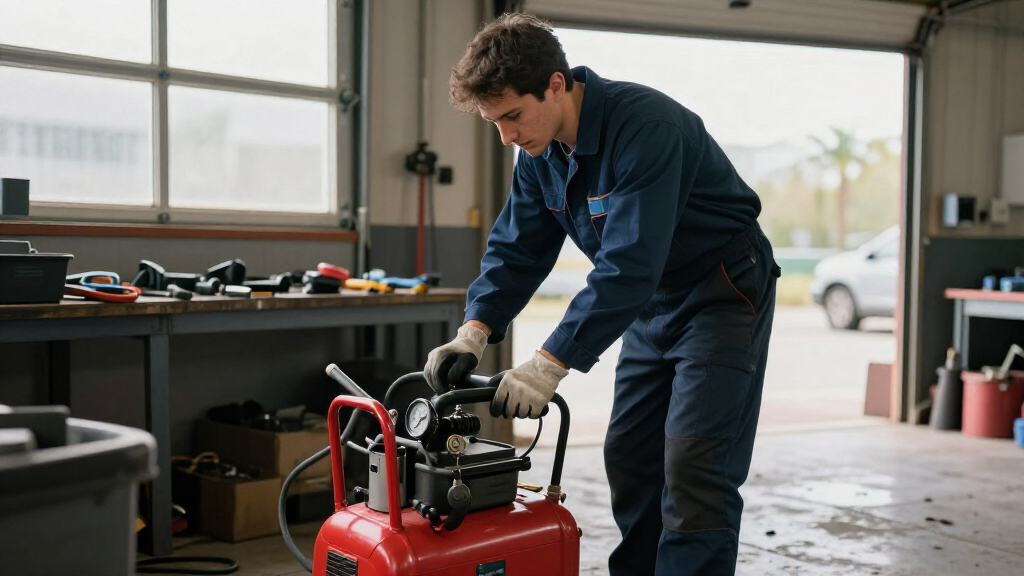
I evaluated each compressor through the lens of what actually happens in a garage: airing up truck tires, running an impact wrench on a brake job, driving nailers through trim, and blowing off a workbench. The criteria that separated winners from the rest were tank reserve and recovery time (whether the compressor keeps up with your tools or stalls mid-task), noise output, physical footprint, and total value including accessories and expected pump lifespan.
The ranking reflects a hierarchy of garage needs rather than raw specs. Large-tank units sit near the top because reserve capacity unlocks the widest range of tools, quiet models rank high for real-world usability in shared or attached garages, and compact pancakes earn their spots on value and portability despite their airflow limits. Every pick was also judged on its tradeoffs — a compressor that excels in one area almost always compromises somewhere else, and I made those compromises explicit so the ranking logic is easy to follow.
Factors to Consider When Choosing Garage Air Compressors
Before settling on a specific model, it helps to understand how compressor specs translate into what you can actually do in your garage. These are the factors that most often make or break the purchase.Match Tank Size to Your Tools, Not Your Ambitions
The most common mistake I see is buying a compressor for the tools you own today without checking the tools you’ll want tomorrow. A 6-gallon pancake runs a framing nailer beautifully but will have you waiting between bolts when you put an impact wrench on a suspension job. The dividing line is continuous vs. intermittent demand: nailers and inflators use air in short bursts, while impact wrenches, sanders, and grinders drain a tank steadily. Twenty gallons is the practical threshold where sustained impact-tool work becomes comfortable. Also remember that a bigger tank doesn’t add airflow — it only buys time before the pump catches up, so a big tank with a weak motor still disappoints.
Take Noise Seriously If Your Garage Is Attached
Compressor noise is the spec buyers regret ignoring most. A loud conventional compressor at 90-plus dB means hearing protection, interrupted conversations, and possibly a complaint from whoever is inside the house. Quiet oil-free designs running in the 60s of dB let you work in the evening without disruption, which realistically means you’ll use the tool more often. The honest tradeoff: quiet compressors pump slower, so recovery between tasks takes longer. If your garage is detached and noise doesn’t matter, you get more performance per dollar by skipping the quiet premium entirely.
Oil-Free vs. Oil-Lubricated Pumps
Nearly every compressor in this category is oil-free, and for garage use that’s usually the right call — zero maintenance, no oil mist in the air line (important if you ever paint), and no winter storage worries. The compromise is pump longevity and duty cycle: oil-free pumps typically have a shorter rated lifespan and don’t love running constantly. If you’re a weekend user, this tradeoff is nearly irrelevant because the pump will outlast your interest in the hobby. If you run tools daily in a home shop, a heavier-duty pump and attention to duty-cycle ratings matter far more than the convenience of oil-free operation.
Floor Space, Weight, and the Wall-Mount Option
A 29-gallon compressor is a piece of furniture — once it’s in your garage, it’s staying there, and you need to plan hose reach around it. Pancake and small-tank units trade reserve for portability, which matters if you work in the driveway or share the compressor between garage and house projects. Wall-mount units are the underrated middle path: they get the compressor off the floor entirely and pair beautifully with a retractable hose reel. The catch is that wall-mounts are limited by circuit capacity and compact tanks, so treat them as inflation and nail-gun stations, not impact-wrench power sources. Measure your wall stud spacing and available circuit before committing.
PSI Ratings, CFM, and the Numbers That Actually Matter
Max PSI is the spec marketed hardest and understood least. Almost every garage tool runs happily at 90 PSI, so a 150 PSI tank’s real advantage is stored reserve, not higher tool pressure — a 150 PSI tank holds roughly 20% more usable air than the same tank cycled to 125. What you should actually check is CFM at 90 PSI against your hungriest tool’s requirement, plus recovery time. A compressor that delivers 4 CFM while your grinder wants 6 will run continuously and struggle. This is also where budget models quietly cut corners, so compare CFM figures, not just horsepower labels, which are notoriously optimistic across the category.
Accessories, Outlets, and Total Cost of Ownership
The sticker price rarely tells the whole story. A bare compressor still needs a hose, couplers, a blow gun, and a tire chuck — and buying those separately adds real cost, which is why bundled kits like the ECOMAX pancake offer genuine value for first-time buyers. Beyond accessories, factor in a moisture drain routine (tanks left undrained rust from the inside and fail early), the cost of extra hose to reach your work area, and whether you’ll want a regulator upgrade for delicate tasks like painting. Cheap compressors also sometimes ship with marginal gauges and plastic fittings; budget to replace those eventually and the value math changes.
Frequently Asked Questions
Will a 6-gallon compressor run an impact wrench?
It can, but only in short bursts. A typical half-inch impact wrench needs 4-5 CFM to sustain, and a 6-gallon oil-free pancake simply can’t keep up, so the tool loses torque quickly while the pump runs constantly trying to recover. For occasional lug nut work — swapping wheels seasonally, for example — the wait between bolts is tolerable. If impact tools are a regular part of your garage work, the Klutch 20-gallon or 29-gallon models are the honest answer, since their tank reserve bridges the gap while the pump catches up. Think of the small tanks as inflation and nail-gun machines that can fake impact duty in a pinch.
How quiet does a compressor need to be for an attached garage?
As a rule of thumb, anything at or under about 70 dB is livable in an attached garage, and the low-70s will still be audible through a shared wall. The quiet models in this lineup — the Ultra-Quiet 8-Gallon and the 68 dB 5-gallon unit — sit at roughly normal conversation level, which means no hearing protection and no complaints when you’re working in the evening. Conventional louder compressors in the high 80s and 90s are genuinely painful without protection and will absolutely be heard inside the house. One nuance: pump noise and vibration travel differently, so a quiet compressor mounted on a hard floor can still transmit hum through the structure — a rubber mat helps more than you’d expect.
Is a wall-mount compressor powerful enough for garage work?
It depends entirely on what you call garage work. Wall-mount units like the CRAFTSMAN 1.5 HP and ECOMAX models handle tire inflation, nail guns, blow-off cleaning, and airbrushing without breaking a sweat, and their retractable 30-foot hose reels are genuinely convenient in a small space. Where they fall short is sustained airflow — sanding, grinding, and extended impact-wrench use will outrun the compact tank and smaller motor. The practical move for many garages is a wall-mount as a permanent always-ready station, paired later with a bigger floor unit only if you take on heavy mechanical work. If you only ever buy one compressor and want to run everything, a 20-gallon floor model is the better single purchase.
Do I need a 120V outlet upgrade for a bigger compressor?
Most compressors in this class are designed for standard 120V household circuits, including the 2.5 HP Klutch 29-gallon, but motor size isn’t the whole story — circuit capacity and what else shares that circuit matter just as much. A large motor starting up draws a brief surge that can trip a 15-amp breaker, especially on a long circuit run or one shared with garage lighting and a freezer. Plug a big compressor into a dedicated 20-amp circuit whenever possible, and use a properly rated extension cord or none at all — undersized cords cause voltage drop that overheats motors and shortens pump life. Before buying any large compressor, check your garage breaker panel; it’s a five-minute task that prevents a frustrating returns process.
Are oil-free compressors really maintenance-free?
Mostly, but not entirely — and the part people skip is what kills these tanks. You never change oil or worry about oil in the air line, which makes oil-free designs genuinely low-effort for garage use. However, every tank accumulates water from compressed air humidity, and draining the tank regularly is the single habit that determines whether your compressor lasts five years or fifteen. Open the drain valve after heavy use, or at least monthly, and let the moisture out until you get clean air. Also keep intake vents clear of dust, since garage air is notoriously gritty and a clogged filter forces the motor to work harder. Ten minutes of basic care a month is all the maintenance these machines actually need.
Conclusion
The right choice here depends less on specs and more on what your garage is actually for. For the best overall pick, the Klutch 20-Gallon hits the sweet spot of reserve capacity, 175 PSI headroom, and reasonable footprint — it’s the one compressor that covers everything from tires to impact wrenches. The best premium choice is the Klutch 29-Gallon, which adds serious reserve for sustained tool use if you have the floor space and budget. On the value side, the CRAFTSMAN 6-Gallon pancake and the ECOMAX 6-Gallon with accessories deliver everything a first-time buyer needs at a fraction of the cost.
For beginners, the ECOMAX bundle wins because it includes the accessories you’d otherwise buy piecemeal. If noise is your constraint, the Ultra-Quiet 8-Gallon is the standout, offering real tank reserve at conversation-level volume — a rare combination. And for small garages or tire-and-trim duty only, the wall-mount CRAFTSMAN or ECOMAX with its retractable hose keeps your floor clear while staying always ready. Whatever you pick, match the tank to your hungriest tool and the noise level to your living situation, and you won’t regret the purchase.