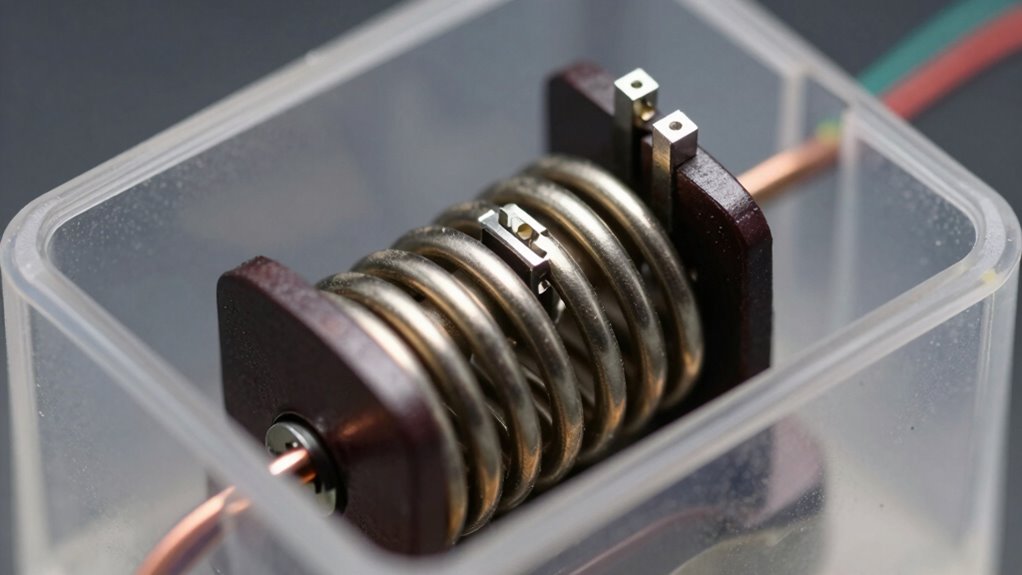
A relay is an easy-to-understand electromechanical switch that uses an electromagnetic coil to control high-power devices with a small signal. When current flows through the coil, it creates a magnetic field that pulls switch contacts from one position to another—either opening or closing the circuit. A simple diagram shows how energizing the coil moves the contacts, making it clear how relays work. Keep exploring to see more details and how they fit into various systems.

Get business pricing on garage and car supplies
- Business-only prices and quantity discounts
- Tax-exempt purchasing
- Multiple users, one account, clear invoices
Key Takeaways
- A relay uses an electromagnet to switch high-power circuits with a low-voltage control signal.
- Energizing the coil creates a magnetic field that moves switch contacts between open and closed states.
- The diagram shows the coil, switch contacts (NO or NC), and their connection to control and load circuits.
- Electrical isolation between control and load sides prevents high voltages from damaging low-voltage electronics.
- Simple diagrams clearly illustrate how energizing the coil changes the contact position, controlling the load.

Have you ever wondered how electrical circuits can control high power devices with just a small signal? The answer lies in the clever use of relays. At the heart of a relay is a relay coil, a simple electromagnet that, when energized, creates a magnetic field. This magnetic field pulls a set of switch contacts, allowing a low-voltage control signal to switch on or off a much higher voltage circuit. The relay coil is energized by a control circuit, and its magnetic field acts as a switch operator, enabling you to control large loads with minimal effort and risk.
When the relay coil receives power, it becomes magnetized, pulling the switch contacts from their default position. Typically, these contacts are normally open (NO) or normally closed (NC). In a normally open configuration, the contacts remain apart until the coil is energized, closing the circuit and allowing current to flow to the high-power device. Conversely, in a normally closed setup, the contacts stay connected until the coil energizes, breaking the circuit and turning off the device. This simple switching action makes relays incredibly versatile, enabling automation and remote control in a wide range of applications.
The switch contacts are designed to handle high currents and voltages, often far exceeding what the relay coil itself needs. This separation of the low-voltage control side from the high-power load side guarantees safety and reliability. When the relay coil is de-energized, the switch contacts return to their default state, either opening or closing the circuit depending on their configuration. This rapid switching, combined with electrical isolation, allows relays to protect sensitive control circuits from high voltages and currents, preventing damage and ensuring system stability. electrical isolation is a fundamental principle that enhances safety in relay applications.
Understanding the relay’s operation with its coil and switch contacts clarifies how they function seamlessly in complex systems. You can think of the relay as a bridge: a tiny, low-power control signal on one side controls a high-power load on the other, all without direct electrical contact. This setup is especially vital in automation, where microcontrollers or sensors signal relays to turn on motors, lamps, or other heavy-duty equipment. The elegance of relays lies in their simplicity—using electromagnetic principles to achieve reliable, fast switching with minimal components.
In essence, the relay’s coil acts as the control element, creating a magnetic field that moves the switch contacts. This straightforward yet powerful mechanism allows tiny signals to control large electrical loads safely and effectively, making relays indispensable in modern electrical and electronic systems.
As an affiliate, we earn on qualifying purchases.
Frequently Asked Questions
How Do Relays Differ From Switches?
Relays differ from switches in their relay design and electrical control. While switches are manual devices that open or close circuits directly, relays use an electromagnetic coil to activate a switch internally. This allows you to control high-power circuits with low-power signals, making relays essential in electrical control systems. You can automate processes more efficiently with relays, providing remote or automatic switching capabilities that switches can’t offer.
What Are the Common Types of Relays?
You’ll find common relay types include electromechanical, solid-state, and reed relays. Electromechanical relays use relay symbols to show their coil and contact configurations, with coil ratings indicating voltage and current limits. Solid-state relays lack moving parts, offering faster switching. Reed relays feature tiny glass tubes with magnetic reeds. Understanding these types helps you select the right relay based on coil ratings and application needs, ensuring reliable circuit control.
How Do Relay Coils Work Internally?
You can understand relay coils by looking at their construction and electromagnetic principles. When you pass current through the coil, it creates a magnetic field due to electromagnetic principles. This magnetic field then pulls a switch or armature, closing or opening a circuit. The coil’s construction involves insulated wire wound around a core, typically iron, which enhances the magnetic effect, allowing the relay to control larger currents with a small input.
What Are Typical Applications for Relays?
You use relays in relay automation to control high-power devices with low-voltage signals, making systems more efficient and reliable. They’re essential for safety, allowing you to disconnect or isolate circuits during faults or maintenance. Typical applications include home automation, industrial machinery, and automotive systems. Relays help you automate processes, enhance relay safety, and guarantee that your equipment operates smoothly and securely, even in complex or hazardous environments.
How Do You Troubleshoot Relay Failures?
To troubleshoot relay failures, start by checking the relay’s lifespan—if it’s overdue, replacement might be necessary. Listen for relay noise; excessive or no clicking indicates issues. Test the coil with a multimeter to confirm proper resistance, and verify the contacts aren’t stuck or corroded. If the relay isn’t functioning properly, replacing it usually resolves the problem, ensuring your system runs smoothly.
high current relay for electronics
As an affiliate, we earn on qualifying purchases.
As an affiliate, we earn on qualifying purchases.
Conclusion
So, next time you see a relay, don’t overlook it as just another tiny switch. It’s the unseen hero that keeps your gadgets running smoothly—yet, it’s often so simple, you might forget it’s even there. Ironically, the very device that seems so basic is actually the backbone of complex electrical systems. Without relays, your devices would be pretty powerless. So, give a nod to these unassuming champs—you might just owe them a lot more than you realize.
As an affiliate, we earn on qualifying purchases.
As an affiliate, we earn on qualifying purchases.
Halloween Picks
halloween
As an affiliate, we earn on qualifying purchases.