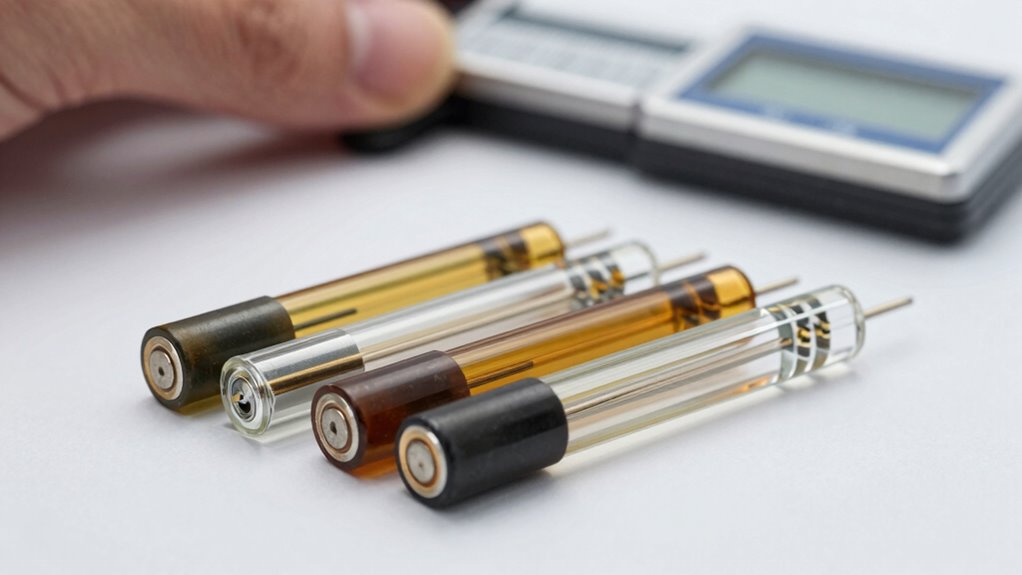

To pick the right fuse size, you need to match its rating to your circuit’s load current, adding a safety margin of about 125-135% to handle surges. Make sure the fuse’s voltage rating matches or exceeds your system’s voltage, and choose the appropriate fuse class and type for your application. Consider environmental factors like temperature, space, and vibration. If you want to guarantee safe, reliable protection, exploring these points further will guide your selection perfectly.

Get business pricing on garage and car supplies
- Business-only prices and quantity discounts
- Tax-exempt purchasing
- Multiple users, one account, clear invoices
Key Takeaways
- Match fuse voltage ratings to your circuit’s voltage to prevent failure and ensure safety.
- Calculate total load current and add a safety margin (125-135%) before selecting fuse size.
- Choose fuse class and type based on application, considering inrush currents and short-circuit protection.
- Consider environmental factors like temperature and humidity, adjusting fuse size accordingly.
- Ensure physical size fits your installation space and device requirements for safe and reliable operation.
As an affiliate, we earn on qualifying purchases.
Understanding Fuse Ratings and Ampacity

Understanding fuse ratings and ampacity is essential for selecting the right fuse for your circuit. Fuse ratings indicate the maximum current a fuse can handle before melting to protect your wiring and devices. Ampacity refers to the maximum continuous current that circuit components can safely carry without overheating. Choosing a fuse with a rating close to your component’s ampacity prevents nuisance blowing or fire hazards. Proper fuse sizing also involves considering the circuit’s load characteristics, which directly influence fuse selection. Standard ratings include values like 15A, 20A, and up to 150A, helping you match your circuit’s load. Oversized fuses risk overheating and fires, while undersized ones blow too often, causing inconvenience. Always ensure the fuse’s voltage rating matches your application—AC or DC—and consider the fuse class and type for proper protection. Correct understanding of ratings and ampacity is key to safe, effective circuit protection. Proper fuse selection ensures your system remains safe and reliable. Additionally, understanding the fuse ratings and ampacity helps prevent damage to your components and ensures long-term system stability. Recognizing the importance of circuit protection can further safeguard your system from potential hazards.
As an affiliate, we earn on qualifying purchases.
How to Calculate the Correct Fuse Size for Your Circuit

To find the right fuse size, start by determining your circuit’s load current accurately. Then, add a safety margin to account for temporary surges and variations, ensuring reliable protection. This approach helps you select a fuse that provides safety without unnecessary interruptions. Incorporating energy-efficient solutions can further optimize your circuit’s overall performance and longevity. Additionally, understanding the contrast ratio of your components can influence your decision by ensuring your circuit can handle the required image quality demands. Regularly reviewing industry trends can also help you stay informed about advances in fuse technology and best practices. Moreover, being aware of air quality considerations can help you design circuits that operate efficiently in environments with varying dust, humidity, or airborne pollutants. Staying informed about Youngster Choice can also provide insights into emerging trends and innovative solutions in electrical safety and circuit design.
Determine Load Current
How do you accurately determine the load current in your circuit? First, identify all the devices that will operate simultaneously. Check each device’s nameplate or technical specifications to find its current draw. Add these currents together for a total load. If your circuit powers multiple components, sum their individual currents to get the combined load. For circuits with variable loads, use the maximum expected current during peak operation. Remember, the load current is different from the circuit’s rated voltage; focus on the actual current flowing through the circuit during normal operation. Precise measurement may require using a clamp meter or multimeter. Understanding the safety margins of your circuit helps prevent overfusing or underprotecting your components. Incorporating industry standards ensures your fuse size selection aligns with best practices. Additionally, consider the environmental conditions where the circuit will operate, as temperature and humidity can influence fuse performance. Properly accounting for ambient temperature can help prevent premature fuse blowouts or failures. This step ensures you select a fuse that protects your circuit without nuisance blowing or fire risk, providing a solid foundation for proper fuse sizing.
Apply Safety Margins
Applying safety margins when selecting a fuse guarantees your circuit stays protected under various conditions, including surges and transient currents. To do this, multiply your calculated load current by a safety factor—usually between 125% and 135%. For example, if your circuit draws 10A continuously, multiply by 1.25 to get 12.5A. Then, round up to the next standard fuse size, such as 15A. This buffer accounts for temporary surges and minor current spikes, preventing nuisance blowing while maintaining protection. Remember, choosing a fuse too close to the load current increases the risk of false trips, while an excessively large fuse reduces safety. Always consider potential transient conditions and ambient temperature changes, and select a fuse size that balances protection and reliability. Understanding circuit protection is key to ensuring safety and optimal operation. Additionally, consulting fuse specifications can help you better understand how different fuse types respond to various electrical conditions, further improving your selection process.
As an affiliate, we earn on qualifying purchases.
The Importance of Matching Voltage Ratings

Matching the fuse’s voltage rating to your application is vital for safe operation. Using an underrated voltage rating can lead to fuse failure or arcing, risking damage or fire. Always guarantee the fuse’s voltage matches or exceeds the voltage of your circuit to prevent these issues. Proper circuit protection ensures safe and reliable operation of your electrical devices. Additionally, understanding voltage ratings helps prevent potential electrical hazards and ensures your setup complies with safety standards. Selecting the correct fuse size also involves considering the environment where the fuse will be used, as certain conditions can affect its performance and safety. Being aware of wave and wind conditions can influence the choice of fuse to ensure durability in varying environments. Recognizing the impact of temperature fluctuations can also assist in choosing a fuse that maintains performance under different operating conditions.
Voltage Compatibility Essential
Ensuring the fuse’s voltage rating aligns with your application is essential for safety and reliable operation. Using a fuse with too low a voltage rating can cause it to fail prematurely or not protect effectively. Conversely, selecting a fuse with a higher voltage rating than needed won’t harm your circuit but offers no added benefit. Always verify the fuse’s voltage compatibility with your system to prevent hazards. Remember these key points: – Match AC or DC voltage ratings to your circuit. – Use fuses rated for at least the maximum voltage in your system. – Avoid fuses with considerably higher ratings, which can compromise protection. – Check for fuse classes designed for your voltage type. – Overlooking voltage ratings can lead to dangerous failures or fires. Proper voltage compatibility ensures your fuse functions correctly, safeguarding your equipment and preventing hazards. Additionally, understanding the voltage ratings helps ensure the fuse will perform reliably over the lifespan of your system. Incorporating connected technology into your fuse selection process can enhance safety and system performance.
Prevents Fuse Failure
Choosing a fuse with the correct voltage rating is essential because using one with a lower rating than your circuit’s voltage can cause it to fail prematurely or not provide adequate protection. When the fuse’s voltage rating is too low, it may break down or arc over before melting, risking damage or fire. Always match the fuse’s voltage rating to your application—AC or DC—and the circuit’s voltage level. Refer to the table below for typical ratings:
| Voltage Rating | Suitable Applications |
|---|---|
| 600V or less | Household, automotive, low-voltage |
| Over 600V | Industrial, high-voltage systems |
| 125V | Small appliances, electronics |
| 250V | General-purpose, power supplies |
| 300V+ | Heavy machinery, large motors |
Choosing the right voltage rating guarantees your fuse functions reliably, preventing failure and safeguarding your circuit. Proper verification of voltage ratings helps avoid fuse failure and ensures safety in your electrical systems.
Matches Application Voltage
Using a fuse with the correct voltage rating is essential because it directly affects the safety and reliability of your circuit. If the fuse’s voltage rating is too low, it may fail prematurely or fail to interrupt a fault, risking damage or fire. Conversely, a fuse rated for higher voltage than your application can handle may not blow properly during overloads. Always match the fuse’s voltage rating to your system—AC or DC—since they aren’t interchangeable.
- Confirm the fuse’s voltage rating matches your circuit’s voltage.
- Use AC-rated fuses for alternating current systems.
- Select DC-rated fuses for direct current applications.
- Check manufacturer specifications for voltage compatibility.
- Avoid using a fuse with a higher voltage rating than necessary.
fuse holder for electrical panel
As an affiliate, we earn on qualifying purchases.
As an affiliate, we earn on qualifying purchases.
Adjusting Fuse Sizing for Ambient Temperature Changes

When ambient temperature changes, you need to modify your fuse sizing to make certain of proper protection. Higher temperatures reduce fuse capacity, so you should select a larger fuse to prevent nuisance openings. Conversely, lower temperatures allow for smaller fuses without risking overloads. Use the following table to determine adjustments:
| Ambient Temp (°C) | Adjustment Factor |
|---|---|
| Below 20°C | Decrease fuse size |
| 20°C | No change |
| 40°C | Increase by 10-15% |
| 65°C | Increase by 20-25% |
| Above 65°C | Consult manufacturer |
Always verify with fuse manufacturer guidelines for specific ratings. Proper adjustments ensure reliable circuit protection across temperature variations.
Choosing the Right Fuse Class and Type for Your Application

Selecting the appropriate fuse class and type is essential for guaranteeing reliable protection tailored to your specific application. Choosing the right fuse depends on factors like voltage, current, and response time. Here are key considerations:
- Match fuse class to voltage rating and application (AC/DC)
- Use time-delay fuses for circuits with inrush currents
- Select current-limiting types for fast protection against short circuits
- Choose general-purpose fuses for standard loads
- Make certain fuse type suits environmental conditions, like temperature or vibration
Physical Sizes and Space Considerations for Fuses
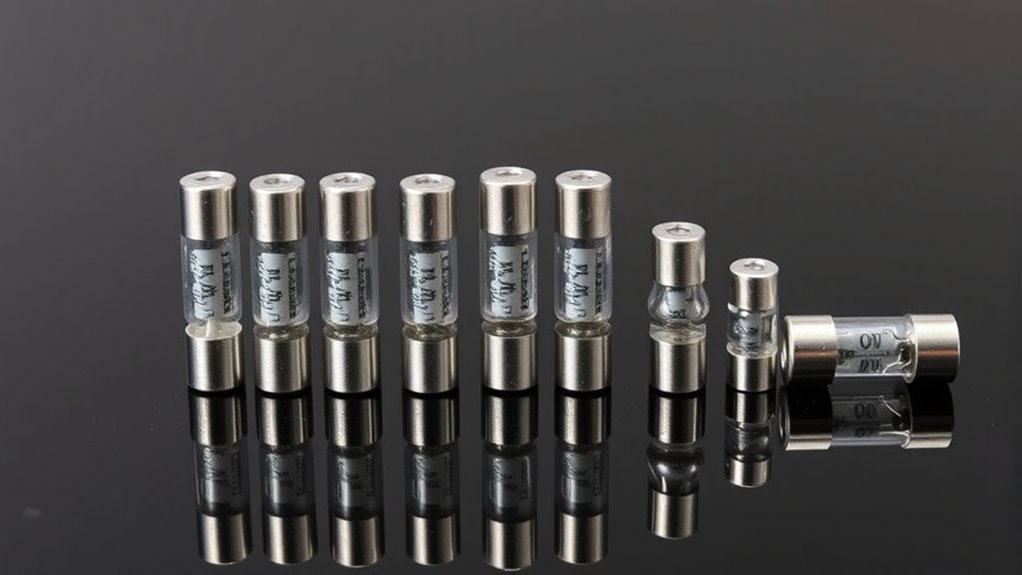
Fuses come in a wide range of physical sizes to fit various applications and space constraints. Smaller fuses, like chip and surface-mount types, are ideal for compact electronics and circuit boards, measuring just fractions of an inch. Midget and glass tube fuses, around 1/4” diameter, suit panel-mounted or limited-space setups. Larger fuses, such as 5AG or ferrule types, provide higher current capacity and are used in industrial or heavy-duty applications, with sizes up to over an inch in diameter. When selecting a fuse, consider the available space, fuse holder dimensions, and ease of replacement. Proper sizing guarantees safe operation without overcrowding your panel or risking damage. Always match the fuse size to your device’s physical constraints to maintain both safety and reliability.
Ensuring Safety With Proper Fuse Selection

Proper fuse selection is essential to guarantee electrical safety and prevent damage to your system. Choosing the right fuse size ensures protection without nuisance blows or fire hazards. To do this effectively, consider these key points:
- Match the fuse’s ampacity to the circuit’s continuous load, avoiding undersized fuses.
- Verify voltage ratings align with your application’s voltage to prevent failure.
- Account for ambient temperature changes that can affect fuse performance.
- Use the correct fuse type—fast-acting, time-delay, or current-limiting—for your specific needs.
- Ensure physical size and mounting fit within your system’s space and design constraints.
Common Mistakes to Avoid When Sizing Fuses
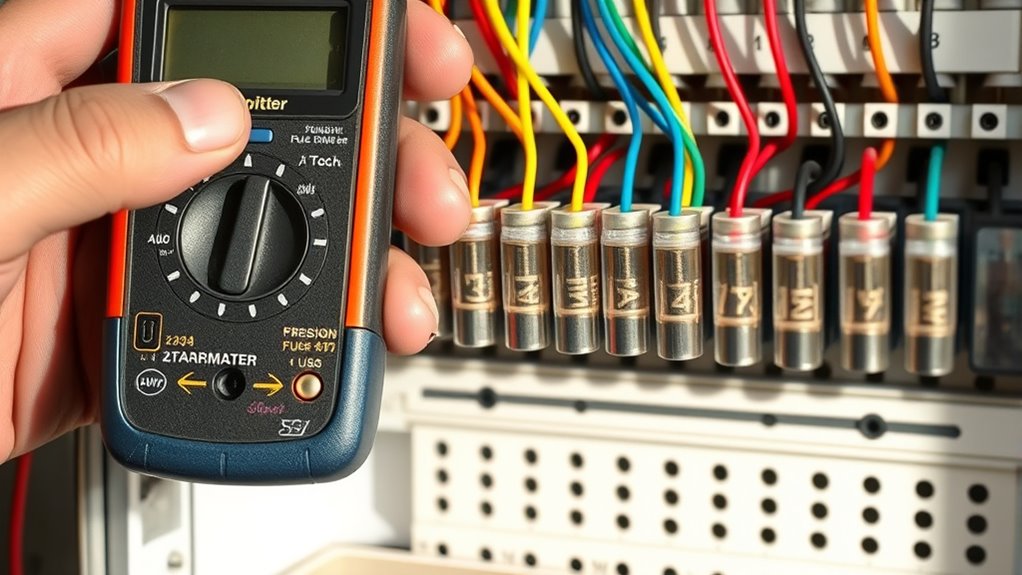
One common mistake is choosing a fuse that doesn’t match the circuit’s actual load or operating conditions. This can lead to nuisance blowing or, worse, insufficient protection. Avoid selecting a fuse rated too high for the circuit’s ampacity, which increases fire risk. Conversely, picking a fuse that’s too small causes frequent interruptions, disrupting operation and possibly damaging components. Don’t ignore the importance of voltage rating or ambient temperature, as these factors influence fuse performance. Another mistake is relying solely on standard fuse ratings without calculating the specific load requirements. Always base your decision on accurate calculations considering both continuous and non-continuous loads. Finally, avoid using a fuse with inappropriate characteristics—such as mismatched trip times or classes—that don’t suit your circuit’s needs. Proper sizing guarantees safety, reliability, and ideal protection.
Practical Tips for Maintaining Optimal Fuse Protection

To guarantee your fuse protection remains effective, regularly inspect fuses for signs of wear, corrosion, or damage, as these can compromise their performance. Keep an eye out for discoloration, cracks, or loose connections that indicate potential failure.
- Replace blown or damaged fuses immediately to prevent circuit issues.
- Use the correct fuse type and rating specified for your application.
- Keep spare fuses of matching ratings on hand for quick replacements.
- Ensure fuse holders are clean, secure, and corrosion-free.
- Periodically verify circuit loads to confirm fuses aren’t undersized or oversized.
Consistent maintenance helps avoid unexpected failures or fires, ensuring your system stays protected and runs smoothly. Proper care prolongs fuse life and optimizes circuit safety.
Frequently Asked Questions
How Do Ambient Temperature Variations Affect Fuse Performance?
Ambient temperature variations directly impact fuse performance by requiring you to calibrate the fuse rating accordingly. Higher temperatures mean you should select a larger fuse to prevent premature blowing, while lower temperatures might allow for a smaller fuse. Typically, every 20°C change adjusts the fuse rating by about 10-15%. Always consider your environment’s temperature to ensure your fuse provides reliable protection without nuisance openings.
Can I Use a Larger Fuse Without Risking Safety?
You can use a larger fuse, but it risks safety. For example, in a boat wiring system, installing a 60A fuse instead of a 50A increases fire risk if a short occurs. Larger fuses may not blow quickly enough to prevent damage or fire. Always match fuse size to the load and wiring, considering safety margins, and avoid surpassing recommended ratings to protect your system and lives.
What Happens if the Fuse Voltage Rating Is Mismatched?
If the fuse voltage rating is mismatched, it can cause safety issues and equipment damage. Using a fuse with a lower voltage rating than your application can lead to insulation breakdown or arcing, increasing fire risk. Conversely, a fuse rated for higher voltage may not blow as intended during overcurrent situations, compromising protection. Always verify the fuse’s voltage rating matches or exceeds your circuit’s voltage for safe, reliable operation.
How Do Transient Surges Influence Fuse Selection?
Imagine a thunderstorm tearing through your circuit—transient surges can strike unexpectedly. These surges demand that you select a fuse with enough margin to handle brief overloads without blowing prematurely. You should choose time-delay or slow-blow fuses, which allow temporary surges to pass while still protecting the circuit. This way, you prevent nuisance blowing and make certain your system stays safe during electrical storms.
Are There Differences Between Fast-Acting and Time-Delay Fuses?
Yes, fast-acting and time-delay fuses differ markedly. Fast-acting fuses trip quickly when a fault occurs, protecting sensitive components from short, high-current surges. Time-delay fuses, on the other hand, withstand brief overloads, allowing for temporary current spikes without blowing. You should choose fast-acting fuses for delicate electronics and time-delay fuses for motors or equipment with inrush currents, ensuring proper protection while avoiding nuisance blowing.
Conclusion
Choosing the right fuse size is your secret weapon against electrical chaos—think of it as your circuit’s ultimate shield. By understanding ratings, matching voltage, and considering application specifics, you prevent disasters and keep your system running smoothly. Don’t let guesswork leave you vulnerable—armed with these tips, you’ll master fuse sizing like a pro. Stay vigilant, stay safe, and keep your electrical world running flawlessly—because a well-chosen fuse can be the difference between peace of mind and chaos!
Halloween Picks
halloween
As an affiliate, we earn on qualifying purchases.