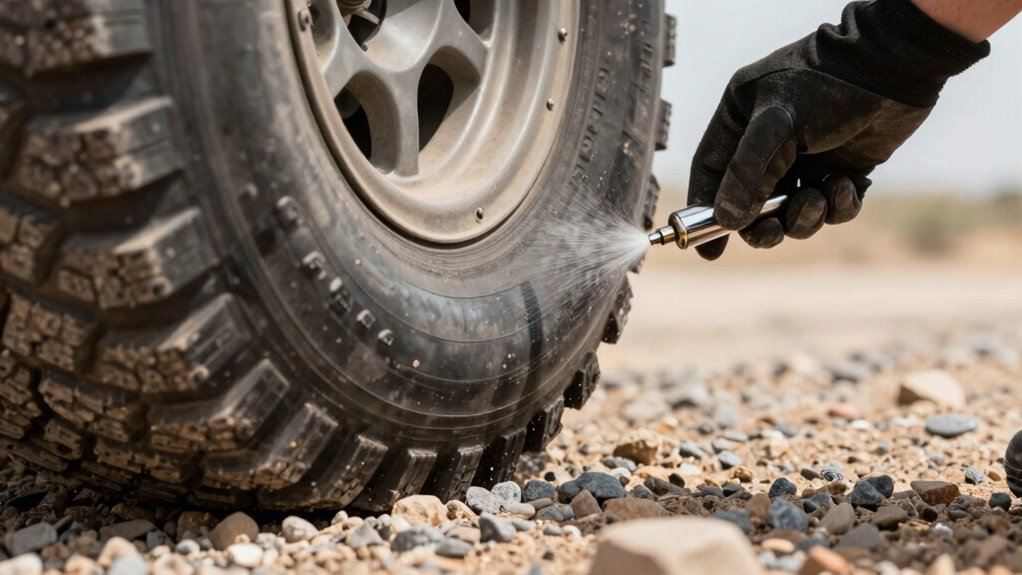

To air down fast without over-deflating, use preset or automatic deflators set to your target PSI, ensuring quick and consistent pressure reduction. Attach the deflator to each tire, monitor pressures with a quality gauge, and deflate gradually in small increments. Recheck often to avoid dropping below the ideal pressure. Handling valve cores carefully and using tools for precise control help prevent over-bleeding, so continue on to learn more tips for safe and efficient airing down.
Key Takeaways
- Use automatic or preset deflators set to your desired PSI for consistent, rapid air removal without over-deflating.
- Always measure initial tire pressure with a reliable gauge before deflation to set accurate target PSI.
- Deflate gradually in small 10–15 PSI increments, monitoring pressure frequently to prevent over-deflation.
- Recheck tire pressures after initial deflation, adjusting as needed to maintain balanced, safe pressures.
- Reinstall valve cores promptly after deflation to avoid unintended air loss and over-deflation.

DEWALT Tire Inflator Portable Air Compressor 20V MAX, Car Air Pump with Automatic Shut Off, LED Light, Tool Only (DCC020IB)
High-pressure inflation mode with automatic shutoff
As an affiliate, we earn on qualifying purchases.
Selecting the Right Tools for Rapid Air Removal
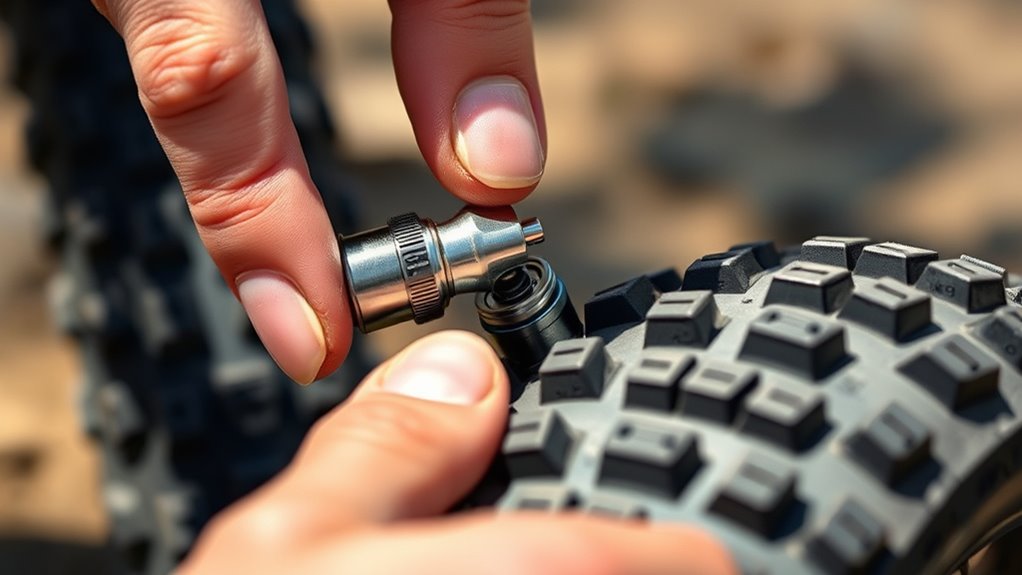
Choosing the right tools for rapid air removal is essential to guarantee safe, accurate, and efficient airing down. Automatic or preset tire deflators are ideal, as they set a target PSI and bleed air until reached, ensuring consistency across all tires. Digital or high-quality analog gauges are indispensable for precise initial and spot checks, preventing over-deflation. Valve-core removal tools allow quick, bulk deflation when very low pressures are necessary; just remember to reinstall the cores immediately afterward. A portable compressor or 12V air pump is critical for quick reinflation after off-road segments. Also, carry a tire repair kit and spare parts, like plugs and extra valve cores, to address any damage or leaks during airing down. Using these tools properly saves time and keeps your tires safe. Incorporating energy-efficient cloud solutions can also streamline your maintenance processes and enhance overall efficiency. Additionally, understanding tire pressure management principles can help prevent over-deflation and ensure optimal tire performance during your adventures. For added safety, consider using tire pressure monitoring systems to keep real-time track of pressure levels during your trips.

JACO Lightning RX4 Tire Deflator with Gauge | Rapid Quick-Connect Off Road 4x4 Air Down Tool
PATENTED AIR DOWN TOOL: Rapidly deflates tires for maximum off road traction by securely removing the tire valve...
As an affiliate, we earn on qualifying purchases.
Preparing Your Vehicle and Tires for Deflation
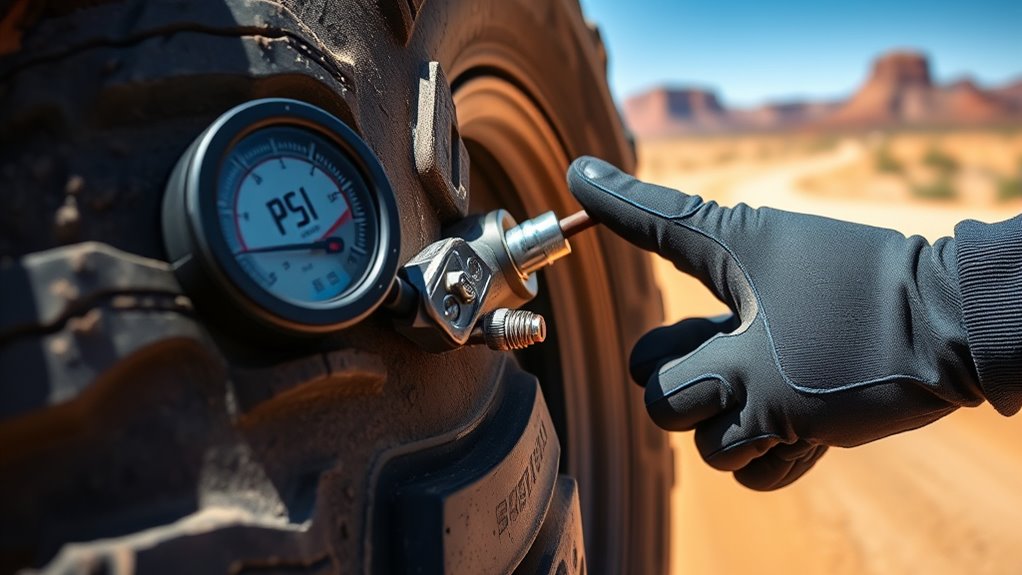
Before you begin deflating, you need to check your tire pressure with a reliable gauge to guarantee accuracy. Next, inspect each tire for any damage or issues that could worsen during airing down. Additionally, it’s important to consider style compatibility to ensure your tires are suited for your intended off-road activities. Proper tire selection can also help optimize performance and safety during the process. Ensuring your tires are appropriately air pressure is essential for effective deflation and to prevent damage. Using an electric or manual tire inflator can help you quickly reach your desired pressure levels and make the process more efficient. Finally, gather your deflation tools so you’re prepared to quickly and safely reduce tire pressure to the desired level. Ensuring proper ventilation considerations can also help prevent heat buildup and maintain safety during the process.
Check Tire Pressure
Have you checked your tire pressure recently? Before deflating, it’s essential to know your current PSI to avoid over‑deflating. Use a reliable gauge—digital or analog—for accurate readings. Record the pressure on all four tires to guarantee consistency. Inspect each valve stem for cleanliness and damage, as dirt or debris can affect readings. If you have preset deflators, set them to the current PSI to help manage pressure loss evenly. For quick checks, use a portable compressor or inflator to verify pressures after adjustments. Remember, proper pressure measurement prevents under- or over-deflation, protecting your tires and ensuring safe off-road performance. Regular checks also help you track pressure changes over time, maintaining excellent tire health. Proper maintenance of your tires is essential for optimal performance and safety. Additionally, being aware of vacuum cleaner features like suction power can help you understand how to keep your vehicle interior clean, especially when dealing with pet hair or dirt. Incorporating sensor technology into tire pressure monitoring systems can provide real-time alerts, further enhancing safety and convenience. Being familiar with tire pressure guidelines ensures you can make informed decisions when adjusting pressure for different driving conditions.
Inspect Tire Condition
Inspecting your tires for damage or wear before deflating guarantees you’re not risking a blowout or further injury to the tire. Start by visually examining each tire for cuts, punctures, cracks, or sidewall bulges. Check for embedded debris or sharp objects that could worsen during deflation or off-road use. Inspect the tread for uneven wear, excessive thinning, or exposed cords, which indicate internal damage. Ensure valve stems are intact, free of leaks, and not cracked. If you notice any issues, address them before airing down—either repair or replace the affected tire. Confirm that all tires are properly mounted and free of any pre-existing damage. Proper inspection ensures safe deflation, reduces the risk of sudden failure, and prepares your tires for challenging terrain. Additionally, understanding tire maintenance fundamentals helps prolong tire life and maintain optimal performance in demanding conditions. Regularly checking tire pressure levels contributes to better fuel efficiency and tire longevity, especially when preparing for off-road adventures. Furthermore, knowing how to properly air down tires ensures you can quickly adapt to changing terrains without compromising safety. Being familiar with water retention and drainage is also beneficial, especially if you encounter water crossings or muddy conditions.
Gather Deflation Tools
To effectively prepare your vehicle for airing down, gather all the necessary deflation tools in advance to guarantee a smooth and safe process. Having the right equipment ready saves time and prevents mistakes during critical moments. Start by collecting these essential items:
- Automatic or preset tire deflators for quick, consistent pressure reduction
- Digital or high-quality analog tire pressure gauge for accurate readings
- Valve-core removal tools for rapid deflation when needed
- Portable compressor or 12V air pump for reinflation on the trail
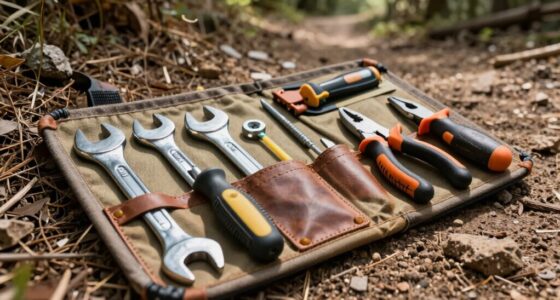
- Tire repair kit and spare parts to address potential damage or leaks
Ensuring your preparation process includes verifying that all tools are in good working order and easily accessible. Proper tool organization helps you avoid delays and confusion at critical moments. Familiarizing yourself with the deflation procedures beforehand can significantly speed up the process and reduce frustration. Additionally, understanding the benefits of proper air pressure can help you make informed decisions during deflation and reinflation. Being aware of air pressure guidelines tailored to your vehicle and driving conditions can further optimize your off-road experience. This preparation allows you to safely and efficiently lower your tire pressures without over-deflating or rushing, setting you up for successful off-road adventures.

Staun Tyre Deflators | The Australian Original Tire Deflator | Automatically Airdown Tires to 6-30 PSI
FAST: Accurately air down all four tires from street pressures to trail pressures effortlessly in just a few...
As an affiliate, we earn on qualifying purchases.
Establishing Accurate Starting Tire Pressures
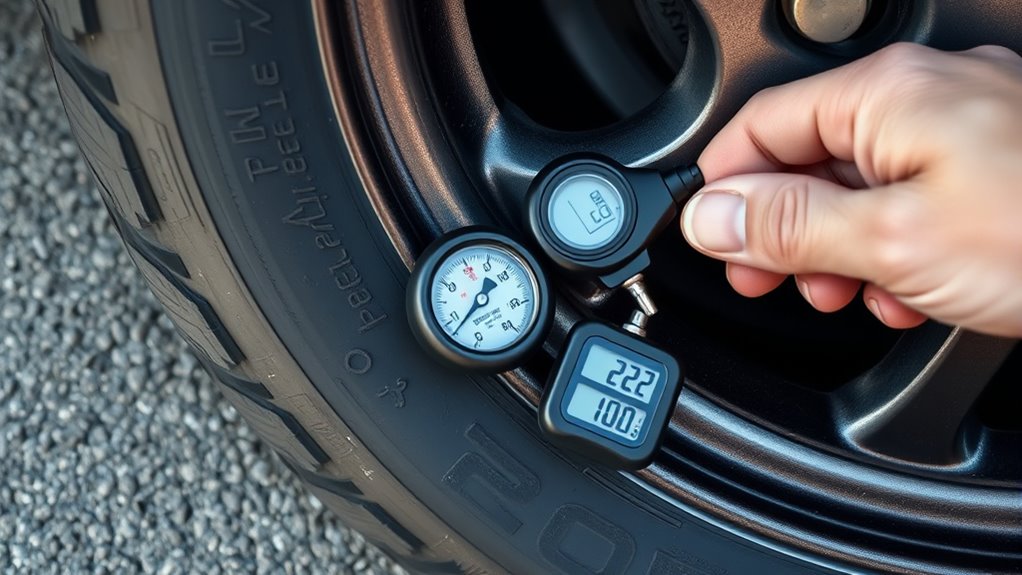
Establishing accurate starting tire pressures is essential for safe and effective airing down. You need to know your current PSI to avoid over- or under-deflating. Use a high-quality digital or analog gauge to check all four tires before starting. Record these pressures for reference. Remember, different terrains require specific starting pressures, so ensure your tires are properly inflated for highway driving first. This baseline prevents accidental over-deflation during terrain-specific adjustments. To emphasize, here’s why starting at the right pressure matters:
| Tire Condition | Starting PSI | Notes |
|---|---|---|
| Worn tires | Slightly higher | Compensate for wear |
| Cold tires | Lower initial | Measure before drive |
| Hot tires | Avoid measurement | Read when cold |
Proper initial PSI sets the stage for safe, controlled airing down.

DORNATA Adjustable Tire Deflator Auto-Stop (10-40 PSI) Offroad Accessories Valve Stem kit 4x4 Tyre Air Down Tool for Truck, Pickup, Motorcycle,Jeep etc. (Orange)
CREATIVE DESIGN- DORNATA's tire deflation valve has an auto-stop function, no need to wait and pay attention to...
As an affiliate, we earn on qualifying purchases.
Setting Up and Using Automatic or Preset Deflators
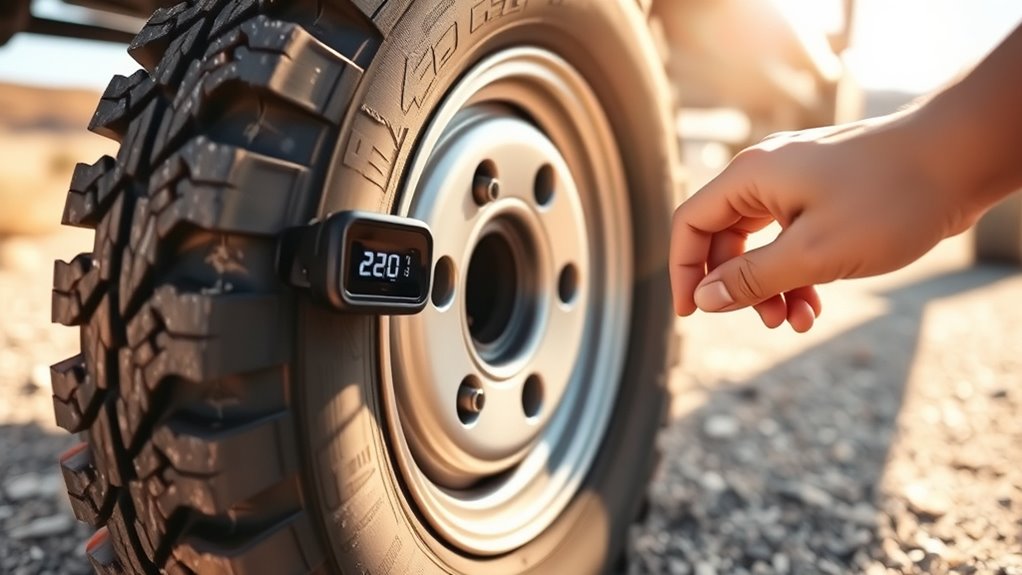
To set up automatic or preset deflators effectively, you need to verify they’re properly calibrated and configured to your target PSI for each terrain. As you use them, monitor the pressure readings closely and make adjustments if necessary to achieve consistent results across all tires. Always double-check pressures after deflation to confirm accuracy before heading out. Additionally, proper calibration is essential to ensure your deflators provide accurate and safe pressure adjustments. Regularly testing and maintaining your deflators helps prevent discrepancies and prolongs their lifespan.
Proper Deflator Setup
Setting up automatic or preset deflators guarantees you can quickly and accurately reduce tire pressure to your desired level without guesswork. To verify precise operation, start by calibrating your deflator against a reliable pressure gauge, confirming it reaches your target PSI. Make sure the deflator is clean and free of debris to prevent malfunctions. Attach it securely to your tire valve, then set the desired PSI on the device. Test the setup on a single tire first, adjusting as needed for accuracy. Once confirmed, apply it to all tires for consistent deflation. Always double-check each tire’s pressure with a quality gauge after deflation to avoid over- or under-deflation. Proper setup guarantees safe, efficient airing down tailored to your terrain.
Monitoring and Adjusting PSI
Monitoring and adjusting PSI with automatic or preset deflators guarantees you achieve accurate tire pressures quickly and reliably. Set your deflator to your target PSI for the terrain, then attach it to each tire. As it bleeds air, check readings frequently with a high-quality gauge to prevent over-deflation. Once the desired pressure is reached, remove the deflator and recheck with your gauge. Drive a short distance to let the tires settle, then re-measure and adjust if needed. Consistency across all tires enhances handling and safety. Use the table below to track your process:
| Step | Action |
|---|---|
| 1 | Set deflator to target PSI |
| 2 | Attach deflator to tire |
| 3 | Monitor pressure regularly |
| 4 | Recheck and fine-tune with gauge after deflation |
Ensuring Consistent Inflation
Using automatic or preset deflators simplifies the process of achieving consistent tire pressures across all your wheels. These tools automatically bleed air to your set target PSI, saving time and reducing guesswork. To maximize their effectiveness, verify they’re properly calibrated before use. Always double-check the pressure after deflation to confirm accuracy. Adjust the deflator settings according to terrain, so your tires reach the ideal pressure for sand, mud, or rocks. Keep a backup gauge handy for spot-checks and verify each tire’s PSI during and after deflation. When reinflating, use the same tools to restore pressures evenly. This consistency improves handling, protects your tires, and prevents over- or under-deflation, making your air-down process faster, safer, and more reliable.
Manual Deflation Techniques for Precise Control
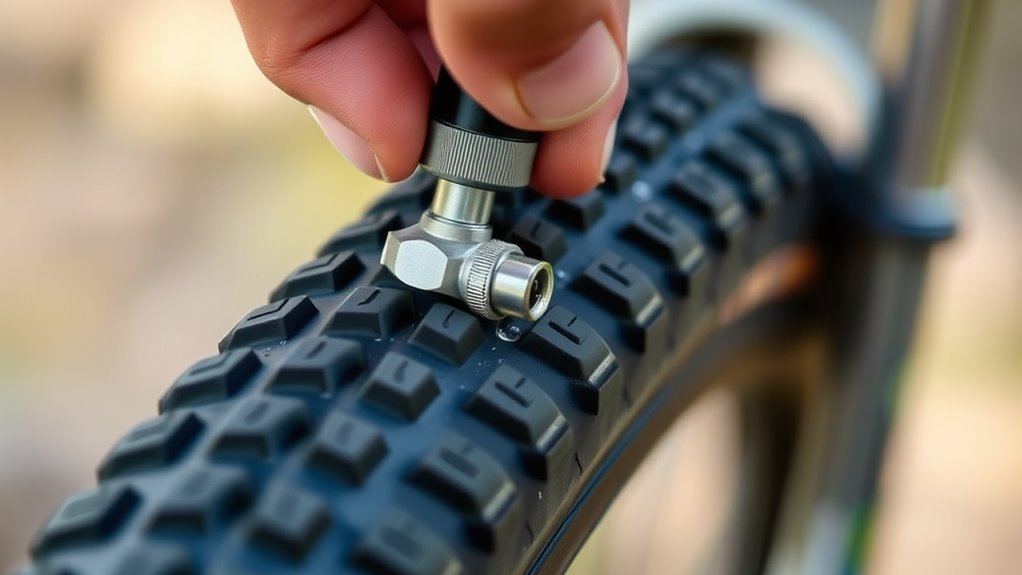
Manual deflation techniques allow you to precisely control tire pressure, guaranteeing ideal contact patch and traction for your specific terrain. Start by checking and recording your current PSI with a reliable gauge. Attach a manual deflator or preset automatic device, then deflate gradually—about 10–15 psi at a time—to prevent over-deflation or bead unseating. Monitor pressure frequently, adjusting as needed to reach your target based on terrain, such as 12–15 psi for sand or 15–20 psi for mud. Use valve-core removal tools for rapid adjustments, but reinstall the core immediately afterward. After each deflation step, recheck pressures and ensure all tires are evenly deflated. Moving the vehicle slightly helps the tire beads settle and reveals any slow leaks. This method offers precise, safe control over your airing down process.
Monitoring and Adjusting Tire Pressure During Airing Down
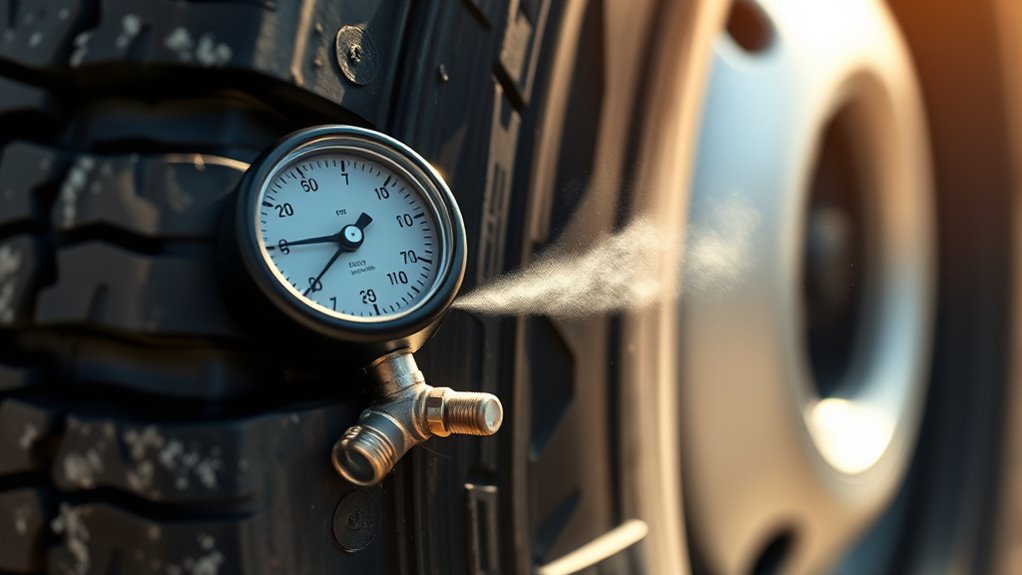
To effectively air down, you need to monitor your tire pressure accurately and make small, controlled adjustments. Using precise measurement tools guarantees you don’t over-deflate or leave your tires underinflated, which can cause handling issues or damage. Always adjust incrementally, checking each tire often to maintain consistent pressure across all four tires.
Precise Pressure Measurement Techniques
Accurate pressure measurement during airing down is essential for achieving the desired tire pressure without risking over-deflation or uneven pressures. Using reliable tools helps you monitor each tire’s PSI precisely, ensuring consistency and safety. Always start by checking the current PSI with a high-quality gauge, whether digital or analog. When deflating, use preset or automatic deflators that stop at your target PSI for speed and uniformity. Recheck pressures frequently during the process, especially after deflating each tire. After reaching your target, re-seat valve cores immediately and verify pressures again. Moving the vehicle slightly helps the tire bead settle and reveals leaks. Consistent, precise measurements prevent over-deflation and guarantee your tires perform at their best on challenging terrains.
- Use a high-quality tire pressure gauge for accuracy
- Employ preset or automatic deflators for consistency
- Recheck pressures after each deflation step
- Re-seat valve cores before final pressure check
- Measure tire pressure on a flat, stable surface
Incremental Pressure Adjustments
Monitoring and adjusting tire pressure incrementally during airing down guarantees you reach your target PSI safely and consistently. You should deflate in small steps, checking pressure frequently to avoid over-deflation or bead unseating. Use a reliable gauge and deflate one tire at a time, setting initial targets based on terrain. Once near your goal, fine-tune pressures to match specific conditions, ensuring even contact and stability. This method minimizes risks like sudden leaks or rim damage. To streamline the process, consider the following table:
| Step | Action |
|---|---|
| 1 | Record starting PSI |
| 2 | Deflate in small increments, check often |
| 3 | Recheck after moving slightly, adjust as needed |
This approach maximizes safety and precision during airing down.
Ensuring Even Pressure Reduction Across All Tires
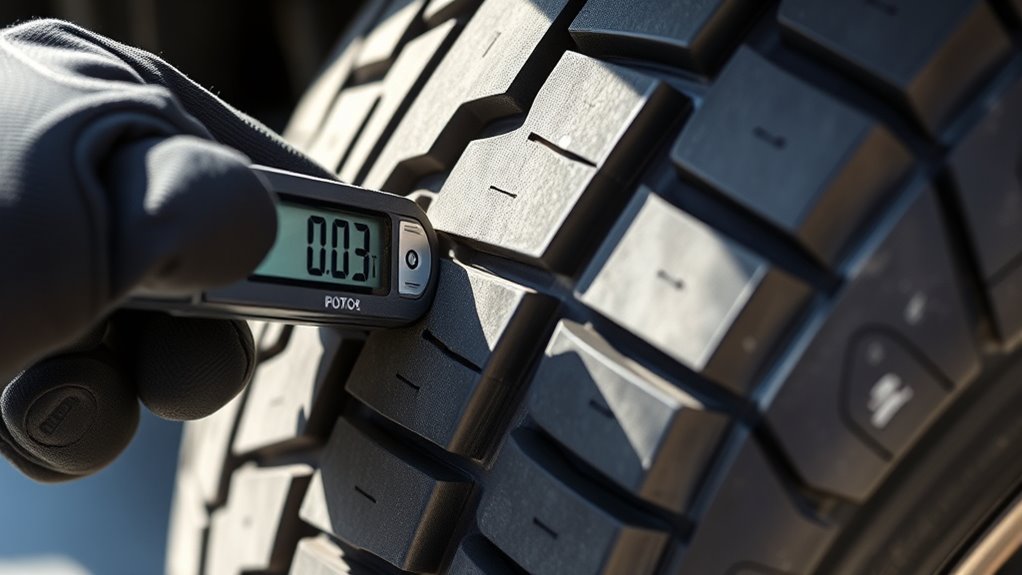
Achieving even pressure reduction across all tires is essential for maintaining vehicle stability and optimizing off-road performance. If pressures are uneven, you risk handling issues, uneven tire wear, and reduced traction. To guarantee consistency:
- Use a high-quality, calibrated gauge to check each tire’s pressure before and after deflation.
- Set your deflators to the same target PSI for all tires to maintain uniformity.
- Deflate each tire gradually, monitoring pressure frequently to prevent over-deflation.
- Recheck all tires after initial deflation to confirm equal pressures.
- Move the vehicle slightly between adjustments to help the tires settle and identify leaks early.
Following these steps guarantees balanced pressure, better handling, and safer off-road adventures.
Handling Valve Cores and Preventing Over-Deflation
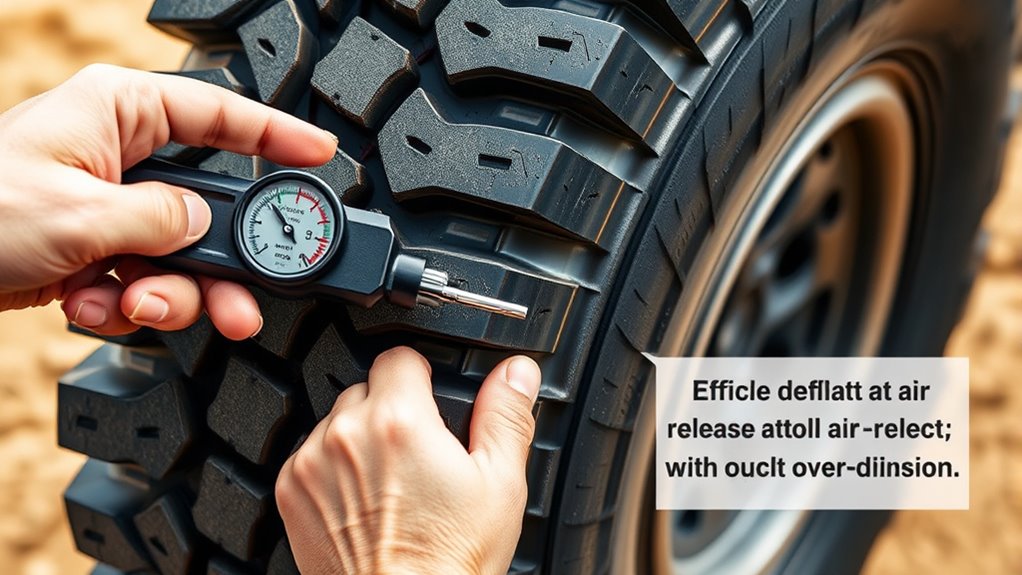
Handling valve cores properly is key to maintaining consistent tire pressure during airing down and reinflation. Always use a valve core tool to remove or reinstall cores carefully, preventing accidental leaks. When deflating, remove the core quickly to release air, then reinsert it immediately to avoid over-deflation. Use a reliable gauge to monitor pressure closely. To visualize, here’s a quick overview:
| Step | Key Action |
|---|---|
| Removing valve core | Use tool carefully; avoid damaging the core |
| Reinstalling core | Ensure it’s seated properly to prevent leaks |
| Checking pressure | Verify with a precise gauge before and after |
| Preventing over-deflation | Follow target PSI and recheck regularly |
This approach keeps your tires at safe, controlled pressures without risking damage or sudden deflation.
Tips for Safe and Efficient Re-inflation After Off-Roading
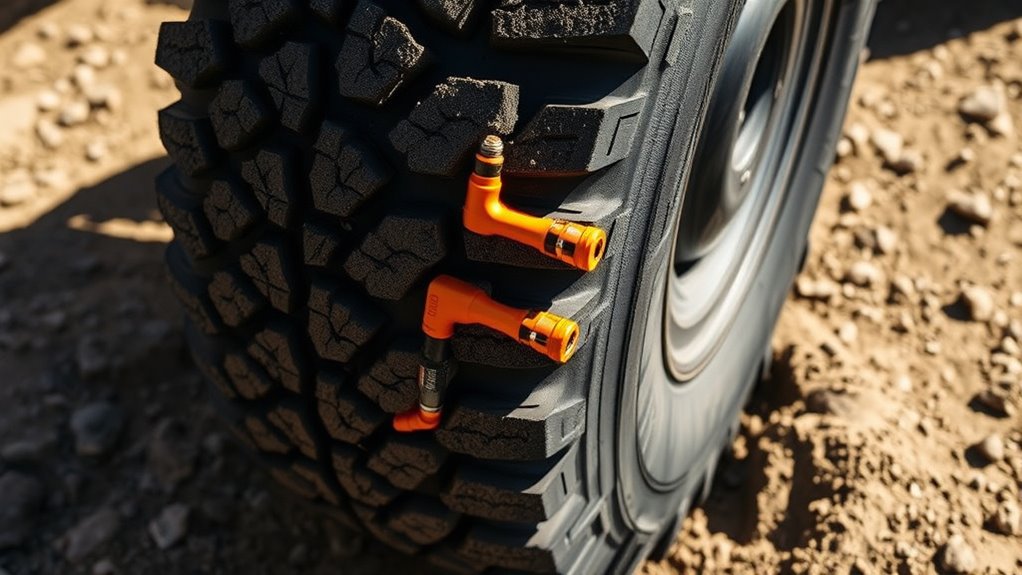
After off-roading, reinflating your tires safely and efficiently is essential to guarantee ideal vehicle performance and prevent damage. Proper reinflation restores stability, handling, and tire longevity. Use a portable compressor or 12V pump to quickly bring tires back to highway PSI. Always verify pressures with a high-accuracy gauge before hitting paved roads. Inspect valve stems, bead seating, and sidewalls for damage or leaks, ensuring everything is intact. Recheck each tire after a short drive to confirm even pressure distribution. Adjust for temperature changes if needed, especially after long highway runs. Keep safety in mind—don’t rush the process, and avoid over-inflating. Proper reinflation helps maintain optimal traction, ride comfort, and tire lifespan.
- Use a reliable gauge for precise pressure checks
- Reinstall valve cores immediately after deflation or topping off
- Reinflate gradually in small increments
- Inspect tires thoroughly for damage or leaks
- Recheck pressures after a short drive
Verifying Proper Tire Pressure and Post-Run Checks
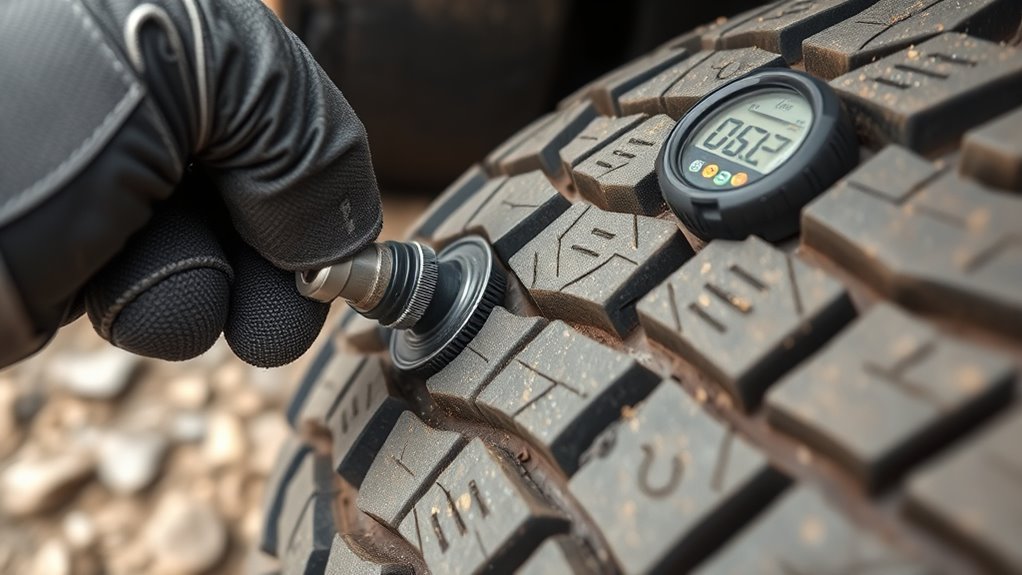
To guarantee your tires are properly maintained and safe for continued use, verifying your tire pressure and performing post-run checks are essential steps. After airing down and off-road driving, use a high-quality gauge to measure each tire’s PSI, ensuring they match your target pressures for the terrain. Inspect sidewalls, valve stems, and bead seating for cuts, bulges, or leaks. Reinflate tires to factory or recommended PSI before highway driving to prevent heat buildup and uneven wear. Check for any damage or loss of pressure that could signal leaks or punctures. Record pressures and observations to refine future airing-down settings. Performing these checks helps maintain safety, prolongs tire life, and guarantees optimal vehicle handling during your next adventure.
Frequently Asked Questions
How Do I Prevent Bead Unseating During Rapid Deflation?
To prevent bead unseating during rapid deflation, you should deflate gradually in steps, monitoring pressure closely with a reliable gauge. Avoid dropping pressure too quickly or below recommended minimums. Use preset deflators or manual control to maintain consistent, moderate deflation. After each adjustment, recheck the pressure and ensure the bead stays seated. Moving the vehicle slightly after deflation helps the bead settle, reducing the risk of unseating.
What Are Signs of Over-Deflation After Airing Down?
Imagine your tires as balloons; if they’re over-inflated, they can burst or leak. Signs of over-deflation include a soft, squishy feel when you press the tire, noticeable bulging, or a tire that looks flattened or rim-deep. You might also notice handling issues, like excessive sidewall flex or poor steering response. Always check pressure with a gauge and reinflate if you spot these signs to guarantee safe, ideal tire performance.
How Often Should I Recheck Tire Pressure During Off-Road Running?
You should recheck your tire pressure every 10 to 15 minutes during off-road driving. This guarantees your tires stay within the target PSI for the terrain and helps catch any leaks or pressure drops early. Use a reliable gauge to monitor closely, especially after traversing rough or sharp terrain. Regular checks prevent over-deflation, protect your rims, and maintain ideal traction and handling throughout your off-road adventure.
Can I Use a Standard Air Compressor for Quick Reinflation?
Sure, a standard air compressor can quickly reinflate your tires—if you enjoy waiting. Most household units are slow and might struggle with multiple tires, especially if they’re still warm from off-road use. For fast, efficient reinflation, it’s better to use a portable 12V compressor designed for tires. It’ll save you time, reduce frustration, and get you back on the road without turning into a tire-filling marathon.
What Is the Safest Minimum PSI for Different Terrains?
You should keep your tire pressure above 12 psi for sand, 15 psi for mud, and around 15–25 psi for rocky or technical terrain. For snow or ice, aim for 20–30% below highway psi, but always check your vehicle’s capabilities. Staying above these minimums helps prevent bead unseating, rim strikes, and sidewall damage. Always re-inflate to factory specs before hitting paved roads to guarantee safety and tire longevity.
Conclusion
Mastering deflation techniques guarantees you can air down quickly without overdoing it. For example, if you’re heading off-road and need to reduce pressure for better traction, using preset deflators can save time and prevent mistakes. Just remember to check your pressures afterward; a quick re-inflation ensures you’re ready for the road or trail. With the right tools and approach, you’ll confidently manage your tires for safe, efficient adventures every time.