Recovery strap ratings, like MBS (Minimum Breaking Strain) and WLL (Working Load Limit), help prevent gear failure by showing you how much weight your strap can safely handle. The MBS is the force that will break the strap, while the WLL is a safe working capacity, usually set at a fraction of the MBS. Safety factors add extra margin to protect against shock loads. Understanding these numbers keeps you safe; explore to learn how to choose the right gear for your needs.
Key Takeaways
- MBS (Minimum Breaking Strain) indicates the maximum load a recovery strap can withstand before breaking.
- WLL (Working Load Limit) is the safe, recommended maximum load for everyday use, set below the MBS.
- Safety factors (typically 2x or 3x) ensure the gear can handle dynamic shocks and prevent failure.
- Proper labeling displays WLL, MBS, and safety ratings to help select the correct gear for your vehicle.
- Matching gear ratings to vehicle weight and recovery conditions prevents snapping and enhances safety.
Understanding the Basics of Recovery Strap Ratings
Understanding the basics of recovery strap ratings is essential for safe and effective vehicle recovery. You need to know the key terms, like MBS (Minimum Breaking Strain), which is the lowest force that causes the strap to break after cyclic testing. WLL (Working Load Limit) indicates the maximum safe load you can apply during recovery, factoring in safety margins. The safety factor (SF) is the ratio of MBS to WLL, usually 2x for metal shackles and 3x for soft shackles. Proper labeling must show these ratings in order. Testing protocols involve initial destructive tests to determine MBS, followed by cyclic testing to simulate real-world use. Understanding these ratings helps you select the right gear, preventing failures and ensuring your safety during recovery operations. Additionally, knowing the strength ratings of gear like the Flat Iron Bike can help you choose equipment that matches the demands of off-road activities, and familiarity with paint sprayer components ensures you maintain your gear properly for optimal performance. Being aware of the security measures involved in payment processing can also inform safer purchasing decisions for recovery gear and accessories. For example, comprehensive testing procedures ensure the durability and reliability of recovery straps under real-world conditions. Moreover, understanding the importance of proper aftercare can extend the lifespan of your recovery gear, much like caring for piercings prolongs their health and safety.
The Significance of Minimum Breaking Strain (MBS)

Understanding the Minimum Breaking Strain (MBS) helps you choose the right recovery strap for your needs. Testing procedures guarantee that the MBS reflects real-world strength and safety. By paying attention to MBS, you can prevent failures and ensure reliable recovery operations. Additionally, selecting a strap with an appropriate performance rating can optimize safety during use. Knowing the history of pinball machines can also help you appreciate the evolution of safety features in gaming equipment. This knowledge underscores the importance of proper equipment maintenance to maintain safety standards over time. Proper maintenance ensures that safety standards are upheld and that the equipment continues to perform reliably.
Importance of MBS
Why is the Minimum Breaking Strain (MBS) such a critical measurement when selecting recovery straps? Because it tells you the maximum force the strap can withstand before breaking. Knowing the MBS helps you choose a strap strong enough to handle your vehicle’s weight and the stresses of recovery. It ensures safety by providing a clear margin between normal use and failure. A higher MBS means the strap can handle more load and reduces the risk of snapping during a recovery operation. Without understanding this number, you risk selecting gear that’s too weak, which could lead to accidents or damage. MBS is the foundation for safe, effective recovery gear, giving you confidence your strap can handle the forces involved. Additionally, understanding how the strength ratings are determined can further help you compare different straps effectively. Recognizing the role of industry standards in testing and quality assurance can also guide you in making safer, more informed choices. Moreover, being aware of manufacturer certifications can provide extra assurance of quality and reliability. A thorough understanding of testing procedures can help ensure the strap has been evaluated properly according to recognized benchmarks. Furthermore, considering material quality is essential, as it directly impacts the durability and safety of the recovery strap over time.
MBS Testing Procedures
MBS testing procedures are essential to guarantee recovery straps can reliably withstand the forces they’ll encounter during use. You start by destroying three samples to determine the Initial MBS, ensuring the strap’s baseline strength. Next, three additional straps undergo cyclic testing at 80% of Initial MBS—simulating real-world, repeated pulls—until they reach their expected service life. The lowest breaking point among these indicates the Final MBS. This process accounts for manufacturing variations and material inconsistencies. The table below summarizes key test parameters:
| Test Step | Description |
|---|---|
| Initial destructive test | Determines baseline MBS by breaking three straps |
| Cyclic testing | Repeated pulls at 80% Initial MBS |
| Final MBS measurement | Lowest breakage from cyclic tests |
| Variability check | Ensures consistency across production lots |
| Standards compliance | Meets specific industry or regional standards |
This rigorous testing guarantees your gear’s safety and performance. Understanding the importance of precise testing procedures helps ensure your recovery gear performs reliably under stress. Additionally, adherence to industry standards during testing reinforces confidence in the product’s durability and safety. Moreover, these procedures help identify material inconsistencies that could affect overall performance.
Working Load Limit (WLL): What It Means for Your Gear
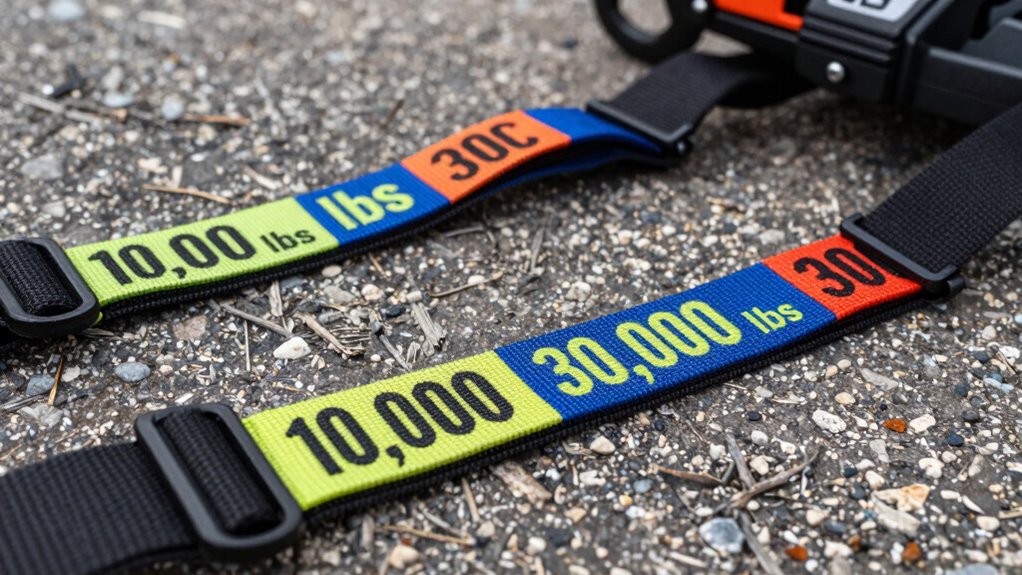
The Working Load Limit (WLL) is the maximum safe weight you can apply to your recovery gear without risking failure. It’s set well below the gear’s breaking strength to verify safety during operation. For example, if a strap has a WLL of 20,000 lbs, you should never exceed that load during recovery. This limit accounts for wear, fatigue, and dynamic forces that occur during pulling. It’s essential to match your gear’s WLL with the vehicle’s weight and recovery conditions to prevent accidents. Properly understanding and respecting this limit is key to safe recovery operations. Regular inspections of your recovery gear ensure it remains reliable and safe for use over time. Additionally, knowing the material composition of your gear can help assess its durability under different environmental conditions. Recognizing the importance of gear ratings helps in selecting appropriate equipment for various recovery scenarios. Being aware of load ratings also helps prevent overloading and potential gear failure during critical moments.
The Role of Safety Factors in Recovery Equipment
Safety factors are built into recovery gear ratings to guarantee you stay within safe operating limits during pulls. They act as a buffer, ensuring gear won’t break under unexpected stresses or manufacturing variations. For example, a safety factor of 3x means the gear’s minimum breaking strength (MBS) is three times its working load limit (WLL). This extra margin accounts for dynamic loads, shock, and wear over time. Higher safety factors, like 3x for soft shackles, are used for high-wear materials to prevent failure. By adhering to these safety margins, you reduce the risk of catastrophic failure during recovery operations. Always respect the safety factor ratings on your gear, avoiding pushes beyond recommended limits, which can lead to dangerous situations or gear failure. Proper gear maintenance and regular inspections help ensure these safety margins remain effective. Understanding safety margins is essential for safe and effective recovery practices.
How Testing Protocols Establish Reliable Ratings

Testing protocols are designed to guarantee recovery gear ratings are both accurate and consistent by subjecting products to controlled, repeatable conditions. You’ll perform initial destructive tests on three items to find the baseline MBS. Then, you conduct cyclic tests on three more items up to 80% of the initial MBS, simulating real-world wear. The lowest breaking point among these determines the final MBS. Repeating tests accounts for manufacturing variations, ensuring reliability. This rigorous process ensures the ratings reflect actual performance, not just ideal conditions.
| Step | Purpose | Result |
|---|---|---|
| Initial destructive | Find baseline MBS | Establishes maximum load |
| Cyclic testing | Simulate repetitive use | Ensures durability |
| Final break test | Confirm lowest MBS | Sets reliable rating |
| Repetition | Account for manufacturing differences | Ensures consistency |
Material Choices and Their Impact on Strength and Stretch

Material choices directly influence a recovery strap’s strength and elasticity. Nylon webbing offers high stretch, absorbing shock and reducing stress during softer pulls, making it ideal for dynamic recoveries. Polyester, on the other hand, has less stretch, providing greater stability and weather resistance, which suits tow or hybrid straps. Poly/silk blends balance stretch and durability for dual tow and recovery use. The amount of stretch impacts how energy is transferred; more stretch means the strap can elongate up to 20%, harnessing kinetic energy to enhance recovery power. However, excessive stretch can lead to increased risk of failure if the material isn’t rated properly. Always inspect your straps for cuts or abrasions, as damaged material weakens strength and increases the likelihood of snapping under load.
Matching Ratings to Vehicle and Recovery Needs
Matching your recovery strap’s ratings to your vehicle and recovery situation is essential for safe and effective towing. You need to select a strap with a Working Load Limit (WLL) that exceeds your vehicle’s weight, typically by 2-3 times. For example, a 4,000 lb vehicle should use a strap rated at least 8,000 to 12,000 lbs WLL. Consider the type of recovery—snatch or straight pull—and the conditions, such as terrain and potential dynamic loads. Make certain your recovery points and shackles are rated accordingly. Straps with insufficient ratings risk snapping under load, risking injury or damage. Properly matching ratings means choosing a gear that can handle the stress without over-specifying, ensuring safety and durability during recovery efforts.
Interpreting Product Labels and Specifications
Have you ever wondered how to quickly determine if a recovery strap is suitable for your vehicle? Reading product labels and specifications is key. Look for these critical details:
- WLL (Working Load Limit): indicates the maximum safe load.
- MBS (Minimum Breaking Strain): shows the lowest force causing failure.
- Safety Factor (SF): ratio of MBS to WLL, guiding safe usage.
- Material Info: nylon, polyester, or blends affect stretch and durability.
- Standard Compliance: guarantees the strap meets industry safety standards.
Understanding these elements helps you match the strap’s rated capacity to your vehicle’s needs, avoiding under- or over-specification. Labels often follow a standard order—WLL, MBS, SF—making it easier to compare products. Clear labels ensure you select gear that’s safe, reliable, and suited for your recovery tasks.
Common Misconceptions About Recovery Strap Ratings
Many people mistakenly believe that the WLL alone guarantees safety, but it’s only a part of the story. Confusing MBS with WLL can lead you to underestimate the real strength of your recovery gear. Additionally, ignoring dynamic loads during recovery can cause underestimations of the forces involved, risking failure.
Overestimating WLL Safety
One common misconception is that the Working Load Limit (WLL) alone guarantees safety during recovery operations. Relying solely on WLL can lead you to underestimate risks, especially since dynamic loads, angles, and wear aren’t reflected in the rating. Remember:
- WLL doesn’t account for shock loads or sudden jerks.
- It assumes ideal conditions, which rarely match real-world recovery.
- Overlooking material fatigue can cause failure below WLL.
- Using a strap at its WLL instead of a safer margin increases risk.
- Different recovery scenarios demand higher safety buffers than WLL alone suggests.
Trusting only the WLL can give a false sense of security. Always factor in additional safety margins, conditions, and proper technique for safe recovery.
Confusing MBS and WLL
Misunderstanding the difference between Minimum Breaking Strain (MBS) and Working Load Limit (WLL) is a common mistake that can compromise safety during recovery operations. MBS is the force that causes the strap to break after testing, representing its maximum strength. WLL, on the other hand, is the recommended safe working load, usually set with a safety factor to prevent failure during use. Many people confuse these ratings, assuming they’re interchangeable, which can lead to overloading and gear failure. Remember, WLL is intentionally lower than MBS to ensure safety. Always check the label carefully and understand that WLL is the real limit for regular use, while MBS indicates the strap’s absolute breaking point. Proper knowledge prevents accidents and keeps your recovery safe.
Ignoring Dynamic Loads
Have you considered how dynamic loads considerably increase the stress on recovery straps during a pull? When you’re yanking or snatching a vehicle free, the force isn’t static—it peaks suddenly, often exceeding the strap’s rated capacity. Ignoring this means underestimating the actual stress your gear faces.
Remember:
- Dynamic loads can double or triple the initial force.
- WLL ratings are based on static or controlled conditions.
- Kinetic energy from sudden pulls increases strain.
- Stretching straps absorb some force but also add to the peak load.
- Using only static ratings risks catastrophic failure.
Understanding this difference helps you choose straps with higher ratings and appropriate safety margins. Never rely solely on static figures; always account for the unpredictable, high-impact forces involved in real recovery situations.
Practical Tips for Choosing and Using Recovery Gear Safely
Choosing the right recovery gear starts with understanding your vehicle’s weight and the specific demands of the recovery situation. Always select gear with a Working Load Limit (WLL) at least 1.5 times your vehicle’s weight, preferably more for dynamic recoveries. Match your straps and shackles to the rated recovery points on your vehicle, ensuring they can handle the forces involved. Inspect all gear thoroughly before use, checking for cuts, abrasions, or wear that could weaken the material. Use gear with appropriate safety factors—like 3x MBS for soft shackles or straps—so you’re prepared for sudden shocks or dynamic loads. Follow manufacturer instructions for proper attachment points and techniques. Never exceed rated capacities, and always work within the gear’s limits to prevent failure or injury.
Frequently Asked Questions
How Does Cyclic Testing Influence Recovery Strap Ratings?
Cyclic testing directly influences recovery strap ratings by simulating real-world use through repeated pulls at 80% of the initial MBS. You’re testing how the strap performs over time, ensuring it can withstand multiple recoveries without failing. This process determines the final MBS, accounting for manufacturing variations and wear, so you know the strap’s true strength and safety limits, ultimately preventing gear failure during critical recovery situations.
Why Do Australian Standards Produce Lower Ratings Than Others?
Australian standards produce lower ratings because they enforce stricter testing protocols and quality controls, ensuring gear is more reliable and durable. You’ll find that straps tested under these standards must meet higher safety margins, which often results in lower labeled working load limits. This cautious approach prioritizes safety and longevity, so you can trust that Australian-rated gear is less likely to fail under stress, providing you with peace of mind during recovery operations.
What Is the Difference Between MBS and MTS in Testing?
Did you know that MTS tests often involve applying cyclic loads, simulating real-world recovery conditions? MBS, or Minimum Breaking Strain, measures the lowest force that causes gear to break after multiple cycles, indicating ultimate strength. MTS, or Material Test Standard, assesses how the gear returns to normal after being loaded, focusing on resilience. While MBS focuses on failure point, MTS emphasizes durability and recovery capability during repeated use.
How Does Stretch Affect Recovery Strap Performance?
Stretch considerably impacts your recovery strap’s performance by allowing it to absorb and release energy during pulls, reducing the shock load on both vehicles. Straps with higher elasticity, like nylon, stretch up to 20%, helping to prevent sudden snapbacks and gear failure. However, too much stretch can decrease pulling power, so choose a strap with appropriate stretch for your task, ensuring safety and efficiency during recovery.
Can a Higher WLL Compensate for Lower MBS Ratings?
A higher WLL doesn’t necessarily compensate for a lower MBS. While a higher WLL means you can safely load closer to the strap’s limit, it doesn’t alter the actual breaking strength. You still risk snapping the gear if the MBS is low. To stay safe, make certain your strap’s MBS is well above your intended load, and WLL aligns with safety standards. Both ratings matter for reliable recovery.
Conclusion
Now that you know the numbers behind recovery strap ratings, you can confidently choose and Chuck your gear with clarity. Remember, understanding the meaning of MBS, WLL, and safety factors helps you stay safe while staying smart. So, don’t forget to match your gear to your vehicle’s needs, and always prioritize proper use. With knowledge and caution, you’ll confidently conquer challenges and keep your recovery routine reliable and risk-free.