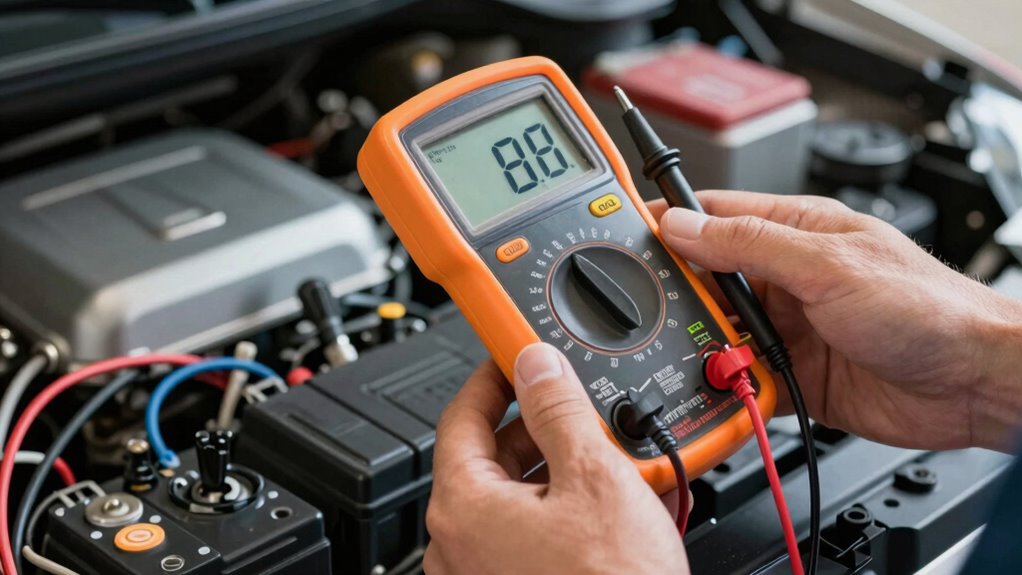

To master your car’s electrical system, focus on five key tests with your multimeter. Start by checking your battery voltage to ensure it’s healthy, then measure parasitic draw to find any excessive drain. Use voltage drop tests to locate resistances, verify continuity to spot wiring issues, and check the alternator’s charging voltage for proper operation. If you want to become more confident, exploring each test in detail will bolster your skills even further.

Get business pricing on garage and car supplies
- Business-only prices and quantity discounts
- Tax-exempt purchasing
- Multiple users, one account, clear invoices
Key Takeaways
- Understand the correct multimeter settings: voltage, current, resistance, and continuity for specific automotive tests.
- Use proper probe placement: black to ground or negative terminal, red to positive or test point.
- Always turn off power before resistance or continuity tests to prevent false readings or damage.
- Be cautious when measuring current; connect multimeter in series and select the appropriate amp range.
- Regularly calibrate and maintain your multimeter to ensure accurate diagnostics in various automotive scenarios.
Battery Voltage Test

To check your vehicle’s battery voltage, start by turning off the engine and setting your multimeter to the DC voltage setting. Place the black probe on the negative terminal and the red probe on the positive terminal. A fully charged battery should read around 12.6 volts. If the reading drops below 12.4 volts, your battery might be weak or nearing failure. When the engine is running, a healthy charging system should show 13.8 to 14.5 volts, indicating the alternator is working properly. Always guarantee good contact with the terminals for an accurate reading. If your voltage is too low or fluctuates wildly, it could point to a problem with your battery or charging system. Regular testing helps prevent unexpected breakdowns and keeps your vehicle running smoothly. Additionally, understanding contrast ratio can help you interpret how well your dashboard display or diagnostic screens are visible under different lighting conditions. Monitoring your battery health regularly is essential for early detection of potential issues before they lead to breakdowns. Knowing how to interpret voltage fluctuations can further assist in diagnosing electrical problems and maintaining vehicle reliability. Being aware of security zone info can also help safeguard your vehicle and tools from theft or vandalism during repairs or breaks. Properly tracking these readings can also aid in preventive maintenance, saving you time and money in the long run.
Parasitic Draw Measurement

When your vehicle’s battery drains unexpectedly, measuring parasitic draw with a multimeter can help pinpoint the problem. To do this, set your multimeter to amps and disconnect the negative battery cable. Connect one lead to the battery terminal and the other to the negative cable. Confirm the multimeter is in series with the circuit, so current flows through it. Start the vehicle and turn off all accessories; then, observe the reading. A normal parasitic draw is under 50mA. If it’s higher, identify the culprit by pulling fuses one at a time and watching the meter. This method isolates faulty components or circuits causing the excessive drain. Remember to reconnect everything properly after testing to avoid issues. Proper multimeter use is essential for accurate readings and safe testing. Understanding the basics of multimeter operation can also help you troubleshoot other electrical issues in your vehicle more effectively, especially when recognizing quality components and their typical characteristics.
Voltage Drop Analysis

Ever wonder why your vehicle’s electrical system sometimes behaves erratically? That’s where voltage drop analysis comes in. It helps you identify issues in wiring or connections by measuring voltage differences across circuit sections under load. To perform the test, turn on the system you’re testing, then place your black probe on the battery’s negative terminal or ground point, and the red probe on the connection or component in question. A voltage drop over 0.5 volts usually indicates resistance from corrosion, loose terminals, or damaged wiring. These drops cause reduced power and component malfunction. By pinpointing where excessive voltage loss occurs, you can target repairs effectively—whether that’s cleaning connections, replacing wires, or fixing grounds. Understanding electrical principles is essential for accurate diagnostics. Voltage drop analysis is a crucial tool in maintaining a reliable electrical system and understanding modern electrical diagnostics. Additionally, gaining familiarity with circuit testing techniques can further improve your troubleshooting skills. Being aware of common electrical issues can also help you anticipate problems before they become serious.
Continuity and Resistance Verification

Continuity and resistance verification are essential steps in diagnosing electrical issues in your vehicle. Using your multimeter’s ohms setting, you can check if circuits are complete or broken. To test continuity, connect the probes across a wire, fuse, or component; a zero or low reading indicates a good connection, while infinite resistance signals a break. Resistance tests help identify components that may be failing or damaged. For example, measuring resistance across a switch or sensor can reveal if it’s functioning correctly. Always turn off the power before testing to avoid false readings or damage. Proper testing techniques are crucial for reliable measurements and avoiding misdiagnosis. These tests are quick ways to pinpoint wiring issues, faulty fuses, or damaged sensors, saving you time and money during troubleshooting. Understanding electrical principles can further improve your diagnosis skills and ensure accurate results. Incorporating proper testing techniques ensures reliable measurements and prevents misdiagnosis, which is crucial for effective repairs. Additionally, familiarizing yourself with circuit diagrams can streamline the troubleshooting process and improve accuracy. To enhance your troubleshooting efficiency, learning common electrical problems can help you recognize and address issues more quickly.
Alternator Charging Check

To guarantee your vehicle’s charging system is working properly, you need to perform an alternator charging check. Start the engine and set your multimeter to DC voltage. Place the black probe on the negative battery terminal and the red on the positive. Observe the reading; a healthy alternator should produce 13.5 to 14.5 volts. If the voltage is below 13.5V, the alternator isn’t charging properly. Before testing, check fuses and relays related to the charging system. Here are some key points:
- Verify voltage with engine both off and running
- Ensure connections are clean and secure
- Confirm belt tension and condition
- Be aware that proper ventilation can prevent overheating of electrical components during testing.
Performing this check helps catch charging issues early, preventing battery drain or electrical failures, and understanding your vehicle’s charging system is essential for safe operation. Additionally, inspecting the battery terminals for corrosion and tightness can further ensure reliable performance during testing. Regularly monitoring your alternator output can extend the lifespan of your vehicle’s electrical components.
Frequently Asked Questions
How Do I Calibrate My Multimeter for Accurate Readings?
To calibrate your multimeter for accurate readings, start by turning it off and disconnecting any test leads. Set it to the highest resistance or voltage range, then connect it to a known calibration source, like a precision resistor or a voltage reference. Adjust the calibration screw or dial (usually inside the case) until the display matches the known value. Regular calibration guarantees your measurements stay precise and reliable.
Can Multimeters Test Automotive Sensors Like MAP or TPS?
Back in the day, folks relied on analog gauges, but now your multimeter is a powerful tool for testing sensors like MAP or TPS. You can measure voltage and resistance to verify sensor output and wiring integrity. Simply connect the probes to the sensor terminals, turn on the ignition, and observe readings. Good voltages and resistance within specs mean the sensor’s likely functioning correctly, helping you troubleshoot engine performance issues efficiently.
What Safety Precautions Should I Take When Testing Live Circuits?
When testing live circuits, you should wear insulated gloves and safety goggles to protect against sparks or shorts. Always guarantee your multimeter probes are in good condition, and keep one hand away from the circuit to avoid completing a shock path. Turn off the vehicle before connecting or disconnecting the multimeter, and work in a dry, well-ventilated area to minimize risk. Never touch exposed wires or terminals during testing.
How Do I Differentiate Between a Bad Fuse and Wiring Issue?
You want to know if it’s a bad fuse or wiring gremlin causing trouble? First, check the fuse with your multimeter set to continuity—if it buzzes, it’s good. No beep? Replace it. Then, use voltage readings along the wiring. If you see power at the fuse but not downstream, wiring’s the culprit. Think of fuses as gatekeepers, and wiring as the unwelcome party crashers—both can cause chaos, but only one’s easily swapped out.
What Features Should I Look for in a Professional Automotive Multimeter?
When choosing a professional automotive multimeter, look for auto-ranging capability to simplify readings, a high maximum current rating for testing circuits, and a durable, automotive-specific design like Fluke models. make certain it has essential functions such as voltage, resistance, current, and frequency measurement, along with temperature testing if needed. A backlit display helps in low-light conditions, and a robust build ensures it withstands the automotive environment.
Conclusion
Mastering these five tests with your multimeter is like holding the heartbeat of your car in your hands. Each measurement becomes a pulse, revealing the health beneath the hood. When you understand these signals, you’re not just fixing cars—you’re nurturing trust and confidence in every journey. Your multimeter becomes a compass, guiding you safely through the unknown. Embrace these skills, and let your car’s silent song tell you everything it needs.
Fall Picks
fall essentials
As an affiliate, we earn on qualifying purchases.