TL;DR

Get business pricing on garage and car supplies
- Business-only prices and quantity discounts
- Tax-exempt purchasing
- Multiple users, one account, clear invoices
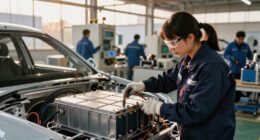
Aptera has announced that its solar EV production depends heavily on Chinese manufacturing. This marks a significant development in the company’s supply chain strategy and global manufacturing plans.
Aptera has officially confirmed that its solar electric vehicle (EV) production relies on manufacturing facilities and suppliers based in China. This revelation marks a significant shift in the company’s supply chain strategy and raises questions about production scalability and geopolitical implications, making it a key development for potential investors and consumers.
During a recent company briefing, Aptera CEO Steve Fambro stated that the company’s core manufacturing processes are now tied to Chinese suppliers and manufacturing plants. This marks a departure from previous claims that the company would primarily produce in the United States. The company did not specify exact locations or suppliers but emphasized that China provides critical components and assembly capabilities for its solar EVs.
Sources familiar with the matter indicate that Aptera’s decision aligns with broader industry trends of sourcing advanced materials and manufacturing services from China to reduce costs and access specialized technology. The company also mentioned ongoing efforts to ensure quality control and supply chain resilience, despite geopolitical tensions and trade restrictions.
Implications for Aptera’s Production and Global Supply Chain
This development is significant because it clarifies where and how Aptera’s solar EVs are being manufactured, which could impact cost, quality, and scalability. Relying on Chinese suppliers may enable faster ramp-up but also introduces risks related to trade policies and supply chain disruptions. For consumers and investors, understanding this dependency is crucial for assessing the company’s future growth prospects and manufacturing reliability.
Products Worth Considering

Chemical Guys 16-Piece Arsenal Builder Car Wash Kit with Foam Cannon & Bucket

Chemical Guys 14-Piece Arsenal Builder Car Wash Kit with Foam Blaster

DEWALT 20V MAX Drill and Impact Driver Combo Kit (DCK240C2)
As an affiliate, we earn on qualifying purchases.
Aptera’s Manufacturing Plans and Supply Chain History
Previously, Aptera announced plans to manufacture its solar EVs primarily in the United States, emphasizing a focus on domestic production and sustainability. However, as the company progressed toward mass production, it faced challenges in sourcing certain advanced components, prompting a shift toward international suppliers. The company’s strategic pivot to China reflects broader industry trends of leveraging Chinese manufacturing expertise for tech-intensive products like EVs.
Aptera’s approach has evolved amid ongoing global supply chain issues affecting the automotive sector, including semiconductor shortages and material sourcing difficulties. The company’s decision to openly acknowledge its reliance on Chinese manufacturing marks a notable transparency shift, possibly aimed at managing investor expectations and regulatory scrutiny.
“Our manufacturing process now involves key Chinese suppliers, which allows us to scale production efficiently while maintaining quality standards.”
— Steve Fambro, CEO of Aptera
Details on Specific Suppliers and Manufacturing Locations
It is not yet clear which specific Chinese suppliers or manufacturing facilities Aptera is working with, nor the extent of their involvement in the production process. The company has not disclosed detailed supply chain arrangements, and the potential impact of geopolitical tensions on these operations remains uncertain.
Next Steps for Aptera’s Production Strategy and Transparency
Aptera is expected to provide further details on its supply chain and manufacturing partnerships in upcoming investor briefings or product updates. The company may also face scrutiny over its reliance on Chinese manufacturing, especially as it moves toward mass production and global distribution. Monitoring these developments will be key for stakeholders assessing the company’s growth trajectory.
Key Questions
Why did Aptera choose to rely on Chinese manufacturing?
Aptera cited cost advantages, access to advanced manufacturing technology, and supply chain efficiency as reasons for partnering with Chinese suppliers.
Does this reliance affect the quality or safety of Aptera’s EVs?
While the company emphasizes maintaining quality standards, the reliance on international suppliers could pose risks, which Aptera is actively managing through quality control measures.
Will this affect the price of Aptera’s solar EVs?
Potentially, as sourcing from China may reduce manufacturing costs, which could influence the final retail price, but specific pricing impacts are not yet confirmed.
How might geopolitical tensions impact Aptera’s supply chain?
Trade restrictions or political conflicts could disrupt supply chains, but Aptera has not yet disclosed contingency plans. The company is likely monitoring ongoing developments closely.
When will Aptera provide more details about its manufacturing partners?
The company is expected to share further information during upcoming investor updates or official announcements, likely within the next few months.
Source: rss