TL;DR

Get business pricing on garage and car supplies
- Business-only prices and quantity discounts
- Tax-exempt purchasing
- Multiple users, one account, clear invoices
Peugeot has shown the Hypersquare, a square steering control with a central display, in its E-T16 electric concept at the 2026 Paris Motor Show. The design depends on steer-by-wire, which replaces a direct mechanical steering connection with electronic signals and motors. Peugeot describes the system as performance-focused, but production plans and real-world handling remain unclear.
Peugeot has presented a square steering control called the Hypersquare in its E-T16 electric concept at the 2026 Paris Motor Show, pairing the unusual shape with steer-by-wire rather than a conventional mechanical steering connection. The setup matters because it lets software vary how much wheel movement is needed to turn the car, removing the need for a round wheel that rotates through several turns.
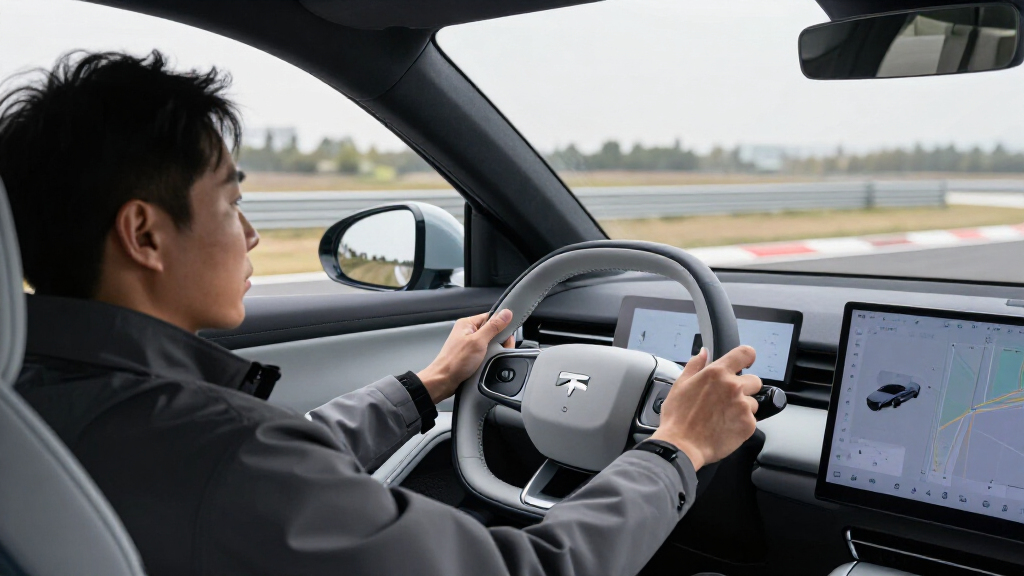
Peugeot describes the E-T16 as a tri-motor electric hatchback and says its Hypersquare is a performance-focused application of steer-by-wire. The control has a configurable central display for information such as speed and lap timing, while buttons are positioned for operation by finger movement. Those are Peugeot’s descriptions of the concept; the company has not established through the material provided that the design is ready for a production vehicle.
The steering system sends the driver’s input electronically to motors that turn the wheels, instead of transmitting it through a steering column and rack. Peugeot says the system is specially calibrated for the E-T16. The source report also relays a claim from Peugeot that the concept can complete three laps of the Nürburgring Nordschleife—more than 60 kilometers—in Performance mode without power limitation. That is a manufacturer claim about a concept car, not an independently verified production-car performance result.
Steer-by-wire allows steering response to change with driving conditions: the same small movement at the control can be configured to produce a larger turn at low speed and a smaller one at highway speed. Peugeot says the Hypersquare is inspired by the steering control in its 9X8 endurance-racing car. The concept places the display and controls within the driver’s hand position, an arrangement Peugeot presents as useful for sporty driving.
How Electronic Steering Enables the Shape
The Hypersquare shows why a square control is not simply a styling change. With conventional steering, the wheel is mechanically linked to the front wheels, and drivers may need to rotate it substantially to move from full left to full right. A square shape can make that motion awkward because the driver’s grip and hand position do not follow a continuous rim. Steer-by-wire changes that constraint by allowing software to set the steering ratio, potentially limiting how far the control needs to move.
The arrangement could also change what drivers feel. With no direct mechanical link, feedback through the control has to be generated electronically. The source report identifies whether that feedback can feel as natural as a conventional steering rack as an unresolved question. Peugeot’s claims about precision and agility have not been independently established in the supplied material, and a show-car demonstration would not by itself answer how the system behaves across ordinary driving conditions.
For drivers, the issue is practical as well as visual: a new control layout and variable steering response would need to feel predictable and easy to use. The concept offers a look at how electronic steering could free up cabin design, but it does not yet show whether motorists will prefer the experience.
As an affiliate, we earn on qualifying purchases.
From Mechanical Wheels to By-Wire
In a conventional car, the steering wheel connects through mechanical components to the front wheels. A driver generally turns the wheel through a wide range of motion, often moving both hands around the rim during parking maneuvers. A steer-by-wire vehicle instead reads the driver’s input electronically and uses motors to turn the wheels. That makes the steering ratio adjustable rather than fixed by the mechanical linkage.
Steer-by-wire is not new, according to the source report, which cites the Tesla Cybertruck and Lexus RZ as vehicles offering the technology. The report argues that the Hypersquare uses the freedom of electronic steering more visibly than a conventional-shaped wheel would. Peugeot has also shown the Hypersquare on other concepts, including the Polygon, described in the report as a non-performance vehicle. The E-T16 is part of a wider Paris show display of French concepts, but the square control is the development at issue here.
A useful comparison is Tesla’s yoke, which the source report says retained conventional steering underneath its altered shape. That meant drivers still had to make large hand-over-hand movements without the upper section of a round wheel to grip. The Hypersquare’s proposed logic differs: the shape is tied to steer-by-wire, so the system can be designed around smaller control movements rather than a traditional wheel’s full rotation.
“The Hypersquare integrates a configurable central display showing essential information such as speed and lap timing according to driving conditions.”
— Peugeot, in its description of the E-T16
As an affiliate, we earn on qualifying purchases.
Production Plans and Driver Feel
The material provided does not say whether the E-T16 will enter production, whether the Hypersquare will reach a consumer vehicle, or when that might happen. Peugeot has presented the system as a concept and described its intended benefits, but no independent road-test findings or detailed technical specifications are included.
It is also unclear how the control would provide steering feedback, how drivers would adapt to its shape in emergency maneuvers, and how its response would be tuned across different speeds and conditions. The source report says a demonstration unit was expected at the show, but it does not provide results from that demonstration. Peugeot’s stated claims about precision, agility, and performance therefore remain claims about the concept rather than confirmed outcomes for a production car.
As an affiliate, we earn on qualifying purchases.
Show Demonstrations Before Road Tests
The immediate next opportunity to evaluate the idea is the Paris Motor Show demonstration described in the source report. A hands-on display could help visitors understand the control’s layout and movement, though it would not establish how the system performs on public roads or in a production vehicle.
Further clarity depends on Peugeot providing technical details, testing evidence, or a decision about production use. Until then, the Hypersquare is best understood as a design and technology concept showing how steer-by-wire could support a non-round steering control—not as a confirmed feature of an upcoming showroom model.
As an affiliate, we earn on qualifying purchases.
Key Questions
What is Peugeot’s Hypersquare?
It is a square steering control with a central configurable display, shown in Peugeot’s E-T16 concept. Peugeot says it is designed to work with steer-by-wire.
Why does it need steer-by-wire?
Steer-by-wire sends steering inputs electronically to motors rather than through a direct mechanical linkage. That lets software vary the steering ratio, so the control need not rotate through the wide range associated with a conventional wheel.
Is the Hypersquare going into production?
The supplied source material does not confirm a production plan or launch date for the Hypersquare or the E-T16. Peugeot has presented them as part of a concept vehicle.
Has the system been independently tested?
No independent test results are included in the source material. Peugeot describes the system as precise and agile, but those remain the automaker’s claims about the concept.
Source: rss
Halloween Picks
halloween
As an affiliate, we earn on qualifying purchases.