
TL;DR

Get business pricing on garage and car supplies
- Business-only prices and quantity discounts
- Tax-exempt purchasing
- Multiple users, one account, clear invoices
Tesla is rolling out an over-the-air feature called Emergency Drive Away that lets eligible vehicles shift into Drive and leave a U.S. Supercharger while still connected. Tesla says the connector is designed to break away, but warns the maneuver will damage the vehicle and charger and is intended only for emergencies.
Tesla is rolling out Emergency Drive Away, an over-the-air feature that lets eligible vehicles shift into Drive and leave a U.S. Supercharger while still connected to its cable. The company says it is intended for emergencies, and warns that driving away this way will damage both the vehicle and the charger.
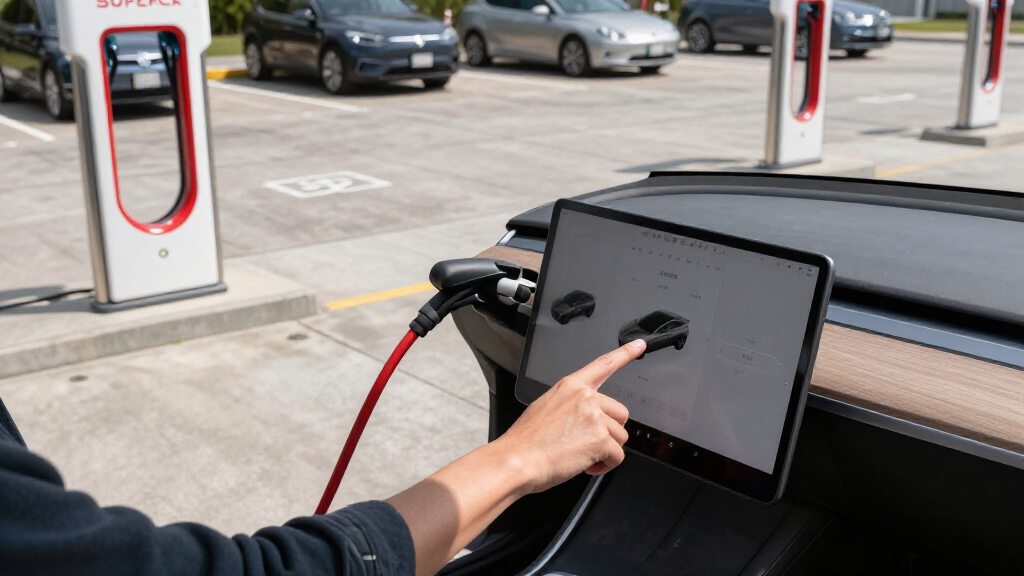
The Tesla Charging account on X announced the feature earlier this week and posted a demonstration. A driver shifts into Drive, receives an alert on the touchscreen and confirms the action before moving. The connector is designed to break away as the car pulls off, rather than dragging the charging equipment along.
Tesla says the feature requires software version 2026.38.3 and is limited to U.S. Superchargers. It is not available for pre-2021 Model S sedans or Model X crossovers. The company is distributing it as an over-the-air update; the source report does not specify a completion date for the rollout.
The demonstration shows part of the connector falling to the ground after separation. Tesla says the action will damage the car and Supercharger, and warns that deliberate misuse could bring additional penalties. Drivers should treat the feature as an emergency override, not a routine way to end a charging session.
A Last-Resort Escape From Charging
The feature gives drivers of supported Teslas a way to leave a charging stall when unplugging first may not be safe or practical. Its release follows a lethal shooting at a Tesla Supercharger in Idaho this summer, according to The Drive. That timing links the update to a real safety concern, though the source material does not establish further details about the shooting or say the feature would have changed its outcome.
Emergency Drive Away involves a clear trade-off: the driver may be able to leave more quickly, but the vehicle and charging equipment can be damaged. It does not make the cable disconnect harmless or remove the need to use the feature only when an emergency justifies the consequences.
Products Worth Considering

Nextbase iQ 4K Smart HD Dash Cam Pro with 64GB microSD Card – Front and Rear View, 1440p, Smart Sense Parking, Emergency SOS, Roadwatch AI

Innova 5610 OBD2 Bidirectional Scan Tool

DEWALT 20V MAX 1/4-Inch Impact Driver Kit with Battery and Charger (DCF787D1)
As an affiliate, we earn on qualifying purchases.
How the Cable Release Works
During an ordinary charging session, the vehicle is locked against shifting into Drive while the cable is connected. Emergency Drive Away provides an override: the driver selects Drive, reviews the touchscreen alert, confirms, and pulls away. The connector is designed to separate under that force, but Tesla’s demonstration and warning indicate the process can cause damage.
Tesla has previously used over-the-air software updates to add vehicle functions. This update is different in purpose: it is a narrowly specified emergency measure rather than a convenience feature. The Drive also notes that Tesla has explored a robotic charging arm, but says that system did not enter production. The current feature does not autonomously unplug the car; the driver must initiate and confirm the departure.
““Emergency Drive Away””
— Tesla Charging account on X
Rollout and Damage Details
The available information does not give a schedule for when the update will reach every eligible vehicle, or explain whether access varies by vehicle configuration beyond the stated model-year exclusions and software requirement. Tesla has not provided details here about the precise damage likely in different breakaway scenarios, repair costs, or how any penalties for deliberate misuse would be determined.
The source material also does not describe whether the feature will expand beyond U.S. Superchargers. Tesla’s account presents the connector as designed to break away, but that does not mean separation is damage-free; the company explicitly warns that both the car and charger will be damaged.
Eligible Cars Await the Update
Tesla owners can check whether their vehicle has received software version 2026.38.3 and whether their model is eligible. Tesla has not supplied a public end date for the rollout in the source material. Until more details are available, the feature’s stated role remains narrow: allow a supported car to leave a U.S. Supercharger during an emergency, with damage expected.
Key Questions
What does Tesla Emergency Drive Away do?
It allows an eligible Tesla to shift into Drive and leave a Supercharger while still connected. The driver must confirm an alert on the touchscreen, and the connector is designed to break away.
Will driving away damage the car or charger?
Yes. Tesla says the action will damage both the vehicle and the Supercharger. The feature is intended for emergency use only.
Which Tesla vehicles can use it?
The update requires software version 2026.38.3 and works at U.S. Superchargers. Tesla excludes pre-2021 Model S sedans and Model X crossovers; the source report does not list other vehicle-specific exceptions.
Can the feature unplug the car automatically?
No. The driver initiates the maneuver by shifting into Drive and confirming the touchscreen alert. The connector is designed to break away as the car moves.
Why did Tesla introduce the feature?
The Drive reports that the update follows a lethal shooting at a Tesla Supercharger in Idaho this summer. Tesla’s announcement describes the function as an emergency feature, but the available material does not say it would have changed the outcome of that incident.
Source: rss