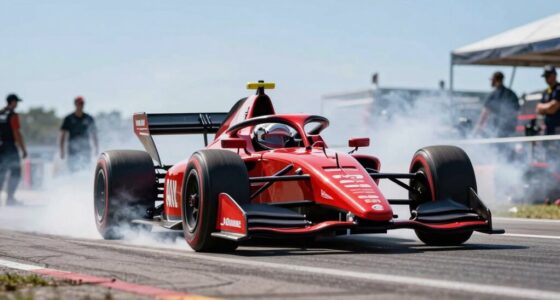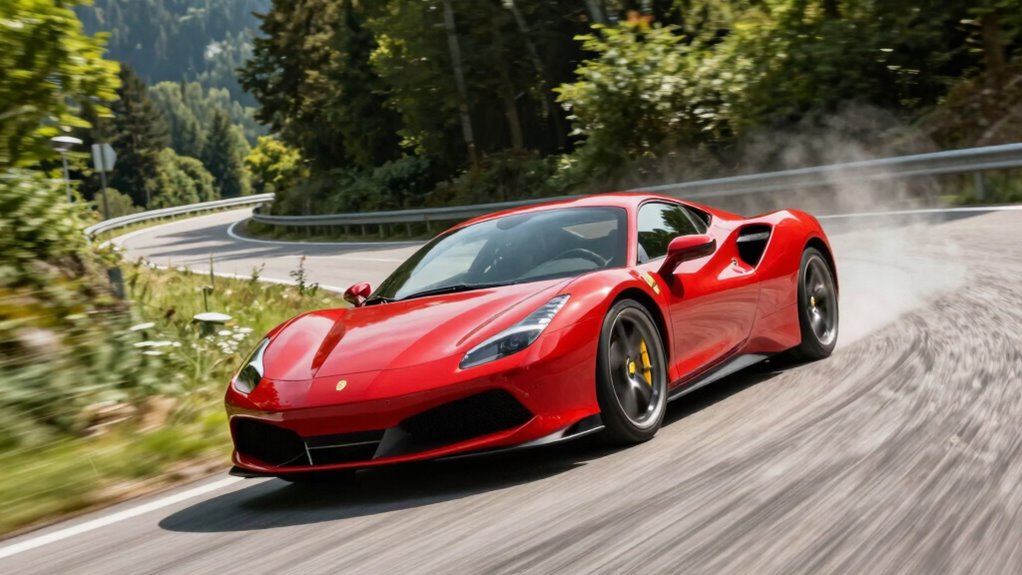

High-performance driving involves mastering precise vehicle control, understanding how your car responds, and anticipating its limits to maximize speed and safety. By applying effective techniques like smooth steering, proper brake modulation, and balancing throttle, you can improve your response and confidence under challenging conditions. Recognizing vehicle feedback helps you adapt quickly, while planning your move prevents mistakes. Continue exploring these concepts, and you’ll uncover even more ways to elevate your driving skills.
Key Takeaways
- High-performance driving involves advanced vehicle control techniques to optimize speed, stability, and safety on challenging terrains or tracks.
- It emphasizes understanding vehicle dynamics to respond effectively to inputs and maintain control at high speeds.
- Mastery includes sensing vehicle feedback, anticipating responses, and adjusting steering, throttle, and braking smoothly.
- Developing confidence through practice allows for instinctive reactions and safer handling near vehicle limits.
- Effective driver technique integrates vision, anticipation, and precise control to maximize performance and minimize risks.
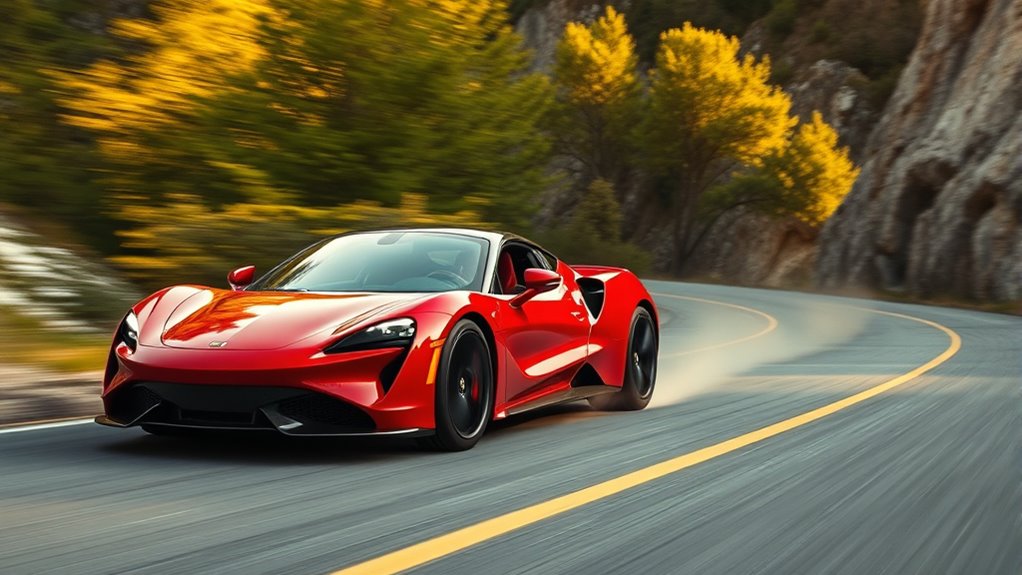
High-performance driving pushes your skills to the limit, demanding precision, focus, and quick decision-making. At its core, it’s about understanding and mastering vehicle dynamics—the way your car responds to your inputs and how it interacts with the road. Every turn, acceleration, and braking maneuver is influenced by these dynamics, and your ability to interpret and react to them determines your speed and safety. You need to develop a keen sense of how your vehicle behaves under different conditions, whether it’s cornering at high speeds or maneuvering sudden changes in terrain. This understanding forms the foundation of effective driver technique, which involves precise control over throttle, brake, and steering inputs to maximize performance while maintaining safety.
Master vehicle dynamics for safer, faster driving through precise control and quick reactions.
Your driver technique is vital because it directly influences how well you harness vehicle dynamics. For example, smooth steering inputs help keep the car balanced, reducing unnecessary weight transfer that could destabilize it. Proper brake modulation prevents skidding and maintains control during deceleration, especially approaching tight corners. Accelerating out of turns requires a delicate balance—too much throttle too soon can cause wheel spin, while too little delays your exit speed. Developing these skills takes practice, but it’s about more than just muscle memory; it’s about sensing how your car responds in real-time and adjusting your inputs accordingly. Vehicle response is an essential aspect of high-performance driving, as it helps you adapt quickly to changing conditions. Additionally, understanding vehicle feedback can improve your ability to fine-tune your inputs for optimal control. Recognizing how different vehicle responses manifest allows you to anticipate and react more effectively, enhancing your overall driving mastery.
High-performance driving also emphasizes the importance of vision and anticipation. You learn to look ahead, spotting potential hazards or ideal racing lines well before you reach them. This foresight allows you to plan your vehicle’s movements with purpose, reducing abrupt corrections that could upset vehicle dynamics. Your ability to stay calm and focused under pressure enhances your driver technique, enabling smoother transitions through corners and more efficient use of your car’s capabilities. Additionally, understanding the vehicle’s limits helps prevent overconfidence and promotes safer driving at high speeds.
Furthermore, high-performance driving involves understanding the limits of your vehicle and knowing when to push those boundaries or back off. Overconfidence can lead to loss of control, while hesitation can cost precious seconds. It’s about finding that sweet spot where your vehicle’s dynamics are harnessed to their fullest potential through refined driver technique. As you improve, you’ll notice that your responses become instinctive, your inputs more precise, and your confidence in handling high-speed situations grows. Developing a keen awareness of your vehicle’s capabilities is essential for safe and effective high-performance driving, ensuring you can make informed decisions at the limits. This mastery not only elevates your driving experience but also makes you a safer, more competent driver in everyday situations.

BELTTT 2000W Pure Sine Wave Inverter, Inverter 12V DC to 120V AC for Solar, RV, Truck, Outdoor, Power Inverter with Dual AC and 20A Socket, 5V 2.1A USB, Surge 4000W, Hardwire Port, Remote Controller
【POWERFUL DC to AC CONVERTER】: This solar inverter delivers 2000W of continuous battery DC 12V to AC 110V...
As an affiliate, we earn on qualifying purchases.
Frequently Asked Questions
How Do I Choose the Right High-Performance Vehicle?
To choose the right high-performance vehicle, consider your driving style and the kind of vehicle customization you want. Look for one that matches your skill level and offers advanced driving techniques. Test drive different models to see how they handle, and check reviews on their stability and responsiveness. Remember, the best vehicle suits your needs, enhances your skills, and allows you to apply effective driving techniques confidently.
What Safety Gear Is Essential for High-Performance Driving?
You need essential safety gear like a helmet to guarantee helmet safety and fire-resistant suits to protect you in emergencies. Always wear a properly fitted helmet designed for high-performance driving, which helps prevent head injuries. Fire-resistant suits shield you from flames and heat, providing critical protection during accidents. Don’t forget gloves and racing shoes for better grip and control. Prioritize these gear pieces to stay safe and confident on the track.
How Can I Improve My Reaction Time During Races?
Think of your mind as a finely tuned engine, accelerating your reaction time. You can sharpen your reflexes through targeted reflex training, like practicing quick steering or braking drills. Enhancing driver anticipation allows you to see the race unfolding before it happens, giving you a head start. By combining these skills, you’ll respond faster to sudden changes, turning instinct into your strongest tool on the track.
What Are the Common Mistakes Beginners Make in High-Performance Driving?
As a beginner, you often oversteer or brake too late, which can throw off your control. You might forget to make proper oversteering corrections or fail to use smooth braking techniques, causing instability. Focus on practicing gentle, precise inputs and maintaining awareness of your car’s balance. Improving your reaction to oversteering and refining braking techniques will help you stay confident and in control during high-performance driving.
How Does Tire Pressure Affect High-Speed Handling?
Tire pressure profoundly impacts handling dynamics at high speeds. When you maintain proper tire pressure, your tires grip the road better, providing balanced, confident control. Overinflated tires reduce contact with the pavement, causing a harsh, unstable ride, while underinflated tires increase rolling resistance and risk of blowouts. You should regularly check and adjust tire pressure to optimize handling, ensuring your vehicle responds precisely and safely during high-performance driving.

RUGCEL WINCH 12000lb Waterproof Electric Truck Winch 12V Steel Rope Winch with Roller Fairlead, Wired Handle and 2 Infrared Remote,for Truck and Wrangler in Car Lift
【STURDY & DURABLE MATERIAL】- Waterproof IP67 rating,this electric truck winches enhanced in almost every area for increasing its...
As an affiliate, we earn on qualifying purchases.
Conclusion
Now that you understand the fundamentals, you can accelerate your skills, sharpen your focus, and master your vehicle. With practice, you’ll improve your technique, increase your confidence, and enjoy the thrill of high-performance driving. Embrace every turn, every shift, and every challenge as opportunities to grow. Stay committed, stay attentive, and keep pushing your limits. Because with dedication and passion, you’re not just driving—you’re elevating your entire driving experience.

XYCLE 12000lbs Electric Winch 12V IP68waterproof Off-Road Vehicle Rescue winchs with2wireless Remote Controls and1/2"Synthetic Rope Suitable for Towing SUVs,Loggers,Trucks,Trailers,Jeeps,4WD(Black)
【 New design and precision manufacturing process 】 XYCLE's unique appearance design provides IP68 waterproof, dustproof, and moisture-proof...
As an affiliate, we earn on qualifying purchases.

WARN VR EVO 12-S Electric 12V Winch – 12,000 lb Pull Capacity, Synthetic Rope, IP68 Waterproof, High-Performance Off-Road Recovery Winch for Trucks, Jeeps, and SUVs
12,000 lb Pulling Capacity: Built for full-size trucks, SUVs, and Jeeps, providing reliable pulling strength for tough off-road...
As an affiliate, we earn on qualifying purchases.