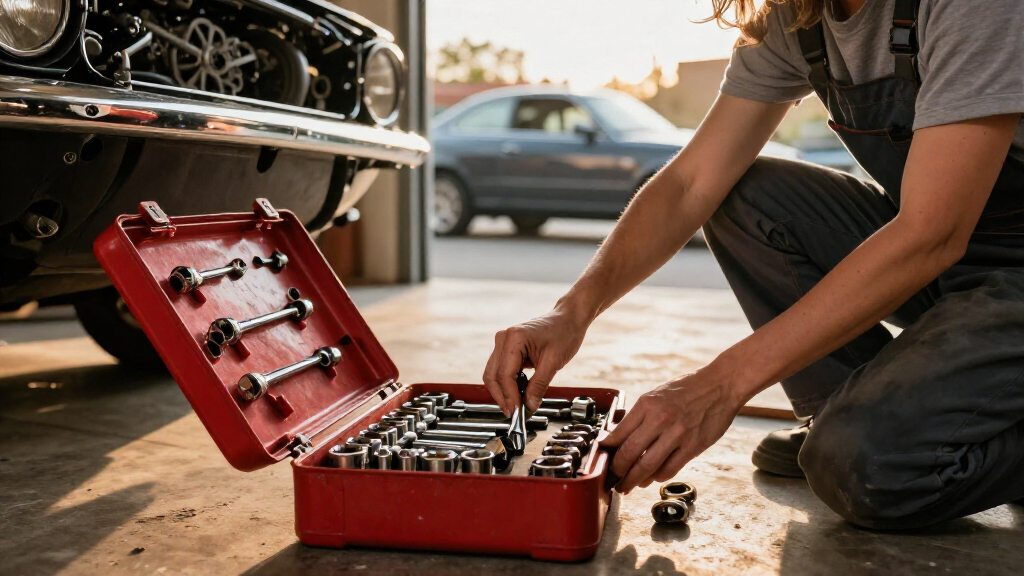

Choosing an automotive tool set is less about buying the biggest case than matching its coverage and durability to the work you expect to do. A mechanic’s tool set is designed for repeated use across a wider range of fasteners and repairs; a homeowner’s automotive set concentrates on common maintenance and keeps the initial cost and storage burden down. That difference matters when a job calls for an unusual socket size, a second drive size, or a tool that sees regular use.

Get business pricing on garage and car supplies
- Business-only prices and quantity discounts
- Tax-exempt purchasing
- Multiple users, one account, clear invoices

CRAFTSMAN 262-Piece Mechanic Tool Set with 3-Drawer VERSASTACK Box
- ✔ Piece count: 262
- ✔ Drive sizes: 1/4 in., 3/8 in., and 1/2 in.
- ✔ Measurement standards: SAE and metric

DEWALT 192-Piece Mechanics Tool Set with SAE and Metric Sockets
- ✔ Piece count: 192
- ✔ Drive sizes: 1/4 in., 3/8 in., and 1/2 in.
- ✔ Measurement system: SAE and metric

VEVOR 450-Piece Mechanics Tool and Socket Set, 1/4, 3/8, and 1/2-Inch Drive
- ✔ Piece count: 450
- ✔ Drive sizes: 1/4 in., 3/8 in., and 1/2 in.
- ✔ Socket types: Deep and standard
This comparison focuses on those two types of set rather than particular brands, since contents, steel quality, warranties, and prices vary by model. The mechanic’s set is the stronger choice for frequent DIY repairs, multiple vehicles, or anyone building a long-term toolkit. The homeowner’s set makes more sense for basic upkeep, occasional roadside fixes, and buyers who would rather add specialist tools only when a job requires them.
At a Glance
| Criteria | Mechanic’s tool set | Homeowner’s automotive tool set | Winner |
|---|---|---|---|
| Coverage | Typically broader socket sizes, drive sizes, extensions, and accessories; exact contents vary. | Usually covers common automotive tasks, with fewer sizes or accessories. | A |
| Durability under repeated use | Often built for more frequent use, though quality depends on the specific set. | Adequate for occasional work; may be less suited to sustained, high-force use. | A |
| Common maintenance | Well suited to routine work and a wider range of repair tasks. | A practical fit for basic maintenance and simple repairs. | A |
| Portability and storage | Usually heavier and larger because it contains more tools. | Usually smaller and easier to store or carry. | B |
| Tool organization | May offer extensive case organization, but a full case can take space and be harder to keep complete. | A compact case can be easier to manage, depending on its layout. | Depends |
| Upfront value | Costs more; the premium pays off when broad coverage sees regular use. | Lower entry cost for buyers with limited or occasional needs. | B |
| Room to grow | Can reduce early gaps, though specialist work still calls for dedicated tools. | Often leaves more reason to add pieces as repair needs expand. | A |
CRAFTSMAN 262-Piece Mechanic Tool Set with 3-Drawer VERSASTACK Box
For a garage set expected to handle a variety of automotive jobs, CRAFTSMAN’s 262-piece assortment strikes the most useful balance in this group. It combines sockets with 24 wrenches, 44 hex keys, and 66 specialty bits, so the contents extend beyond socket work. Like the DEWALT and VEVOR sets, it covers SAE and metric sizes and all three common drive sizes; its differentiator is the breadth of listed tool types paired with a storage system built around drawers.The 90-tooth ratchets with a 5-degree swing arc are suited to confined spaces where a handle cannot move far between strokes. The three drawers open with one hand, lock in place, and can nest on top of the box, giving us a way to access tools without unpacking a single deep case. That is a practical advantage over DEWALT’s hard-shell carrying case, though the box-based format and 27.5-pound weight still make this a substantial kit to move. The 1/4- and 3/8-inch ratchet heads are low profile; the 1/2-inch ratchet is not described that way, so we should not assume the tight-clearance advantage applies equally across the set.This is our strongest all-round recommendation for someone building a home automotive workspace and wanting a varied assortment in an expandable storage platform. VEVOR includes many more pieces, but that comes with considerably more weight; DEWALT is lighter by its listed weight, but offers fewer pieces and a more focused socket-grip feature. Choose CRAFTSMAN for balanced coverage and drawer access; skip it if you need a compact kit to carry frequently or want a hard-shell case.
Pros:
- Broad mix of sockets, wrenches, hex keys, and specialty bits.
- 90-tooth ratchets use a 5-degree swing arc for restricted spaces.
- Three drawers open one-handed, lock, and can nest on the box.
- Compatible with the VERSASTACK storage platform.
Cons:
- The complete set weighs 27.5 pounds.
- Only the 1/4-inch and 3/8-inch ratchets are described as low profile.
Best for: Home mechanics who want a varied SAE and metric assortment, three drive sizes, and accessible drawer storage for recurring automotive work.
Not ideal for: Buyers who need a lightweight travel kit or a low-profile 1/2-inch ratchet specifically.
Bottom line: We recommend CRAFTSMAN for a well-rounded home automotive setup where varied tools and drawer access matter more than minimum weight.
“We recommend CRAFTSMAN for a well-rounded home automotive setup where varied tools and drawer access matter more than minimum weight.”
DEWALT 192-Piece Mechanics Tool Set with SAE and Metric Sockets
DEWALT’s 192-piece set is the most targeted choice here for buyers who put socket engagement and fastener protection near the top of their list. Its six-point sockets use DirectTorque technology to help grip fasteners and reduce rounding. That emphasis distinguishes it from CRAFTSMAN’s wider mix of wrenches, hex keys, and specialty bits, and from VEVOR’s larger but less specifically described assortment. For automotive work on fasteners that may be difficult to loosen, socket design can matter more than adding another row of pieces.The set includes 1/4-, 3/8-, and 1/2-inch drive ratchets, plus extensions, adapters, universal joints, hex keys, spark plug sockets, and bit sockets. Those accessories help us reach and approach fasteners at different angles, making the set more capable than its lower piece count might suggest. Its hard-shell case supports organized transport and protection, though it needs storage room and does not offer CRAFTSMAN’s individual drawer access. The listed weight is 16.8 kg, which is still cumbersome to carry; the hard case does not make this a lightweight option.We would choose DEWALT when a defined socket-grip feature and accessory selection are more important than maximizing the assortment. CRAFTSMAN is the better match for a broader spread of tool categories and more accessible drawers, while VEVOR supplies far more pieces. DEWALT’s tradeoff is that its 192-piece set weighs 16.8 kg and occupies space in its case. It makes sense for a fixed garage or organized vehicle workspace, but buyers seeking a lighter kit should compare actual carrying needs before choosing it.
Pros:
- Six-point sockets with DirectTorque technology are designed to help reduce fastener rounding.
- Includes all three common drive sizes with SAE and metric coverage.
- Extensions, adapters, universal joints, spark plug sockets, and bit sockets broaden use.
- Hard-shell case supports organized storage and transport.
Cons:
- The full set weighs 16.8 kg.
- Hard-shell case requires dedicated storage space.
- Fewer listed pieces and tool categories than the CRAFTSMAN and VEVOR sets.
Best for: Mechanics who want six-point socket engagement, accessories for angled access, and a protective hard-shell storage case.
Not ideal for: Anyone seeking the broadest tool assortment or a light kit for frequent carrying.
Bottom line: We favor DEWALT when socket grip and a protective case outweigh maximum assortment and easy drawer access.
“We favor DEWALT when socket grip and a protective case outweigh maximum assortment and easy drawer access.”
VEVOR 450-Piece Mechanics Tool and Socket Set, 1/4, 3/8, and 1/2-Inch Drive
VEVOR’s 450-piece set leads this group on stated piece count, with deep and standard sockets, bits, wrenches, and accessories in both SAE and metric sizes. That scale can suit a buyer who wants a broad general-purpose set for automotive maintenance as well as home DIY and equipment repairs. It shares all three drive sizes with the other picks, so its case for choosing it is the larger assortment, not a unique drive configuration. Compared with CRAFTSMAN, the listing gives less detail about the count of particular tool categories; the headline number alone does not tell us how many items match the repairs we actually do.The tools are described as chrome-vanadium steel with a polished, chrome-plated finish, and they arrive in a portable PE-HD case. In practice, portability is tempered by the 38.9-pound complete-set weight, making this the heaviest option here. That is a notable difference from both CRAFTSMAN’s 27.5-pound box and DEWALT’s listed 16.8 kg. The set also states a torque range beginning at 95 in-lb; buyers whose tasks call for lower torque should treat that as a limitation and check whether the set suits those jobs.Choose VEVOR when assortment breadth is the priority and the kit will mostly stay in a workshop or be moved occasionally. CRAFTSMAN is the more balanced automotive-focused pick because its listed tool mix and drawer design are clearer, while DEWALT offers the most explicit fastener-grip feature. VEVOR’s large collection may cover varied projects, but it asks us to store and handle a heavier case. Its role is maximum coverage in one kit, with weight and unspecified category counts as the main compromises.
Pros:
- Largest stated assortment at 450 pieces.
- Includes deep and standard sockets in SAE and metric sizes.
- Three drive sizes cover a range of common mechanical tasks.
- Chrome-vanadium steel tools are stored in a PE-HD case.
Cons:
- At 38.9 pounds, it is the heaviest set in this comparison.
- The stated torque range begins at 95 in-lb, which may not suit lower-torque tasks.
- The product details do not break down the count of individual tool categories.
Best for: DIYers and equipment owners who want a large combined assortment for automotive upkeep and other mechanical projects.
Not ideal for: People who regularly carry their tools, need a compact vehicle kit, or work on tasks requiring torque below the stated 95 in-lb starting point.
Bottom line: We recommend VEVOR for buyers who value the broadest stated assortment and can accept a heavy case and less category-level detail.
“We recommend VEVOR for buyers who value the broadest stated assortment and can accept a heavy case and less category-level detail.”
As an Amazon Associate we earn from qualifying purchases.
Key Differences
The mechanic’s set’s main advantage is coverage. When a repair calls for an uncommon size or a different drive setup, a broader kit is more likely to have the needed piece on hand. That can prevent a trip to the store or a pause in the job. The gap is moderate for everyday maintenance, where many tasks rely on common tools, and major for buyers who tackle varied repairs across different vehicles. No general-purpose set replaces specialty equipment for every repair.
The homeowner’s set wins on initial cost and convenience. It takes less room and gives an occasional user a sensible starting point without paying for pieces that may sit unused. Its tradeoff is the likelihood of filling gaps later. If purchases are chosen carefully, that can be economical; if several missing sizes and accessories are needed soon, a fuller set may have been better value.
Neither label guarantees good quality. Compare the actual contents, materials, case design, return policy, and warranty before buying. For repeated use, dependable ratchets and sockets matter more than a high piece count. For infrequent jobs, a manageable set with the common sizes you need can be a better purchase than a bulky case selected by its headline number.
Detailed Comparison
Coverage (Mechanic’s tool set wins — major)
The mechanic’s set wins by a moderate to major margin. It generally includes more size options, drive sizes, extensions, and related accessories. That matters most when jobs vary: a broad set is less likely to stop work over a missing socket. For oil changes, battery work, and other common tasks, the homeowner’s set may already cover the essentials. Check the itemized contents, because piece counts can include duplicates or small accessories that add little useful coverage.
Durability under repeated use (Mechanic’s tool set wins — moderate)
The mechanic’s set usually has the advantage, with a moderate gap. Sets aimed at frequent use are more likely to provide robust ratchets and sockets for regular work. However, the label alone is not proof of quality; compare materials and warranty terms across actual products. A homeowner’s kit can serve occasional maintenance well, but repeated heavy use is a stronger reason to pay for a better-built set.
Common maintenance (Mechanic’s tool set wins — minor)
The mechanic’s set is more versatile, but the practical gap is minor for basic upkeep. Both types may cover routine jobs such as battery terminal work and some straightforward maintenance, depending on their contents. The larger set provides more options when a repair varies from the expected. If the work is limited to a small, known list of tasks, a homeowner’s kit can do the job without paying for extensive coverage.
Portability and storage (Homeowner’s automotive tool set wins — moderate)
The homeowner’s set wins by a moderate margin. A smaller case is easier to keep in a trunk, carry to a parking space, or store in a crowded garage. A mechanic’s set takes more room and can weigh more, though a well-organized case may still be practical for a workshop. If the tools need to travel with the vehicle, compact size can matter more than having every common option.
Tool organization (minor difference)
This is a close call that depends on the case design. A smaller homeowner’s case can be quicker to inspect and return to storage. A broad mechanic’s set may have more clearly marked positions, but it also has more pieces to put back after a job. Look for secure slots, readable size labels, and a case that stays closed in transport. Organization affects whether tools remain findable; it does not compensate for missing or poor-quality tools.
Upfront value (moderate difference)
The homeowner’s set wins for an occasional user; the mechanic’s set can win over time for a regular user. Paying less makes sense when the included tools match a short list of expected jobs. The larger set’s higher price is justified when broad coverage and frequent use prevent repeated purchases or delays. If most of its extra pieces will remain unused, the premium buys little practical value.
Room to grow (Mechanic’s tool set wins — moderate)
The mechanic’s set has a moderate advantage as a starting point. Its wider selection can cover more future repairs before additions are needed. The homeowner’s set is still a reasonable base if it can be supplemented with quality tools as specific needs arise. In either case, specialized tasks may require separate equipment, so a larger general-purpose set should not be treated as a complete workshop.
Mechanic’s tool set: Pros and Cons
Pros:
- Broader coverage for varied repairs
- Better suited to frequent use when the specific set is well built
- Fewer early gaps when maintaining several vehicles
Cons:
- Higher upfront cost
- Larger and heavier to store or carry
- Can include tools that an occasional user rarely needs
Homeowner’s automotive tool set: Pros and Cons
Pros:
- Lower cost to get started
- Compact storage and easier transport
- Sensible coverage for common, occasional maintenance
Cons:
- Fewer sizes and accessories can limit flexibility
- May need additions as repair needs expand
- Some models may be less suited to frequent heavy use
Who Should Choose What
Choose Mechanic’s tool set if:
- You work on vehicles regularly or maintain more than one.
- You want broad coverage and want to reduce interruptions caused by missing common sizes.
- You expect the tools to see frequent use and have compared the set’s materials and warranty.
Choose Homeowner’s automotive tool set if:
- You mainly handle occasional basic maintenance.
- You need a compact kit for a trunk, apartment, or small garage.
- You prefer a lower initial cost and are comfortable adding tools when a specific job calls for them.
Skip both if: Your planned work depends on specialized diagnostic, torque, electrical, or model-specific tools; choose the required equipment for those jobs instead of expecting a general set to cover them.
Value for Money
Pay more for a mechanic’s set when its extra coverage will be used regularly. For a committed DIY mechanic, avoiding several small purchases and keeping more common tools on hand can justify the higher price. Prioritize a useful selection and dependable construction over the largest advertised piece count.
For occasional maintenance, the homeowner’s set is usually better value if it includes the sizes needed for the vehicle and the case suits how it will be stored. Paying for a bigger set makes little sense when its extra tools are unlikely to leave the case. Check the actual contents and compare the cost of likely additions before deciding; the best value is the set that covers your real jobs with the fewest compromises.
Final Verdict
For most buyers who plan to do varied repairs over time, choose a mechanic’s tool set: its broader coverage makes it the more capable long-term base, provided the specific set is well made. Choose a homeowner’s automotive set if your work is occasional, limited to basic maintenance, or requires a compact kit. The deciding factor is how often your jobs change. If you already know you will tackle many kinds of repairs, pay more for coverage; if not, start smaller and add tools as needed.
Frequently Asked Questions
Is a mechanic’s tool set worth the higher price?
It can be if you work on vehicles often, maintain several cars, or regularly encounter varied repairs. If you expect only occasional basic maintenance, a smaller set can provide better value.
Can a homeowner’s automotive tool set handle routine maintenance?
Often, if its actual contents match the tasks you plan to do. Check the socket sizes, drive tools, and accessories rather than relying on the set’s name or total piece count.
Does a larger piece count mean a better automotive set?
No. Piece counts may include small accessories or duplicate items. Compare the useful sizes, ratchet and socket quality, case organization, and warranty.
Should I keep an automotive tool set in my car?
A compact set can be convenient for simple jobs, but avoid carrying a large kit if its size and weight make it impractical. Select tools that suit likely needs and store them securely.
Evergreen bestsellers Picks

KitchenAid Artisan 5-Quart Tilt-Head Stand Mixer, Almond Cream

KitchenAid Classic Series 4.5-Quart Tilt-Head Stand Mixer, Onyx Black

Ninja Luxe Café Mini Plus Espresso and Coffee Maker with AutoFroth, Bone & Champagne
As an affiliate, we earn on qualifying purchases.