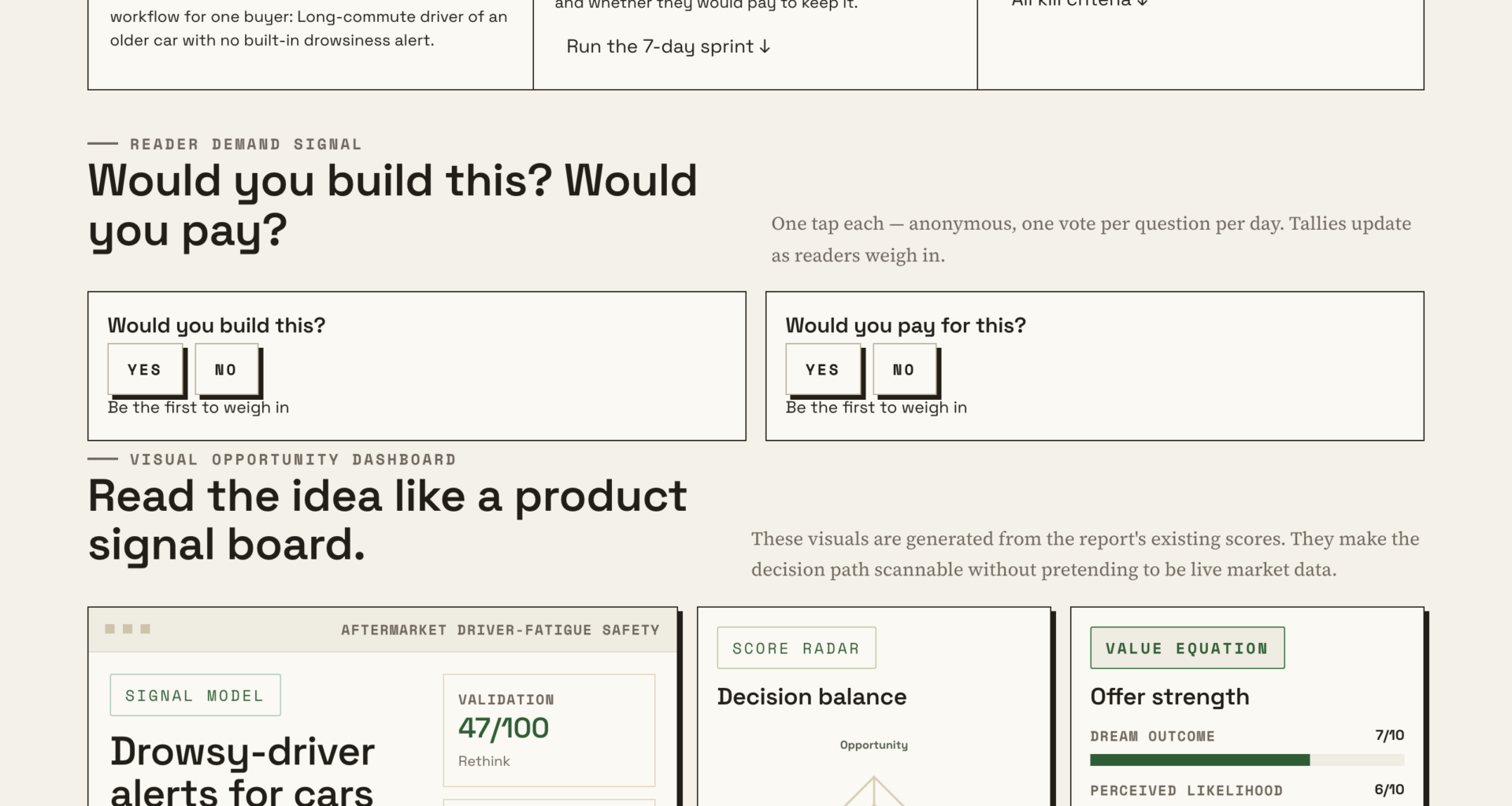
📊 Full opportunity report: Can Aftermarket Driver-Fatigue Alerts Help Keep Drivers Safer? on IdeaNavigator AI — validation score, market gap, and execution plan.

Get business pricing on garage and car supplies
- Business-only prices and quantity discounts
- Tax-exempt purchasing
- Multiple users, one account, clear invoices
TL;DR
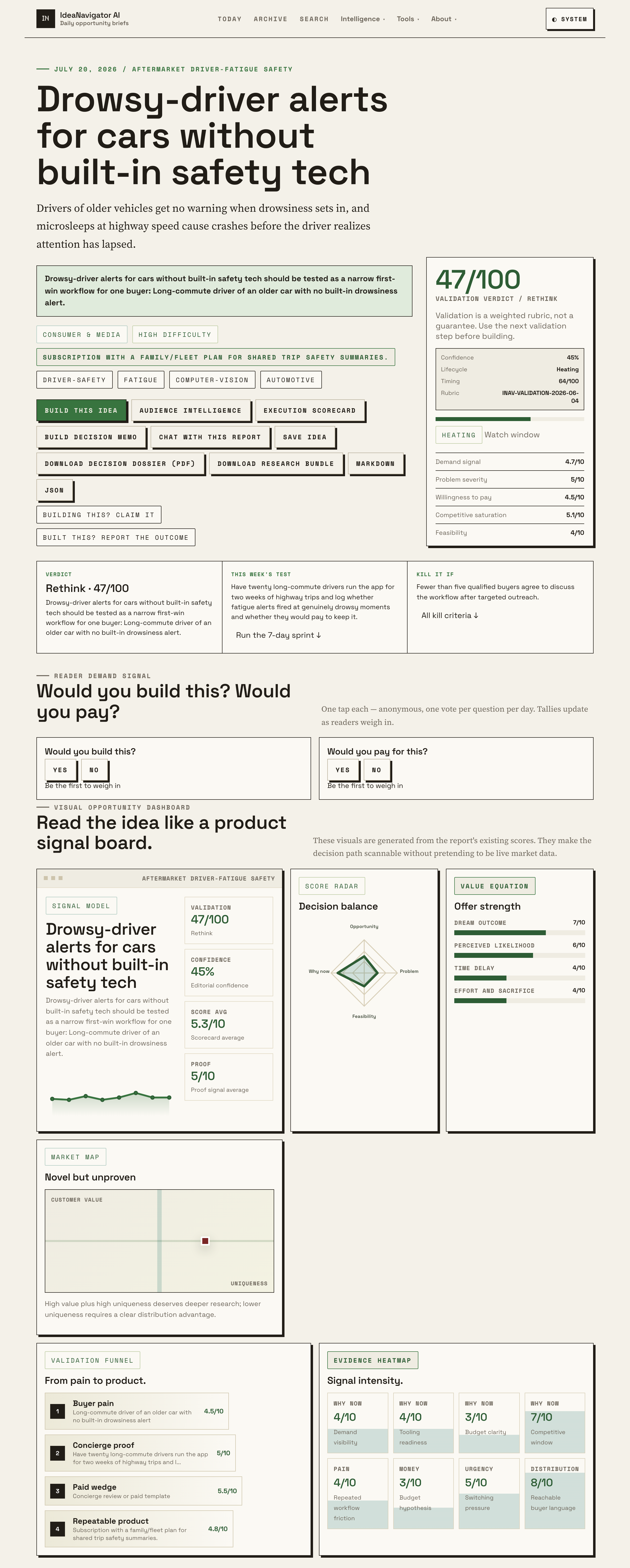
A proposal calls for testing a dashboard phone app that looks for eye-closure and head-nod patterns and alerts drivers who may be drowsy. No trial results or evidence of crash reduction are provided; the suggested first step is a two-week test with 20 long-commute drivers.
According to the IdeaNavigator AI proposal, the app would run on a phone mounted on the dashboard and use on-device facial landmark models to estimate whether a driver’s eyes are closing or their head is nodding. If it detects signs associated with drowsiness, it would issue an escalating alert and prompt the driver to take a break. These are proposed features, not a tested product or validated warning system.
The proposal suggests an initial evaluation: a two-week test with 20 long-commute drivers on highway trips. Participants would log whether alerts occurred when they felt genuinely drowsy and whether they would pay to keep using the app. The source reports no enrolled participants or trial findings, accuracy figures or safety outcome data.
The concept targets drivers of older vehicles that lack factory-installed drowsiness alerts. IdeaNavigator AI also describes a possible subscription model, including family or fleet plans that share trip safety summaries. This is a business proposal; it gives no pricing or demand data and does not specify how shared driving data would be handled.
A Warning Could Reach Older Cars
IdeaNavigator AI presents the phone-based alert as a way to offer some drivers a fatigue warning without requiring a newer vehicle with built-in monitoring. The proposal’s intended audience is people taking long highway trips in cars that lack this feature, where a driver who stops paying attention may not recognize the lapse in time to respond.
The safety value remains unproven. A phone estimate of eye or head movement is not itself evidence that a driver is too tired to continue, and an alert cannot guarantee that the person will stop or rest. False alarms could distract or frustrate drivers, while missed signs could create misplaced confidence. The proposal’s reports from 20 drivers could offer early usability feedback, but would not establish that the app prevents crashes or works across different faces, lighting and road conditions.
driver fatigue alert app for smartphones
As an affiliate, we earn on qualifying purchases.
As an affiliate, we earn on qualifying purchases.
From Built-In Sensors to Phones
IdeaNavigator AI says some newer vehicles offer driver-monitoring or drowsiness warning features and proposes extending a related kind of alert to older cars through a mounted smartphone. The proposal says the phone could use inexpensive hardware and on-device models to estimate facial cues.
The source frames the idea as a narrow initial use case: long-commute drivers in vehicles with no existing drowsiness alert. It proposes a short field test as a validation step, but reports no completed study. It provides no technical specifications, independent evaluation, comparison with vehicle systems or regulatory status.
dashboard mounted driver drowsiness monitor
As an affiliate, we earn on qualifying purchases.
As an affiliate, we earn on qualifying purchases.
Accuracy and Safety Evidence Missing
The IdeaNavigator AI proposal provides no measured results and does not say whether a prototype exists. It is therefore unclear how accurately the app would identify drowsiness, how often it might issue false or missed alerts, or whether performance would change with phone placement, lighting, glasses or road vibration.
The proposal also does not explain whether drivers would respond to alerts by taking a break, what evidence would count as a genuinely drowsy moment, or whether a 20-person, two-week test could capture enough varied driving conditions. Its suggested family and fleet summaries raise further unanswered questions about what trip information would be collected, stored or shared. No crash reduction or other safety benefit can be claimed from the information available.
eye closure detection app for drivers
As an affiliate, we earn on qualifying purchases.
As an affiliate, we earn on qualifying purchases.
A Small Driver Trial Is Proposed
IdeaNavigator AI proposes recruiting 20 long-commute drivers to use the app over two weeks of highway trips. The proposed evaluation would record when fatigue alerts fire, whether drivers believe those alerts coincided with drowsiness, and whether they would pay to continue using the service.
The proposal gives no start date, recruitment plan or results. Any findings would need to clarify how fatigue was assessed and how the app performed across trips before they could support broader safety claims. The source does not specify a later testing or launch schedule.
Source: IdeaNavigator AI
As an affiliate, we earn on qualifying purchases.
Key Questions
What would the proposed app do?
According to IdeaNavigator AI’s proposal, it would use a dashboard-mounted phone camera to estimate eye-closure and head-nod cues, then sound an alert and suggest a break if it detected possible drowsiness.
Has the app been shown to reduce crashes?
No. IdeaNavigator AI reports no crash data or test results. The concept still needs evaluation, and the proposed small driver test would not by itself prove that the app prevents crashes.
Who is the proposed test for?
IdeaNavigator AI identifies long-commute drivers using older cars without built-in drowsiness alerts as the initial target. The proposal suggests a two-week test involving 20 drivers.
Would the app share trip data with family or fleets?
IdeaNavigator AI suggests a family or fleet subscription with shared trip safety summaries as a possible business model. The proposal does not specify what information would be collected or shared.
Source: IdeaNavigator AI
Halloween Picks
halloween
As an affiliate, we earn on qualifying purchases.