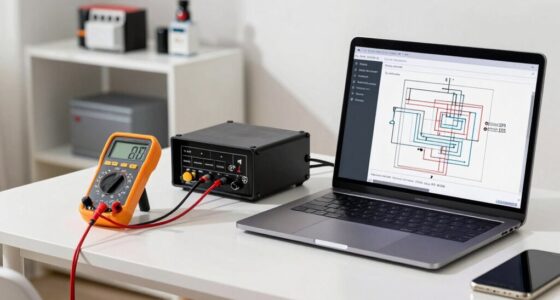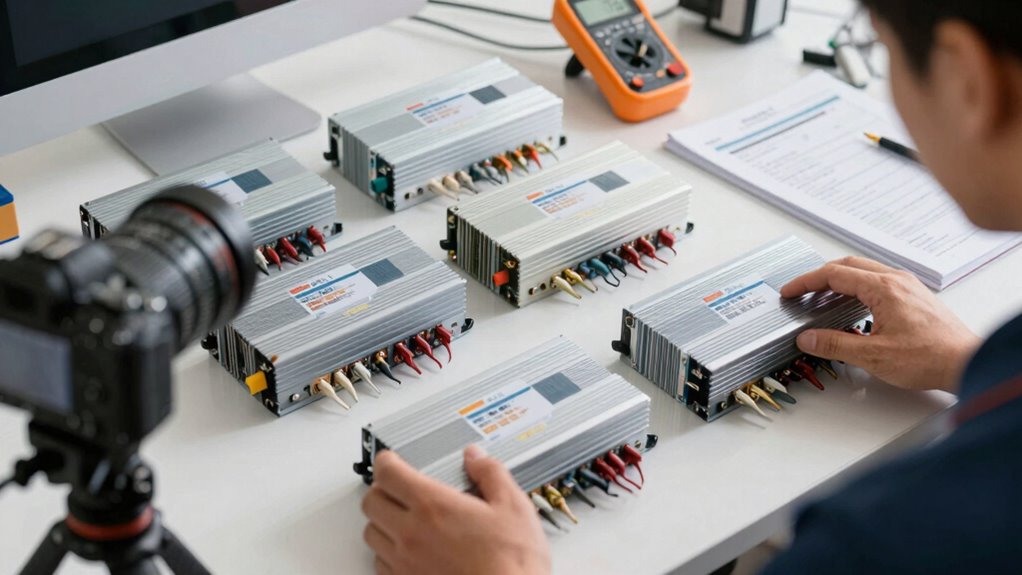

To size an inverter properly, start by listing all devices you’ll run, noting their wattage and surge needs. Add these up to determine your total power requirements and include a safety margin for future expansion. Check each device’s power factor and guarantee the inverter can handle peak demands. Match inverter capacity with your energy needs, considering efficiency and losses. If you keep building your knowledge, you’ll become more confident in designing a reliable, scalable system.
Open a free Amazon Business account
Business pricing, bulk buying and tax-exempt orders.
As an affiliate, we earn on qualifying purchases.
Key Takeaways
- Start by listing all devices’ wattages and their peak surge requirements to determine the total continuous and startup loads.
- Calculate the total energy consumption in watt-hours to select a battery capacity that meets runtime needs.
- Choose an inverter with sufficient continuous power and surge capacity to handle peak loads and startup surges safely.
- Incorporate system efficiency and potential losses into sizing calculations to ensure reliable performance.
- Add a safety margin for future expansion and unexpected surges, balancing capacity with cost-effectiveness.
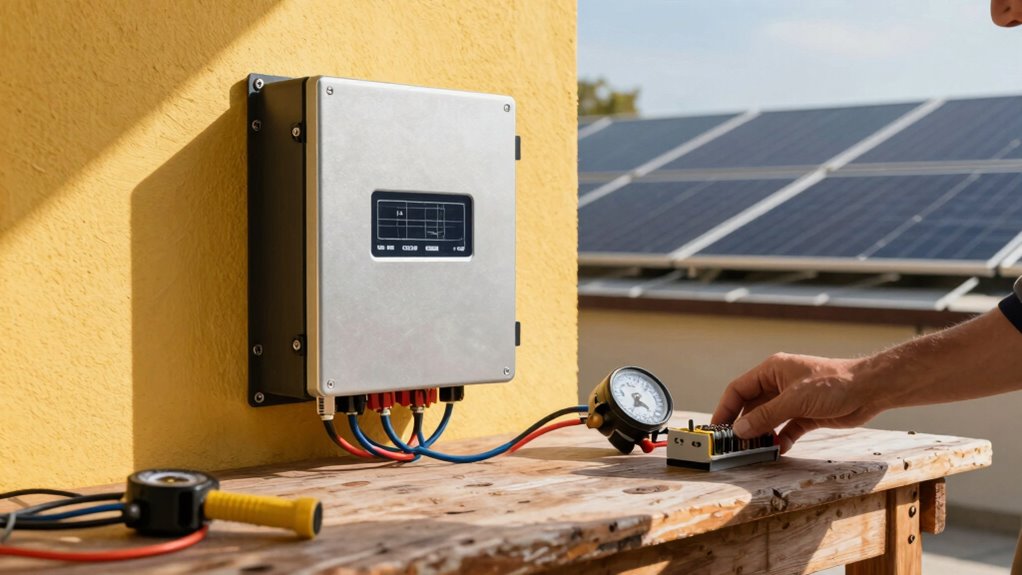
If you’re new to inverter sizing, the process can seem overwhelming at first, but with a clear, step-by-step approach, you can confidently determine the right inverter for your needs. The first step is understanding your power requirements. Start by listing all the devices you plan to run simultaneously, noting their wattage or VA (volt-ampere) ratings. This gives you a baseline to work from. Next, consider the overall power factor of your system, which influences how efficiently your inverter will operate. Power factor, typically expressed as a number between 0 and 1, indicates the ratio of real power to apparent power. A higher power factor means less wasted energy and a more efficient system, so aim for devices and systems with a high power factor or account for this in your calculations.
Understanding your device wattage and power factor is essential for accurate inverter sizing.
Battery capacity plays an essential role in inverter sizing, especially if you’re designing a backup or off-grid system. You need to determine how much energy your batteries can store and how long you want your system to run during power outages. To do this, add up the total watt-hours required by your devices and match that with your battery bank’s capacity, usually expressed in amp-hours (Ah) and voltage. Remember, a larger battery capacity extends your runtime but also increases costs and space requirements. Additionally, understanding your battery capacity helps in planning for future power needs and system scalability. It’s also crucial to consider the efficiency of your system components to ensure accurate sizing and optimal performance. Incorporating knowledge of power requirements and system efficiency can further refine your inverter selection process. Recognizing the impact of system losses is vital for achieving a truly reliable setup.
When selecting an inverter, confirm it can handle the peak power demands of your system, not just the continuous load. For example, appliances like refrigerators or pumps have initial surge currents that can be several times higher than their running wattage. Your inverter should have a surge capacity that exceeds this starting load to avoid shutdowns or damage. Also, check that the inverter’s rated power aligns with the combined wattage of your devices, factoring in the power factor to get an accurate load estimate. Understanding the importance of accurate load estimation can help you choose the right inverter size more effectively.
Finally, don’t forget to incorporate safety margins. Oversize your inverter slightly to accommodate future expansion or unexpected surges, but avoid going too large, as it increases costs unnecessarily. By carefully analyzing your device wattages, understanding your battery capacity, and considering power factor, you build a solid foundation for choosing an inverter that’s both efficient and reliable. With this approach, you’ll move from beginner to pro in inverter sizing, ensuring your system is well-equipped to meet your energy needs now and in the future.
12V pure sine wave inverter for home backup
As an affiliate, we earn on qualifying purchases.
As an affiliate, we earn on qualifying purchases.
Frequently Asked Questions
How Do Inverter Efficiencies Affect Sizing Decisions?
Inverter efficiencies directly impact your sizing decisions because higher efficiency reduces power losses, meaning less energy is wasted during conversion. When you consider efficiency metrics, you’ll select an inverter that minimizes power losses, ensuring your system delivers ideal performance. Poor efficiency can lead to oversized inverters, increasing costs and energy waste. So, choosing an inverter with better efficiency helps you size correctly, saving money and improving overall system reliability.
What Are Common Mistakes to Avoid When Sizing Inverters?
You should avoid common mistakes like underestimating surge capacity, which can cause inverter shutdowns during startup, and ignoring load harmonics, leading to overheating or inefficiency. Always size your inverter with enough margin to handle peak loads comfortably, especially for equipment with high inrush currents. Additionally, consider power quality issues caused by load harmonics, ensuring your inverter can manage these distortions without compromising performance or lifespan.
How Does Ambient Temperature Influence Inverter Performance?
Did you know that high ambient temperatures can reduce inverter efficiency by up to 15%? When temperatures soar, your inverter needs increased cooling requirements to maintain ideal performance. Elevated temperatures challenge its temperature resilience, potentially causing overheating or shutdowns. To keep things running smoothly, guarantee proper ventilation and consider cooling solutions. This way, your inverter stays efficient and reliable, even on the hottest days.
Can Inverter Sizing Vary With Different Types of Loads?
Yes, inverter sizing can vary with different types of loads. When considering load diversity, you account for how various loads draw power at different times, affecting inverter capacity needs. Additionally, a load’s power factor influences the inverter’s ability to handle reactive power, which impacts sizing. By analyzing both load diversity and power factor, you guarantee your inverter is appropriately sized, optimizing performance and efficiency for your specific application.
What Maintenance Is Required for Optimal Inverter Operation?
You need to regularly check your inverter’s cooling requirements to prevent overheating, which can reduce efficiency. Keep vents clean and guarantee proper airflow. Also, monitor noise levels; if they increase, it might indicate a problem like a failing fan or component. Schedule routine inspections and maintain a clean environment around the inverter. Proper maintenance ensures peak operation, extends lifespan, and keeps noise and cooling issues at bay.
off-grid inverter with surge capacity
As an affiliate, we earn on qualifying purchases.
As an affiliate, we earn on qualifying purchases.
Conclusion
As you stand at the edge of your inverter journey, imagine yourself guiding a sturdy vessel through swirling currents. With each sizing decision, you navigate closer to mastery, steering confidently past the rocks of confusion. Your newfound knowledge becomes the compass, illuminating the dark waters ahead. Soon, the horizon reveals a seamless blend of power and precision, transforming your understanding from tentative steps into a steady, confident stride toward professional expertise.
solar inverter for renewable energy systems
As an affiliate, we earn on qualifying purchases.
As an affiliate, we earn on qualifying purchases.
As an affiliate, we earn on qualifying purchases.
Flea & tick season Picks
flea and tick prevention
As an affiliate, we earn on qualifying purchases.