For most car owners seeking a versatile paint-correction tool, I’d start with the SPTA 5-Inch Dual-Action Random Orbital Car Polisher Kit; its dual-action design is a more approachable choice than a rotary for routine correction. The AOBEN 6-Inch Dual-Action is another candidate for buyers who want a larger working area, while the LDHTHOPI 1600W Rotary suits experienced users who prioritize direct cutting power. The main tradeoffs are correction speed versus control, corded power versus cordless freedom, and a full-size machine versus a compact spot polisher. I’ve compared all 14 options by their intended use, handling, power format, and kit contents. Read on for the full breakdown and a guide to choosing a polisher that matches your paintwork and experience.

Get business pricing on garage and car supplies
- Business-only prices and quantity discounts
- Tax-exempt purchasing
- Multiple users, one account, clear invoices
Complete the kit


Key Takeaways
- Dual-action polishers are the strongest starting point for general paint correction: the SPTA 5-inch and AOBEN 6-inch options suit broader panel work better than the rotary models for less experienced users.
- Rotary machines favor correction speed over ease of control: the LDHTHOPI and OFISPEED 1600W models are better matched to experienced detailers than to first-time users.
- Mini polishers fill a different role, not a full-size replacement: the Fanttik P10 Pro and 12V SPTA models are aimed at tight areas and localized work.
- Battery count and voltage are not the whole cordless story: two-battery kits can reduce downtime, but buyers still need to weigh runtime, charging, and the effort of managing a battery-powered tool.
- The WEN 10-inch waxer is a waxing-focused outlier: its large format and bonnet setup serve broad, light-duty applications better than precise paint correction.
| Fanttik P10 Pro Cordless Mini Car Buffer Polisher |  | Best for Precise Spot Detailing | Speed range: 300–950 RPM | Speed settings: 3 variable speeds | Battery capacity: 4,000 mAh | VIEW LATEST PRICE | See Our Full Breakdown |
| LDHTHOPI 1600W Rotary Buffer Polisher, 7-Speed, 6- and 7-Inch Pads |  | Best for Powerful Rotary Work | Motor power: 1,600 W | Speed settings: 7 | Speed range: 1,000–3,500 RPM | VIEW LATEST PRICE | See Our Full Breakdown |
| Niusken Cordless Dual-Action Car Buffer Polisher Kit |  | Best Cordless Dual-Action Kit | Motor: Pure copper brushed motor | Speed settings: 6 | Speed range: 2,800–5,800 RPM | VIEW LATEST PRICE | See Our Full Breakdown |
| SPTA 12V Cordless Mini Polisher Kit |  | Best Mini Kit for Multiple Attachments | Voltage: 12 V | Battery capacity: 2,000 mAh | Batteries included: 2 | VIEW LATEST PRICE | See Our Full Breakdown |
| Niusken Cordless Dual-Action Car Buffer Polisher Kit with Two Batteries |  | Best for Pad Variety | Motor: Pure copper brushed motor | Speed settings: 6 | Speed range: 2,800–5,800 RPM | VIEW LATEST PRICE | See Our Full Breakdown |
| Protmex Cordless Car Buffer Polisher with Two 21V Batteries |  | Best Cordless Kit for Longer Sessions | Brand: Protmex | Model: 21V Car Polisher-Blue | Power source: Battery powered | VIEW LATEST PRICE | See Our Full Breakdown |
| SPTA 5-Inch Dual-Action Random Orbital Car Polisher Kit |  | Best for Paint Correction and Versatility | Brand: SPTA | Model: DAPSET-US | Type: Dual-action random orbital polisher | VIEW LATEST PRICE | See Our Full Breakdown |
| Protmex Cordless Car Buffer Polisher with Two 21V Batteries |  | Best Cordless Pick with a Two-Year Warranty | Brand: Protmex | Power source: Battery powered | Voltage: 21 V | VIEW LATEST PRICE | See Our Full Breakdown |
| SPTA Cordless Mini Car Polisher, 12V |  | Best for Tight Areas and Spot Correction | Brand: SPTA | Model: SP-DA1US | Power source: Battery powered | VIEW LATEST PRICE | See Our Full Breakdown |
| WEN 10-Inch Waxer and Polisher with Case and Extra Bonnets |  | Best for Simple Waxing on Large Panels | Brand: WEN | Model: 10PMC | Pad size: 10 inches | VIEW LATEST PRICE | See Our Full Breakdown |
| 6-Inch Cordless Car Buffer Polisher Kit with Two 2000mAh 21V Batteries |  | Best Cordless Pick | Motor power: 300 W | Maximum speed: 6,000 RPM | Speed settings: 6 adjustable settings | VIEW LATEST PRICE | See Our Full Breakdown |
| OFISPEED 1600W Rotary Buffer Polisher, 6–7 Inch |  | Best for Experienced Rotary Users | Brand: OFISPEED | Model: PGJ | Polisher type: Rotary | VIEW LATEST PRICE | See Our Full Breakdown |
| AOBEN 6-Inch Dual-Action Car Buffer Polisher Kit |  | Best for Beginners | Power: 700 W | Power source: Corded electric | Voltage and frequency: 120 V, 60 Hz | VIEW LATEST PRICE | See Our Full Breakdown |
| Chemical Guys TORQX Random Orbital Polisher Kit, 9-Piece |  | Best Complete Dual-Action Kit | Brand: Chemical Guys | Model: BUF503X | Motor power: 800 W | VIEW LATEST PRICE | See Our Full Breakdown |
| car detailing polisher | Speed range | Weight | Speed settings | Power source |
|---|---|---|---|---|
| Fanttik P10 Pro Cordless Mini | 300–950 RPM | — | 3 variable speeds | — |
| LDHTHOPI 1600W Rotary Buffer P | 1,000–3,500 RPM | — | 7 | AC |
| Niusken Cordless Dual-Action C | 2,800–5,800 RPM | 3.3 lbs | 6 | — |
| SPTA 12V Cordless Mini Polishe | 2,000–4,500 oscillations per minute | — | — | — |
| Niusken Cordless Dual-Action C | 2,800–5,800 RPM | 3.3 lbs | 6 | — |
| Protmex Cordless Car Buffer Po | 2,800–5,500 rpm | 3.3 lb with battery | 6 | Battery powered |
| SPTA 5-Inch Dual-Action Random | — | — | — | Corded electric |
| Protmex Cordless Car Buffer Po | 2,800–5,500 rpm | 3.3 lb including battery | — | Battery powered |
| SPTA Cordless Mini Car Polishe | 1,000–5,000 OPM | — | — | Battery powered |
| WEN 10-Inch Waxer and Polisher | — | 9 lb | — | Corded electric |
| 6-Inch Cordless Car Buffer Pol | 2,500–6,000 RPM | 3 lb | 6 adjustable settings | — |
| OFISPEED 1600W Rotary Buffer P | 1,000–3,500 RPM | 4.5 lb | 7 variable speeds | — |
| AOBEN 6-Inch Dual-Action Car B | 1,000–4,500 rpm | 5.29 lb | 6 | Corded electric |
| Chemical Guys TORQX Random Orb | — | 4.7 lb | — | — |
More Details on Our Top Picks
Fanttik P10 Pro Cordless Mini Car Buffer Polisher
I’d choose the Fanttik P10 Pro for small, awkward areas rather than whole-panel correction. Its compact cordless body and three low-speed settings suit mirrors, badges, handles, and trim where a full-size polisher can be hard to control. Compared with the SPTA 12V Cordless Mini Polisher, it offers a stated runtime of up to 50 minutes and quieter operation, while the SPTA’s multiple plate sizes and dual-action/rotary attachments give it more setup options for varied small jobs. The Fanttik’s quick-change plates and included pads help cover polishing and light surface prep without a cord, but its small format is not a substitute for a full-size machine on broad panels. I’d also check the weight listing before buying: the description and technical details disagree.
Pros:- Compact cordless form fits tight areas that full-size polishers struggle to reach
- Up to 50 minutes of stated runtime with Type-C charging
- Three speed settings and low-noise operation suit controlled spot work
- Quick-change plates and included accessories support several small detailing tasks
Cons:- Small format is inefficient for polishing large panels
- Runtime is limited to up to 50 minutes per charge
- Listed weight conflicts between the description and technical details
Best for: Detailers who want a quiet, cordless tool for badges, mirror caps, door handles, and other tight paintwork.
Not ideal for: Buyers correcting full doors, hoods, or other large panels, or anyone who needs a verified weight specification before purchase.
- Speed range:300–950 RPM
- Speed settings:3 variable speeds
- Battery capacity:4,000 mAh
- Stated runtime:Up to 50 minutes
- Charging:Type-C fast charging
- Voltage:3.6 V
- Dimensions:1.5 × 1.5 × 8.07 inches
- Included accessories:Quick-change backing plates, pads, sandpapers, and cleaning brush
Our verdict“Choose the Fanttik P10 Pro for quiet, precise spot detailing; choose a larger dual-action polisher for whole-panel work.”
LDHTHOPI 1600W Rotary Buffer Polisher, 7-Speed, 6- and 7-Inch Pads
The LDHTHOPI 1600W rotary is the high-power, corded choice here for buyers who want a tool suited to sanding and more forceful polishing, not a forgiving beginner machine. Its 1,000–3,500 RPM range and seven settings give experienced users room to adapt speed, while direct, D-handle, and side-handle configurations offer different ways to steady the tool. That makes it a different proposition from the cordless Niusken Dual-Action Car Buffer, which is easier to move around a vehicle and is better suited to routine polishing. The tradeoff is rotary technique: excess pressure or poor control can create problems, and the manufacturer recommends working for only 15 minutes before a five-minute cooling break. I’d pick it for deliberate, short sessions—not for uninterrupted all-day detailing.
Pros:- 1,600W motor and seven settings cover a broad range of rotary tasks
- Accepts 6-inch and 7-inch pads for different working areas
- Direct, D-handle, and side-handle configurations offer handling choices
- Includes foam and wool pads along with sanding and handling accessories
Cons:- Rotary operation calls for more control than a dual-action polisher
- Manufacturer recommends a cooling break after each 15-minute work session
- AC power limits movement compared with cordless options such as the Niusken
Best for: Experienced detailers who need a corded rotary for sanding, heavier polishing, or work across automotive and other surfaces.
Not ideal for: Beginners seeking a forgiving car polisher, or users who need cordless movement and long continuous working sessions.
- Motor power:1,600 W
- Speed settings:7
- Speed range:1,000–3,500 RPM
- Pad sizes:6 inches and 7 inches
- Power source:AC
- Handle options:Direct, D-handle, or side handle
- Recommended work cycle:Up to 15 minutes, followed by 5 minutes of cooling
- Included accessories:Foam and wool pads, handles, suction cups, cloth bag, carbon brushes, hex wrench, and 1,000-grit sandpaper
Our verdict“Pick this LDHTHOPI for controlled, short-session rotary work if you already have the technique and a nearby power outlet.”
Niusken Cordless Dual-Action Car Buffer Polisher Kit
For car owners who want cordless polishing across larger areas, I’d favor the Niusken 8 mm dual-action kit over a mini tool such as the Fanttik P10 Pro. Its 5-inch backing plate, six speed settings, and included second battery make it more practical for routine panel work, while the LED display helps track speed and battery status as you move around the car. The dual-action motion is a less aggressive fit than the LDHTHOPI rotary for heavy correction, but it better matches polishing and waxing tasks where controlled movement matters. At 3.3 pounds, it remains portable, though high-speed continuous work may trigger a cooling shutoff after more than 20 minutes. Its batteries are also a separate system, not compatible with DeWalt packs, so existing tool batteries won’t extend its use.
Pros:- Cordless operation and two rechargeable batteries support work around the vehicle
- 8 mm dual-action motion and six speeds suit polishing and waxing
- LED display shows speed and battery status
- Includes a 5-inch backing plate, charger, and assorted pads and bonnets
Cons:- May shut off to cool after more than 20 minutes of continuous high-speed use
- Batteries are not compatible with DeWalt tools
- Dual-action motion is less suited than the LDHTHOPI rotary to aggressive correction
Best for: Car owners who want a portable dual-action polisher for regular waxing and polishing, with a spare battery for longer jobs.
Not ideal for: DeWalt battery owners expecting cross-compatibility, or detailers doing prolonged high-speed correction without cooling pauses.
- Motor:Pure copper brushed motor
- Speed settings:6
- Speed range:2,800–5,800 RPM
- Orbital motion:8 mm dual action
- Backing plate:5 inches
- Batteries:2 × 21 V, 2,000 mAh
- Weight:3.3 lbs
- Battery compatibility:Not compatible with DeWalt batteries
Our verdict“Choose this Niusken kit for cordless, routine panel polishing with a spare battery, but not for uninterrupted high-speed work.”
SPTA 12V Cordless Mini Polisher Kit
The SPTA 12V mini kit earns its place through flexibility in tight spaces: it includes dual-action and rotary attachments, several backing-plate sizes, and two batteries. That gives it a broader small-area setup than the Fanttik P10 Pro, whose simpler compact format is easier to choose when quiet spot polishing and a stated runtime matter more than attachment variety. The SPTA’s 25 mm, 50 mm, and 80 mm plates help match the tool to narrow body lines or slightly larger sections, but the kit does not state battery runtime, so I wouldn’t assume the two packs will carry a long session. Its 12V format also makes it a specialist rather than a replacement for a full-size polisher like the Niusken dual-action model. The large accessory assortment is useful, but buyers should be ready to select and manage the right setup for each task.
Pros:- Compact cordless design suits confined areas and body lines
- Dual-action and rotary attachments allow different approaches to small jobs
- Two batteries are included
- Multiple plate and pad sizes give more setup flexibility than the Fanttik P10 Pro
Cons:- Battery runtime is not specified
- 12V format is less suited to demanding, large-area polishing
- The many attachments require more setup choices than a simpler mini polisher
Best for: Detailers who regularly work around emblems, body lines, and other confined areas and want multiple small-tool configurations.
Not ideal for: Buyers seeking a primary polisher for broad panels, demanding correction, or jobs where predictable battery runtime is required.
- Voltage:12 V
- Battery capacity:2,000 mAh
- Batteries included:2
- Speed range:2,000–4,500 oscillations per minute
- Backing plate sizes:25 mm, 50 mm, and 80 mm
- Included attachments:Dual-action and rotary attachments, plus 2 extension shafts
- Included accessories:Support plates, polishing pads, brushes, protective covers, eccentric blocks, and storage bag
- Number of items:91
Our verdict“Choose the SPTA mini kit for varied small-area work and attachment flexibility, not as your main tool for full vehicle panels.”
Niusken Cordless Dual-Action Car Buffer Polisher Kit with Two Batteries
This Niusken variant makes the most sense for buyers who want more pad choices in the box for a cordless dual-action polisher. Like the other Niusken 8 mm dual-action kit in this roundup, it has six speed settings, a 5-inch backing plate, two 21V batteries, and an LED display; the main distinction in the supplied data is its clearly itemized set of flat and wave sponge pads, bonnets, and sanding discs. That range offers more ways to match the tool to polishing, waxing, or surface-prep tasks than the Fanttik P10 Pro’s compact spot-detailing setup. Its 3.3-pound body and cordless design help with mobility, but this is still a general-purpose dual-action machine, not the more forceful rotary option from LDHTHOPI. High-speed sessions may also prompt a cooling shutoff, and the batteries do not work with DeWalt tools.
Pros:- Two 21V batteries and a fast charger support cordless use
- Six speeds and an LED display help track tool settings and battery status
- Includes flat and wave sponge pads, wool pads, bonnets, and sanding discs
- 5-inch backing plate and 8 mm dual-action motion suit routine vehicle polishing
Cons:- May shut off to cool after more than 20 minutes of continuous high-speed use
- Battery system is not compatible with DeWalt batteries
- Larger than mini polishers such as the Fanttik P10 Pro for tight detail work
Best for: Cordless detailers who want a dual-action polisher with two batteries and a varied selection of pads and bonnets for different tasks.
Not ideal for: Buyers who already rely on DeWalt batteries, need uninterrupted high-speed operation, or want a compact tool for tiny trim areas.
- Motor:Pure copper brushed motor
- Speed settings:6
- Speed range:2,800–5,800 RPM
- Orbital motion:8 mm dual action
- Backing plate:5 inches
- Batteries:2 × 21 V, 2,000 mAh
- Weight:3.3 lbs
- Included accessories:Flat and wave sponge pads, wool pads, microfiber and non-woven bonnets, and 6 sanding discs
- Battery compatibility:Not compatible with DeWalt batteries
Our verdict“Pick this Niusken when cordless dual-action polishing and a varied pad assortment matter more than compact size or DeWalt battery compatibility.”
Protmex Cordless Car Buffer Polisher with Two 21V Batteries
I’d choose this Protmex when moving freely around a vehicle matters more than having a corded tool’s uninterrupted power. Its two 21V batteries let you keep a charged backup ready, while six speed settings offer flexibility for different polishing stages and surfaces. Compared with the SPTA 5-Inch Dual-Action Random Orbital Car Polisher Kit, this one trades a steady corded supply for easier movement and less dependence on an outlet. The 32-piece accessory set is broad, but some included items may go unused if your work is limited to paint correction. At 3.3 lb with a battery, it’s a manageable cordless option, though I’d plan around charging before starting a job. Its listed range is 2,800–5,500 rpm; buyers should follow the supplied instructions for choosing pads and speeds.
Pros:- Cordless operation makes it easier to work around the vehicle without managing a cord.
- Two 21V, 2,000mAh batteries provide a charged backup.
- Six speed settings support different polishing tasks.
- Includes pads, discs, cloth covers, sandpapers, and a storage bag.
Cons:- Batteries need to be fully charged before use.
- The broad accessory set may include items some car-focused users will not need.
- Battery capacity means runtime depends on charging and battery rotation.
Best for: DIY detailers who want cordless movement around a car and a spare battery for extended polishing sessions.
Not ideal for: Buyers who need uninterrupted power without charging breaks or who want a focused kit with only paint-correction essentials.
- Brand:Protmex
- Model:21V Car Polisher-Blue
- Power source:Battery powered
- Batteries:Two 21V, 2,000mAh batteries
- Speed settings:6
- Speed range:2,800–5,500 rpm
- Weight:3.3 lb with battery
- Included components:Polisher, batteries, charger, polishing accessories, sandpapers, apron, storage bag, and glove
Our verdict“Choose this Protmex if cordless access and a spare battery matter more than the SPTA corded kit’s continuous power.”
SPTA 5-Inch Dual-Action Random Orbital Car Polisher Kit
The SPTA is the more task-focused choice for buyers who want a 5-inch dual-action polisher for polishing, waxing, sanding, and addressing paint defects. Its 750 W motor and six speed settings give it a broader stated task range than the WEN 10-Inch Waxer and Polisher, whose larger pad is better suited to covering open panels than working through varied detailing jobs. Because the SPTA is corded, it avoids battery charging and is better suited to a work area with a 110 V outlet. The tradeoff is reduced freedom of movement around the vehicle, and its bag of pads, compounds, sanding discs, handles, and other accessories may be more than a simple wax application calls for. I’d favor it over cordless options when consistent access to power and a kit built around correction matter most.
Pros:- Dual-action design is suited to polishing and paint-defect work.
- 750 W motor with six speed settings supports varied tasks.
- 5-inch backing plate offers a more focused working area than the WEN’s 10-inch pad.
- Includes polishing pads, compounds, sanding discs, handles, and a bag.
Cons:- Requires a 110 V corded power source.
- The cord limits movement around the car compared with cordless models.
- The accessory assortment may be excessive for buyers who only wax.
Best for: Home detailers with access to a 110 V outlet who want one polisher for paint correction, waxing, and occasional sanding.
Not ideal for: Drivers who need cordless reach around a vehicle or only want a simple, large-pad wax applicator.
- Brand:SPTA
- Model:DAPSET-US
- Type:Dual-action random orbital polisher
- Backing plate size:5 inches (125 mm)
- Power source:Corded electric
- Voltage:110 V
- Maximum power:750 W
- No-load speed:2,000–5,200 rpm
Our verdict“Pick the SPTA if you want a corded, correction-oriented kit; choose the WEN instead for straightforward waxing across broad panels.”
Protmex Cordless Car Buffer Polisher with Two 21V Batteries
This orange Protmex suits buyers who want cordless polishing with a clearly listed two-year warranty and a second battery ready to swap in. Its six settings span 2,800–5,500 rpm, and the 3.3 lb weight includes the battery, giving shoppers useful context for handling. Against the SPTA 5-Inch Dual-Action Random Orbital Car Polisher Kit, the Protmex offers easier movement around a car but gives up the SPTA’s corded, 750 W supply and 5-inch backing plate specification. The included sponge and wool pads, covers, and sandpapers support a mix of tasks, although the listed accessories do not make this the most pared-back choice for paint-only detailing. I’d compare it closely with the other Protmex listing in this roundup: the core battery and speed details are similar, so the warranty and accessory specifics are the main differentiators given here.
Pros:- Cordless operation makes movement around the vehicle easier.
- Two 21V, 2,000mAh batteries provide a backup during a session.
- Six adjustable speeds offer flexibility across polishing tasks.
- Includes multiple sponge pads, wool discs, covers, and sandpapers.
Cons:- Requires charging before first use.
- The product data does not specify a backing-plate size.
- Battery-powered operation requires managing charge and runtime.
Best for: Cordless DIY detailers who want two batteries, varied pad accessories, and a stated two-year warranty.
Not ideal for: Buyers who prefer a corded tool for continuous work or need a specified backing-plate size for a particular pad system.
- Brand:Protmex
- Power source:Battery powered
- Voltage:21 V
- Battery capacity:2,000mAh each
- Batteries included:2
- Adjustable speeds:6
- Speed range:2,800–5,500 rpm
- Weight:3.3 lb including battery
- Warranty:2 years
Our verdict“Choose this listing for cordless detailing with a stated two-year warranty, but opt for the SPTA if you need corded power and a specified 5-inch plate.”
SPTA Cordless Mini Car Polisher, 12V
For polishing around emblems, body lines, and other cramped spots, I’d take this mini SPTA over a full-size tool such as the SPTA 5-Inch Dual-Action Random Orbital Car Polisher Kit. Its 1-inch backing plate gives access where a larger pad can be awkward, and dual-action and rotary attachments let the tool serve different detailing needs. Variable speed from 1,000 to 5,000 OPM offers control for small-area work, while cordless operation avoids dragging a lead across the paint. The limitation is scale: the tiny plate makes broad panels slow, and the stated runtime is up to one hour at maximum speed. This is a complement to a full-size polisher, not a replacement for one. I’d choose it for targeted correction and skip it if whole-car polishing is the main job.
Pros:- 1-inch backing plate reaches tight areas around emblems and body lines.
- Cordless design improves access around small sections of a vehicle.
- Dual-action and rotary attachments support different detail tasks.
- Variable speed ranges from 1,000 to 5,000 OPM.
Cons:- The small backing plate is inefficient for broad panels.
- Maximum runtime is listed as up to one hour at maximum speed.
- The product data lists the polisher but does not detail a larger accessory kit.
Best for: Detailers who need a compact cordless tool for spot correction around trim, emblems, and body contours.
Not ideal for: Buyers polishing large panels or an entire vehicle, where the 1-inch plate and limited maximum-speed runtime make work slower.
- Brand:SPTA
- Model:SP-DA1US
- Power source:Battery powered
- Power:80 W
- Backing plate:1 inch
- Speed range:1,000–5,000 OPM
- Maximum runtime:Up to 1 hour at maximum speed
- Included components:Polisher
Our verdict“Buy this SPTA as a specialty tool for tight-area correction, not as your only polisher for full-vehicle work.”
WEN 10-Inch Waxer and Polisher with Case and Extra Bonnets
The WEN is aimed at a different job from the correction-focused SPTA 5-Inch Dual-Action Random Orbital Car Polisher Kit: its 10-inch pad and 3,200 rpm speed suit applying and buffing wax across broad areas, rather than working precisely on small defects. Dual handles give you a two-handed grip, and the included bonnets, washing mitt, and carrying case make it a ready-to-store package for occasional car care. Its corded 120 V design means there’s no battery charging to plan around, but the cord can restrict movement compared with either Protmex cordless model. The large pad is also less suited to tight sections and detailed paint correction. I’d pick this for straightforward waxing and skip it if you want a versatile polisher for paint defects, small areas, or a varied correction routine.
Pros:- 10-inch pad covers broad areas more readily than a compact detailing plate.
- Random orbital action is designed for a streak-free finish.
- Dual handles provide a two-handed grip.
- Includes applicator and polishing bonnets, wool blend bonnets, a washing mitt, and a case.
Cons:- Corded operation limits movement around the vehicle.
- The 10-inch pad is awkward for tight areas and detailed correction.
- Its 0.75 A rating and 3,200 rpm speed point to a more basic waxing role than the SPTA’s correction-oriented 750 W kit.
Best for: Car owners who mainly want to apply and buff wax on broad panels and prefer a simple corded tool with included bonnets.
Not ideal for: Detailers correcting paint defects or working around tight contours, where a smaller dual-action tool such as the SPTA 5-Inch kit is a better fit.
- Brand:WEN
- Model:10PMC
- Pad size:10 inches
- Power source:Corded electric
- Voltage:120 V
- Amperage:0.75 A
- Speed:3,200 rpm
- Weight:9 lb
- Warranty:1 year
Our verdict“Choose the WEN for uncomplicated waxing across large panels; choose a smaller dual-action polisher for paint correction or tight spaces.”
6-Inch Cordless Car Buffer Polisher Kit with Two 2000mAh 21V Batteries
The Avhrit is the clearest choice here when cord-free movement matters more than nonstop runtime. Its two 21V batteries let me work away from an outlet and swap packs when one runs down, while the 3-pound body is easier to handle than the corded AOBEN. Six speed settings, reaching 6,000 RPM, give useful control for different polishing jobs, and the included foam, waffle, and wool pads make the kit adaptable beyond paint care. The tradeoff is that each battery holds 2.0 Ah, so long sessions may call for breaks or charging. Its 6-inch plate can also take more passes across a large vehicle than a wider setup. Compared with the OFISPEED rotary, this is the more mobile, less aggressive route, but it is not the pick for sustained heavy correction.
Pros:- Cordless operation with two replaceable 21V batteries
- Light 3-pound design with an ergonomic handle
- Six speed settings from 2,500 to 6,000 RPM
- Includes foam, waffle foam, and knitted wool pads
Cons:- The 2.0 Ah batteries may limit uninterrupted work on long jobs
- The 6-inch plate requires more passes on broad panels
- Battery charging and swaps add planning compared with corded polishers
Best for: Detailers working outdoors or around vehicles without convenient outlet access who want a lightweight polisher and spare battery.
Not ideal for: Buyers correcting several large vehicles in one session, since the 2.0 Ah batteries may need recharging and the 6-inch plate covers less area per pass.
- Motor power:300 W
- Maximum speed:6,000 RPM
- Speed settings:6 adjustable settings
- Speed range:2,500–6,000 RPM
- Battery:2 × 21V 2.0 Ah (2000mAh)
- Weight:3 lb
- Backing plate:6 inches
- Included accessories:Charger, two batteries, foam pads, waffle foam pads, knitted wool pad, and towel
Our verdict“Choose the Avhrit if you need cordless reach and a light tool more than long, uninterrupted correction sessions.”
OFISPEED 1600W Rotary Buffer Polisher, 6–7 Inch
The OFISPEED suits buyers who want a high-powered rotary for correction work and already have the control to use one carefully. Its 1,600W motor and seven speed settings, spanning 1,000–3,500 RPM, offer a different kind of tool from the dual-action AOBEN: the rotary format is aimed at direct, forceful polishing rather than a more forgiving motion. A 4.5-pound body and both D-handle and side-handle options give users ways to manage the tool, while the included pads and sandpapers broaden its use. That versatility comes with a real paint-care tradeoff: rotary polishing can damage paint if handled poorly, so beginners may be better served by the TORQX’s dual-action design. The listed kit contents also do not specify individual pad types or quantities, making its accessory setup less clear than the AOBEN’s.
Pros:- 1,600W motor for demanding polishing and sanding tasks
- Seven speed settings from 1,000 to 3,500 RPM
- Includes detachable D-handle and side handle
- Supplied with sponge pads, wool pads, and sandpapers
Cons:- Rotary action requires careful handling to reduce paint-damage risk
- Included pad quantities and specific types are not detailed
- Noise level is not quantified in the product information
Best for: Experienced detailers seeking a corded rotary for focused paint correction, oxidation removal, or sanding across vehicle and household surfaces.
Not ideal for: First-time polishers or anyone prioritizing a more forgiving approach to paint, since rotary use calls for careful technique.
- Brand:OFISPEED
- Model:PGJ
- Polisher type:Rotary
- Motor power:1,600 W
- Pad size:6–7 inches
- Speed settings:7 variable speeds
- Speed range:1,000–3,500 RPM
- Weight:4.5 lb
- Handles:Detachable D-handle and side handle
Our verdict“Pick the OFISPEED for powerful rotary correction if you have the technique to manage its less-forgiving action.”
AOBEN 6-Inch Dual-Action Car Buffer Polisher Kit
The AOBEN is a practical starting point for buyers who want a corded dual-action polisher with a familiar set of controls and pads. Its six speed settings cover 1,000–4,500 rpm, while dual-action motion is designed to reduce the risk of swirls compared with the more demanding OFISPEED rotary. Side and top handle options let me choose a grip to suit the panel and working position; the four included pads also provide a basic range for polishing and finishing. At 5.29 pounds, it is heavier than the cordless Avhrit, and its cord limits how freely I can move around a vehicle. The product information also notes that it may stop under excessive pressure at settings 1–3, so users should avoid leaning on it to force correction. It is a more paint-conscious entry point than the rotary, not a cordless or heavy-duty choice.
Pros:- Dual-action motion is designed to help reduce swirl risk
- Six speed settings spanning 1,000–4,500 rpm
- Includes three foam pads and one synthetic wool pad
- Side handle fits either side, with a top handle also supplied
Cons:- Corded operation restricts movement around the vehicle
- At 5.29 pounds, it weighs more than the Avhrit cordless polisher
- May stop when excessive pressure is applied at settings 1–3
Best for: Newer DIY detailers who work near an outlet and want a dual-action tool with multiple speed settings, handle choices, and starter pads.
Not ideal for: Detailers who need cordless access or plan to press hard for aggressive correction, since the cord limits reach and the tool may stop under excess pressure at lower settings.
- Power:700 W
- Power source:Corded electric
- Voltage and frequency:120 V, 60 Hz
- Speed settings:6
- Speed range:1,000–4,500 rpm
- Backing disc:6 inches
- Included pads:3 foam pads and 1 synthetic wool pad
- Weight:5.29 lb
- Warranty:12 months
Our verdict“Choose the AOBEN for a beginner-friendly dual-action format if you can work near an outlet and keep pressure controlled.”
Chemical Guys TORQX Random Orbital Polisher Kit, 9-Piece
The TORQX earns its place for buyers who want a dual-action polisher bundled with polishing products, rather than a bare tool and a separate supply list. Its 9 mm orbital throw and 800W motor are specified for removing swirls, scratches, oxidation, and water spots, while the 9-piece kit includes the polisher, backing plate, foam pads, and products for compounding, polishing, and finishing. At 4.7 pounds, it is lighter than the AOBEN, though the product data does not provide the speed range or adjustable speed settings, which makes direct control comparisons harder. The dual-action format is a more approachable paint-care choice than the OFISPEED rotary, but this kit has a notable support drawback: its stated Amazon warranty is only 30 days. Choose it for the bundled workflow, not for extended warranty coverage.
Pros:- Dual-action motion helps reduce the risk of paint burns and holograms
- Nine-piece kit includes the polisher, backing plate, pads, and polishing products
- Designed for compounding, polishing, waxing, and finishing
- At 4.7 pounds, it weighs less than the AOBEN
Cons:- Stated Amazon warranty is limited to 30 days
- Product data does not specify a speed range or adjustable speed settings
- The bundled format may be less useful to buyers who already own pads and polishing products
Best for: DIY detailers who want a dual-action polisher plus pads and polishing products for compounding, polishing, and finishing in one kit.
Not ideal for: Buyers who need a longer stated warranty or want detailed speed-control specifications before choosing a polisher.
- Brand:Chemical Guys
- Model:BUF503X
- Motor power:800 W
- Orbital throw:9 mm
- Speed:4,550 OPM
- Weight:4.7 lb
- Kit size:9 pieces
- Warranty:30 days through Amazon
Our verdict“Choose the TORQX if you want a dual-action polisher and a supplied polishing workflow, and can accept its short stated warranty.”
How We Picked
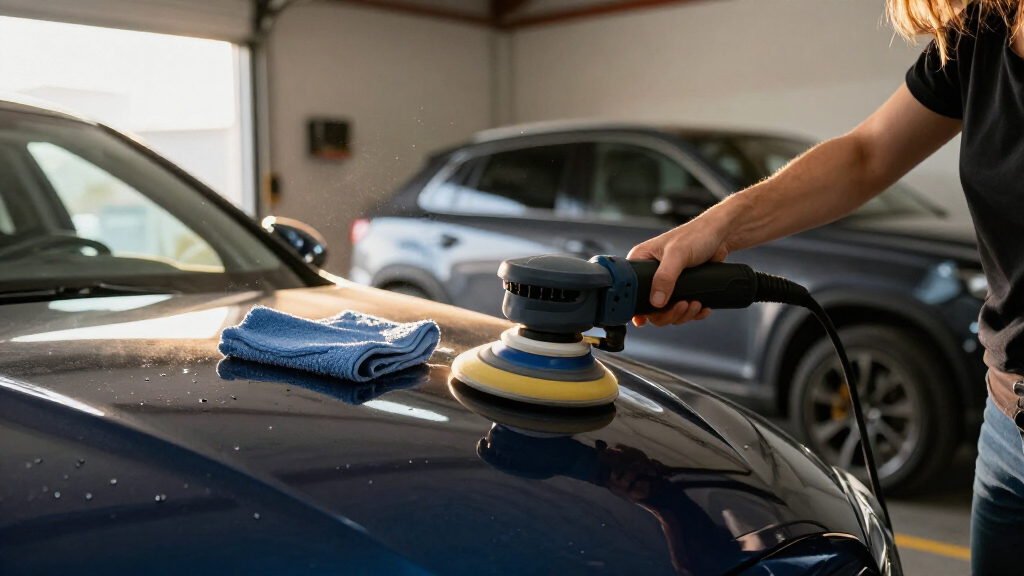
I compared these car detailing polishers by matching their design to likely jobs: broad-panel correction, waxing, spot work, and use by beginners or experienced detailers. I weighed tool type—dual-action, rotary, or waxer—alongside stated power format, pad size, speed controls where specified, included kit items, and the practical effect of corded, cordless, or compact construction. These distinctions matter because a fast-cutting rotary and a small cordless spot polisher solve very different problems.
The ranking favors versatility, manageable operation, and suitability for common detailing tasks over raw power alone. Full-size dual-action tools rank ahead for broad, general-purpose use; rotary polishers rise for users who can manage their more demanding behavior; cordless and mini tools earn their place for access and convenience, not as universal replacements. I also account for limitations: overlapping models do not necessarily offer distinct capabilities, battery kits bring runtime tradeoffs, and a waxing machine should not be mistaken for a paint-correction polisher.
| car detailing polisher | Power source | Brand |
|---|---|---|
| Fanttik P10 Pro Cordless Mini | — | — |
| LDHTHOPI 1600W Rotary Buffer P | AC | — |
| Niusken Cordless Dual-Action C | — | — |
| SPTA 12V Cordless Mini Polishe | — | — |
| Niusken Cordless Dual-Action C | — | — |
| Protmex Cordless Car Buffer Po | Battery powered | Protmex |
| SPTA 5-Inch Dual-Action Random | Corded electric | SPTA |
| Protmex Cordless Car Buffer Po | Battery powered | Protmex |
| SPTA Cordless Mini Car Polishe | Battery powered | SPTA |
| WEN 10-Inch Waxer and Polisher | Corded electric | WEN |
| 6-Inch Cordless Car Buffer Pol | — | — |
| OFISPEED 1600W Rotary Buffer P | — | OFISPEED |
| AOBEN 6-Inch Dual-Action Car B | Corded electric | — |
| Chemical Guys TORQX Random Orb | — | Chemical Guys |
Factors to Consider When Choosing Car Detailing Polishers
Before choosing, I’d match the polisher to the work rather than treating every machine as a paint-correction tool. These four decisions help narrow the field by experience, panel size, power needs, and the finish you want.
Choose the Motion Type for Your Experience
A dual-action polisher combines rotation with an orbital movement, making it a common first choice for general paint refinement. A rotary spins directly, which can cut quickly but calls for closer control of heat, pressure, and movement. A beginner can mistake faster correction for easier correction; those are different benefits. If you are learning, practice on a test panel and start with a mild pad and polish before moving to more aggressive combinations. Waxers are meant for spreading product over broad areas, not for correcting deeper defects. Choose a rotary when you already have the technique and a specific reason to need its cutting behavior.
Match Pad Size to the Panels You Will Work On
Pad diameter affects both coverage and access, so the largest pad is not automatically the most efficient choice. Larger pads can cover doors, hoods, and roofs quickly, while smaller pads can reach around mirrors, trim, and tighter body contours. Many buyers focus on the tool’s advertised pad size and overlook whether replacement pads and backing plates are easy to source in compatible sizes. A small machine can handle localized correction, but using it across an entire vehicle may take considerably longer. For a first full-size polisher, choose a practical middle ground and add a mini tool only if tight areas are a regular part of your work. Keep pads away from delicate trim unless the product and pad are suited to that surface.
Decide Whether Cordless Freedom Is Worth Battery Management
Cordless polishers remove the cord from your path, which can make moving around a vehicle easier and help in spaces without a convenient outlet. That convenience comes with runtime, charging, and battery-wear tradeoffs; a second battery reduces interruptions but does not remove the need to plan work around charging. Battery voltage alone does not tell you how long a tool will run or how it will behave under load. For extended correction sessions, a corded model may be the simpler choice if reliable power matters more than movement. For quick jobs, mobile detailing, or isolated spots, cordless operation can be worth the compromise. Check what batteries and charger the kit includes rather than assuming every listing provides the same setup.
Set the Job: Correction, Finishing, or Wax Application
Polishing can mean removing paint defects, refining a finish, or simply applying wax, and those jobs place different demands on a machine. A tool that suits wax application may not have the control or pad setup you want for correcting swirls. For correction, the result also depends on the pad, polish, paint hardness, and working technique—not just the motor. Start with the least aggressive combination that can address the defect, since unnecessary abrasion removes clear coat without adding value. A small cordless polisher is useful for spot work but can be inefficient as the only tool for a full vehicle. Decide which task you will do most often before paying for features aimed at a different one.
Check the Whole Kit and Plan for Consumables
A kit can look complete while leaving out items you will need for regular work, such as compatible replacement pads or a useful pad variety. Check the included backing plate, pad sizes, battery setup, charger, handles, and storage case, then confirm that replacement parts are available for the exact model. Bundled accessories only add value when they match your intended paintwork and can be replaced later. Pads collect polish and residue, so plan to clean them during a session and keep spare pads ready rather than working with a saturated one. A smaller kit with compatible, replaceable components can serve you better than a large assortment of accessories with unclear fit. This is particularly relevant when comparing similarly named cordless models or listings with nearly identical descriptions.
Frequently Asked Questions
Should I choose a dual-action or rotary polisher for my first car?
I’d choose a dual-action polisher for a first machine used on broad paint panels. Its motion is generally more forgiving for routine correction than a rotary, though good technique and appropriate pads still matter. A rotary makes more sense when you already know how to control the tool and need its direct cutting action for a defined job. If you are unsure how much correction the paint needs, start with a mild polish and test a small area. A mini polisher is useful for tight spots, but it is not the easiest stand-in for a full-size tool on an entire car.
Are two-battery cordless kits a better choice than corded polishers?
They are better for mobility, not automatically better for every detailing session. A second battery can let you continue while the first charges, but the usefulness depends on the tool’s runtime, charging time, and how much work you plan to do. Corded models avoid battery planning and can suit long correction sessions near a power outlet. Cordless tools make more sense for mobile work, quick jobs, or areas where a cord gets in the way. Compare the full battery and charger setup rather than judging a kit by battery count alone.
Can a mini polisher handle a full-size car?
A mini polisher can technically cover many painted areas, but its smaller working area makes full-vehicle work slower than using a full-size machine. Its main advantage is access to tight sections and localized defects where a large pad is awkward. Using a mini as your only polisher may also mean more time spent repositioning and managing the tool across large panels. If you plan to correct an entire vehicle regularly, make a full-size dual-action machine your primary tool and treat the mini as a specialist addition. For occasional spot work, a mini may be all you need.
Is a 10-inch waxer suitable for removing swirls?
A 10-inch waxer is generally better suited to spreading wax over broad areas than to controlled swirl removal. Paint correction calls for a suitable combination of machine, backing plate, pad, and polish, as well as enough control to work smaller sections carefully. The WEN waxer in this roundup is a different kind of tool from the dual-action and rotary polishers. It may fit a buyer whose main goal is light, broad wax application, but I would not select it as a dedicated correction machine. If swirl removal is the goal, choose a polisher designed for that task.
Do the similarly named cordless models offer meaningfully different choices?
Some of the listed Niusken and Protmex entries share a product name or very similar battery descriptions, so the name alone may not identify a distinct capability. Compare the exact listing details for included batteries, pad accessories, charger, and model information before deciding between them. The same caution applies to cordless kits described with similar voltage and battery counts. If the package contents appear identical, do not assume the alternate listing offers a different polishing experience. Put more weight on tool type, pad compatibility, and your intended job than on a small wording change in the product title.
Conclusion
For one versatile machine aimed at common correction work, my best overall recommendation is the SPTA 5-Inch Dual-Action Random Orbital Car Polisher Kit; it puts a manageable tool type ahead of rotary speed. For a best value direction, compare the AOBEN 6-Inch Dual-Action and SPTA 5-inch kits by their included accessories and pad compatibility rather than assuming a larger pad is always better. Buyers seeking a best premium-style kit should look at the Chemical Guys TORQX 9-Piece for its kit-oriented approach, while beginners are better served by a dual-action model than either 1600W rotary. For tight spots or mobile work, consider the Fanttik P10 Pro or a 12V SPTA mini; for broad wax application, the WEN waxer has a more fitting role. Choose the machine around your main task, and treat a rotary as a specialized choice rather than the default pick.