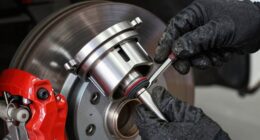
Your pedal feel plays a vital role in braking performance because it gives you real-time feedback on how much pressure to apply, helping you brake more effectively and confidently. A firm, responsive pedal lets you gauge stopping distance and respond quickly, while a soft or spongy pedal can lead to delayed reactions or reduced braking power. Recognizing how pedal sensations relate to system health can prevent issues like brake fade or ABS problems—exploring further will give you deeper insights.
Key Takeaways
- Firm, responsive pedal feel enhances driver confidence and allows precise modulation of braking force.
- Soft or spongy pedal sensation indicates reduced braking performance and potential system issues.
- ABS activation causes pulsations in pedal feel, signaling effective intervention but temporarily affecting braking feel.
- Brake fade softens pedal response, diminishing braking performance during prolonged or aggressive stops.
- Consistent pedal feedback reflects optimal brake system condition, supporting effective and safe braking performance.
When it comes to braking, the feel of the pedal can substantially influence your ability to stop quickly and safely. A firm, responsive pedal gives you confidence, letting you gauge how much pressure to apply and anticipate how your vehicle will respond. If the pedal feels soft or spongy, you might not realize how much pressure is needed, which could delay your reaction time or cause you to apply too little or too much force. This sensation is especially critical in emergency situations where every millisecond counts.
One key factor that affects pedal feel is ABS activation. When your anti-lock braking system kicks in, you might notice a pulsation or a sudden change in pedal firmness. This isn’t a flaw but a designed feature that prevents your wheels from locking up and skidding. Knowing how ABS activation feels helps you maintain control, as the pedal may vibrate or pulse under your foot. Recognizing this sensation means you’re effectively communicating with your vehicle’s safety systems, which are working to maximize braking performance without compromising steering control.
However, even the best braking systems have their limits, especially when brake fade sets in. Brake fade occurs after prolonged or aggressive braking, where the brake components heat up excessively. As temperatures rise, the brake fluid and pads become less effective, leading to a softer pedal and reduced braking power. You might notice the pedal sinking closer to the floor, requiring more effort to slow down or stop. This loss of pedal feel can be dangerous because it masks the diminishing brake performance. If you’re not aware of brake fade, you might push harder, increasing the risk of overheating and further reducing braking effectiveness.
Understanding the relationship between pedal feel and braking performance means paying attention to how your brake pedal behaves in different situations. Smooth, consistent feedback indicates that the system is working at its best, while sudden changes, softness, or a sinking pedal should alert you to potential issues like brake fade or the need to modulate pressure to prevent locking up. If you experience a soft pedal or notice ABS activation occurring more frequently than usual, it’s a sign that your braking system might need maintenance. Proper brake maintenance and understanding how your pedal feels can prevent dangerous situations and ensure you maintain control during critical moments on the road. Additionally, high-quality brake components can help maintain consistent pedal feel and optimal braking performance over time. Recognizing the importance of brake system maintenance and its impact on pedal feel can significantly improve your safety and driving confidence. Regular inspections and addressing issues early — such as brake fluid degradation — are essential for preserving both pedal feel and overall braking performance. Being aware of brake system condition allows you to respond appropriately and avoid unexpected failures.
Frequently Asked Questions
How Does Pedal Feel Influence Overall Driving Comfort?
Your pedal feel directly impacts your overall driving comfort by enhancing ergonomic comfort, making braking feel more natural and less fatiguing. When the pedal responds smoothly, you gain better driver confidence, knowing your vehicle reacts predictably. This seamless feedback reduces strain on your leg, allowing you to focus on the road. Ultimately, a well-designed pedal feel creates a more relaxed, enjoyable driving experience, especially during long trips or stop-and-go traffic.
Can Brake Performance Vary Between Different Vehicle Types?
Think of brake performance as a symphony—different vehicle types play distinct tunes. Yes, it varies due to brake system design and vehicle weight distribution. Sports cars might respond like a sprinter, stopping on a dime, while trucks, with their heavier weight and different setups, perform more like a marathon runner—slower but steady. Your driving experience depends on these elements, making each vehicle’s braking ability uniquely tuned to its purpose.
What Factors Affect Pedal Feel Sensitivity?
You can influence pedal feel sensitivity through several factors. The quality of brake fluid impacts hydraulic response, affecting how smoothly you can modulate the pedal. Proper brake fluid levels prevent sponginess, enhancing pedal firmness. Additionally, the design of the brake system, including master cylinder size and brake lines, influences pedal modulation. Regular maintenance ensures these components work together, providing consistent pedal feel and *ideal* braking control.
Is There a Trade-Off Between Pedal Feel and Braking Power?
Yes, there’s often a trade-off between pedal feel and braking power. When you prioritize brake modulation and pedal firmness, you may sacrifice some of the raw braking force, making the pedal feel more responsive and predictable. Conversely, increasing braking power can sometimes lead to a firmer pedal with less nuanced control. Finding the right balance depends on your driving style and the vehicle’s braking system.
How Does Brake Fade Impact Pedal Feel During Extended Use?
Imagine riding a bike uphill, feeling the pedal gradually sink—this mirrors brake fade, which reduces pedal feel during extended use. As brake fluid heats up, it causes brake fade, making pedal modulation harder and less responsive. You might notice a spongy or soft pedal, indicating diminished pedal feel. To prevent this, verify your brake fluid is fresh and your braking system is well-maintained, keeping your pedal response reliable.
Conclusion
As you consider pedal feel and braking performance, remember that the balance between them can change everything. Will you prioritize a precise, responsive pedal or raw stopping power? The choice isn’t always clear, and the stakes can be higher than you think. One tweak could transform your driving experience—yet, the real question remains: what will you uncover when you explore the limits of your braking system? The answer might just surprise you.