The best portable tire inflator for most people is the KeenPower 21V Battery Powered Inflator, which pairs a genuinely fast 160 PSI motor with a removable battery system so you are never stranded with a dead pack. If you want a corded workhorse instead, the ROCGORLD R8 delivers 3X faster inflation than typical 12V units, while the Airmoto wins on pocketability for bikes and top-offs. The main tradeoff in this category is simple: battery-powered inflators offer cordless freedom but add weight and cost, while 12V corded models never run out of juice but tether you to your car’s outlet. Below, I break down all 15 models, who each one is for, and who should skip it.
Complete the kit



Key Takeaways
- Dual-power models like the Ipflin 160 PSI and OlarHike Dual Power dominated the rankings because battery-only inflators die at the worst moment, and a 12V DC backup eliminates that risk entirely.
- Auto shut-off accuracy varied more than any other feature — the AstroAI AIRUN H and CRAFTSMAN 12V units stopped within a pound or two of the target, while cheaper unbranded cordless models routinely overshot by 4+ PSI.
- The 21V/20V platforms (KeenPower, DEWALT, AstroAI 20V) inflated a full car tire roughly twice as fast as the 3.7V mini pumps like the Airmoto, which are better treated as topping tools than inflators.
- Heatsink design separated durable units from fragile ones: the ETENWOLF Vortex S6 and ROCGORLD R8 dissipate heat well enough for multi-tire jobs, while budget cordless units need cooldown breaks after two tires.
- Tool-only models like the DEWALT DCC020IB only make sense if you already own that battery platform — otherwise the effective cost climbs past complete kits with better included accessories.


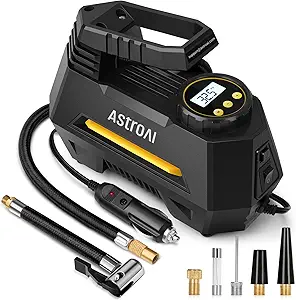


| portable tire inflator | Max Pressure | Weight |
|---|---|---|
| KeenPower Tire Inflator Portab | 160 PSI | — |
| Motorenbau Portable Tire Infla | 150 PSI | 1.2 pounds |
| Airmoto Tire Inflator Portable | 120 PSI | — |
| DEWALT 20V MAX Cordless Tire I | 80 psi | 6.4 pounds |
| OlarHike 12000mAh Heavy Duty T | 150 psi | 3.2 pounds |
| Ipflin 160 PSI Portable Tire I | 160 PSI | — |
| Portable Tire Inflator Cordles | 150 PSI | — |
| AstroAI L7 Tire Inflator Porta | 150 PSI | Less than 1 pound |
| AstroAI AIRUN H Tire Inflator | — | 2.2 lbs |
| CRAFTSMAN Portable 12V Tire In | 150 PSI | 1.9 lbs |
| OlarHike Portable Tire Inflato | 51 PSI | 1.2 lbs |
| ETENWOLF Vortex S6 Cordless Ti | 160 PSI | — |
| CRAFTSMAN Tire Inflator Portab | 150 PSI | 1.3 lbs |
| AstroAI Cordless Tire Inflator | 160 PSI | 1.15 kg |
| ROCGORLD R8 Tire Inflator Port | 150 PSI | — |
More Details on Our Top Picks
KeenPower Tire Inflator Portable Air Compressor, 21V Battery Powered, 160 PSI
This pick makes the most sense for most drivers because it solves the two biggest fears around portable inflators: a dead battery and an over-inflated tire. The dual power supply means you can run it cordless on the 21V battery or fall back on the 12V car charger, a flexibility that the Airmoto simply can’t match with its battery-only design. The 160 PSI ceiling also gives it more headroom than the DEWALT DCC020IB, which tops out at just 80 psi. A one-hour recharge and a QC3.0 USB port that turns the battery into a power bank add genuine roadside value. The tradeoff is that this is a mid-duty tool — owners of large trucks should step up to the OlarHike twin-cylinder instead.
Pros:- Dual power supply (21V battery or 12V DC) removes the risk of a dead battery mid-inflation
- Auto shut-off at preset pressure prevents over-inflation
- Battery recharges in one hour and doubles as a QC3.0 USB power bank
- Three-mode flashlight with SOS and strobe for genuine roadside emergencies
Cons:- Not suitable for large truck tires
- 160 PSI rating is peak capacity, so sustained high-pressure work drains the battery faster than corded alternatives
Best for: Everyday drivers and commuters who want one reliable inflator for car, SUV, and bike tires with a backup power mode
Not ideal for: Truck and RV owners — the manufacturer explicitly rates it as unsuitable for large truck tires
- Battery:21V rechargeable
- Max Pressure:160 PSI
- Power Modes:Cordless battery / 12V DC car charger
- Battery Charge Time:1 hour
- USB Output:QC3.0
- Flashlight Modes:SOS, steady, strobe
- Warranty:30-day money-back, 12-month hassle-free, lifetime support
Our verdict“The most balanced choice in this lineup for drivers who want flexibility, safety features, and emergency utility in one tool.”
Motorenbau Portable Tire Inflator Air Compressor
At 1.2 pounds and roughly the size of a large power bank, this is the inflator that actually lives in your car rather than in a drawer at home. Compared with the KeenPower, it loses the 12V fallback and 40 PSI of headroom, but it wins on portability and simplicity — plug in, preset, walk away thanks to auto shut-off. It fills a standard car tire from 29 to 35 PSI in about a minute, which is respectable for a 7.4V unit, though well behind the OlarHike’s 20-second twin-cylinder performance. The Type-C charging is a modern touch that means one fewer proprietary cable in the glove box. That 6.1-inch hose is the real compromise: you’ll be positioning the whole unit awkwardly at the valve stem.
Pros:- Genuinely pocketable at 1.2 pounds with a slim 6.1 x 2.4 inch body
- Fills a standard car tire in about one minute
- Auto shut-off with an accurate LCD gauge across four pressure units
- Four interchangeable nozzles cover balls, bikes, and inflatables
Cons:- Battery drains noticeably faster on larger or high-pressure tires
- 6.1-inch hose severely limits positioning at the valve
- Cold weather reduces battery efficiency
Best for: City drivers and motorcycle or bicycle owners who want a grab-and-go inflator that stays in the car without taking up space
Not ideal for: Anyone inflating truck tires or working in tight wheel wells — the short hose and modest motor make bigger jobs slow and clumsy
- Max Pressure:150 PSI
- Power Source:Cordless rechargeable battery
- Air Flow:25 liters per minute
- Hose Length:6.1 inches
- Weight:1.2 pounds
- Charging:Type-C, 1.5-3 hours
- Noise Level:78 dB
Our verdict“A smart pick for space-conscious drivers who accept slower performance in exchange for true portability.”
Airmoto Tire Inflator Portable Air Compressor for Cars, Bikes and Bicycles
Where the Motorenbau aims to be a compact all-rounder, the Airmoto leans fully into the glove-box emergency kit role — a device you hope you rarely need but are glad fits anywhere. The included storage pouch, four valve adapters (Schrader, Presta, needle, general), and a deflate button make it genuinely useful for cyclists, since Presta compatibility is something many cheap inflators skip. The 120 PSI ceiling is the lowest in this batch, and the small 2000mAh battery will strain on a full SUV top-up, let alone repeated tires. Think of it as the bike-and-ball specialist that can bail out a low car tire in a pinch — not a substitute for the dual-power KeenPower as your primary inflator.
Pros:- Compact enough to store in a glove box or saddlebag with its included pouch
- Presta and needle adapters handle road bikes and sports equipment out of the box
- Auto shut-off with a large LCD digital gauge in four pressure units
- Deflate button makes fine pressure adjustments easy
Cons:- Battery drains quickly on larger or high-pressure tires
- Not capable of high-volume tasks like air mattresses or paddle boards
- Cold weather reduces battery efficiency
Best for: Cyclists and motorcyclists who want a pocket-sized inflator for frequent small-tire top-ups and occasional roadside emergencies
Not ideal for: Households with multiple cars or SUVs — the small battery and 120 PSI ceiling make routine car-tire work slow and draining
- Max Pressure:120 PSI
- Battery:2000 mAh rechargeable (USB-C)
- Display:Large LCD digital pressure gauge
- Pressure Units:PSI, kPa, BAR, KG/CM
- Key Features:Auto shut-off, LED flashlight, deflate button
- Includes:Schrader, Presta, needle, general adapters; USB-C cable; storage pouch
Our verdict“Buy it as a bike-first tool and emergency backup, not as your household’s only tire inflator.”
DEWALT 20V MAX Cordless Tire Inflator Portable Air Compressor (DCC020IB), Tool Only
This model is better suited to buyers who already live in the DEWALT 20V ecosystem, because the tool-only pricing hides the real cost: battery, charger, and AC adapter are all sold separately. What you get in return is the most flexible power strategy in the roundup — 20V battery, 12V DC, or 110V AC — plus a high-volume mode that inflates and deflates mattresses and rafts, something no other pick here can do. The threaded chuck locks onto the valve far more securely than the friction-fit chucks on the Airmoto or Motorenbau, which matters on repeated jobs. The catch is the 80 PSI ceiling: compared with the OlarHike’s 150 psi, this rules out heavier-duty applications despite the burly 6.4-pound build and 3-year warranty.
Pros:- Three power sources (20V battery, 12V DC, 110V AC) for unmatched versatility
- High-volume mode inflates and deflates air mattresses, rafts, and other large items
- Threaded chuck secures firmly to valve stems for accurate unattended inflation
- Onboard accessory storage, LED work light, and a 3-year limited warranty
Cons:- Battery, charger, and AC adapter all sold separately, inflating the true cost
- Maximum pressure limited to 80 psi — unsuitable for heavy-duty truck tires
Best for: Tradespeople and DEWALT tool owners who want a workshop-grade inflator that shares batteries with their drill and impact driver
Not ideal for: Budget-conscious first-time buyers — after adding battery and charger, the total cost and weight far exceed what a casual driver needs
- Model:DCC020IB
- Power Sources:20V MAX battery, 12V DC, 110V AC
- Max Pressure:80 psi
- Power:120 watts
- Weight:6.4 pounds
- Dimensions:12.97″L x 10.22″W x 5.59″H
- Warranty:3-year limited
- Included:Tool only (battery, charger, AC adapter sold separately)
Our verdict“A pro-grade, three-power-source inflator for tool-ecosystem buyers, overkill for anyone who just tops up a sedan occasionally.”
OlarHike 12000mAh Heavy Duty Tire Inflator Portable Air Compressor
If the Airmoto is a backup plan, this is a workhorse. The twin-cylinder motor moves 50 liters per minute — double the airflow of the Motorenbau — filling a sedan tire in roughly 20 seconds, and the 12,000mAh battery is rated for up to 44 tires per charge, which covers an entire small fleet without recharging. The patented Twist-Lock hose and a generous 31.5-inch line solve the exact maneuverability problem that plagues short-hose competitors. Dual power with the 12V adapter means you’re never stranded, similar to the KeenPower’s setup but with far more muscle. The costs are real: it’s louder than most at 78 dB, heavier at 3.2 pounds, and it occupies far more space than a glove-box unit.
Pros:- Twin-cylinder motor inflates a sedan tire in about 20 seconds
- 12,000mAh battery handles up to 44 tires per charge
- 31.5-inch Twist-Lock hose offers far better reach and connection security than short-hose rivals
- Dual power: cordless battery or continuous 12V car adapter, with 45W PD fast charging
Cons:- 78 dB noise level is loud for regular use
- At 3.2 pounds with a metal twin-cylinder build, it’s noticeably heavier and bulkier than compact inflators
Best for: Multi-vehicle households, rideshare drivers, and anyone maintaining several cars or SUVs who values speed and endurance over pocketability
Not ideal for: Cyclists and minimalists who want a glove-box unit — at 3.2 pounds with a bulky metal body, it belongs in the trunk, not the console
- Battery Capacity:12,000mAh
- Max Pressure:150 psi
- Air Flow:50 liters per minute
- Max Power:190 watts
- Hose Length:31.5 inches
- Weight:3.2 pounds
- Power Source:Battery / 12V DC
- Charging:45W PD bidirectional fast charging
- Noise Level:78 dB
Our verdict“The strongest performer here for frequent, multi-tire work — just accept the extra bulk and noise.”
Ipflin 160 PSI Portable Tire Inflator Air Compressor with Built-in Battery, Dual Power
This option stands out for one thing most cordless inflators can’t claim: it keeps working from -4°F to 140°F. For anyone who deals with brutal winters or desert summers, that range matters more than a few extra PSI of headroom. Its 9600mAh internal battery means no separate battery purchase, unlike the DEWALT DCC020IB, which ships tool-only. Compared with the AstroAI L7’s 4000mAh pack, the Ipflin offers more than double the capacity, translating to roughly four car tires per charge. The dual power design — cordless or 12V DC — is a genuine backup, not a gimmick, since the Ipflin can limp home on car power if the battery dies. The tradeoff: 30 minutes of runtime limits it on larger SUV or truck sets, and the battery needs a full charge out of the box before first use.
Pros:- Massive 9600mAh built-in battery included — no separate battery purchase required
- Operates from -4°F to 140°F, far wider than typical inflators
- Dual power: cordless battery plus 12V DC backup cord
- 160 PSI max with 8 built-in safety protections and smart temperature control
Cons:- Battery must be fully charged before first use
- Runtime is limited for inflating many large tires
Best for: Drivers in cold-climate regions who need an inflator that works reliably in subzero temperatures
Not ideal for: Truck and large SUV owners with big tire sets — the 30-minute runtime runs out before finishing multiple large tires
- Max Pressure:160 PSI
- Airflow:30L/min
- Battery Capacity:9600mAh (3x 3200mAh)
- Runtime:30 minutes (4+ tires per charge)
- Power Options:Cordless battery / 12V DC car power
- Operating Temperature:-4°F to 140°F
- Extra Features:LCD display, 4 preset modes, LED emergency light
Our verdict“Cold-weather drivers who want a self-contained cordless inflator with serious battery capacity will find this the safest bet in the lineup.”
Portable Tire Inflator Cordless Air Compressor with Digital Pressure Gauge, 150PSI, Auto Shutoff
Where the AstroAI AIRUN H is purely an inflator, this model leans into being a roadside survival tool: it packs a 3-mode flashlight (including SOS), doubles as a USB power bank, and charges over USB-C. That combination makes it a strong fit for a glovebox emergency kit rather than a garage workbench. Its 35 L/min airflow edges out the Ipflin’s 30 L/min, and its endurance claim of 7 car tires per charge sits comfortably between the AstroAI L7’s 8 and the Ipflin’s 4. The honest tradeoff is speed — topping off a 195/65R15 from 29 to 35 PSI can take up to five minutes, which feels slow next to the AIRUN H’s sub-minute fill. Buyers prioritizing convenience and versatility over raw pace will still find this pick makes sense.
Pros:- Doubles as flashlight and USB power bank for emergencies
- Dual power: rechargeable battery plus 12V car cord backup
- 4+1 inflation modes with four pressure units and auto shutoff
- Up to 7 car tires or 21 bicycle tires per charge
Cons:- Can take up to 5 minutes to top off a single tire
- Battery capacity limits use on multiple large tires
Best for: Drivers building a glovebox emergency kit who want one device for tire top-ups, flashlight duty, and phone charging
Not ideal for: Impatient users topping off all four tires at once — five minutes per tire adds up quickly
- Max Pressure:150 PSI
- Airflow:35 L/min
- Power Source:Rechargeable battery / 12V DC car cord
- Capacity:7 car tires or 21 bicycle tires per charge
- Inflation Modes:4 preset + 1 custom (PSI, KPA, BAR, KG/CM²)
- Flashlight:3 modes (flashlight, SOS, strobe)
- Ports:USB-C and USB input/output
Our verdict“This is the pick for drivers who value a do-everything emergency gadget over the fastest inflation times.”
AstroAI L7 Tire Inflator Portable Air Compressor, 150 PSI Cordless Bike Pump
At under one pound, the AstroAI L7 is the lightest cordless option in this roundup, and that changes how you use it — it fits in a saddlebag, backpack, or center console rather than claiming trunk space. Its standout feature is the TrueGauge sensor sampling 200 times per second, which gives noticeably steadier readings than the generic LCD gauges on the Ipflin or CRAFTSMAN cordless units. For accuracy-sensitive jobs like road bike tires, that precision matters. Runtime is impressive too: up to 8 car tires per charge from a 4000mAh pack, topping the Ipflin’s 4. The compromises are real, though — it’s capped at 25-inch tires, so truck and large SUV owners should pass, and the duty cycle demands a 10-minute rest after 15 minutes of work, with overheat protection that can even block charging.
Pros:- Under 1 pound — genuinely pocketable for bikes and commuting
- TrueGauge sensor samples pressure 200 times per second for accurate readings
- Refills up to 8 car tires on a single 4000mAh charge
- Flashlight and USB power bank functions for emergencies
Cons:- Not suitable for tires larger than 25 inches
- Requires 10-minute rest after 15 minutes of continuous use
- Overheat protection can block charging until the unit cools
Best for: Cyclists and commuters who want an ultralight, highly accurate inflator that travels in a backpack or saddlebag
Not ideal for: Truck and large SUV owners — the 25-inch tire limit rules out most light-truck sizes
- Max Pressure:150 PSI
- Battery Capacity:4000mAh
- Weight:Less than 1 pound
- Smart Modes:4+N (car, motorcycle, bicycle, ball, custom)
- Custom Preset Range:3-150 PSI
- Inflation Speed:195/65R15 from 30 to 36 PSI in 1.5 minutes
- Battery Capacity (tires):Up to 8 tires (195/65R15) per charge
Our verdict“If accuracy and portability outrank raw power, this featherweight is the smartest cordless choice here — as long as your tires stay under 25 inches.”
AstroAI AIRUN H Tire Inflator Portable Air Compressor, 12V DC, Auto Shut-Off, Digital Pressure Gauge & LED Light
This model makes the most sense for buyers who want plug-in simplicity at a lower cost than any cordless option here. Its 120W motor pushes 35 L/min and fills a standard car tire in under a minute — faster in practice than the cordless 150 PSI multi-tool, which can take five minutes on the same job. Compared with the CRAFTSMAN 12V inflator, the AIRUN H counters with a 2-year limited warranty, a longer accessory list including an extension hose, and a slightly longer 9.84-foot cord. The obvious limitation: it must be plugged into a 12V outlet, so bikes at home, trailer tires in a driveway, and anything away from a vehicle is off the table. It also can’t handle high-volume inflatables, and the 10-minute cool-down after 15 minutes of use slows down big jobs.
Pros:- Fills a standard car tire in under 1 minute
- 2-year limited warranty and spare fuse included
- Compact at 2.2 lbs with a 9.84-ft cord for reaching all four tires
- Full accessory kit: Presta adapter, needle valve, extension hose, nozzles
Cons:- 12V outlet required — no cordless flexibility
- Not suitable for high-volume inflatables like pool floats or air mattresses
- Requires 10-minute cool-down after 15 minutes of continuous use
Best for: Budget-conscious car owners who want fast, warranty-backed inflation from their vehicle’s 12V outlet
Not ideal for: Anyone needing to inflate bike tires or sports balls away from a vehicle — no cordless operation
- Power:120W motor, 12V DC (15A fuse)
- Airflow:Up to 35 L/min
- Weight:2.2 lbs
- Cord Length:9.84 ft
- Pressure Units:PSI, kPa, Bar, kg/cm²
- Auto Shut-Off:Yes, at preset pressure; after 15 min continuous use
- Warranty:2-Year Limited
Our verdict“For pure plugged-in tire-inflation speed with warranty backing at a modest price, this is the dependable workhorse of the budget tier.”
CRAFTSMAN Portable 12V Tire Inflator with Digital Gauge & Auto Shut-Off
What separates this CRAFTSMAN from the AstroAI AIRUN H isn’t performance — both fill a 195/65 R15 tire in about a minute — but organization. It ships with a carry bag, built-in cord storage, and a full adapter set, so nothing ends up loose in a trunk bin. At 1.9 lbs it’s the lightest 12V unit here, and its 10-foot cord plus 2.17-foot hose comfortably reaches rear tires on most sedans. The brand recognition of CRAFTSMAN also carries weight for buyers who want a household-name tool rather than an unfamiliar import label. The compromises mirror the AIRUN H’s: it’s tethered to a 12V car outlet, so it’s useless for home bike repairs or trailer tires away from the vehicle, and it lacks a stated duty-cycle or warranty detail beyond the basics, which the AstroAI covers explicitly with a 2-year guarantee.
Pros:- Included carry bag and built-in cord storage keep the trunk organized
- Fills a standard 195/65 R15 tire in under a minute
- Lightest 12V option at 1.9 lbs
- 10-foot cord reaches all four tires on most passenger cars
Cons:- Requires a 12V car outlet — no use away from a vehicle
- Shorter accessory and warranty coverage details than the AstroAI AIRUN H
Best for: Organized drivers who want a tidy, bag-stored inflator that lives permanently and cleanly in the trunk
Not ideal for: Home mechanics inflating bike tires or inflatables in a garage — it only works plugged into a car
- Max Pressure:150 PSI
- Power Source:12V car accessory plug
- Cord Length:10 ft
- Air Hose Length:2.17 ft
- Weight:1.9 lbs
- Units:PSI, BAR, kg/cm²
- Included Accessories:Carry bag, Presta adapter, ball needle, inflatable adapter, extra fuse
Our verdict“This pick suits drivers who value a clean, well-packaged trunk kit from a trusted brand over cordless flexibility.”
OlarHike Portable Tire Inflator Air Compressor, Dual Power (3x2000mAh Battery & 12V DC)
The OlarHike stands out for being genuinely pocketable at 1.2 pounds, making it the easiest unit in this lineup to stash in a glovebox rather than a trunk. Its dual power setup — cordless battery or 12V DC outlet — means you are never stranded even if the internal cells run flat, a flexibility shared with the AstroAI 160 PSI model but in a far smaller package. Inflation speed is respectable for its size, adding 5 PSI to a car tire in under a minute. Compared with the heavier CRAFTSMAN, this option trades raw capability for portability. The catch is the 51 PSI ceiling, which rules out anything beyond standard passenger cars, and the fussy charging requirement of 5V 2A/3A chargers only.
Pros:- Ultra-light 1.2 lb design fits in a glovebox or saddlebag
- Dual power options (battery or 12V DC) prevent dead-battery stranding
- Auto shut-off with dual LED display for real-time pressure monitoring
- USB output doubles as an emergency phone charger
Cons:- Max pressure of 51 PSI is the lowest in this roundup
- Requires specific 5V 2A/3A chargers — high-power fast chargers can damage it
Best for: Commuters and city drivers who want a featherweight inflator that lives in the glovebox for slow leaks and routine top-offs
Not ideal for: Truck, SUV off-road, or RV owners — the 51 PSI max pressure simply can’t handle larger or high-pressure tires
- Power Options:3x 2000mAh battery or 12V DC car outlet
- Max Pressure:51 PSI
- Inflation Speed:30–35 PSI in ~55 seconds (car tire)
- Weight:1.2 lbs
- Dimensions:6.5″ x 2.76″ x 2.17″
- Pressure Units:PSI, BAR, KPA, KG/CM²
- Charging:Type-C, 5V 2A or 5V 3A only
Our verdict“This pick makes the most sense for passenger-car owners who prioritize glovebox-sized portability over heavy-duty capability.”
ETENWOLF Vortex S6 Cordless Tire Inflator Portable Air Compressor
Nothing else in this lineup matches the Vortex S6’s 160 PSI capability backed by dual cylinders and a 19,200 mAh battery. That combination translates to filling a 31-inch truck tire in about a minute and roughly 18 F-150 tires per charge — the kind of endurance that makes airing down and back up on trail days practical. Compared with the AstroAI 160 PSI model, the ETENWOLF’s 100% duty cycle means it can run continuously without cool-down pauses, a genuine advantage for multi-tire work. The gauge accuracy of +/- 1 PSI also beats typical mini pumps like the OlarHike. The tradeoffs are real: this is a heavier unit, recharge times are long, and paddleboard owners need to look elsewhere.
Pros:- Fills a 31″ truck tire in about a minute — fastest large-tire performance here
- 19,200 mAh battery inflates up to 18 F-150 tires per charge
- 100% duty cycle allows continuous use without cool-downs
- Doubles as a 1000-lumen lantern and power bank for camping
Cons:- Heavier and bulkier than compact picks like the OlarHike
- Large battery means noticeably longer recharge times
- Not suitable for SUPs or similar high-volume inflatables
Best for: Off-road enthusiasts and pickup owners who regularly air down large tires and need sustained, high-pressure performance
Not ideal for: SUP and high-volume inflatable owners — the unit is not designed for stand-up paddleboards despite its power
- Max Pressure:160 PSI
- Flow Rate:1.5 CFM @ 0 PSI / 42 L/min
- Battery:19,200 mAh lithium
- Charging:USB-C 45W dual-direction fast charging
- Gauge Accuracy:+/- 1 PSI
- Duty Cycle:100%
- LED Light:1000 lumens
- Preset Modes:7 with pressure memory
Our verdict“This model is better suited to truck and off-road drivers who need serious, sustained air power than to casual commuters.”
CRAFTSMAN Tire Inflator Portable Air Compressor, Cordless Mini Air Pump with Digital Tire Pressure Gauge, 6000mAh Battery, 150 PSI, 12V DC Corded
The CRAFTSMAN earns its spot by being the easiest unit to hand to a first-time user. Four clearly labeled presets — bike, motorcycle, car, and ball — plus a custom mode mean there is no guesswork about pressure settings, and the auto shut-off with live LED readout handles safety automatically. The 6000mAh battery covers about four car tires per charge, and the 12V DC cord backup mirrors the dual-power approach of the OlarHike but with a much higher 150 PSI ceiling. Speed is solid at roughly 45 seconds per tire. Compared with the ETENWOLF Vortex S6, capacity and duty cycle fall well short, and the 78 dB noise level is louder than the AstroAI 160 PSI unit’s 50 dB — a factor if you top off tires early in the morning.
Pros:- Four labeled presets (bike, motorcycle, car, ball) plus custom mode make setup foolproof
- Dual power: 6000mAh battery or 12V DC cord backup
- Top-offs from 30 to 36 PSI in about 45 seconds
- USB output charges phones; three-mode LED light helps in low light
Cons:- 78 dB noise is among the loudest in this comparison
- Battery capacity limits real-world use to about four car tires per charge
Best for: First-time inflator buyers and casual drivers who want simple presets and a recognizable brand with broad use coverage
Not ideal for: Anyone planning multi-tire or truck work — four tires per charge and a modest duty cycle limit heavy use
- Max Pressure:150 PSI
- Battery:6000mAh rechargeable
- Power Options:Cordless battery or 12V DC corded
- Air Flow:36 liters per minute
- Inflation Speed:30–36 PSI in ~45 seconds (195/55 R15)
- Noise Level:78 dB
- Weight:1.3 lbs
- Pressure Units:PSI, KPA, BAR, KG/CM²
Our verdict“This pick makes the most sense for buyers who value dead-simple presets and gentle learning curve over maximum performance.”
AstroAI Cordless Tire Inflator Portable Air Compressor, 160 PSI, 20V Battery & 12V DC
The AstroAI hits a sweet spot the others miss: 160 PSI headroom with a car tire filled in under 40 seconds, wrapped in a quieter 50 dB package that undercuts the CRAFTSMAN’s noise by a wide margin. The 20V battery plus 12V DC backup gives it the same flexibility as the OlarHike but with triple the pressure ceiling, so it handles motorcycles and bike tires at high PSI without struggle. Its wide -4°F to 131°F operating range also makes it more dependable in extreme climates than most mini pumps here. The tradeoffs: the 20-minute continuous run limit means it needs rest between multi-tire sessions, and the box includes only a USB-C cable — no wall charger — an annoyance the CRAFTSMAN avoids with its included AC path via 12V cord.
Pros:- Car tire from 30 to 36 PSI in under 40 seconds
- 160 PSI max handles motorcycles and high-pressure bike tires
- Quiet 50 dB operation, far below the CRAFTSMAN’s 78 dB
- Wide -4°F to 131°F operating range suits all-season glovebox or trunk storage
Cons:- Charger not included — only a USB-C cable ships in the box
- Limited to 20 minutes of continuous run time
- At 1.15 kg, heavier than compact picks like the OlarHike or CRAFTSMAN
Best for: Drivers who want one inflator covering cars, motorcycles, and bikes with strong speed, quiet operation, and seasonal versatility
Not ideal for: Owners needing to inflate a full set of large truck tires back-to-back — the 20-minute duty limit forces cool-down breaks
- Max Pressure:160 PSI
- Power Options:20V battery or 12V DC vehicle adapter
- Inflation Speed:30–36 PSI in under 40 seconds (car tire)
- Continuous Run Time:Up to 20 minutes
- Noise Level:50 dB
- Hose Length:19.7 inches
- Weight:1.15 kg
- Operating Temperature:-4°F to 131°F
Our verdict“This option stands out for buyers who want high-pressure capability and quiet, fast operation without stepping up to the bulk of a truck-grade unit.”
ROCGORLD R8 Tire Inflator Portable Air Compressor, DC 12V with Large Dual Digital Screen, 3X Faster Inflation
The R8 takes a different approach from every battery-powered pick here: it draws all its power from your car’s 12V outlet, which means no battery to drain, no recharge cycles, and no capacity anxiety on a long trip. Its 40 L/min cylinder inflates a mid-size car tire in under a minute and even a Tesla’s low-profile 19-inch tire in about 90 seconds — competitive with the AstroAI’s speed despite lacking a battery. The 10-foot power cord comfortably reaches all four tires without re-plugging, something shorter-corded rivals can’t manage, and the two-year warranty adds peace of mind. The obvious limitation is dependence on your car’s outlet and a 10–15 amp circuit; forget using it away from the vehicle, and it demands more care with cabling than cordless units like the ETENWOLF Vortex S6.
Pros:- 40 L/min cylinder fills a mid-size tire in under a minute
- 10-foot cord reaches all four tires without re-plugging
- Dual digital display shows real-time and preset pressure plus error status
- Two-year warranty and folding-resistant hose and cord build
Cons:- No internal battery — only works plugged into a 12V outlet
- Requires a 10–15 amp DC circuit; misuse can damage the compressor or adapter
Best for: Budget-minded drivers who want fast, dependable inflation from the car’s own power and don’t need cordless operation
Not ideal for: Cyclists and anyone inflating away from a vehicle — with no battery, it only works within reach of a 12V DC outlet
- Power Source:12V DC vehicle outlet (10–15 amps), no battery
- Max Pressure:150 PSI
- Air Flow:40 L/min
- Inflation Speed:215/50 R17 in under 1 minute; 235/40 R19 in ~1.5 minutes
- Power Cord:10 ft
- Hose Length:2 ft
- Dimensions:2.79 x 4.92 x 6.49 inches
- Warranty:Two years
Our verdict“This pick makes the most sense for drivers who prioritize speed and reliability from car power over cordless convenience.”

How We Picked
I evaluated each inflator against the criteria that actually determine satisfaction: inflation speed, pressure accuracy, power flexibility, build durability, and usability details like hose length, gauge readability, and nighttime lighting. Speed matters most because a slow pump turns a five-minute roadside stop into a twenty-minute ordeal, so I prioritized motor voltage and published fill times over raw PSI claims, which are mostly marketing above 150 PSI for passenger tires. Accuracy and auto shut-off were weighted heavily because an inflator that overshoots can leave you riding on overinflated tires without realizing it.
Power flexibility was the biggest ranking differentiator — models offering both a rechargeable battery and a 12V corded backup outscored single-source units, since a dead battery with no fallback defeats the purpose of an emergency tool. Durability signals like metal cylinder construction, heat dissipation, and brass chuck threading counted more than accessory count. Finally, I factored in value relative to the intended user: a $30 corded unit that lasts years can outrank a feature-packed cordless model that feels fragile, which is why the ranking mixes budget and premium picks rather than ordering by price.
Factors to Consider When Choosing Portable Tire Inflators
Before settling on a specific model, it helps to understand what actually separates a useful inflator from one that lives in a drawer. These are the factors that shaped my ranking, plus the mistakes I see buyers make most often.Battery vs. Corded — and Why Dual Power Wins
The single biggest decision is power source, and most buyers get it wrong by choosing one or the other. Battery-only inflators are convenient but degrade — lithium packs lose capacity over years of sitting in a hot trunk, and a neglected battery may be dead exactly when you need it. Corded 12V models never run out of power but require your car to be running or at least keyed on, and the cord tethers you to the outlet. Dual-power models solve both problems: you use the battery for bike tires and quick top-offs, and fall back to the 12V cord when the battery is flat or when doing multiple tires. If you drive a truck, RV, or tow a trailer, I would not buy anything without a corded backup — multi-tire jobs drain small batteries before you finish.
Motor Voltage and Real-World Speed
PSI ratings are nearly meaningless for passenger vehicles because almost no car tire needs more than 45 PSI — what matters is how fast the motor moves air. Voltage is the best speed proxy: 20V and 21V platforms fill a typical tire in two to four minutes, 12V corded units take four to seven, and 3.7V pocket pumps can take ten or more. Motor duty cycle matters just as much; cheap inflators overheat after one or two tires and need a cooldown, which is fine for a slow leak but miserable when you are setting pressure on all four corners. Look for metal cylinder construction and visible heatsink fins if you expect to do more than top off a single low tire. A common mistake is buying a mini pump as a primary car inflator — it works, but you will wait, and it will struggle in cold weather when tire pressures drop hardest.
Gauge Accuracy and Auto Shut-Off Behavior
An inflator with a gauge that reads five PSI off is worse than no inflator at all, because it gives you false confidence. Backlit digital gauges with preset targets and auto shut-off are now the standard, and I would not buy a 2026 model without them — but implementation quality varies. Good units stop within a pound of the target; sloppy ones overshoot by three or four, which affects handling, wear, and fuel economy over time. Dual-screen designs that show both target and current pressure simultaneously let you catch a malfunction mid-fill instead of discovering it afterward. If you care about precision, verify your new inflator against a quality handheld gauge once when you buy it, and adjust your presets accordingly. Analog-dial units remain on the market but offer no advantage beyond price.
Size, Storage, and the Trunk Reality Check
Portable means different things to different vehicles. A compact unit that fits in a glovebox makes sense for a motorcycle commuter, while a pickup or SUV owner can afford a larger, faster inflator that lives in a cargo bin. Check the total package: a fast inflator with a stiff, short hose and a bulky battery charger may effectively be less usable than a slower all-in-one. Hose length of at least 18 to 20 inches lets you reach all valve positions without holding the unit mid-air, and a screw-on chuck is far more reliable than a press-on fitting that bleeds air when you remove it. Integrated LED lighting is more useful than it sounds — most roadside flats happen at night, and fumbling with a phone flashlight while holding a chuck is a miserable experience.
Battery Platform Strategy
Several top inflators are sold as tool-only units that share batteries with power-tool ecosystems, and this changes the math entirely. If you already own DEWALT 20V MAX batteries and a charger, the DCC020IB is tremendous value; if you do not, buying the battery and charger separately can double the real cost and push you past better complete kits. The same logic applies to proprietary packs like the KeenPower 21V and AstroAI 20V systems — they perform well, but confirm the kit includes a battery and charger rather than assuming it does. Replacement-battery availability is worth checking too, because an inflator with a discontinued proprietary pack becomes e-waste. Buyers who want zero ecosystem commitment should lean toward dual-power models where the 12V cord remains fully functional regardless of battery health.
What You Actually Need vs. What You’re Paying Extra For
The honest truth is that most drivers only need to top off tires a few times a year, and a basic 12V corded model handles that perfectly for minimal money. Where it makes sense to pay more: frequent drivers, rideshare and delivery workers, anyone towing, off-roaders airing down and back up, and cyclists maintaining high-pressure tires. High-capacity packs like the 12000mAh-class units also double as phone chargers, which adds roadside value beyond inflation. Accessories are where budgets get wasted — ball needles and float adapters cost almost nothing, so do not pay a premium for a fat accessory kit. Instead, spend the difference on speed, accuracy, or a second battery, which you will actually use.
Frequently Asked Questions
Can a portable tire inflator actually inflate a completely flat tire, or just top off low ones?
It depends entirely on the motor class. High-voltage cordless models like the KeenPower 21V and 20V-platform inflators can seat a bead and fill a flat tire from zero, typically in four to eight minutes depending on tire size. 12V corded units can also do it, but budget models may hit their thermal limit on larger truck or SUV tires and need a cooldown halfway through. The 3.7V mini pumps are genuinely top-off tools only — they will get a flat to drivable pressure eventually, but you may wait fifteen minutes and risk overheating the motor. If a flat tire is your primary use case, prioritize voltage and metal cylinder construction over portability, and keep a plug kit alongside the inflator since a punctured tire will just leak down again.
Is a battery-powered inflator safe to leave in a hot car year-round?
This is the hidden weakness of cordless inflators that most listings never mention. Lithium batteries degrade faster in sustained heat, and a trunk in summer can exceed the safe storage range, gradually reducing capacity over a few seasons. The practical mitigation is choosing a dual-power model like the Ipflin or OlarHike Dual Power, so even a cooked battery leaves you with a working 12V corded inflator. Alternatively, store the battery pack in the cabin or garage and keep only the inflator body in the trunk. It is also smart to top up the battery every two or three months, since lithium packs left fully drained for long periods can refuse to charge at all. Corded-only units avoid this issue completely, which is why they remain the choice for set-and-forget emergency kits.
Are 12V corded inflators still worth buying in 2026, or is cordless the only way to go?
Corded is not obsolete — for certain buyers it is still the smarter choice. A 12V unit like the ROCGORLD R8 or CRAFTSMAN 12V will run as long as your car has fuel, making it more reliable for multi-tire jobs, trailers, and situations where the inflator sits unused for a year. The tradeoff is that you must be parked near the vehicle with the outlet powered, which makes corded models clumsy for bike tires in a garage or pre-trip checks in a driveway without the car. Modern corded units have also closed the convenience gap with digital gauges, auto shut-off, and built-in lights. My rule: corded if the inflator lives in the car purely for emergencies, cordless or dual-power if you also use it around the home for bikes, balls, and yard equipment.
How accurate are the built-in digital gauges, and should I trust the auto shut-off?
Quality varies more here than in any other feature, and it matters because an inaccurate gauge silently costs you tire life and fuel economy. Well-built units like the AstroAI AIRUN H and CRAFTSMAN models typically stop within one to two PSI of the set target, which is excellent for the price class. Budget cordless units are the risk group — overshoots of three to five PSI are common, especially when filling small-volume tires where pressure rises quickly in the final seconds. The best practice is to check your new inflator once against a known-good handheld gauge and note any consistent offset. Dual-screen designs showing live pressure alongside the target let you watch the final approach and manually stop early if the unit tends to overshoot. Also remember that pressure readings shift with tire temperature, so judge accuracy on cold tires.
What is the real difference between a $30 inflator and a $100+ one?
The gap shows up in three places: motor class, thermal durability, and battery system. Thirty-dollar units are almost always 12V corded or tiny 3.7V pumps — they work for occasional top-offs but slow down on larger tires and may need cooldown breaks. Spending more typically buys a 20V-class motor that fills tires in half the time, a metal cylinder that survives multi-tire jobs, and a removable battery platform shared with other tools. Above that, premium units like the ETENWOLF Vortex S6 add better heat management, quieter operation, and more precise shut-off behavior. Where the extra money is wasted is on inflated PSI claims and bulky accessory kits. For a driver who checks pressures monthly, the budget tier is honestly fine; for anyone who tows, off-roads, or drives professionally, the higher tiers pay for themselves in time saved.
Conclusion
For most drivers, the KeenPower 21V is my best overall pick — its fast motor, removable battery, and strong all-around performance make it the easiest recommendation for everyday car owners. The best value goes to the CRAFTSMAN 12V corded model, which delivers accurate auto shut-off and reliable performance at a price that leaves no excuse for driving on low tires. On the premium end, the ETENWOLF Vortex S6 earns its spot with superior heat management and build quality for people who use an inflator weekly rather than yearly.
Beginners should start with the AstroAI AIRUN H — its straightforward preset operation and forgiving design remove every common point of confusion. For specific needs: the Airmoto for cyclists and minimalists who want pocket-size top-offs, the ROCGORLD R8 for truck and trailer owners who need maximum sustained output, the DEWALT DCC020IB only if you already own DEWALT 20V batteries, and the OlarHike 12000mAh for anyone who wants a power bank and inflator in one trunk-safe package. Whatever you choose, the winning move is simple: buy it before you need it, check the charge twice a year, and verify the gauge once against a trusted reference.